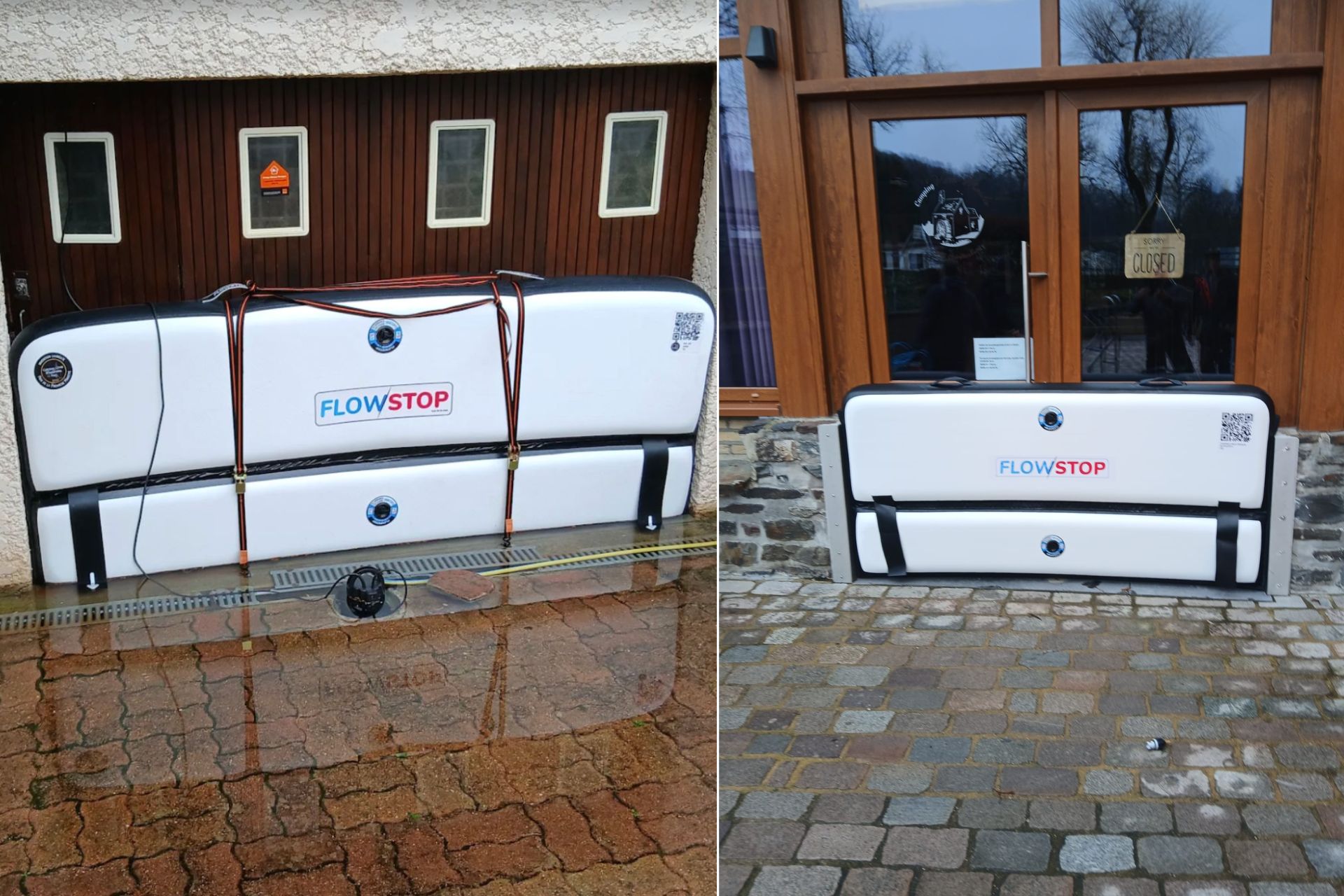
As flooding affects more properties each year, many homeowners are looking for alternatives to sandbags and permanent flood gates. FlowStop, made by FlowStop USA in Tampa, Florida, is a custom-made inflatable flood barrier designed to seal doors, garage openings, windows, vents, and other framed openings. Rather than blocking water with rigid panels, the system inflates inside an opening and creates a pressure-sealed barrier against incoming floodwater.
How the system works
FlowStop uses a patented two-cushion design. The upper cushion inflates first and presses sideways against the surrounding frame, locking the barrier in place. The lower cushion then inflates beneath it, expanding downward against the ground to create a water-resistant seal. The company says the system can be installed in minutes using the included pump and does not require drilling, rails, or permanent modifications.
The barriers are custom-made to match the dimensions of each opening. The inflatable design allows them to adapt to minor imperfections and uneven surfaces, with the gasket capable of sealing gaps and irregularities up to approximately 0.3 inches (8 mm).
Barrier types and sizes
FlowStop offers two primary barrier configurations.
Single-chamber FlowStop
The single-chamber model presses against all four sides of an opening and includes a gasket around its entire perimeter. It is intended for windows, vents, and openings exposed to wave action.
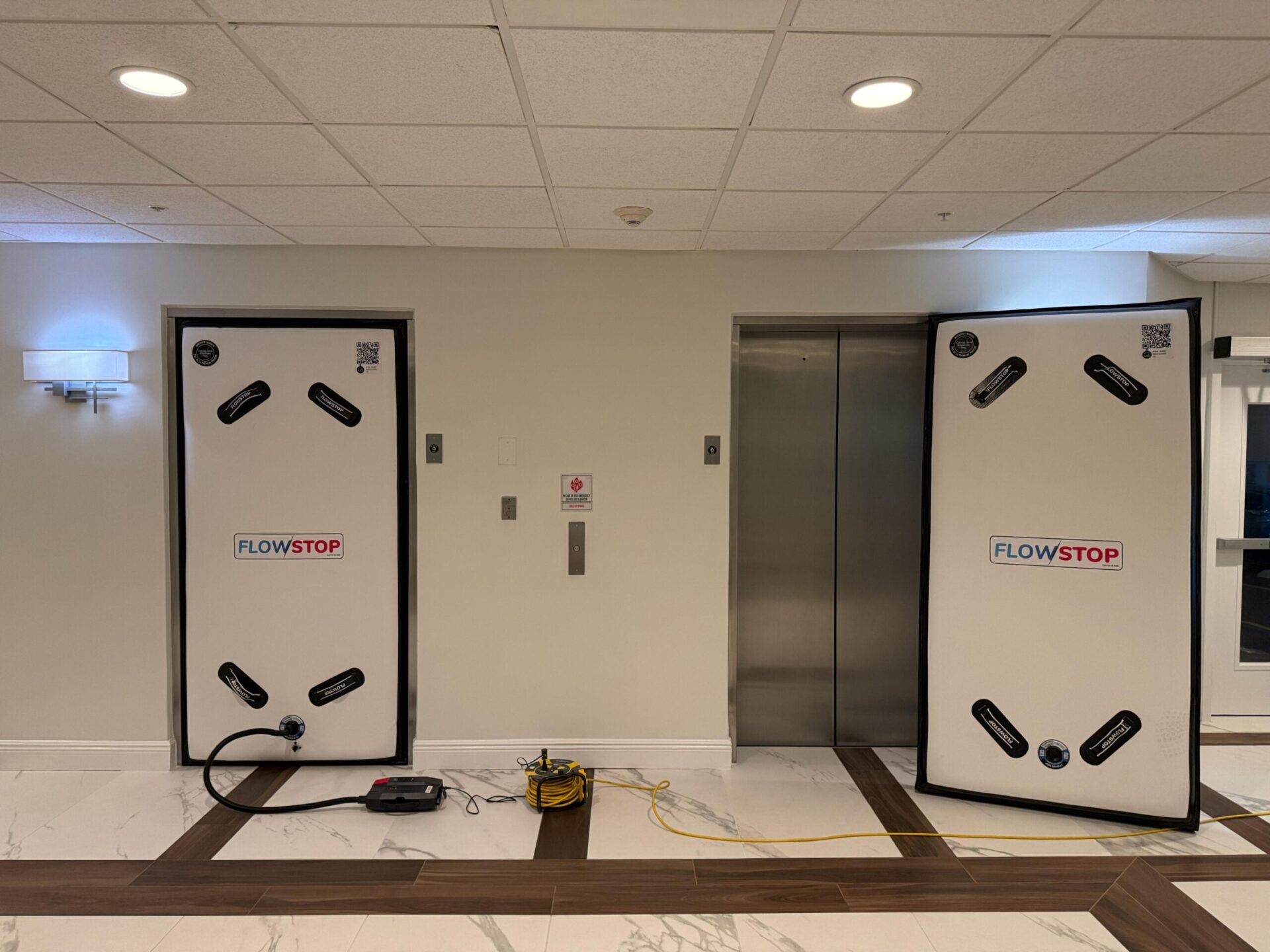
Key specifications include:
- Seals against four walls.
- Gasket on all four sides.
- Customizable to virtually any height.
- Maximum width of 275 inches (23 feet).
- Rated for floodwater depths up to 42 inches.
- Available in standard depths of 6 or 8 inches, with additional custom depths available for certain applications.
- Support posts can be added to increase opening depth where required.
Double-chamber FlowStop
The double-chamber model is designed for doors, garage doors, and larger openings. It seals against three sides—the two vertical walls and the floor—and uses two independently inflated chambers to create the seal.
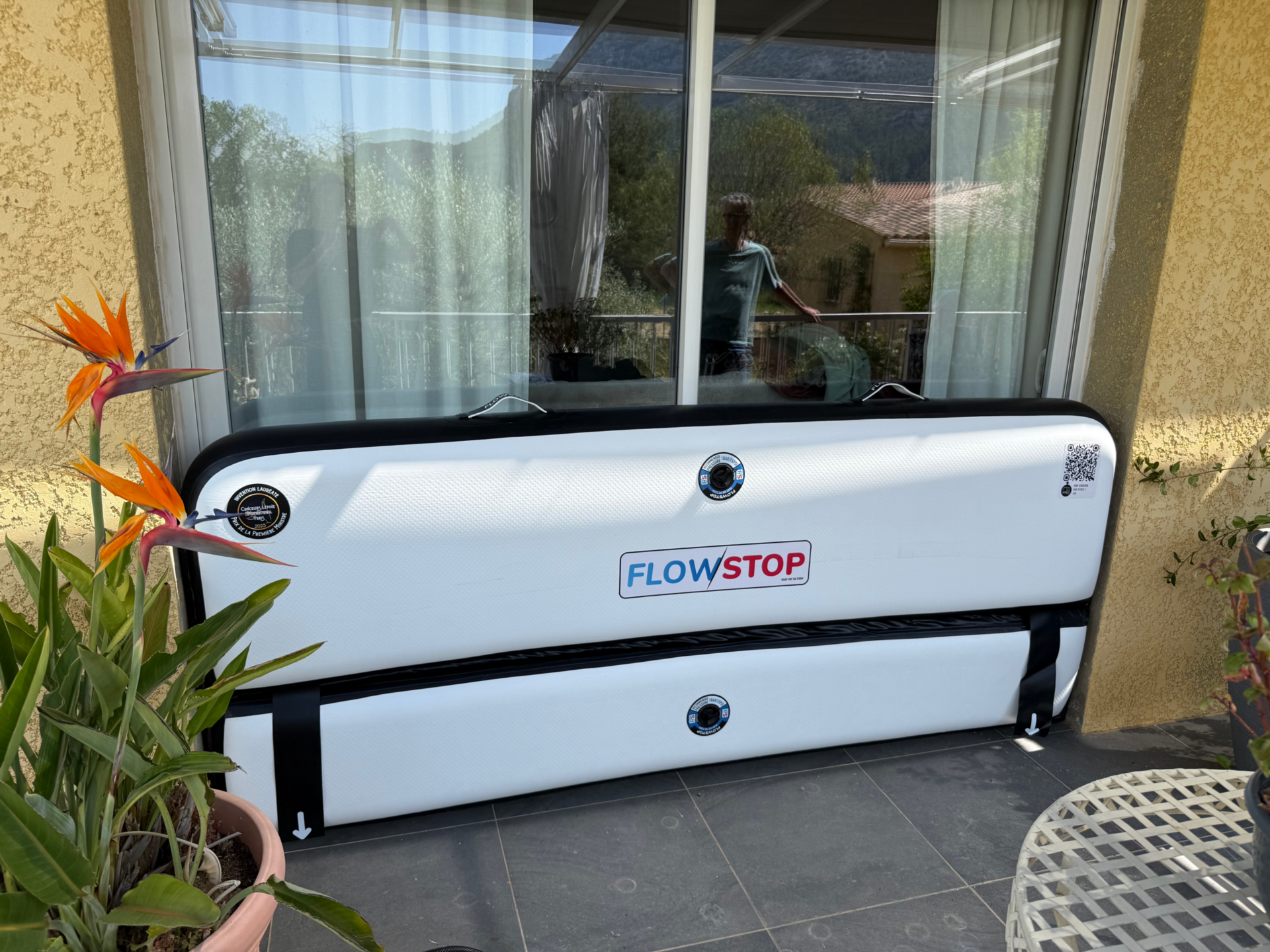
Key specifications include:
- Seals against three walls.
- Gasket on both sides and the bottom.
- Rated for floodwater depths up to 40 inches.
- Available in four standard heights: 31.5, 35.5, 39.5, and 47.5 inches.
- Minimum available height is 31.5 inches.
- Openings wider than 60 inches typically require a minimum barrier height of 39.5 inches.
- Standard depths of 6 or 8 inches depending on width.
- Wider installations may require anchoring straps for additional stability.
- Support posts can be installed where additional depth is needed.
Opening requirements
FlowStop barriers can be manufactured up to 275 inches wide. For openings under 78 inches wide, a minimum depth of 6 inches is typically required. Openings wider than 78 inches generally require at least 8 inches of depth. Depending on the size and surface characteristics of the opening, anchoring straps may also be recommended.
Materials, weight, and durability
FlowStop barriers are constructed from PVC and use drop-stitch technology similar to that found in inflatable paddleboards. According to the company, this construction allows internal pressures exceeding 15 PSI, helping the barrier maintain a rigid shape while remaining lightweight and portable.
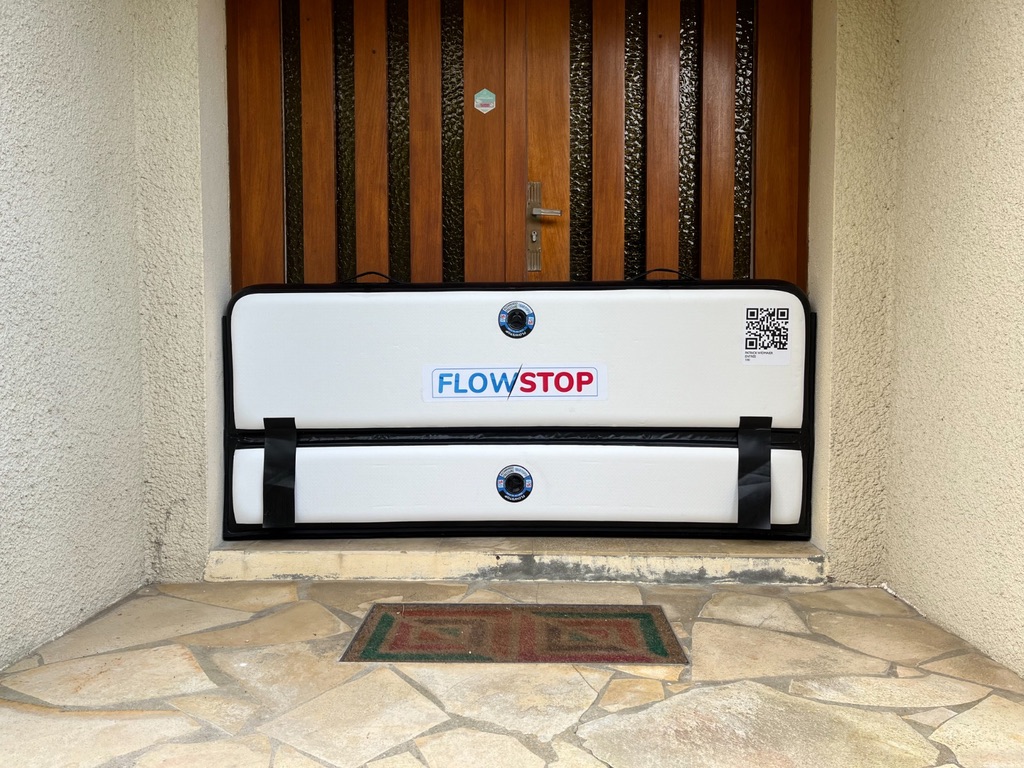
The company states that the material is resistant to impacts, debris, wind, and temperature fluctuations, and has been tested against floating objects and sharp debris. FlowStop also reports that the barriers can withstand temperatures up to 167°F (75°C). However, the product is not intended to function as a hurricane shutter.
One of FlowStop’s advantages is its relatively low weight compared with rigid flood panels. According to the company, barrier weights range from approximately 4 kg (8.8 lb) for smaller units to 15 kg (33.1 lb) for the largest standard models, allowing most barriers to be carried, installed, and stored by a single person. The inflatable barriers can be rolled up when not in use, reducing storage requirements compared with permanent flood-protection systems.
Surface Compatibility
FlowStop is designed to work against solid masonry and similar structural surfaces, including:
- Brick
- Stone
- Concrete
- Plaster-covered masonry walls
The company warns against installing the barriers against drywall, sheetrock, flexible cladding, or unsupported stud walls, as the pressure generated by the barrier could damage the structure or cause failure during flooding. Anti-slip strips may be required when installing against particularly smooth surfaces such as painted wood or aluminum.
Understanding the limits
FlowStop emphasizes that the limiting factor is often the building itself rather than the barrier. Although barriers can be manufactured to withstand significant water loads, holding back floodwater creates substantial lateral pressure on walls.
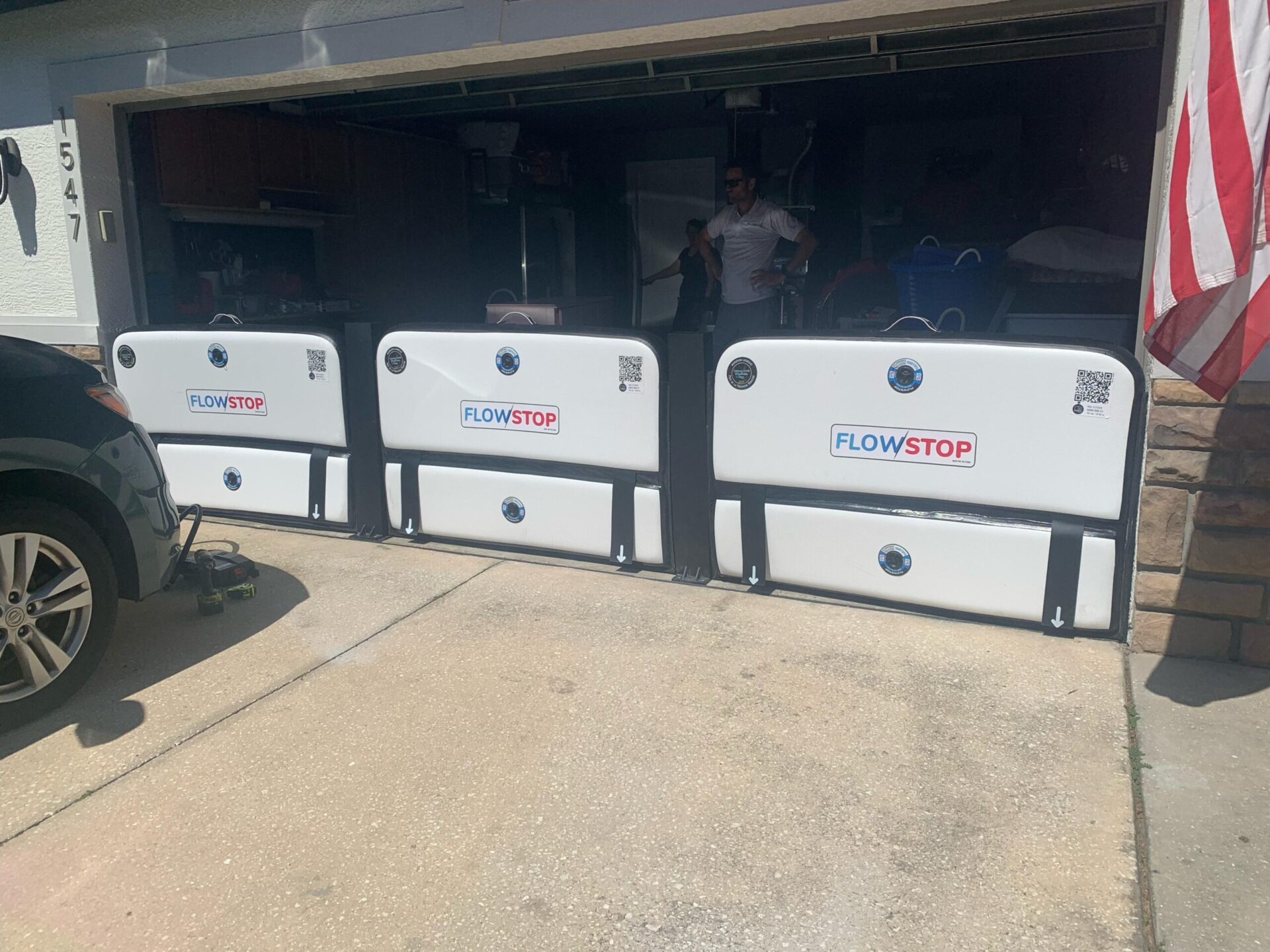
The company references FEMA and engineering guidance that generally limit dry floodproofing on typical masonry structures to around 36 inches of floodwater. For wood-frame construction, it recommends limiting protection heights to approximately 24 inches due to lower resistance to lateral water pressure.
FlowStop therefore evaluates wall construction, opening location, site drainage, and building design before recommending a protection height.
The company also notes that opening protection alone does not make a structure waterproof. Water may still enter through cracks, utility penetrations, vents, crawlspaces, and foundation leaks, making flood barriers just one part of a broader flood-mitigation strategy.
Pricing and availability
FlowStop barriers are custom-manufactured to fit each opening and are sold directly through FlowStop USA. Pricing is based on the size and configuration of the barrier rather than a fixed model lineup.
According to the company’s website, the Single-Chamber FlowStop starts at approximately $75 per square foot, while Double-Chamber FlowStop models start at approximately $90 per square foot. Final pricing varies based on opening dimensions, barrier depth, height, support posts, straps, and other installation requirements.
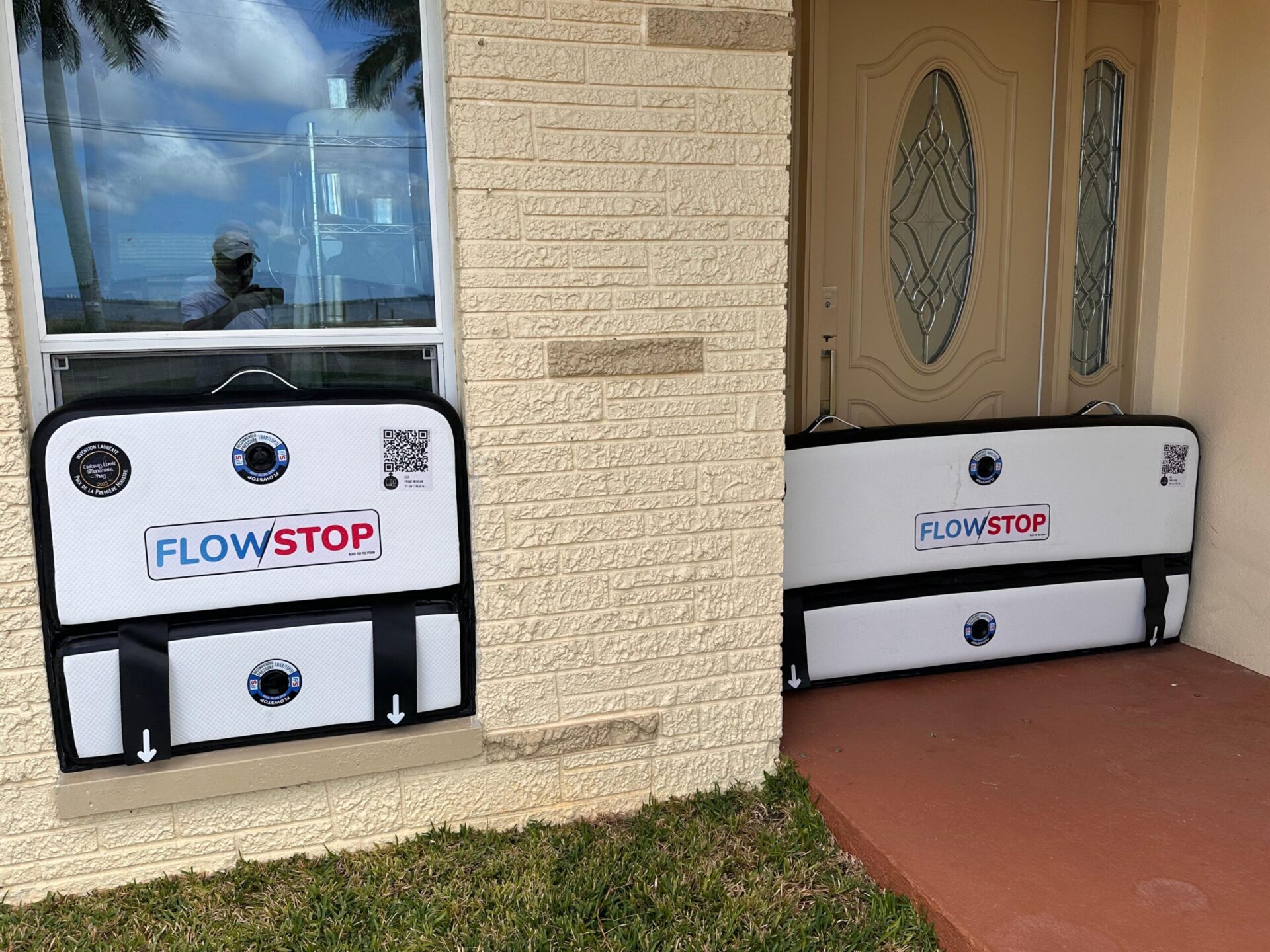
The company provides online measurement guides, a pricing calculator, and custom quotations through its website. Because every barrier is built to order, lead times can increase significantly during hurricane season when demand is highest.
Source: FlowStop