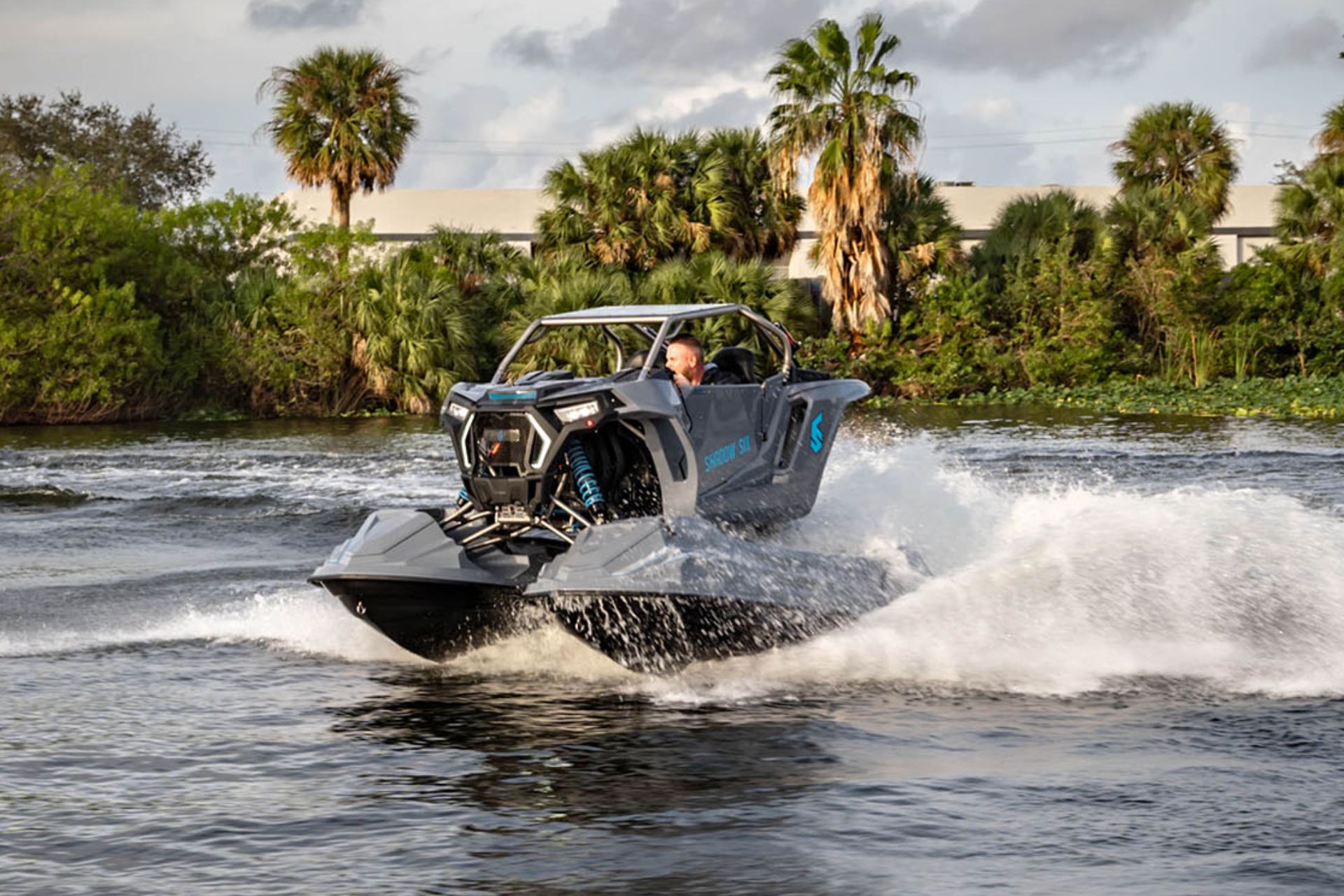
Most recreational watercraft fall into familiar categories: boats, jet skis, or rigid inflatable vessels. The Shadow Six Typhoon belongs to none of them. Built by Florida-based Shadow Six Racing, it is marketed as the world’s first Aquatic Utility Vehicle (AUV), combining the driving position and suspension philosophy of an off-road side-by-side with the propulsion of twin jet-powered hulls. Rather than adapting an existing vehicle, the Typhoon was engineered from the ground up as a purpose-built machine for high-performance use on the water.
Designed as a completely new class of watercraft
At first glance, the Typhoon resembles a Polaris RZR sitting on two personal watercraft. In reality, only the styling cues are familiar. The machine uses a custom titanium chassis and a pair of carbon-composite racing hulls developed specifically for the vehicle. Shadow Six says the goal was not to create an amphibious vehicle, but to build a new type of watercraft that combines the confidence and seating position of a UTV with the speed and maneuverability of jet propulsion.
Unlike an amphibious vehicle, the Typhoon cannot be driven on land. Everything beneath the cockpit is purpose-built for water, from the hulls to the jet pumps and suspension system.
Titanium chassis and independent suspension
One of the Typhoon’s defining features is its suspension. While conventional boats and personal watercraft rely solely on hull design to absorb impacts, the Typhoon mounts each hull to an independent FOX 3.0 adjustable dual-rate suspension system offering 20 inches (51 cm) of travel. The setup is intended to reduce the harsh impacts that occur when crossing waves at speed, helping the cockpit remain more composed in rough water.
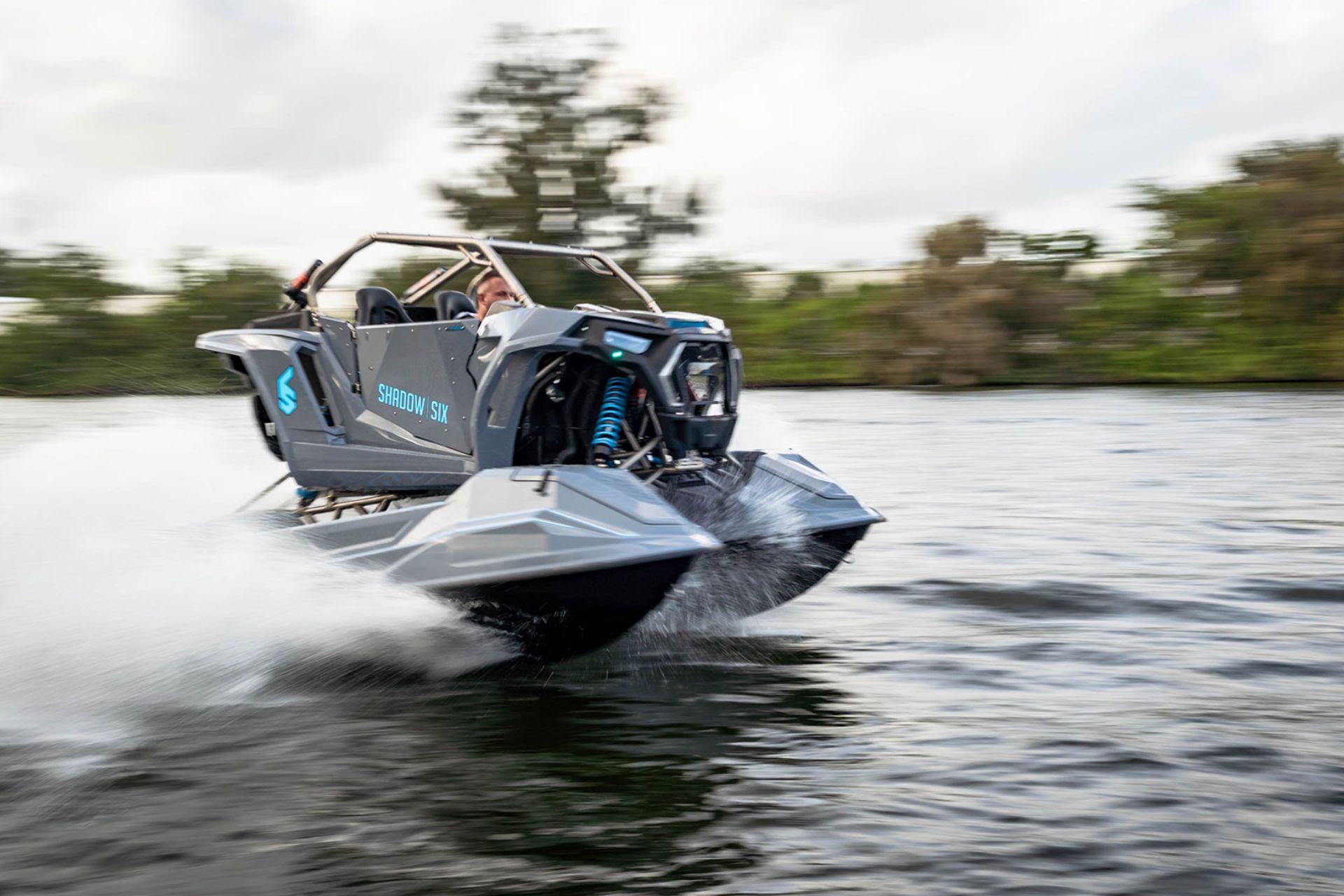
The main chassis is constructed from titanium for corrosion resistance and strength, while the custom hulls are built from carbon composite. The combination keeps the structure rigid while reducing weight compared with conventional steel construction. According to the latest official specifications, the Typhoon has a dry weight of 2,467 lb (1,119 kg).
Twin supercharged Yamaha engines produce 500 horsepower
Power comes from two supercharged and intercooled 1,812 cc Yamaha four-cylinder marine engines, each producing 250 horsepower for a combined output of 500 hp. Each engine drives its own 160 mm high-pressure jet pump, providing independent thrust through the twin hulls. Shadow Six recommends premium unleaded fuel, and the Typhoon carries 37 gallons (140 liters) of fuel.
Notably, Shadow Six’s current specifications no longer publish an official top-speed figure. Earlier promotional material referenced optional performance upgrades and higher speeds, but those claims have been removed from the latest specification sheet. Instead, the company emphasizes the vehicle’s power, stability and handling rather than quoting a maximum speed.
Premium technology on board
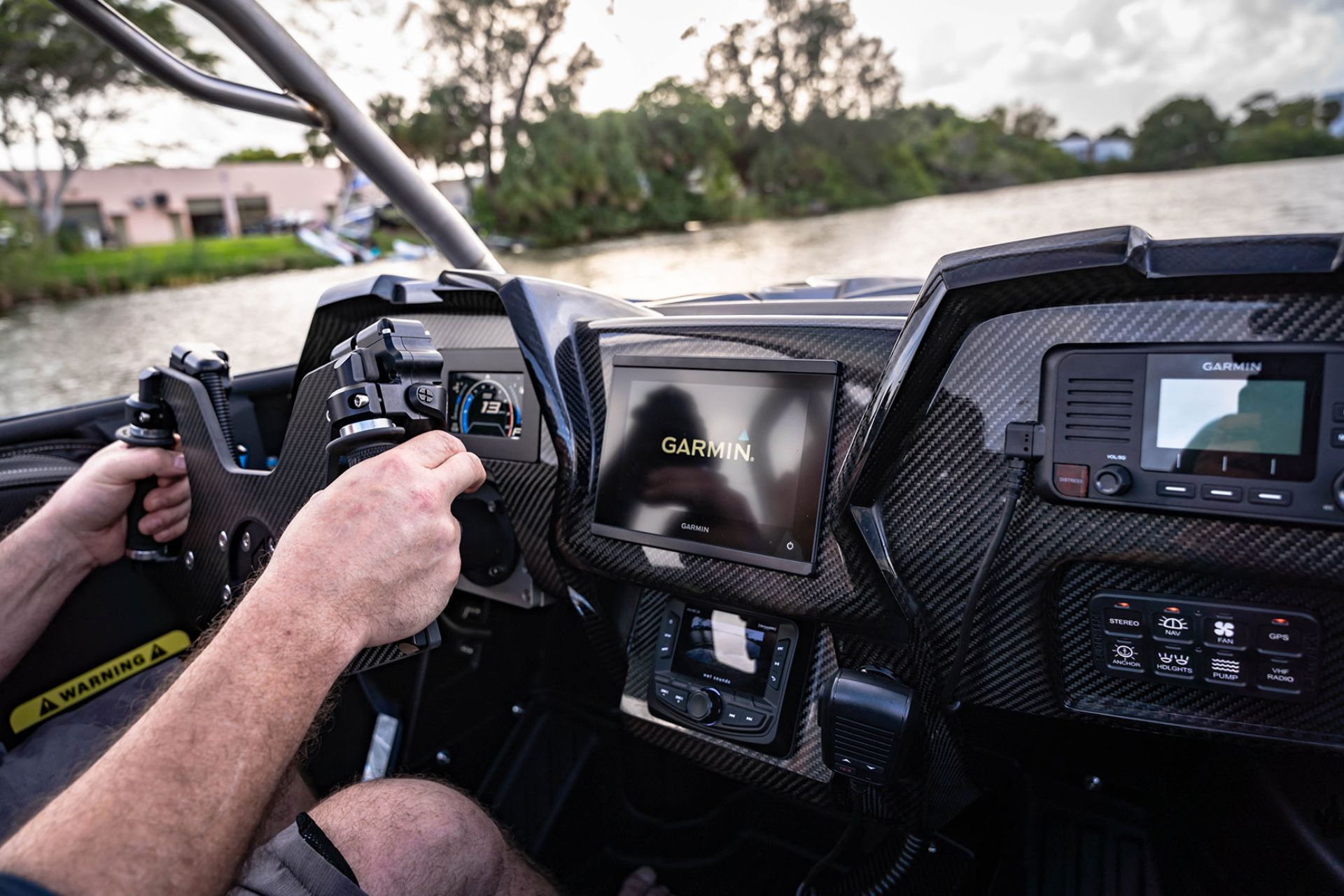
The Typhoon is equipped more like a luxury performance vehicle than a typical personal watercraft. Standard equipment includes:
- Garmin GPSMAP 7-inch touchscreen navigation
- Wet Sounds premium audio system
- Dual 4.2-inch Yamaha Connext engine displays
- Front and rear cameras
- Bluetooth connectivity
- Yamaha RiDE electronic reverse system
- Five-position electronic trim
- Connext anti-theft system
- ACR wireless safety switch
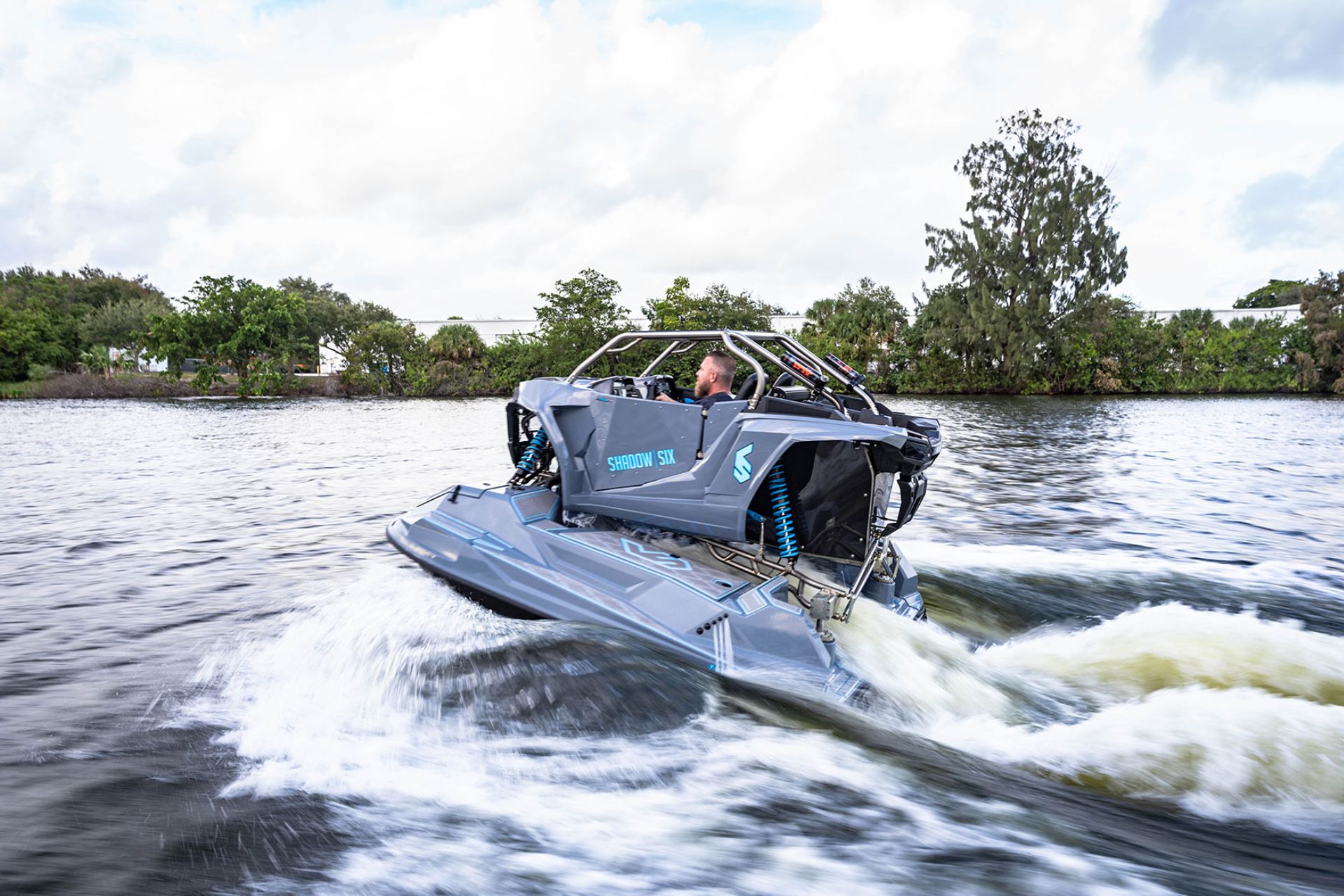
The cockpit also features dual carbon bucket seats, two cup holders, door storage compartments, USB charging, LED lighting, and a 30-liter cooler that doubles as a cargo box. Four electric bilge pumps, an automatic siphon system, and a three-battery electrical setup are included as standard equipment.
Built for two passengers
The current Typhoon is configured for two occupants and has a payload capacity of 553 lb (251 kg). It measures 130 inches (330 cm) long, 108 inches (274 cm) wide and 84 inches (213 cm) tall. Storage capacity totals 30 gallons (114 liters), allowing room for safety equipment and personal gear during longer outings.
Company sees applications beyond recreation
Although the Typhoon is marketed as an ultra-premium recreational machine, Shadow Six also highlights broader possibilities. The company says the platform could suit applications such as rescue operations, coastal patrols and other missions where stability, speed and rough-water capability are valuable. Shadow Six is part of a group of privately held companies operating across the defense, technology and motorsports sectors, and says it applies engineering practices from those industries when developing new vehicles.
Pricing and availability
The 2026 Shadow Six Typhoon is listed on the company’s official website with a base MSRP of US$275,399. The price excludes freight, delivery, preparation charges and optional accessories. Interested buyers are directed to contact Shadow Six Racing or its sales partner, Riva Motorsports, for ordering information.
For buyers looking for something that stands apart from conventional boats and personal watercraft, the Typhoon occupies a category almost entirely of its own. Whether viewed as an engineering experiment or a luxury performance machine, it remains one of the most unusual production watercraft currently available.
Source: Shadow Six Racing