Air conditioning is responsible for roughly 10% of global electricity consumption, and demand continues to grow as temperatures rise and cooling becomes more essential. Against this backdrop, a Florida-based DIY builder has developed an off-grid cooling system that takes a different approach—storing cold energy in ice rather than relying on continuous electrical power.
The system is built entirely from readily available, off-the-shelf components and uses solar energy to create and store cooling for later use. While simple in concept, the underlying physics makes it an interesting alternative for specific use cases such as vehicles, cabins, and other off-grid environments.
Turning sunlight into stored cooling
At the core of the setup are three standard 100-watt solar panels mounted on a vehicle. These panels generate electricity, which is regulated by a charge controller to safely charge a 35 amp-hour lead-acid battery. This type of battery is widely used for energy storage due to its reliability and low cost.
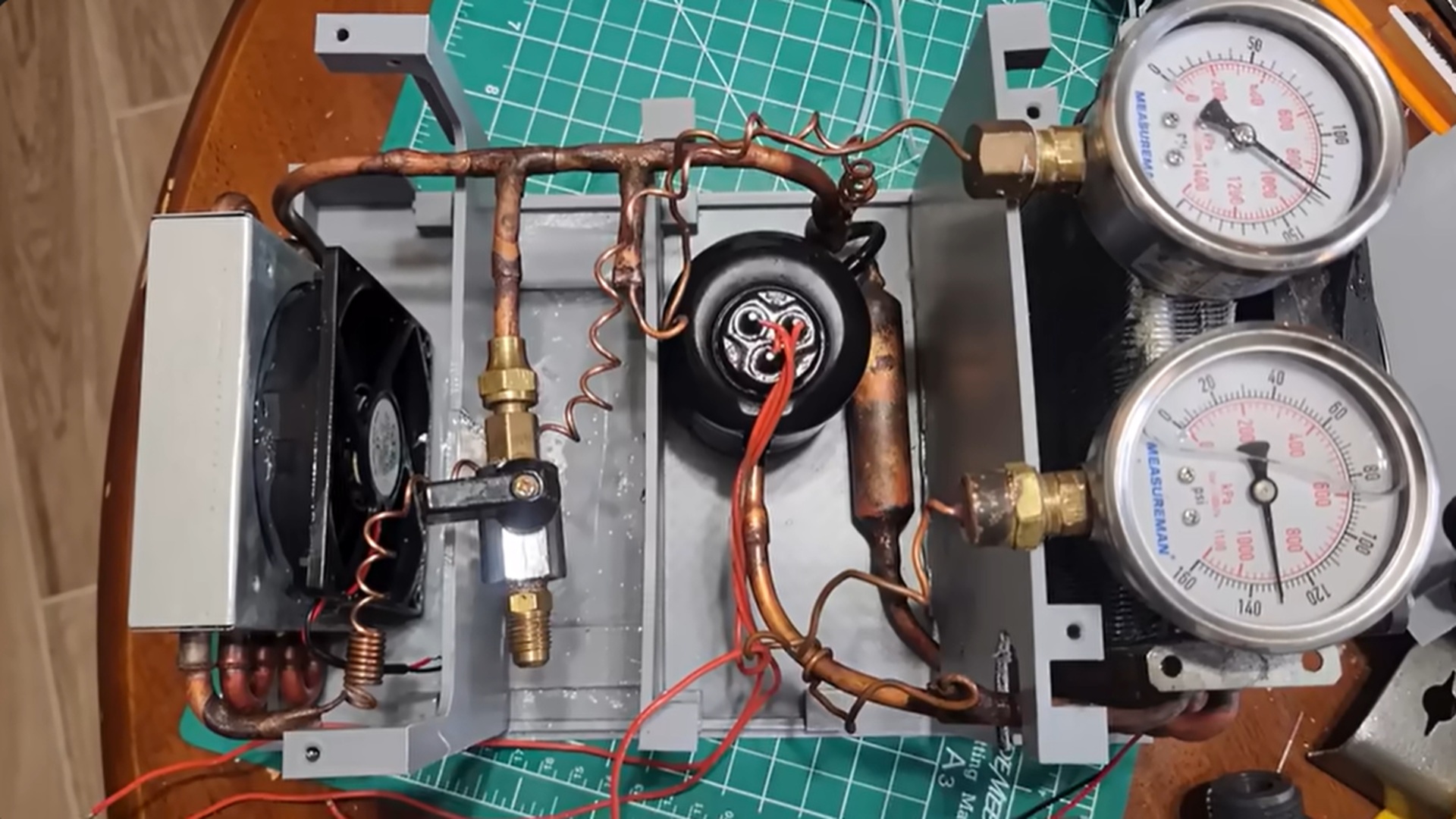
Once the battery reaches full charge, a microcontroller activates an inverter that converts the stored direct current (DC) into alternating current (AC). This AC power is used to run a compact refrigerator compressor that operates with R600 refrigerant, also known as n-butane, in a closed-loop system.
Rather than cooling air directly, the compressor removes heat from a 2-gallon (approximately 7.6 liters) water container. The container is insulated with around 1 inch (2.5 cm) of foam panels along with fiberglass wool to reduce heat transfer from the surroundings.
Over several hours of exposure to direct sunlight, the system gradually freezes the entire volume of water into a solid block of ice. In doing so, it stores approximately 2.5 million joules (2.5 MJ) of thermal energy. Due to the insulation, heat leakage is limited to around 7 to 8 watts, allowing the ice to remain frozen for several days—well beyond a single night’s cooling requirement.
Releasing cooling when needed
The stored cooling is delivered through a separate glycol-based loop. A small pump circulates a 50/50 mixture of water and ethylene glycol through about 20 feet (roughly 6 meters) of copper tubing embedded inside the ice block.
As the fluid passes through the tubing, it absorbs cold from the ice and carries it to a standard automotive radiator equipped with a small fan. The radiator then dissipates this cold into the surrounding air, effectively cooling the space.
The pump and fan require only a few watts of power, meaning the system can operate for extended periods even after sunset without significantly draining the battery. In real-world testing, the setup was able to cool a truck cab noticeably over a couple of hours on a warm day, demonstrating practical viability.
The system delivers around 700 watts of cooling capacity per hour, which is comparable to a small window air conditioning unit, but without continuous high electricity demand at the time of use.
Why ice is used instead of batteries
One of the key ideas behind this design is using ice as a thermal energy storage medium. Ice has a high energy density when it comes to storing cooling. One cubic meter of ice can store approximately 93 kilowatt-hours of cooling capacity.
This is comparable to large chemical battery systems but comes without issues such as degradation over repeated charge cycles. Water retains its latent heat properties indefinitely, regardless of how many times it is frozen and thawed.
The system also aligns well with solar energy production patterns. The compressor performs the energy-intensive freezing process during peak sunlight hours, when solar panels generate the most electricity. The stored cooling is then released later, during the evening or night, when cooling demand is often higher but solar generation is no longer available.
Scalability and practical use cases
The design is inherently scalable. Increasing the size of the water container or adding more solar panels can proportionally increase the cooling output. According to the concept, a system using around one cubic meter of ice could provide enough cooling for a small house.
Because all components—solar panels, battery, compressor, copper tubing, and radiator—are commercially available, the system can be replicated or modified without specialized manufacturing. The microcontroller manages compressor operation based on battery voltage, ensuring safe operation and efficient energy use.
The creator notes that this approach is particularly suitable for off-grid applications such as RVs, remote cabins, or mobile setups where connecting to the electrical grid is difficult or expensive.
While not a direct replacement for conventional air conditioning in all scenarios, the system demonstrates how combining basic thermodynamics with solar power can provide a functional and efficient cooling solution in the right conditions.