A French startup that built a pedal-powered boat capable of flying above the water has released a second model aimed at riders who would rather not pedal quite so hard. The E-JetCycle, from Annecy-based JetCycle, pairs the company’s original hydrofoil concept with electric pedal assistance and a wider, more stable trimaran hull. The result is a watercraft that’s meant to be easier to learn and less physically demanding than the all-human-powered version that came before it.
JetCycle was founded in 2020 and entered the personal watercraft market in 2022 with the JetCycle Max, a single-seat, fully human-powered hydrofoil boat. The newer E-JetCycle, first shown at the 2023 Cannes Yachting Festival and later presented at the Boot Düsseldorf boat show in January 2024, broadens the lineup with a model designed for a wider range of riders.
How it works
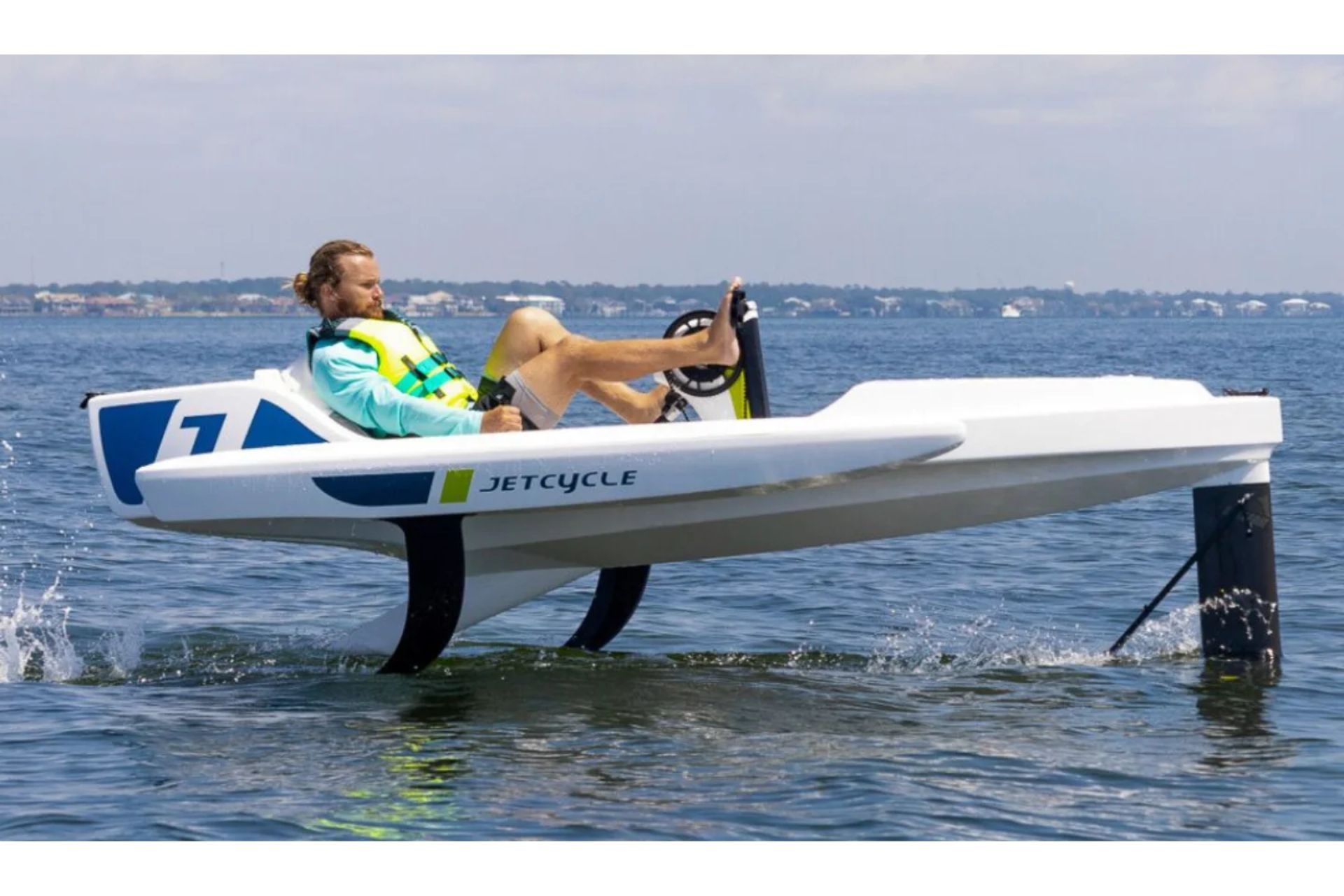
Both JetCycle craft use the same basic idea: the rider sits in a recumbent, kayak-like cockpit and pedals, and two carbon-fiber hydrofoils generate enough lift to raise the hull clear of the surface. Once the boat is “flying,” drag drops and the rider glides above the water rather than plowing through it.
On the original JetCycle Max, that lift comes entirely from leg power. The boat is 3.40 m (about 11 ft) long with a hull just 0.80 m (2.6 ft) wide, and it stands 1.20 m (3.9 ft) tall including the foils. To take off, the rider has to pedal hard enough to reach roughly 9 km/h (about 5.6 mph); steering is handled by a small handle on the right that controls the front foil, while a lever on the left adjusts flight altitude. JetCycle says the Max can fly at up to 20 km/h (about 12 mph) on leg power alone. The company recommends calm water such as a lake, a minimum depth of one meter, and starting from a pontoon rather than a sandy beach. It also advises against use by anyone under 14.
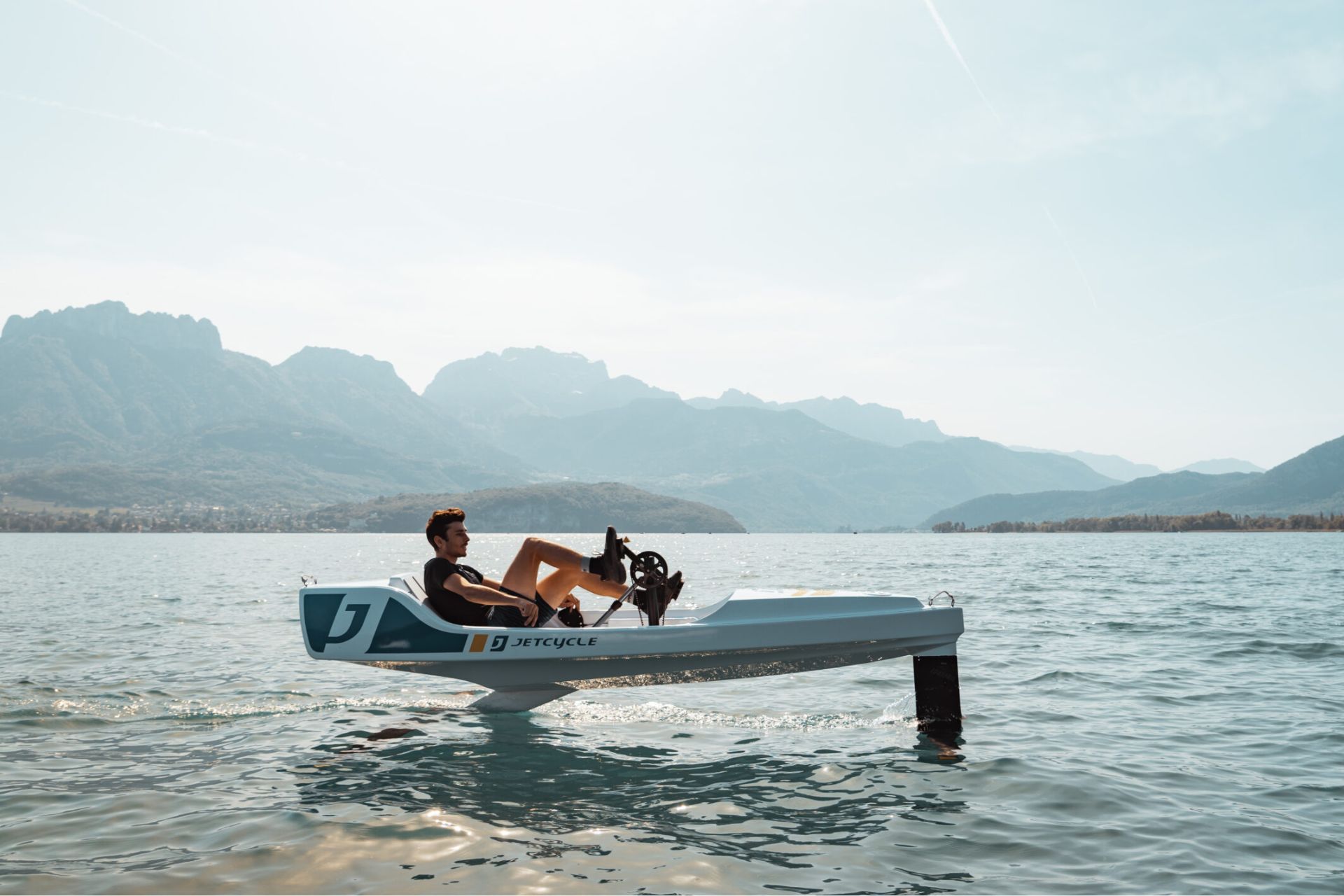
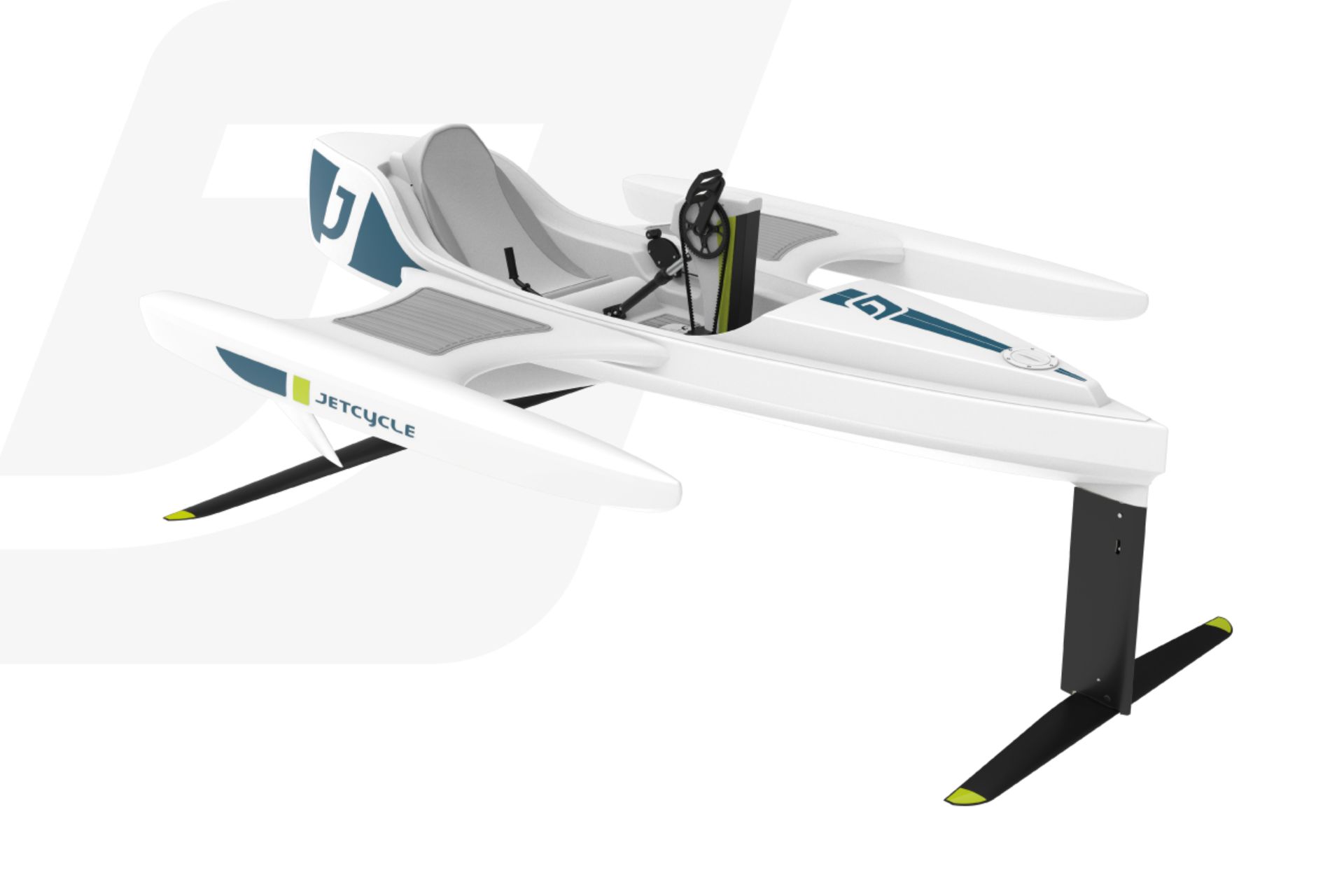
The E-JetCycle keeps the same recumbent layout and central hull length but adds two key changes: a motor and two outer floats.
Electric assistance and a trimaran hull
The E-JetCycle’s electric system works like a pedal-assist e-bike rather than a throttle. A motor reported at around 200 watts, built into the pedal box, adds power in proportion to the rider’s own effort, and several assistance levels let the rider dial in how much help they want. A battery provides up to three hours of running time.
A company engineer explained the reasoning behind the design:
“We first integrated electric pedal assistance, similar to what can be found in the world of cycling. The motor provides additional power to the user, proportionally to what the user provides. This allows feeling the effort under the pedal without actually exerting it and thus being able to appreciate all the sensations of flying.” — Gwendal, JetCycle Engineer
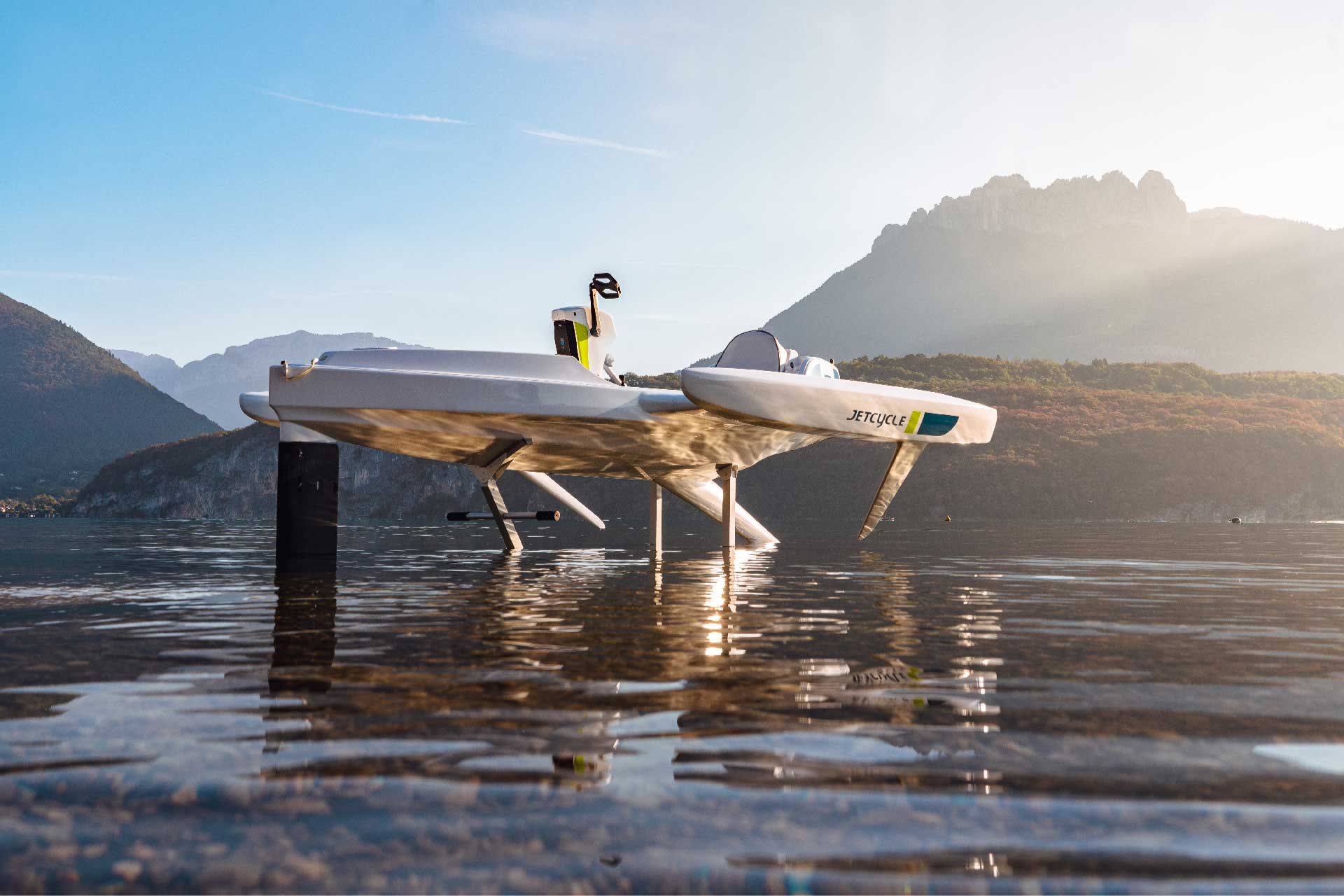
The second change is the move from a single hull to a trimaran. Two outer floats flank the cockpit, each fitted with its own curved foil, and the arms that connect them double as a platform for getting in and out of the boat. According to the same engineer:
“The difference with the JetCycle Max also lies in the integration of stabilizing elements, the floats, which give it excellent stability when the hull is in the water. This beautiful platform allows for easy descent and ascent into the boat, thus allowing the passenger to swim between flights. Finally, the addition of 2 curved lateral foils under the floats has increased stability in flight by correcting heeling errors and keeping the boat flat.” — Gwendal, JetCycle Engineer
Specifications
The E-JetCycle measures 3.40 m (11 ft) long, 2.30 m (7.5 ft) wide, and 1.20 m (3.9 ft) tall, and weighs 55 kg (121 lb). Its draft is 0.75 m (2.5 ft). The front foil spans 1.40 m (4.6 ft) and the rear foil 2.30 m (7.5 ft).
In terms of speed, JetCycle lists a surface-gliding (pre-takeoff) figure of about 5 knots (roughly 9 km/h or 5.7 mph), a cruising speed of 8 knots (about 15 km/h or 9 mph) once foiling, and a top speed of 10 knots (about 19–20 km/h or 11.5 mph). Because it runs on an electric motor rather than a combustion engine, the company describes it as producing no noise and no emissions. Both models are designed and manufactured in France.
The E-JetCycle can be taken apart for transport, with the central hull carried on a roof gallery and the floats, stabilizers, and foils stored separately.
Where it fits
JetCycle positions the E-JetCycle as a calmer, lower-effort alternative to activities like kayaking, paddleboarding, or jet skiing, and as an easier entry point for people new to foiling. The trimaran layout and electric assist address the two most common hurdles with the original design: balance and stamina. The trade-offs are added weight, width, and cost, plus the usual hydrofoil constraints — reasonably deep, calm, weed-free water and a dock-style launch rather than a beach start.
For now, the practical reality is that the E-JetCycle sits in premium-toy territory, closer in price to a high-end jet ski than to a kayak. The company has also pointed to rentals as a way for curious riders to try one without buying.
Pricing and availability
JetCycle lists the E-JetCycle at €19,990 (US$22,900) before VAT and the JetCycle Max at €9,990 (US$11,445) before VAT — putting the electric model at roughly double the price of the human-powered original. Both boats are sold through the company directly, which invites quote requests via its website.
Product page: JetCycle