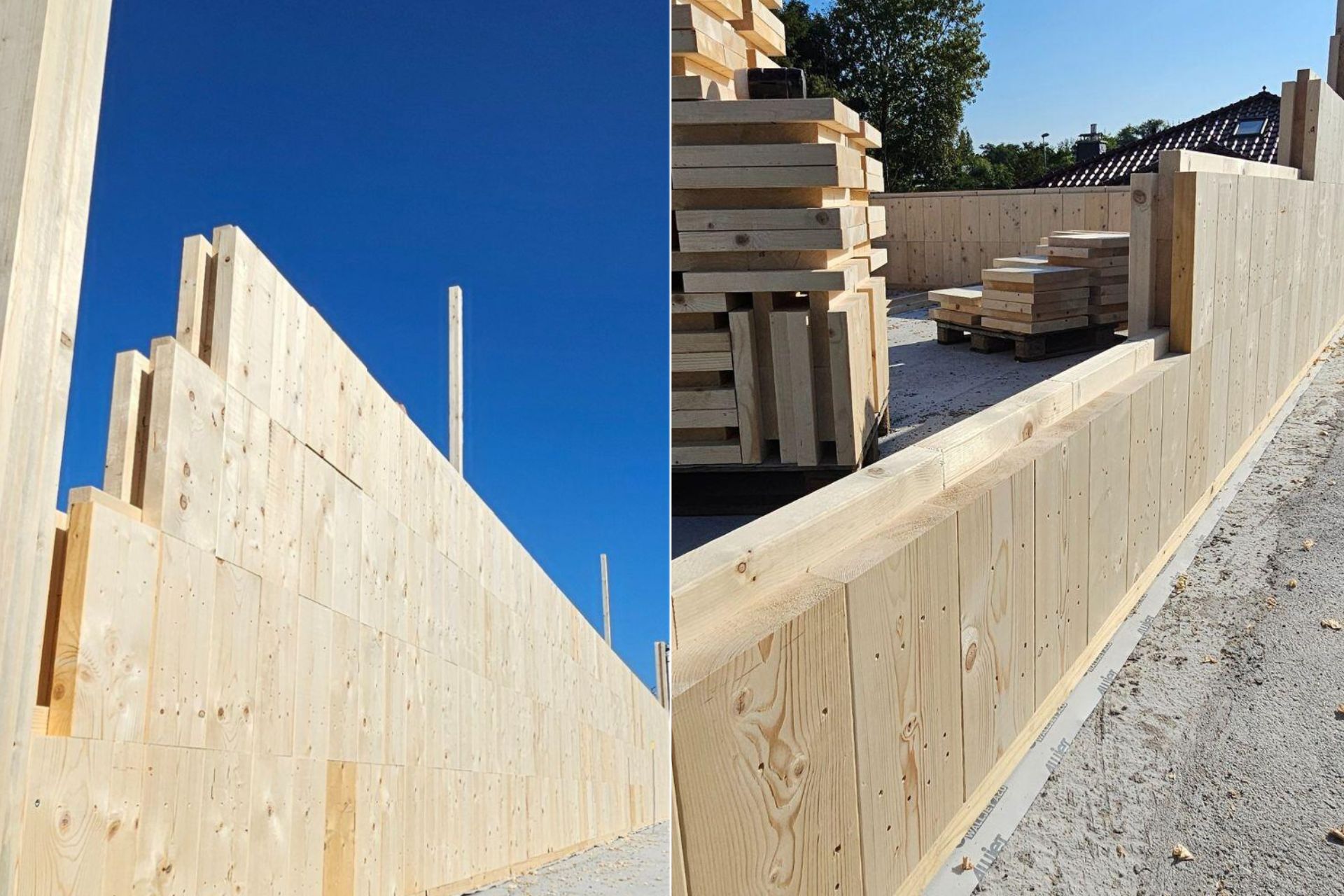
A German company called NiTO Holzstein has developed a modular building block made entirely from solid timber that interlocks without glue, mortar, or special tools. The system is certified for structures up to two floors plus an attic, and the company says one square meter of wall takes less than a minute to assemble.
Construction has never been a field that lends itself to improvisation. The materials are heavy, the tolerances matter, and the skills required — masonry, concrete work, carpentry — take years to develop. A small company based in Schwanewede, Germany is trying to change that logic with a deceptively simple idea: make the wall itself out of interlocking wooden blocks that anyone can stack.
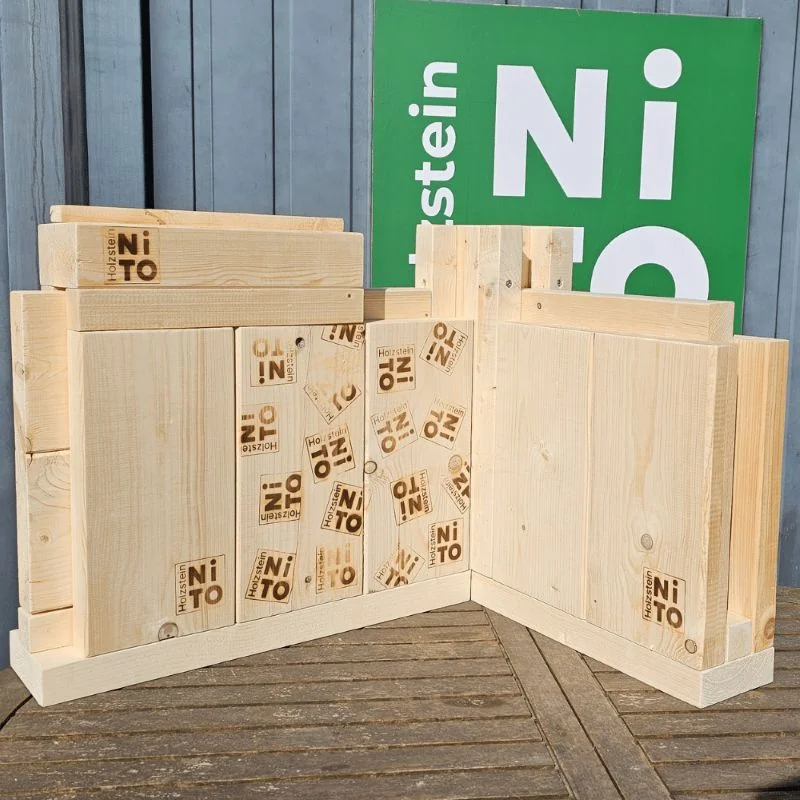
NiTO Holzstein GmbH, which operates under the English-facing brand NiTO Wooden Brick, produces what it calls a Holzstein — literally a “wood stone” — a solid timber block shaped to function like a large-scale building unit. The blocks connect using a tongue and groove system and require no adhesives, mortar, or metal fasteners to assemble. The company describes the process as comparable to stacking oversized building blocks.
The concept is not entirely new — log cabin construction and stacked timber walls have existed for centuries — but the NiTO system’s use of standardized, precision-dimensioned components and its formal building certification make it an unusual product in the modern construction market.
What the bricks are made of
Each NiTO wooden brick is made from six individual plank sections held together by wooden nails — specifically, NiTO uses Lignoloc wooden nails from fastener manufacturer Beck. The blocks contain no metal hardware, no chemical adhesives, and no synthetic materials of any kind. The wood meets strength class C24, a structural timber grade used in load-bearing applications in European construction standards.
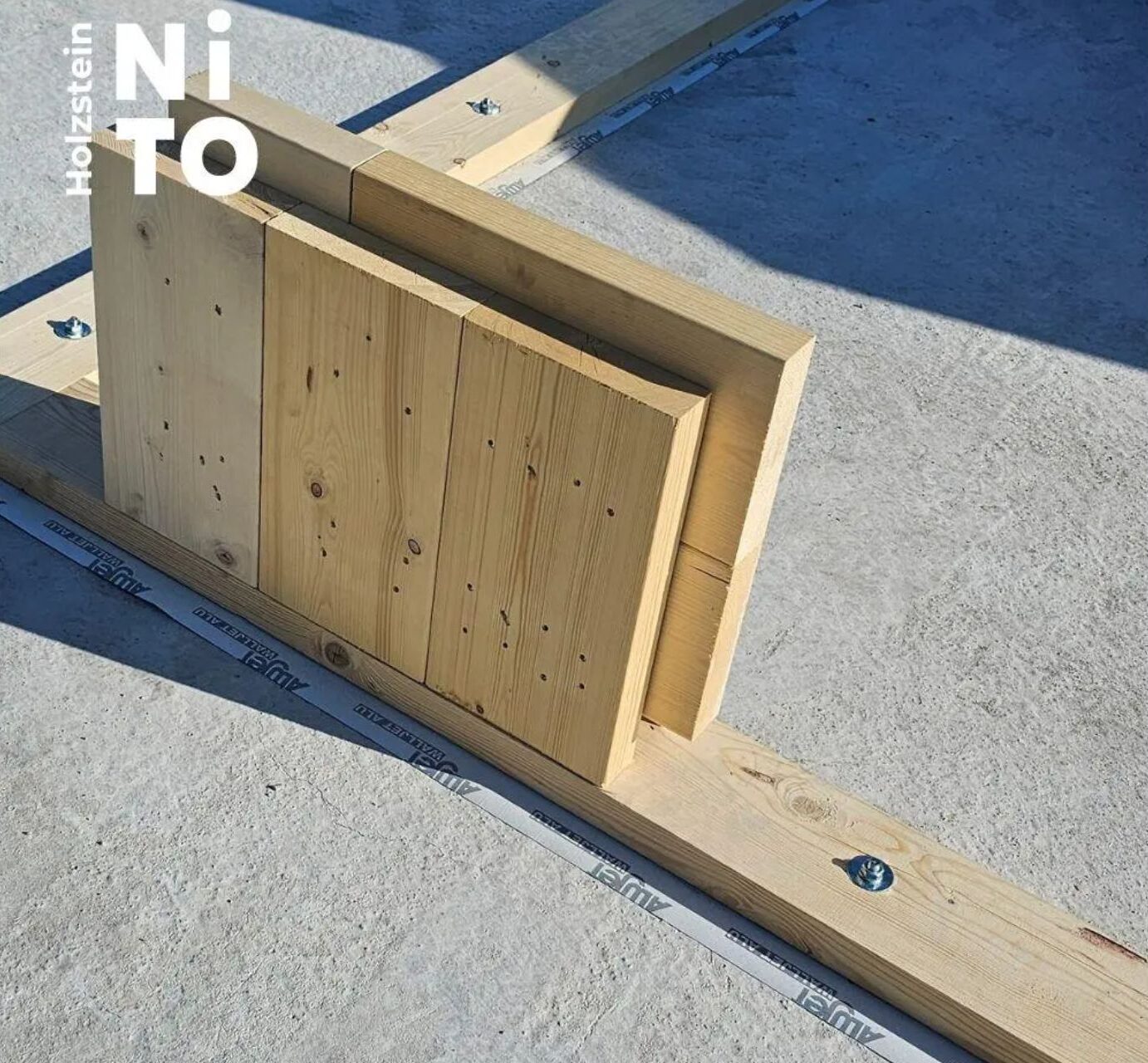
The solid brick measures 40 × 40 × 15 cm (roughly 15.7 × 15.7 × 5.9 inches) and weighs about 10 kilograms (22 pounds). The half brick measures 20 × 40 × 15 cm and weighs approximately 5 kilograms (11 pounds). Both units share the same 5 cm tongue and groove profile, which allows them to interlock in all directions. The residual moisture content of the finished bricks is maintained at 10 to 15 percent.
Strength class C24 wood and wood-only fastening throughout the structure means no risk of hitting metal when cutting, which the company highlights as a practical advantage when trimming bricks to fit non-standard dimensions on site.
How the system assembles
The tongue and groove profile is the central engineering feature. When a full brick is placed on a half brick, or vice versa, the protruding tongue on one unit slides into the corresponding groove on the other, locking them together without any additional fixings. Rows are alternated so that joints never run continuously through the wall — a standard practice in masonry that distributes load and prevents weak planes.
Wall assembly follows a 40 cm planning grid. NiTO states that one square meter of wall can be built in less than a minute once a builder is familiar with the system — compared to roughly 30 minutes for a conventional masonry wall of equivalent area. The company positions this as a significant reduction in labor time, particularly for owner-builders who take on the shell construction themselves.
Corner connections use either specialized corner posts or direct brick-to-brick interlocking. Posts and thresholds (sill plates at the base) are part of the component system alongside the solid and half bricks.
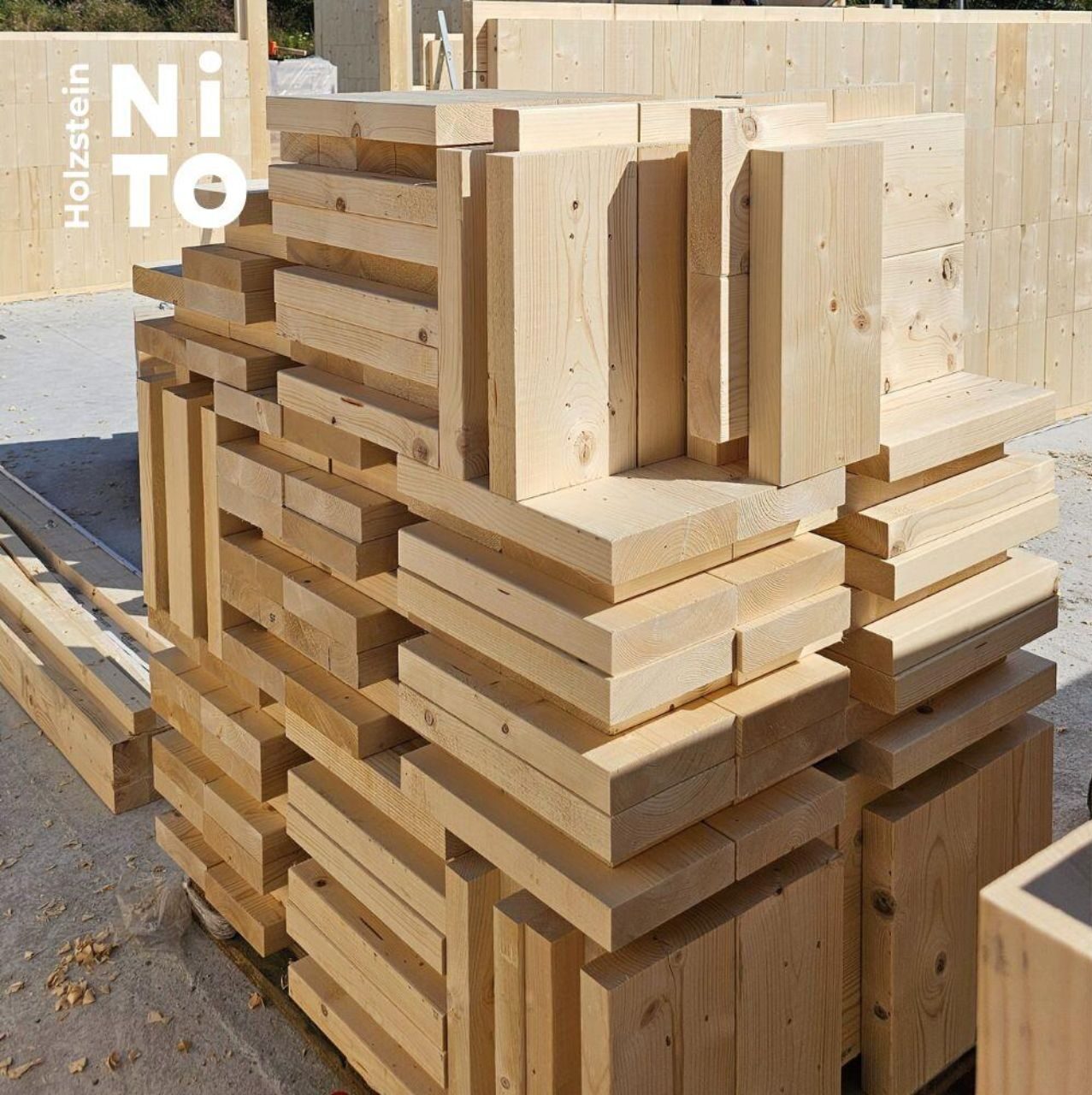
Cutting is possible with a standard saw when non-standard dimensions are required, and the tongue and groove geometry is maintained through the cut material in layered sections.
What it’s certified for
NiTO holds approval from the Deutsche Institut für Bautechnik — the German Institute for Building Technology, known as DIBt — which covers structures up to two stories plus an attic. This certification covers the wooden brick as a structural wall material for residential and commercial buildings within those height limits.
The DIBt certification is the meaningful credential here. German building codes require third-party approval for construction systems used in regulated structures, and obtaining it validates the system’s structural performance under defined load conditions. Quality testing is also conducted independently by the Karlsruhe Institute of Technology (KIT), one of Germany’s leading engineering research institutions.
For structures within the certified scope — single-family homes, garages, garden buildings, small commercial spaces — the NiTO system can be used for load-bearing external walls and internal partitions alike.
The environmental case
NiTO makes specific claims about the environmental properties of its product. Because the bricks are made from solid wood with no adhesives or synthetic additives, they are described as fully recyclable at the end of their service life — the material can re-enter the timber supply chain without processing to remove contaminants.
The company also notes that one cubic meter of NiTO wooden bricks binds approximately one ton of CO2, consistent with the general behavior of structural timber that sequesters carbon as it grows and retains it in use.
Vapor permeability — the ability of a wall to allow moisture to pass through rather than trapping it — is cited as a health benefit for occupants. Solid timber walls are naturally diffusion-open, meaning they regulate interior humidity by absorbing and releasing moisture, unlike most conventional wall assemblies that rely on vapor barriers to prevent moisture infiltration.
On fire behavior, solid timber performs differently from lighter engineered wood products. When exposed to fire, the outer layer of the wood chars and forms a carbon layer that slows heat penetration, a property known in structural timber engineering as charring behavior. NiTO notes this as a distinguishing characteristic compared to other building materials — though external cladding is still recommended for weather protection on exterior facades.
Indoor climate and health considerations
Natural wood construction has a long association with indoor air quality, and NiTO leans into this positioning. The bricks contain no chemical binders or formaldehyde-releasing adhesives — issues commonly associated with some composite wood products. The company describes the interior environment of a NiTO building as supportive of well-being, citing humidity regulation and the absence of off-gassing as key factors.
Whether these benefits are clinically significant or largely subjective is a topic with an extensive research literature, and independent studies on specific products are worth consulting separately. What is unambiguous is that solid wood without adhesives has a simpler material profile than many engineered alternatives.
Who is building with it
The NiTO system is being used for a range of building types. Projects visible in the company’s documentation include holiday accommodations in the Steigerwald region of Germany — elevated guest cabins with cork facades over NiTO structural walls — as well as single-family homes in L-shaped floor plans and various garden and commercial structures.
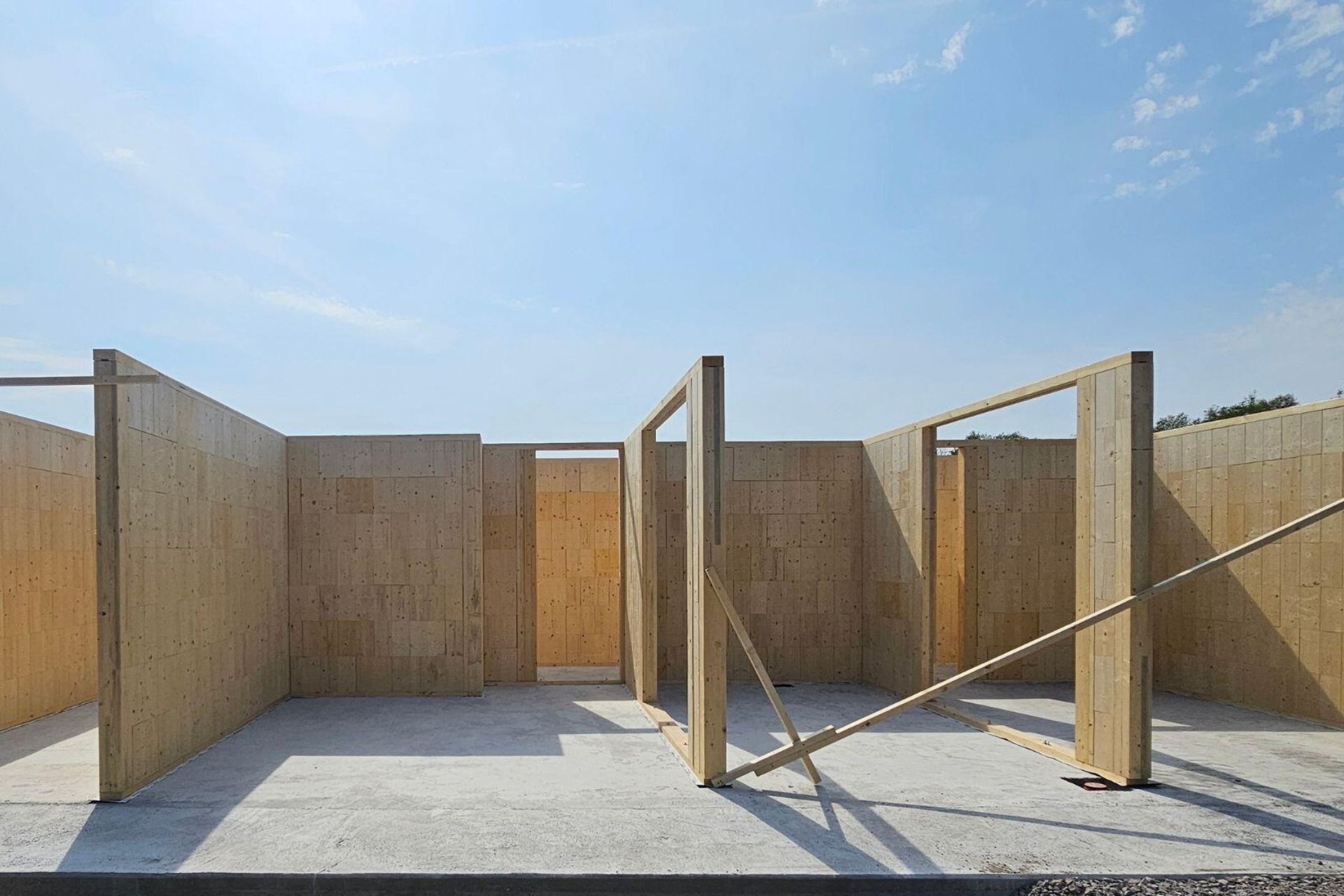
The company operates a partner network for regional distributors and production partners, with quality oversight conducted through a combination of in-house inspection and independent KIT audits. It is actively recruiting new production and distribution partners across Germany.
The NiTO system is positioned as accessible to non-professionals, but a solid timber wall still requires a proper foundation, a roof structure, and the full range of services — electrical, plumbing, insulation, windows — that any shell building needs. The cost savings NiTO describes refer specifically to the shell wall construction labor, not total build costs.
The system also requires external facade cladding for weather protection on exterior walls, which adds materials and labor beyond the bricks themselves. And as with any wood construction, moisture management during the build phase — before the roof and cladding are installed — requires attention, though NiTO notes that the bricks can get wet and dry out without damage.
Pricing and availability
Prices from the NiTO shop (nitoshop.de) are listed excluding VAT. A single full brick (Vollstein) costs €26 (~$30), while a half brick (Halbstein) is €17 (~$20). A full pallet of bricks is priced at €1,292 (~$1,486), and a sample corner set (Musterecke) — useful for evaluating the system before committing to a full order — is available for €240 (~$276).
NiTO is currently certified for use in Germany under DIBt approval. International building certification — required for most permit-regulated construction projects in other countries — is expected to become available in fall or late 2026, the company states on its international information page.
Until that certification is in place, NiTO can be used in non-regulated applications outside Germany, such as interior partition walls or projects in countries where local building authorities recognize the German DIBt certification. The company says it is receiving a high volume of international inquiries and is building its team and technical infrastructure in preparation for the certification’s arrival.
Source: NiTO