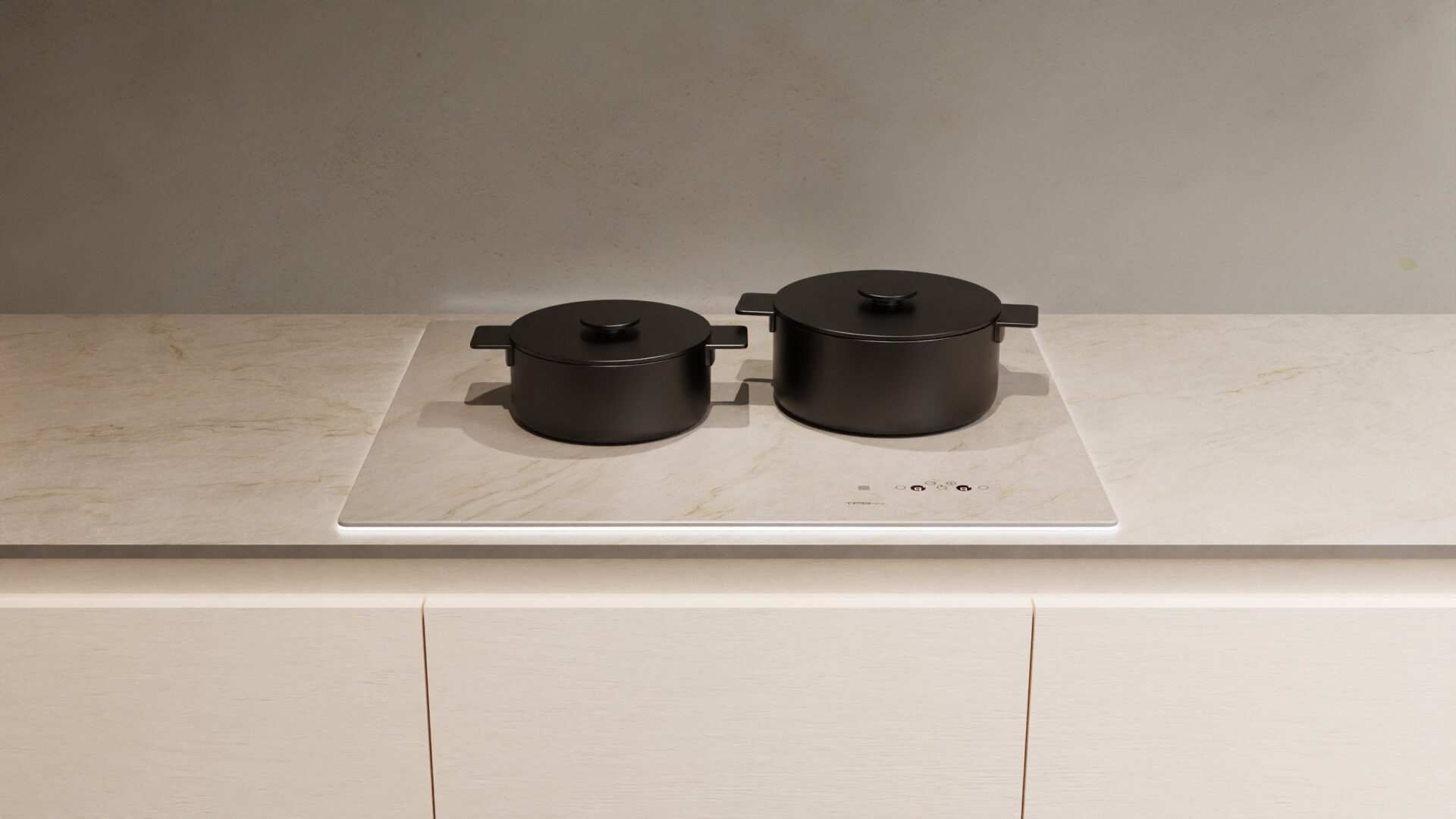
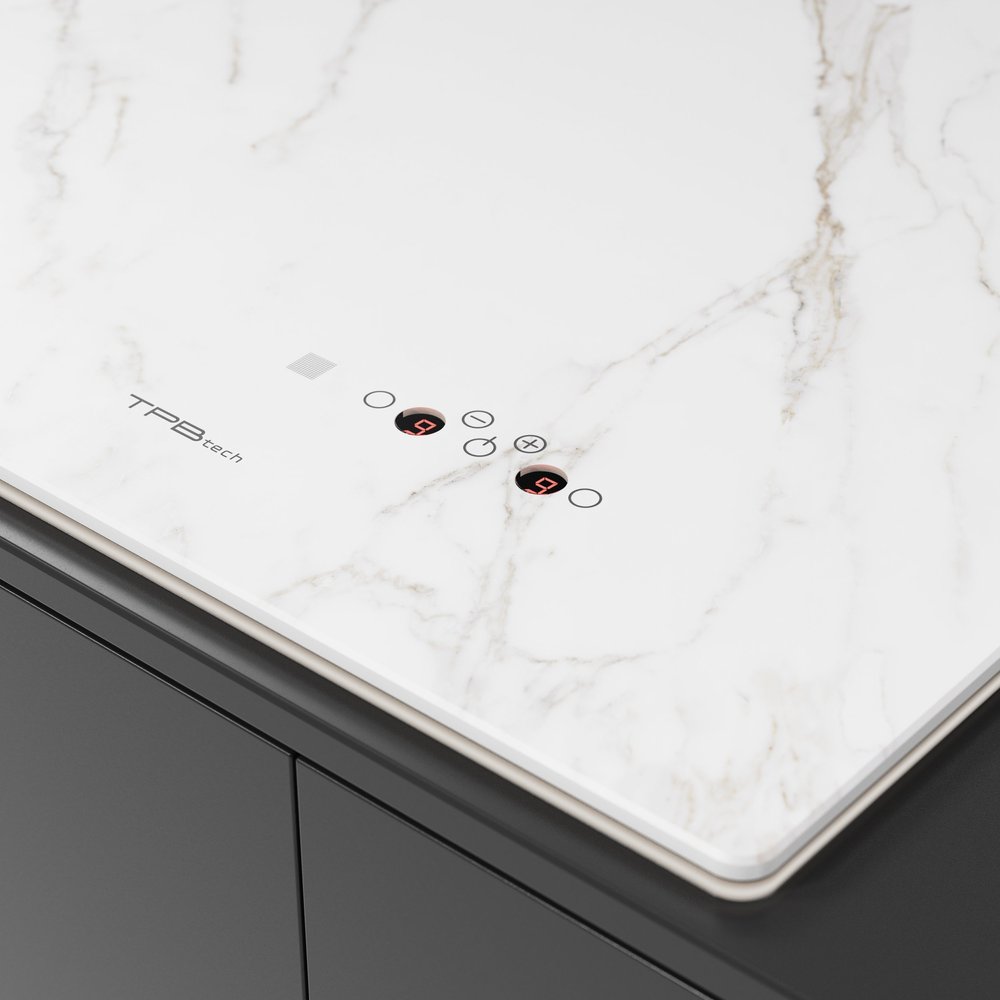
A Barcelona-based company is making the traditional stovetop disappear — not as a concept, but as a product already deployed in homes, restaurants, and hospitality venues across Europe. TPB tech, short for Top Porcelanic Barcelona, has developed what it calls an invisible induction system: a fully functional kitchen cooking surface that looks, to the naked eye, like an ordinary countertop.
There are no visible burners. No black glass ceramic panel. No raised elements or exposed controls interrupting the worktop. Instead, the induction technology is embedded directly beneath a porcelain ceramic surface, turning the entire countertop into a cooking zone that can also prepare and serve food in the same continuous space.
What it is — and what it isn’t
Standard induction cooktops work by generating an electromagnetic field beneath a glass-ceramic panel, which then heats compatible cookware placed on top. The glass is necessary with conventional systems because it needs to transmit heat while protecting the electronics below.
TPB tech removes the glass entirely. In its place is a proprietary multilayer composite material built from porcelain ceramic, aluminum, and bakelite. The outer layer is a 6 mm porcelain ceramic tile, which provides what the company describes as a non-porous, antibacterial, scratch-resistant surface that can also function as a cutting board. Beneath that sits an aluminum layer that acts as a heat conductor — effectively serving as a heat sink to prevent thermal shock. The remaining bakelite and aluminum layers contribute impact resistance, structural flatness, and weight reduction.
The engineering challenge TPB tech had to solve was a fundamental material property problem. Porcelain tile by itself tends to crack when exposed to sudden temperature shifts — exactly the kind of thermal stress that occurs every time someone starts or stops cooking. TPB tech’s patented multilayer construction addresses that directly, and the company holds patents on the material solution. Notably, this is not a system that works with off-the-shelf induction equipment; the company states explicitly that TPB tech requires its own specially adapted induction modules.
The TPB module: What’s under the surface
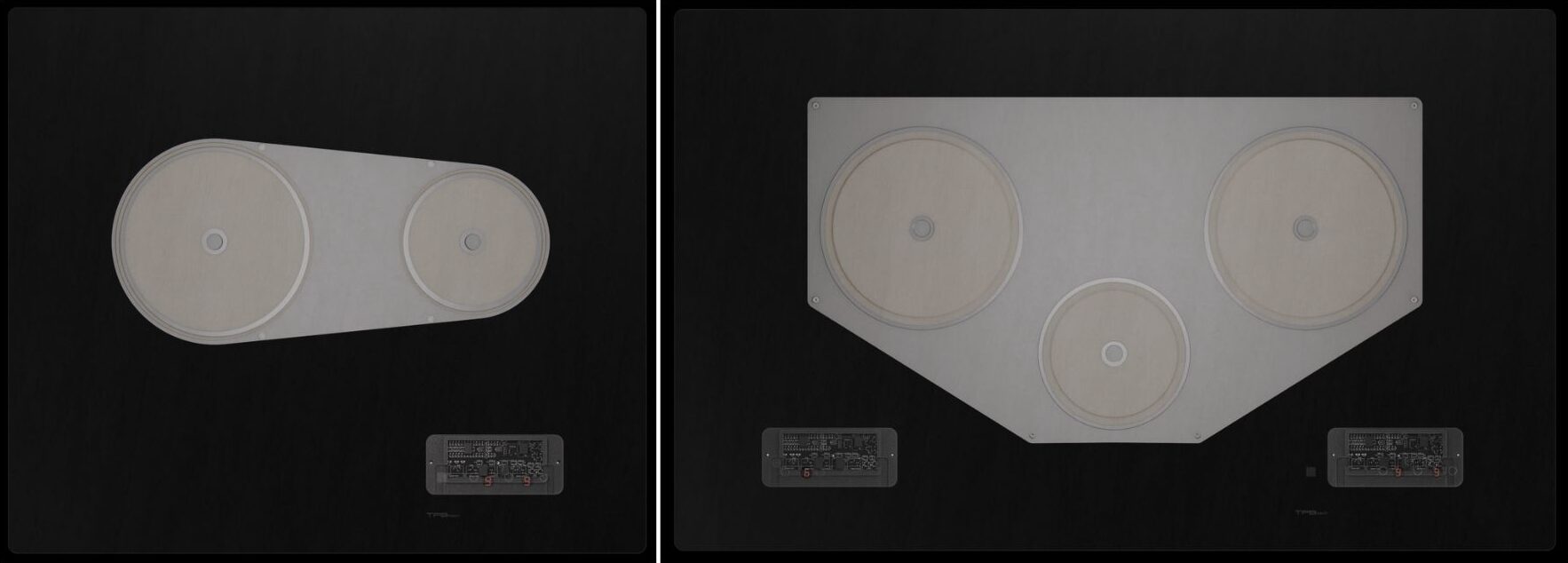
The power electronics, control circuitry, and heating coils are contained in a self-contained unit called the TPB tech Module, which installs beneath the countertop surface. This compact box handles everything needed for induction cooking in a single integrated unit — an approach that makes installation more straightforward compared to building out separate components.
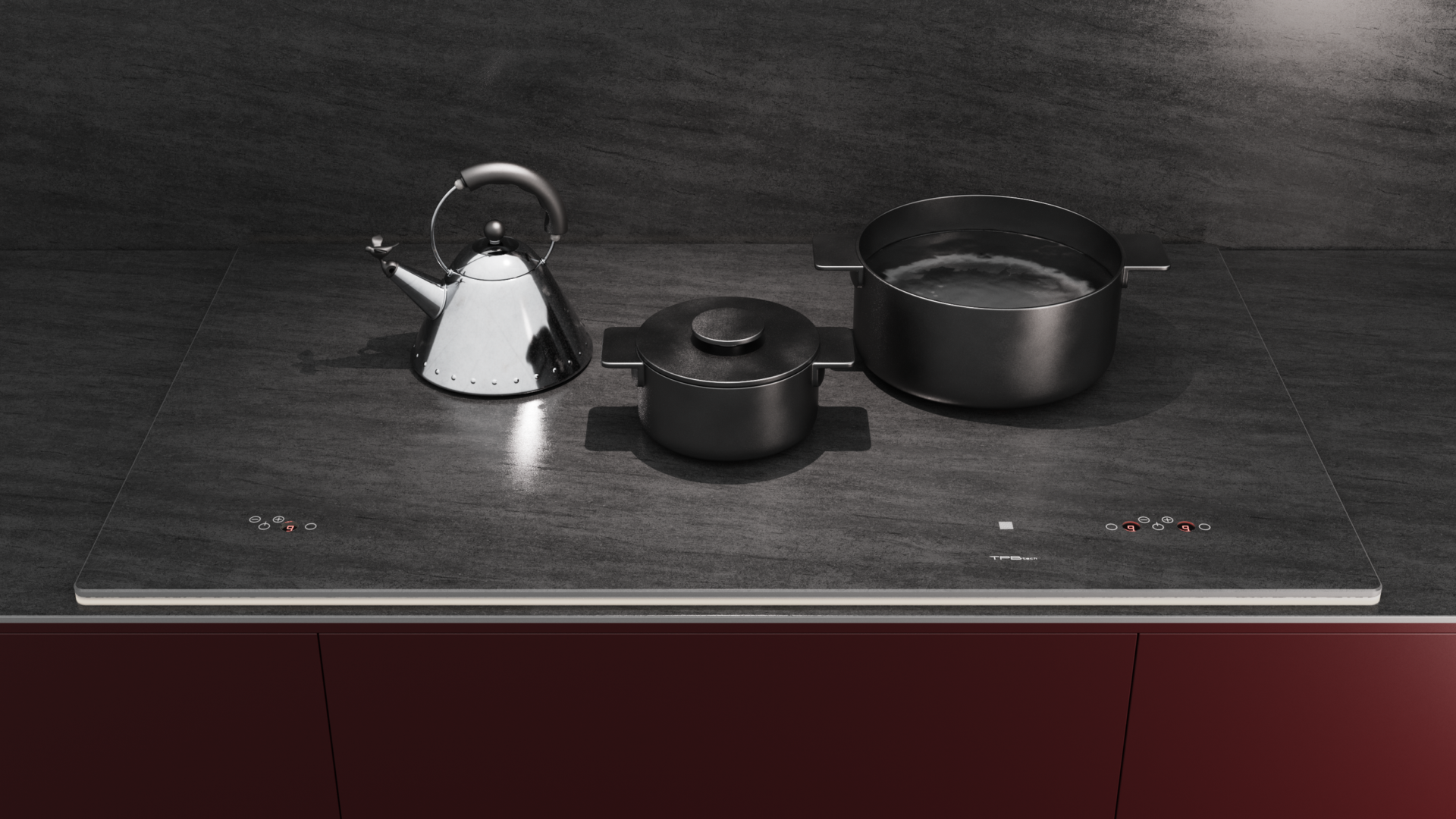
The module configuration determines how many cooking zones are available. The standard residential induction hob comes in 2-inductor and 3-inductor versions. The 2-inductor model measures 590 mm × 690 mm (approximately 23 × 27 inches), with inductor diameters of 230 mm and 170 mm (about 9 and 6.7 inches). The 3-inductor version extends to 590 mm × 960 mm (roughly 23 × 38 inches) and adds a third cooking zone, with the larger inductor optionally available at 280 mm (about 11 inches).
Three profile options are offered: Slim at 10 mm thick (about 3/8 inch), Standard at 15 mm (about 5/8 inch), and a Levitating variant at 10 mm plus 30 mm — currently listed as coming soon — which would give the surface a floating appearance above the cabinet below.
Controls and finishes
For user interaction, TPB tech offers four control interfaces. The most minimal is a touch control panel embedded into the surface itself, virtually invisible when not in use. There is also a touch slider option (available on configurations with at least two inductors), a touch control with a built-in timer, and a physical knob. Knob finishes include aluminum in silver gloss, grey matte, and black matte, as well as stainless steel in standard and a larger Magnum format.
The surface itself is available in eleven finished options under the product’s Neo line, ranging from marble-look options like Neo Calacatta Silk and Neo Taj Mahal to darker choices like Neo Basalt Black Satin. The system allows homeowners or designers to either match the induction hob’s surface finish to their existing countertop for seamless integration, or select a contrasting finish to make the cooking zone a visible design statement.
The elevation requirement
One practical consideration worth understanding before purchasing: TPB tech requires that all cookware be used with an elevation system. The company offers its own TPB Pods — small magnetic devices that attach to the base of pots and pans — which lift the cookware slightly off the surface. According to TPB tech, this keeps the residual surface temperature low, reduces noise when moving pots around, and improves energy efficiency. The pods attach magnetically and can stay on cookware through dishwashing or be removed and transferred to other pots as needed.
This is not optional. The company explicitly warns that cooking directly on the surface without the elevation system can result in poor cooking performance and potential damage to the unit. For buyers accustomed to placing any pot directly on a conventional cooktop, this is an adjustment to factor in.
The company also sells custom TPB cookware designed for the system, and notes that the Pods are patented and exclusively for domestic TPB tech and TPB Lux customers.
Residential and professional versions
TPB tech markets products across residential and professional categories. The residential line includes the standard induction hob discussed above, a Bespoke version for custom countertop integration, and the Lux tier. The Professional line is aimed at restaurants and hospitality installations, which appear in the company’s project portfolio across European venues.
The system has attracted some recognition: the TPB tech Induction Hob was selected at IFA 2025 in Berlin in the Best in Home Appliances category, an award the show describes as honoring smart, sustainable, and well-designed household solutions.
Who it’s for — and what to consider
TPB tech’s proposition is clearest for new construction or full kitchen renovations where the countertop and cooking system can be specified together from the start. The standard induction hob is also designed to install on existing worktops without masonry work, which broadens its potential use as a retrofit option.
The cooking approach is fundamentally the same as standard induction — fast heating, precise control, low residual surface temperature, and energy efficiency comparable to or better than conventional induction. The differentiation is almost entirely about integration and aesthetics: the surface reads as a continuous countertop rather than an appliance embedded in one.
There are some practical boundaries to be aware of. The system requires its own proprietary pods or elevation accessories rather than working with any induction-compatible cookware placed directly on the surface. It also requires specifically adapted induction modules — not standard induction equipment — which means servicing and replacement parts go through TPB tech’s own supply chain.
Pricing and availability
TPB tech does not publicly list pricing on its website. Orders are handled through direct inquiry or via the company’s network of dealers and partners. Prospective buyers are directed to contact TPB tech for a personalized quote, which the company says will include guidance from a TPB expert.
Source: