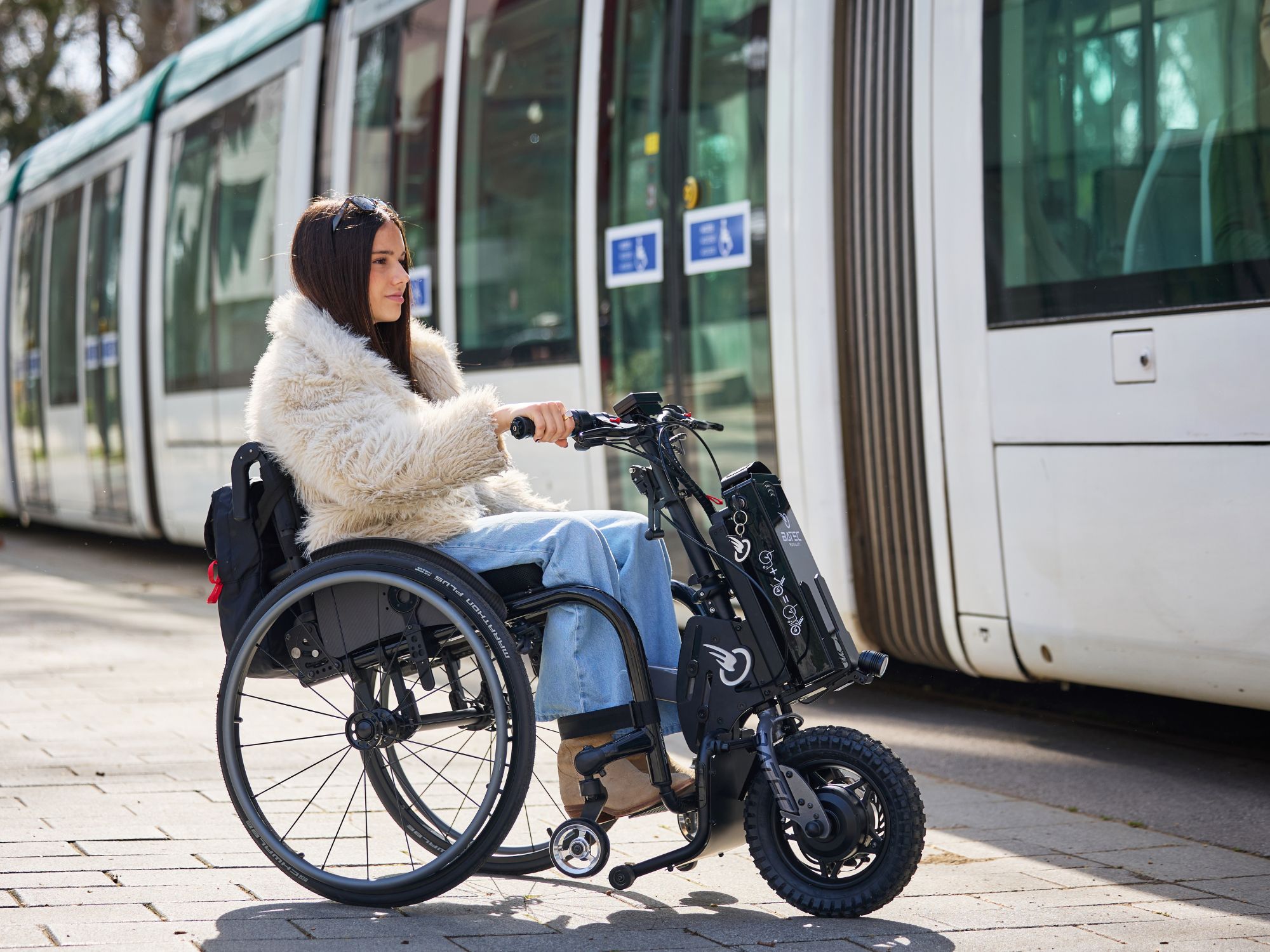
For wheelchair users who want to travel faster, farther, and across more varied terrain than a manual chair typically allows, attachable electric handbikes offer a practical solution. Barcelona-based Batec Mobility has developed a range of front-wheel electric attachments that connect to a manual wheelchair and transform it into a motorized three-wheeled vehicle in less than three seconds.
The company’s current lineup includes six models, ranging from a lightweight urban-focused option to a powerful off-road machine equipped with knobby Maxxis tires and a 1,440-watt motor. All models are certified medical devices under ISO 13485, and Batec states that its system is compatible with approximately 95% of manual wheelchairs currently on the market.
How the system works
A Batec handbike is not a standalone vehicle. Instead, it attaches to the front of a manual wheelchair using the company’s Easy-Fix anchoring system. The user positions the handbike in front of the chair, engages a lever, and the unit locks into place. Removal follows the same process in reverse.
Once connected, the wheelchair becomes a front-wheel-drive electric tricycle controlled through handlebars, a throttle, and hand-operated brakes. The attachment frame can be adjusted in height, depth, and width to accommodate different wheelchair configurations and user preferences.
Batec also offers specialized control systems for users with varying mobility needs. Quadriplegic users can opt for a Gas & Brake handlebar that accelerates and brakes through gentle handlebar movement rather than grip strength, while hemiplegic users can choose a Monolever braking system and a single-sided throttle.
The current range
Batec currently offers six models designed for different use cases.
The compact Batec Air serves as the lightweight entry point to the lineup, while the Mini 2 Plus focuses on urban mobility. The Electric 2 Plus occupies the middle ground between city and rural use. The Rapid 2 Plus prioritizes road performance, the Scrambler 2 Plus targets off-road riding, and the Hibrid 2 adds pedal assistance for users who want to contribute physical effort alongside motor power.
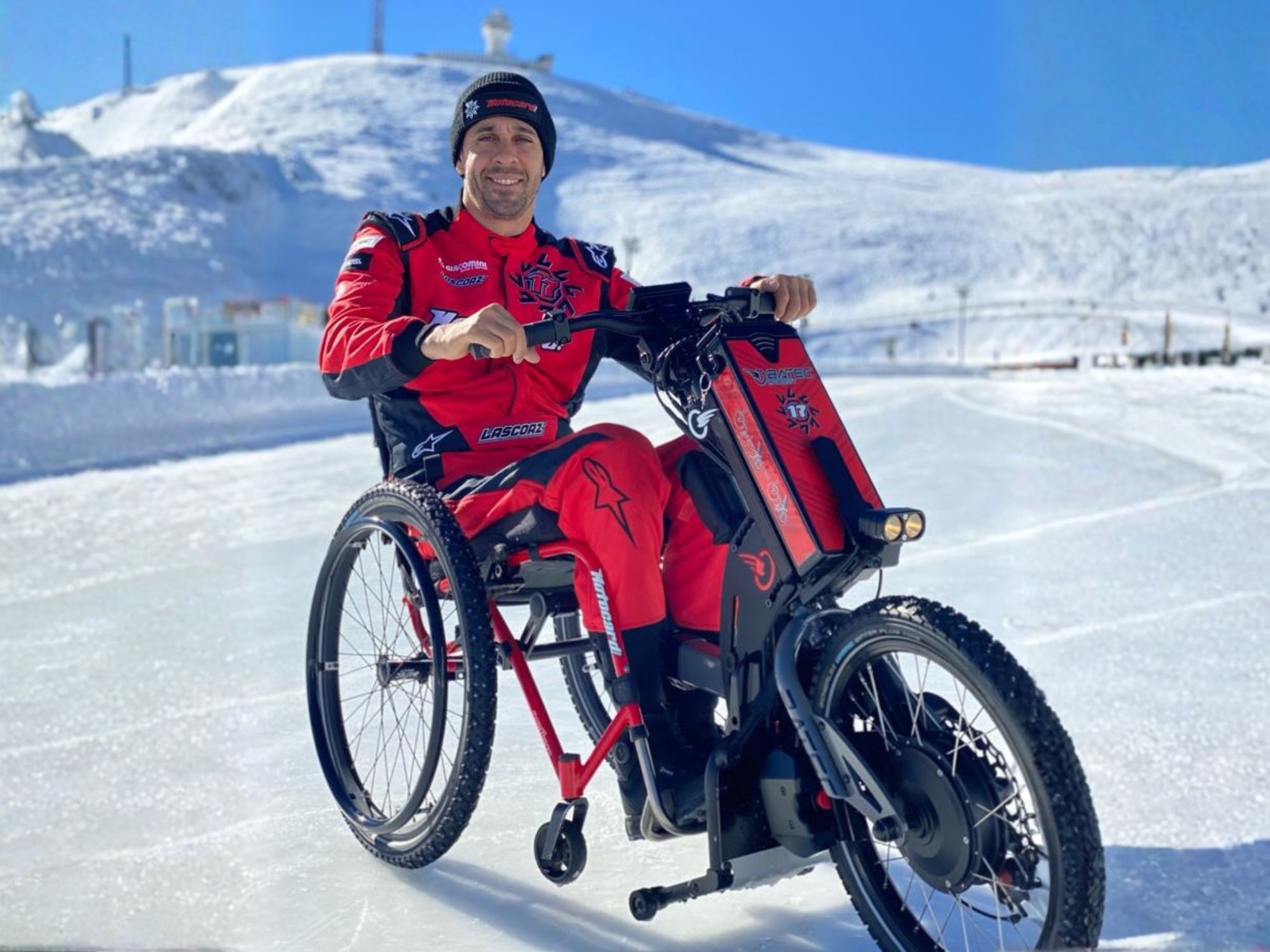
Recent promotional imagery appears to show updated versions of the Scrambler and a related off-road model featuring a redesigned rectangular battery housing, updated electronics, and a distinctive dual amber-lens headlight arrangement.
Scrambler 2 Plus: Built for off-road use
The Scrambler 2 Plus is Batec’s most powerful production model and the flagship of its off-road range.
Power comes from a 300 RPM brushless motor rated at 1,440 watts with a peak output of 1,620 watts. Top speed is limited to 20 km/h (12.4 mph), which aligns with regulations for this category of mobility device in many European markets.
The handbike uses a 768 Wh battery and is rated for a range of up to 55 km (34 miles) under standardized test conditions that assume a 75 kg rider, an ultra-light wheelchair, flat terrain, no wind, and a constant speed of 15 km/h. Batec notes that real-world range can vary by roughly 20 percent.
A 19-inch Maxxis ultra-grip knobby tire mounted on a double-wall aluminum rim helps the Scrambler tackle rough terrain. The removable right dropout allows tire and tube changes without specialized tools.
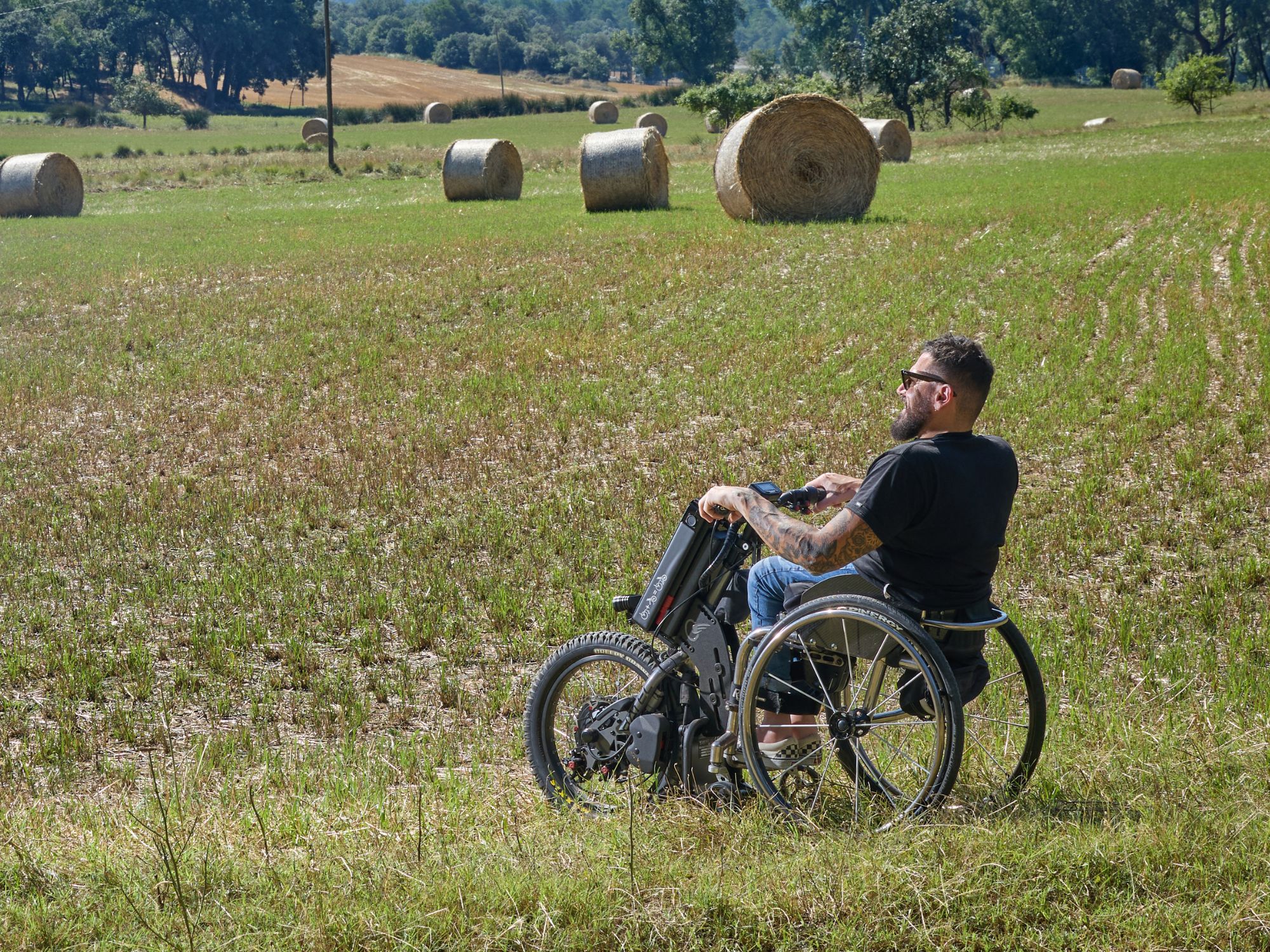
The electronics package includes anti-slip traction control, cruise control, reverse gear, and electronic braking that supplements the mechanical disc brakes. Standard equipment also includes a USB charging port, horn, LED lighting, dual rear brake lights, and dual 2,000-lumen front headlights with two brightness settings.
The aluminum frame and handlebar keep weight to 16.7 kg (36.8 lbs) without the battery. Maximum user weight is 110 kg (243 lbs).
One limitation is travel. The Scrambler’s 768 Wh battery exceeds airline limits and is not currently approved for air transport. It is also incompatible with Batec’s smaller 280 Wh travel battery, although the company says it is working on a flight-compliant solution.
Electric 2 Plus: The all-rounder
Positioned between the urban Mini and the off-road Scrambler, the Electric 2 Plus is designed as a versatile everyday model.
It uses an 18-inch wheel and a mixed-terrain tire suited to both paved streets and unpaved paths. Power comes from a 350 RPM brushless motor producing 900 watts continuously and 1,050 watts at peak output. Top speed is also limited to 20 km/h.
Buyers can choose between a 280 Wh battery or a larger 576 Wh pack. Under Batec’s standardized test conditions, these provide ranges of approximately 21.5 km (13 miles) and 44 km (27 miles) respectively.
The Electric 2 Plus weighs 15.9 kg (35 lbs) without the battery and supports users up to 110 kg. Like the Scrambler, it includes anti-slip traction control, cruise control, reverse gear, electronic braking, and removable ballast weights that improve front-wheel traction.
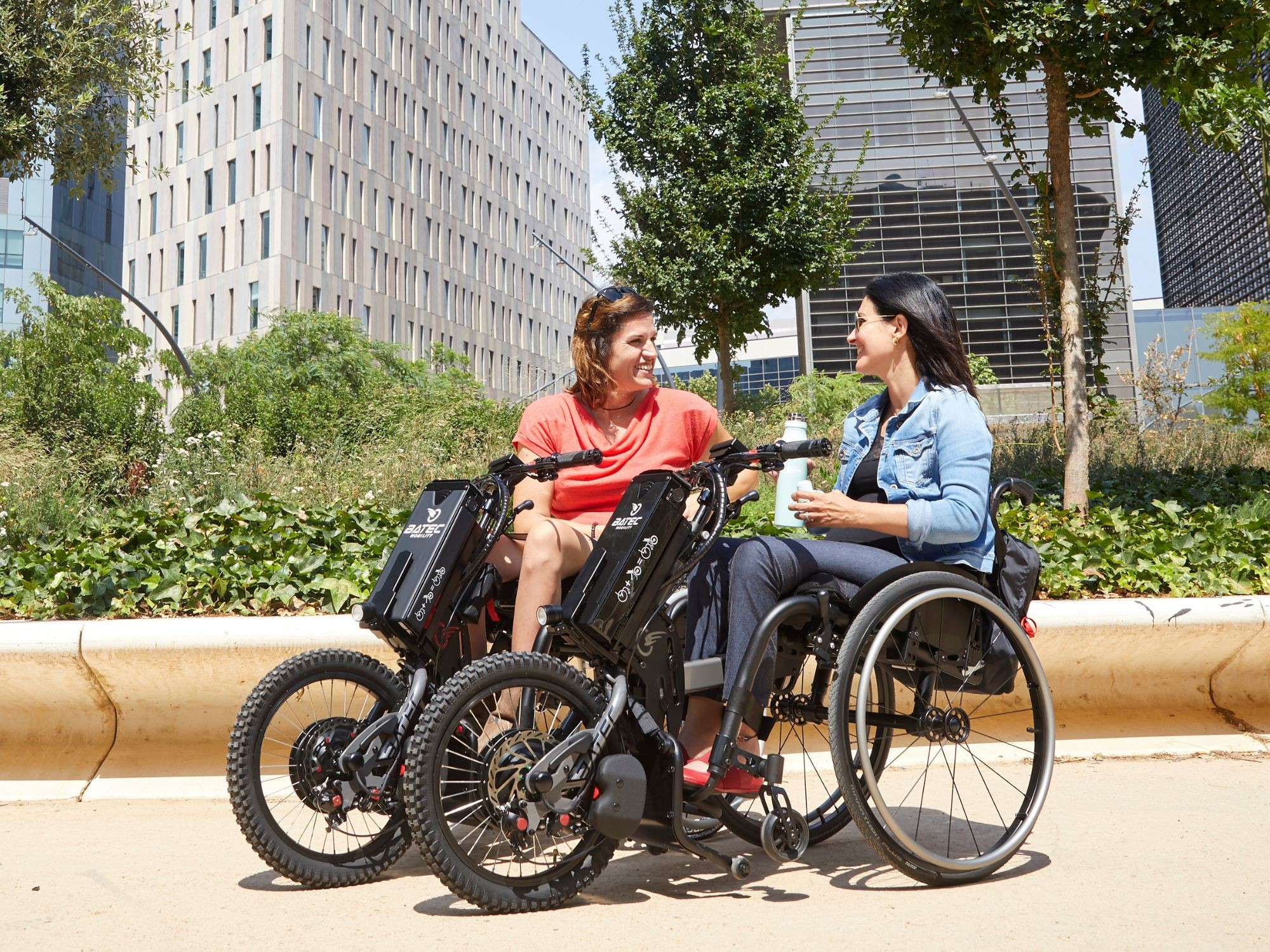
Unlike the Scrambler, the Electric 2 Plus equipped with the 280 Wh battery complies with IATA airline regulations, making it suitable for air travel.
Compatibility and setup
Batec maintains an online compatibility database covering wheelchairs from more than 35 manufacturers, including Quickie, Ottobock, Küschall, TiLite, Ki Mobility, Invacare, RGK, and others.
The company categorizes compatibility as fully compatible, Batec Bloc compatible, in progress, or not compatible. While Batec states its products fit roughly 95% of manual wheelchairs, users with unlisted models can contact the company for evaluation.
Initial installation is performed through Batec’s dealer network rather than by the end user. Dealers install the anchoring hardware, adjust the system for the individual user, and provide setup support before delivery.
Safety and certification
All Batec handbikes are registered medical devices and manufactured under ISO 13485 certification, the international quality-management standard for medical device manufacturers.
The current 2 Plus range incorporates anti-slip traction control, a feature designed to reduce wheel spin on loose, wet, or inclined surfaces and improve control during hill starts. Combined with disc brakes, lighting systems, and speed-limiting electronics, the feature set reflects the practical demands of daily mobility rather than recreational riding alone.
Considerations for U.S. buyers
Batec products are sold through authorized dealers worldwide. In the United States, insurance reimbursement eligibility for powered wheelchair attachments varies by insurer and policy, so prospective buyers should verify coverage before purchasing.
Local regulations governing mobility devices can also differ by state and municipality, particularly regarding use on sidewalks, bike paths, and public spaces. Given the Batec’s 20 km/h (12.4 mph) top speed, buyers should review local requirements before use.
Pricing and availability
Batec Mobility does not publish pricing on its website. Costs vary depending on the model, battery configuration, control system, and regional dealer. Interested buyers are directed to contact an authorized Batec dealer or service center for pricing, product demonstrations, and personalized consultations.
Source: Batec Mobility