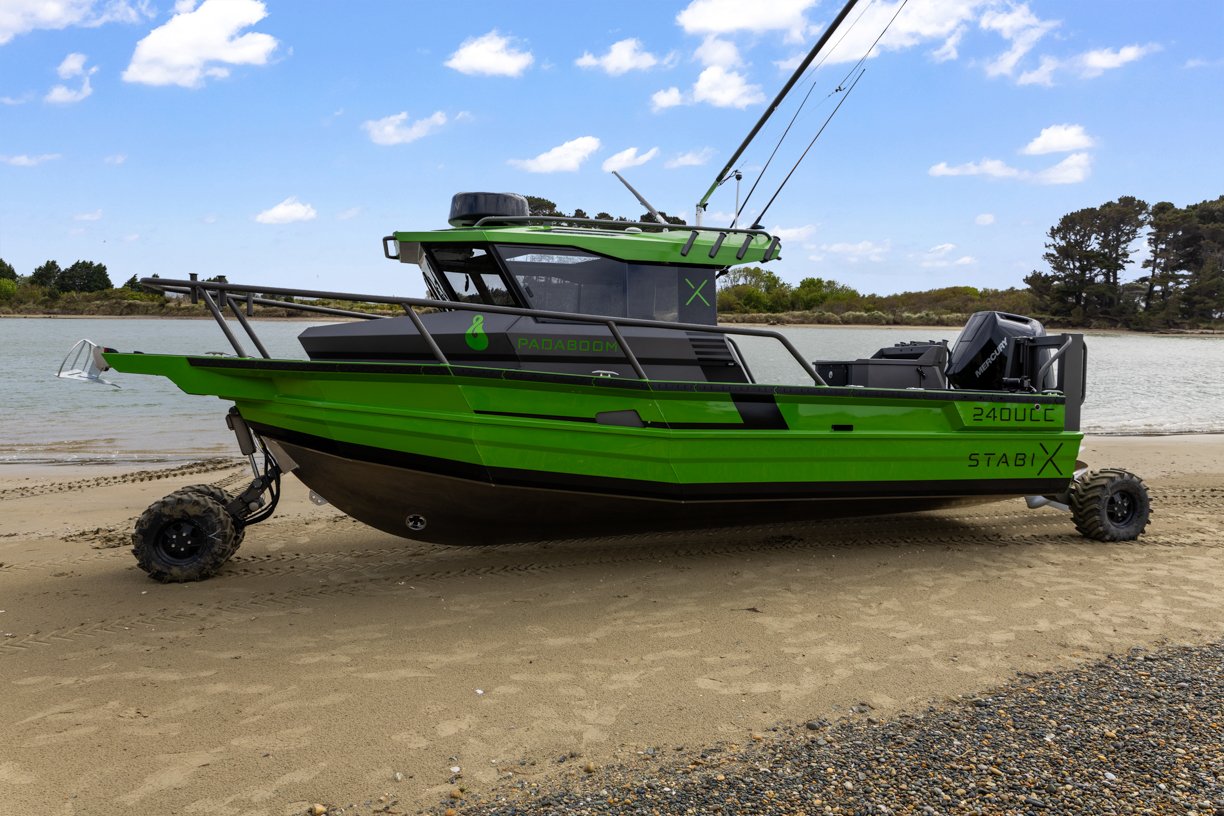
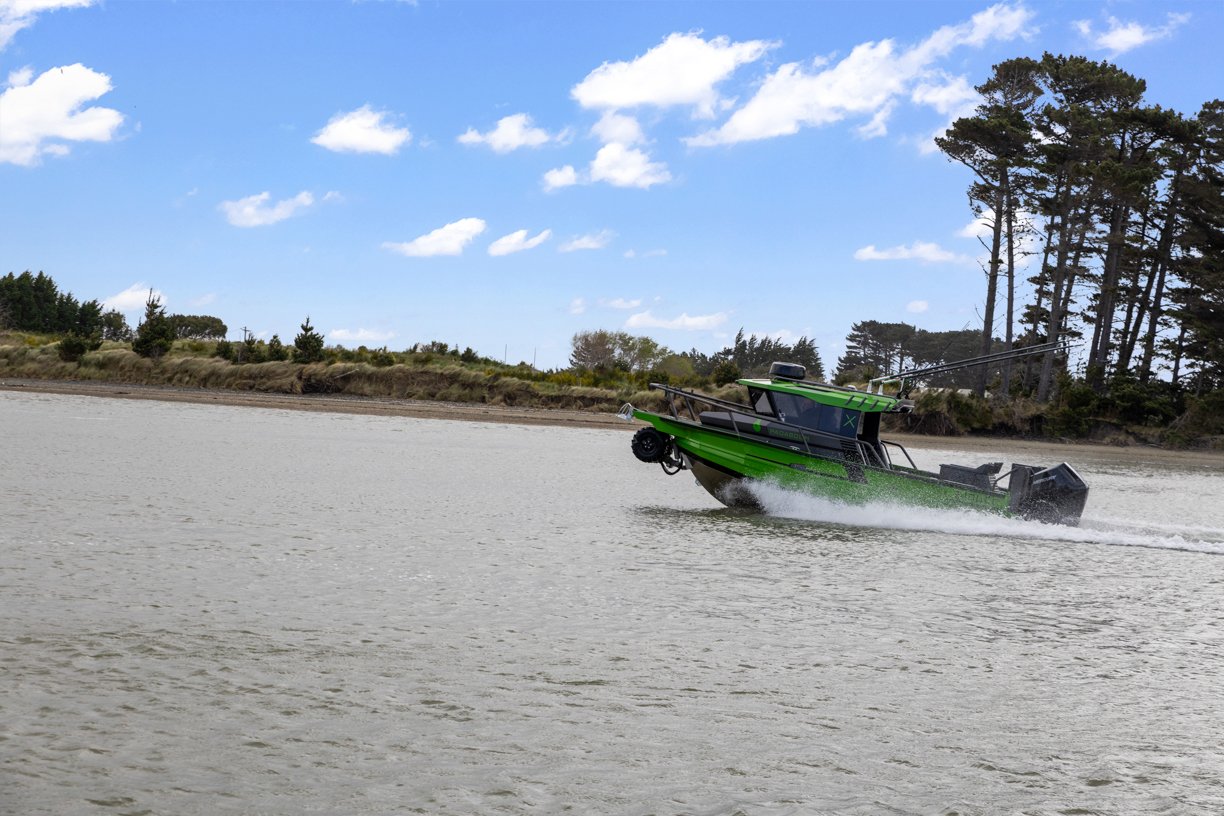
A New Zealand boatbuilder has rolled out the first example of a redesigned amphibious vessel that drives down a beach on wheels and then motors away across the water. Built by StabiX, a company based in Invercargill at the southern tip of New Zealand, the 240UCC is the latest in a line of boats designed to remove the need for a traditional trailer and ramp.
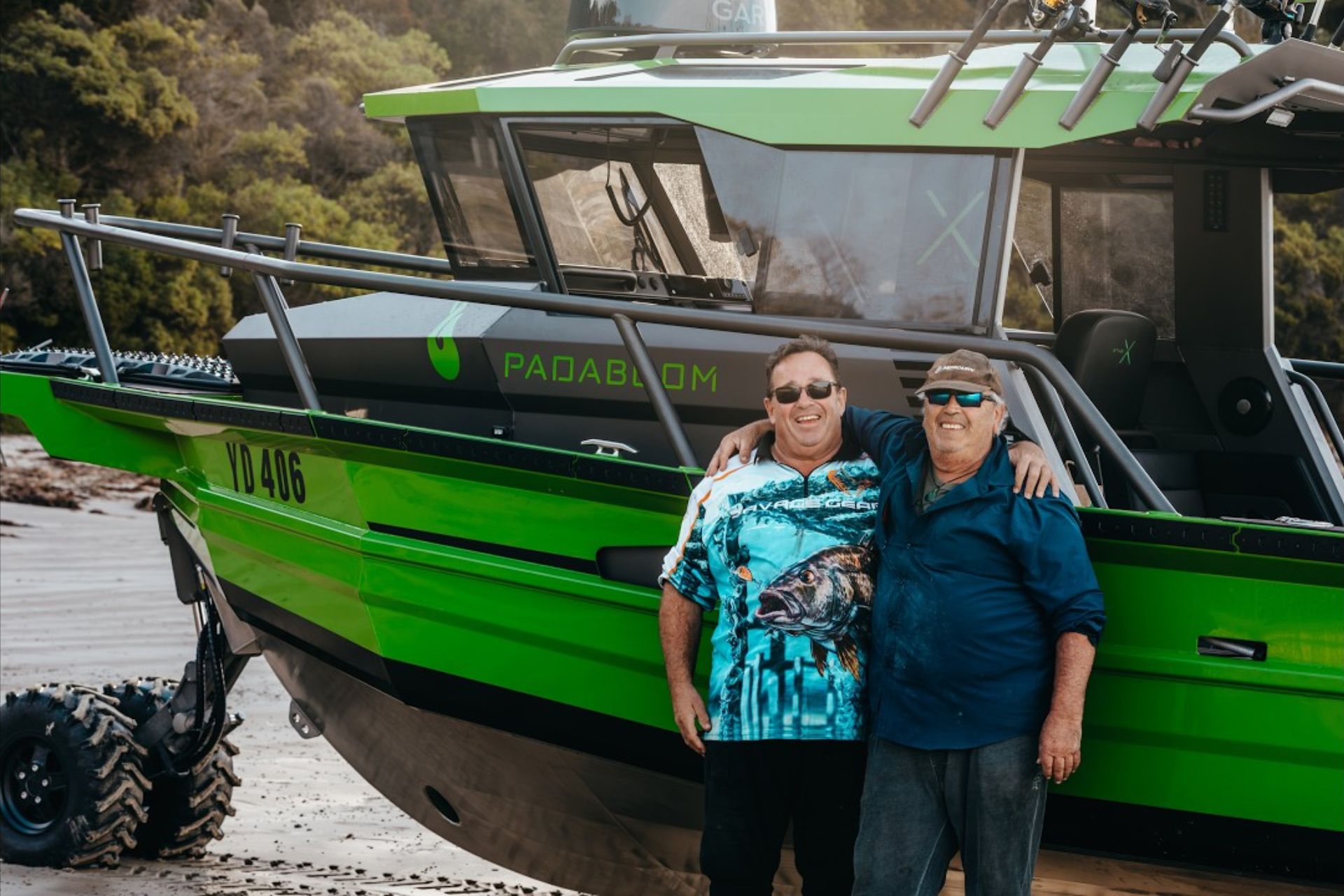
The unit in question, listed by the company as Build 0060, is the first of its second-generation 240 models. It was commissioned by two longtime friends from southeast Victoria, Australia, who live a short drive from Wilsons Promontory National Park—a coastal area known for its remote shorelines.
How an amphibious boat works
The defining feature of the 240UCC is its retractable wheel system. On land, the boat sits on powered wheels that let the owner drive it across sand, boat ramps, or rough ground without a trailer. Once in the water, the wheels retract and the vessel operates as a conventional powerboat driven by its outboard motor.
That land mobility is handled by a separate, dedicated drivetrain rather than the main outboard. StabiX uses what it calls the Anura Premium Amphibious System, powered by a 40-horsepower Briggs & Stratton fuel-injected engine. The setup uses drive-by-wire controls for automotive-style response, a sound-insulated engine bay, and twin cooling fans. Buyers can choose either a three-wheel or four-wheel drive configuration, and the system includes a differential lock for low-traction surfaces such as soft sand.
Size and specifications
The second-generation 240 adds 120mm (about 4.7 inches) of cabin width over the previous version while keeping a walk-around deck. The full specifications, with imperial conversions for U.S. and international readers, are:
- Hull length: 7.31 m (24 ft)
- External beam: 2.55 m (8 ft 4 in)
- Internal beam: 1.97 m (6 ft 5 in)
- Height on wheels: 3.01 m (9 ft 10 in)
- Transom deadrise: 17 degrees
- Fuel capacity: 300 L (about 79 US gallons)
- Approximate unfueled weight: 2,500 kg (5,511 lb)
- Maximum rated power: 350 hp
The hull rides on foam-filled pontoons, and the deep-V transom angle of 17 degrees is intended to soften the ride in chop.
Cabin and onboard features
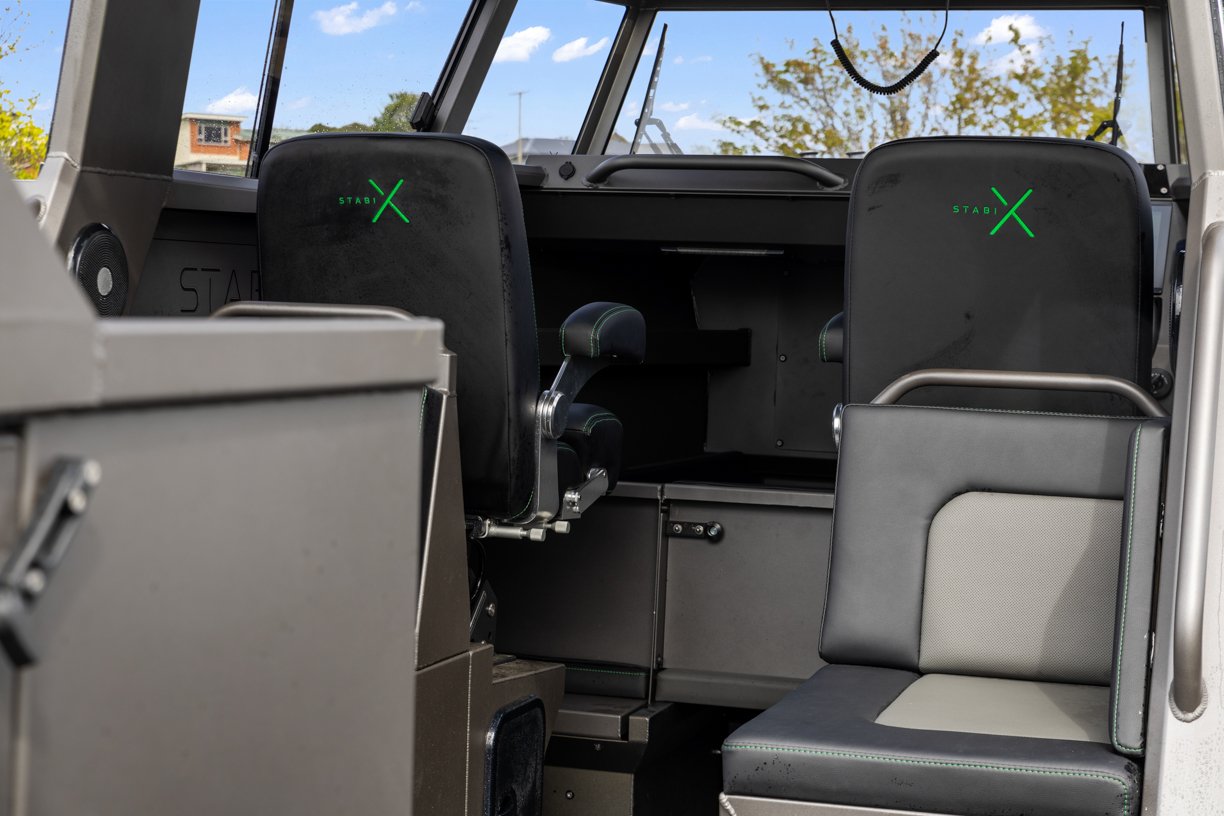
Inside, the standard build includes twin bolstered captain’s chairs, rear-facing upholstered seats with storage underneath, and a fold-down V-berth operated by a gas ram. The boat uses a CZone digital switching system to control its electrical functions, along with a Garmin 12-inch electronics package, LED navigation and cockpit lighting, and a Fusion audio system.
Practical fishing and touring touches are built in as well: a transom bait table with twin drawers, twelve alloy roof-mounted rod holders, welded boarding steps, and wash-down plumbing. Optional extras range from a drawer fridge and electric toilet to a diesel heater, thermal camera, and a 140-watt flexible solar panel.
The Australian buyers specified their boat for both family use and fishing trips, fitting it with a solar panel, a ski-tow hook, a live bait tank, and outriggers. According to StabiX, the hardest part of the project was settling on a paint color—the finished boat wears a bright green.
Why it matters
Amphibious boats remain a niche category, but they address a real problem for owners who launch in areas without good ramp access or who want to avoid the hassle of towing and reversing a trailer. For coastal users in places like southern Australia and New Zealand, where beaches and tidal flats are common launch points, a self-propelled hull can simplify access considerably.
The trade-offs are weight, mechanical complexity, and the added cost of carrying a second drivetrain. At roughly 2,500 kg unfueled, the 240UCC is a substantial machine, and the wheel and drive systems add components that a standard boat does not have to maintain. For buyers who launch frequently in difficult conditions, though, that complexity may be worth it.
Price and availability
StabiX builds its boats to order from its base in Invercargill, New Zealand, and ships worldwide, with an established customer base in New Zealand and Australia and at least one unit exported to the United States. The first U.S.-bound 240UCC was displayed at the 2024 Seattle Boat Show.
The company does not publish a fixed list price, and final cost depends heavily on the chosen drivetrain, engine, and options. As a reference point, a used 2024 StabiX 240UCC offered through the Australian marketplace boatsales.com.au was listed at AU$395,000 excluding government charges—roughly US$277,425. Buyers should treat these figures as indicative rather than official, and contact StabiX directly for a current quote on a new build.
Source: StabiX