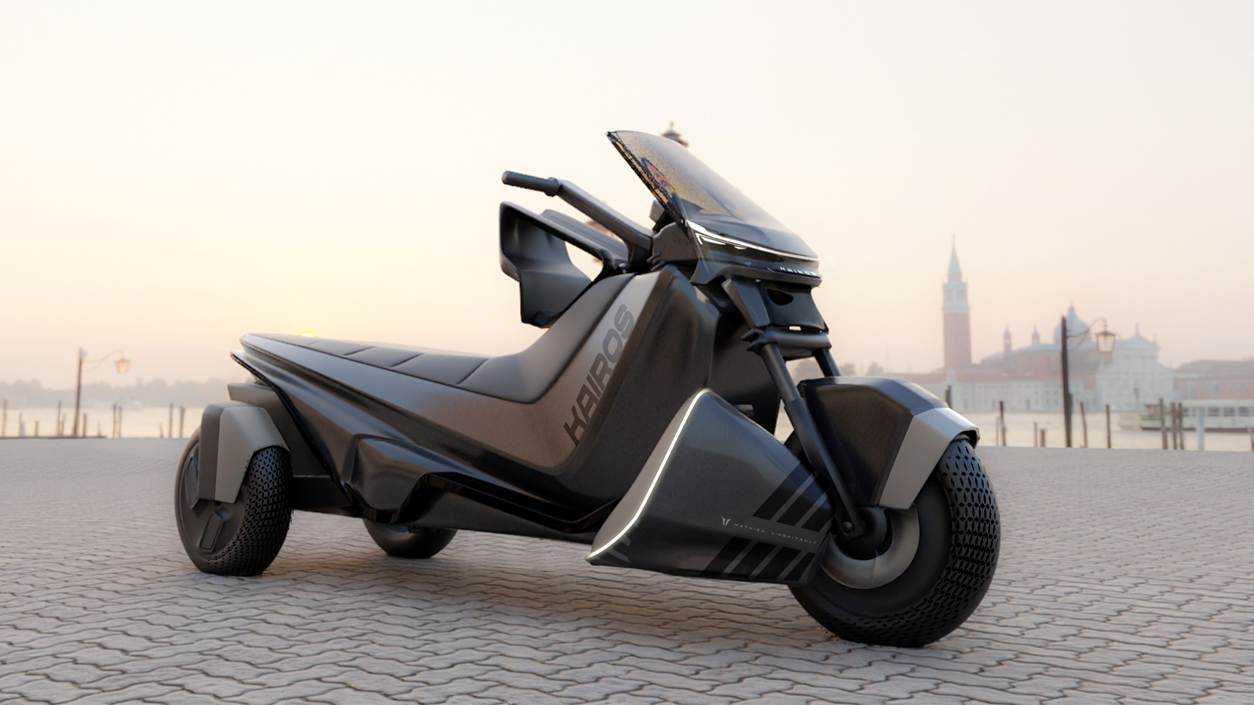
Motorcycle safety has always been a trade-off between freedom and risk. The Kairos EV trike tries to challenge that idea by rethinking how protection is built into the vehicle itself. It’s not quite a motorcycle, not a car, and not a scooter—but a hybrid concept that borrows from all three.
Originally imagined by French designer Mathieu L’Hopitault and now developed further under project lead Philippe Girardi, the Kairos has moved beyond early concepts into a working demonstrator. And its approach is clear: improve safety without removing the core riding experience.
Leaning like a bike, stabilizing like something else
At first glance, the Kairos looks like a three-wheeled motorcycle—but its behavior is very different. Unlike conventional trikes, both rear wheels tilt along with the front when cornering, allowing the vehicle to lean naturally into turns.
This leaning system helps maintain the feel of a motorcycle while adding stability typically associated with four-wheeled vehicles. It’s a subtle but important shift, especially for riders who want more confidence in urban environments.
Two built-in safety systems, no rider input needed
The Kairos introduces two patented systems designed to work automatically.
The first is the Programmed Restraint Device (PRD). Integrated into the front structure, it partially couples the rider to the vehicle during a frontal impact. Unlike a seatbelt, it doesn’t require any action from the rider. In more severe crashes, it can release the rider at a reduced speed after absorbing part of the impact energy.
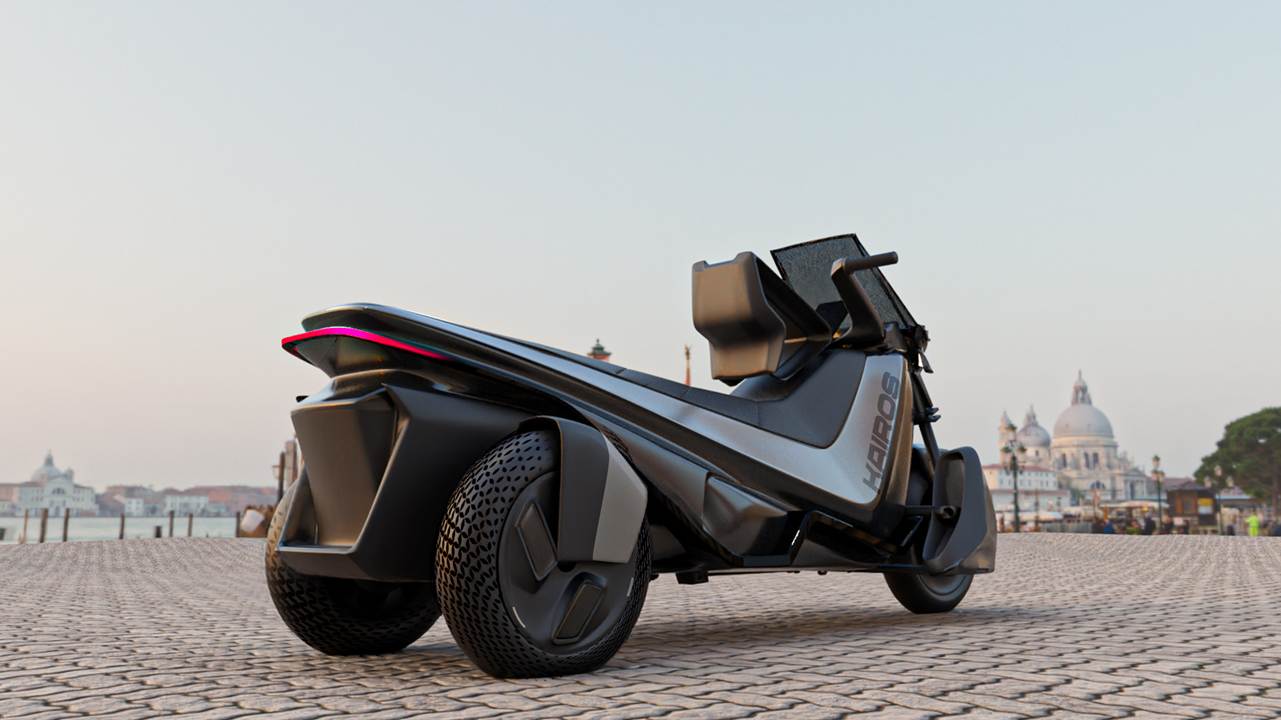
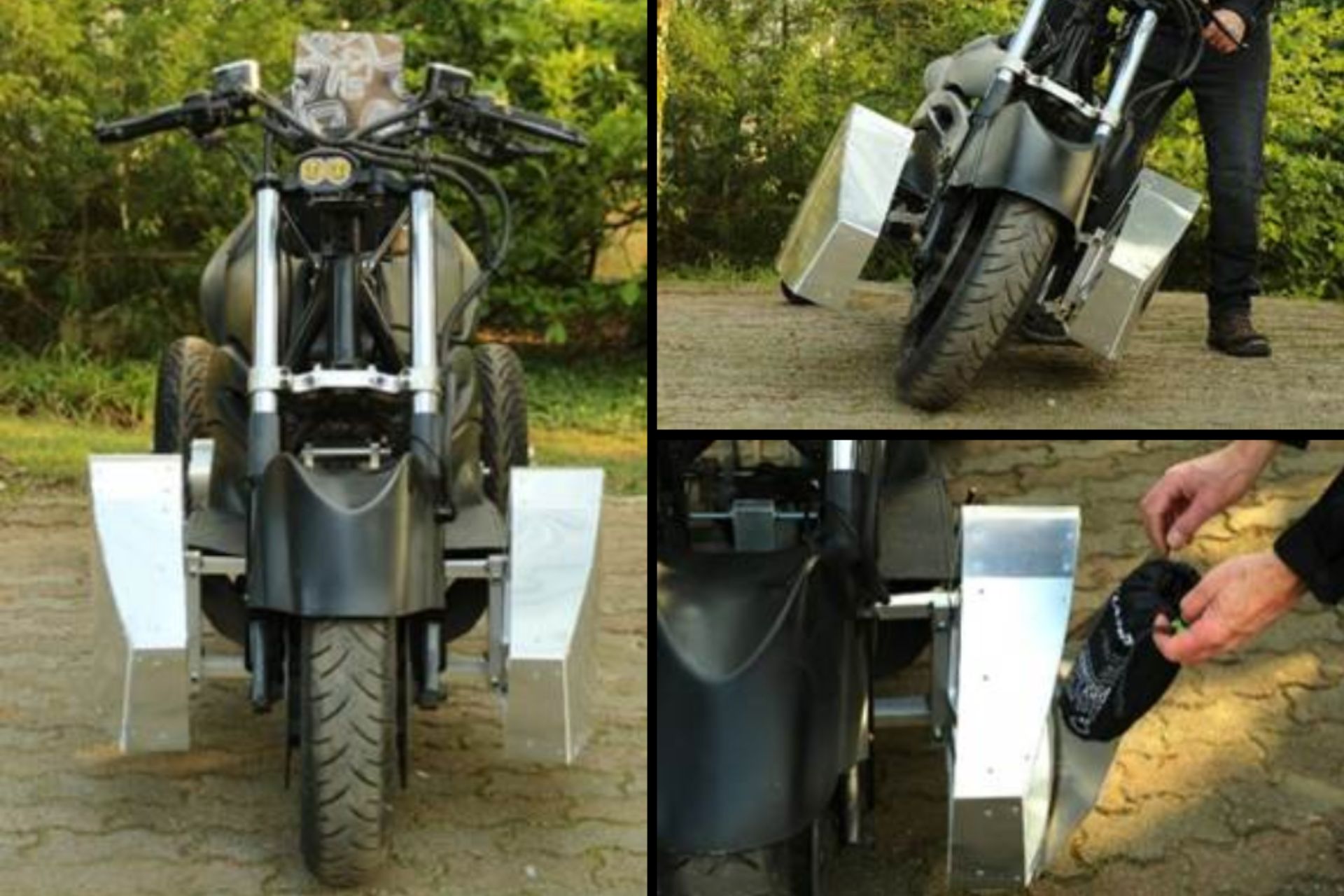
The second system is called Mobile Lateral Elements (MLE). These wedge-shaped components sit on either side of the front wheel and move with the bike as it leans. During normal riding, they help balance the vehicle and prevent excessive tilt. In a crash, they brace against the ground, absorbing impact forces and helping keep the trike upright.
Interestingly, these elements also double as small storage compartments—though they’re better suited for smaller items rather than full luggage.
Performance targets and battery plans
While still in prototype form, the projected specs give a rough idea of where this vehicle is headed. The production version is expected to use a 30 kWh solid-state battery, paired with a 40 kW (53.6 hp) rated output and a 70 kW (93.8 hp) peak output.
Top speed is estimated at 93 mph (150 km/h), placing it in line with many traditional motorcycles. The team is also aiming for strong acceleration in both straight-line and cornering scenarios.
However, these numbers remain targets for now, as the vehicle still requires extensive validation and testing.
Timeline and industry ambitions
The Kairos project is still in its early stages, with certification expected around 2029–2030. The team has already completed the design, filed patents, and built a rolling prototype, but the next steps include laboratory crash testing and securing industrial partners.
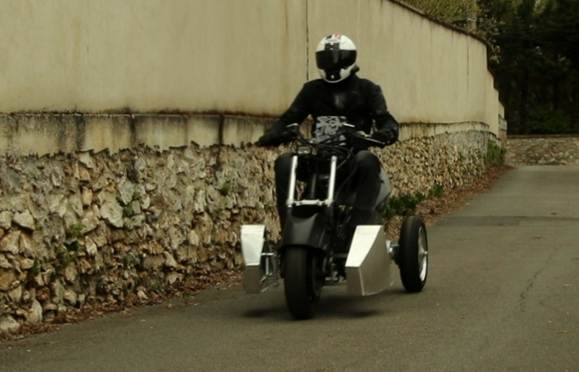
Beyond building a single vehicle, the larger goal is to license this safety technology to other manufacturers—potentially influencing the broader two-wheeler market.
A bigger question about the future of riding
The Kairos EV trike raises an interesting question. If you engineer out most of the risk from riding, what happens to the experience itself?
On one hand, it offers a compelling mix of stability, protection, and electric performance—especially for city use. On the other, it shifts more control to the machine, reducing the unpredictability that many riders associate with the thrill of motorcycling.
It may ultimately come down to what riders value more: raw engagement or controlled safety. The Kairos attempts to bridge that gap—but whether it strikes the right balance is something only real-world riding will answer.
Source: Kairos EV