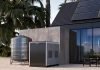
Beekeeping has always carried a set of assumptions: outdoor space, protective gear, a tolerance for stings, and at least some prior knowledge of colony management. A company called Futuristic Beehive is challenging most of those assumptions with a product called the Symbiotic — a wall-mounted, fully enclosed indoor beehive designed to let apartment dwellers, homeowners, and offices house a live honeybee colony without any of the traditional barriers.
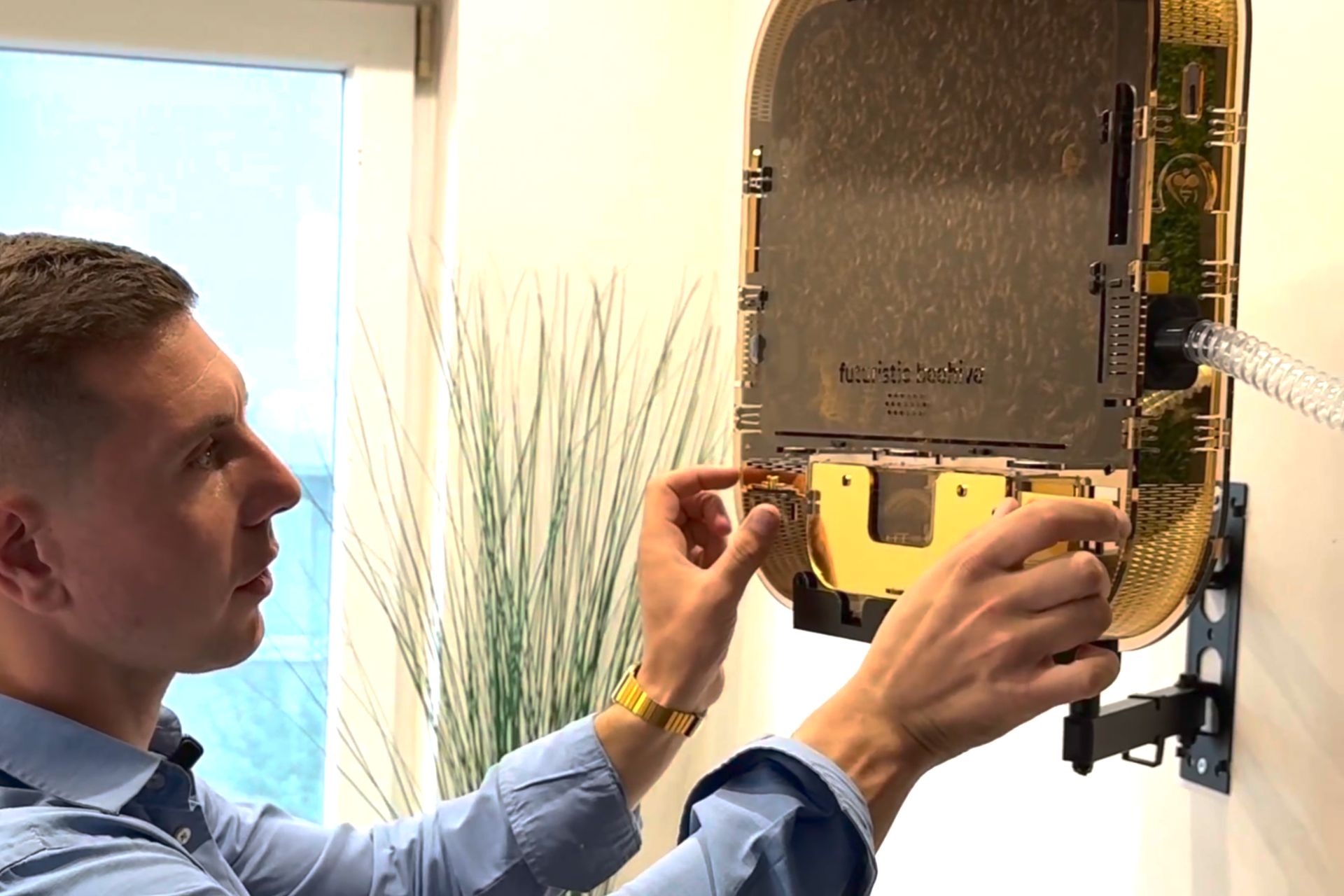
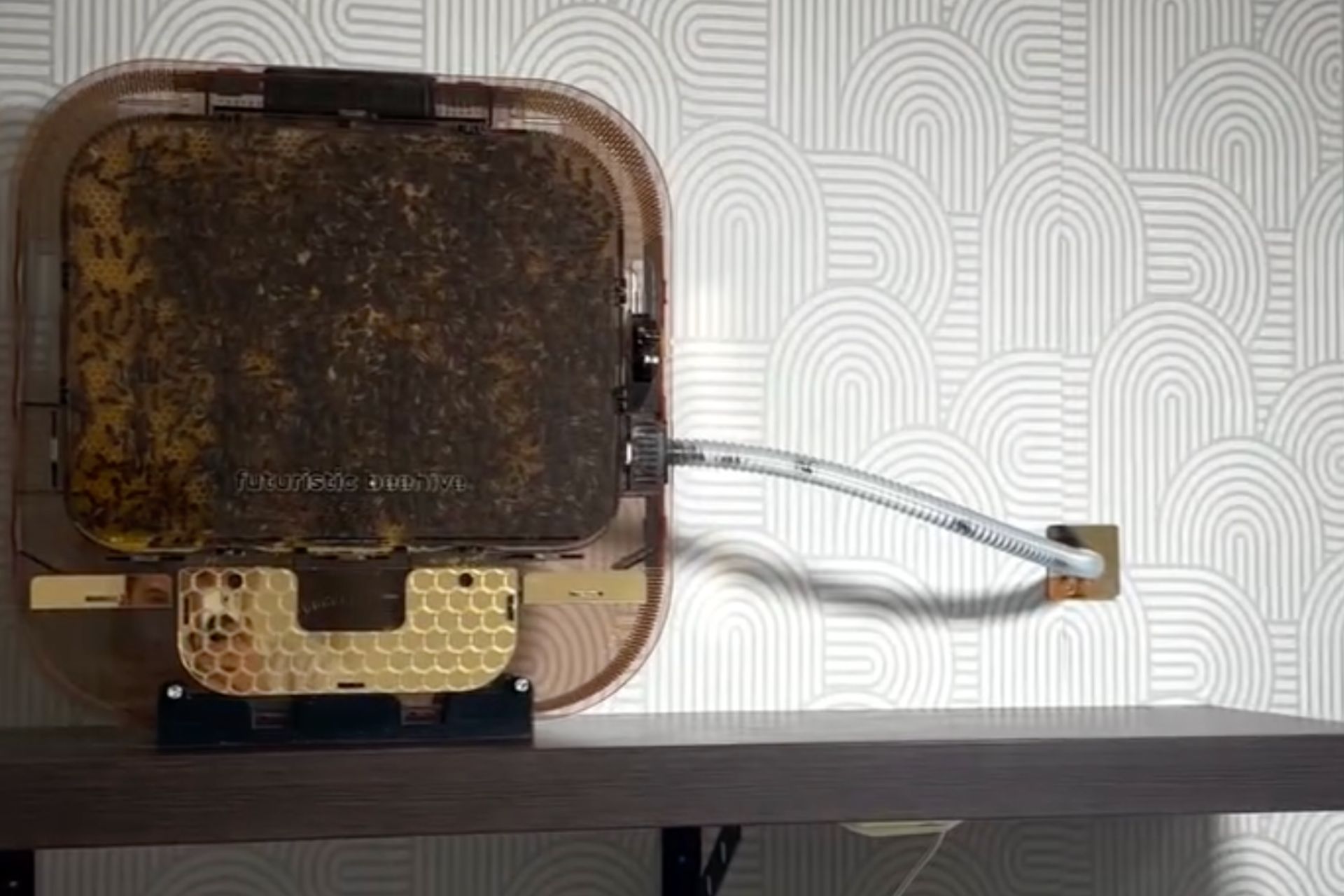
The Symbiotic is currently available through the company’s website, with free worldwide shipping. It is built from amber-tinted acrylic and laser-cut metal panels, mounts flush to an interior wall, and houses a functioning colony that can be observed around the clock through its transparent face. Bees enter and exit through a 20mm tube that passes through the wall — the only physical connection between the hive and the outdoors.
The company’s stated mission is: “to let everyone experience the wonder of bees without the barriers.”
What the Symbiotic actually is
At its core, the Symbiotic is a sealed observation hive. The amber acrylic panels allow full visibility into the colony’s activity — honeycomb being built, bees moving through their daily routines, honey accumulating in real time — while keeping the colony completely contained. There is no open access to the hive interior during normal use, and no bees circulate inside the room.
The enclosure measures 43 × 43 × 8 cm (approximately 17 × 17 × 3 inches) and mounts to a wall or sits on a surface. Bees enter and exit exclusively through the 20mm wall tube, which is recommended to be sealed around with silicone after installation. The unit includes an integrated pollen and honey collector and a built-in feeder for supplementing the colony’s nutrition when needed.
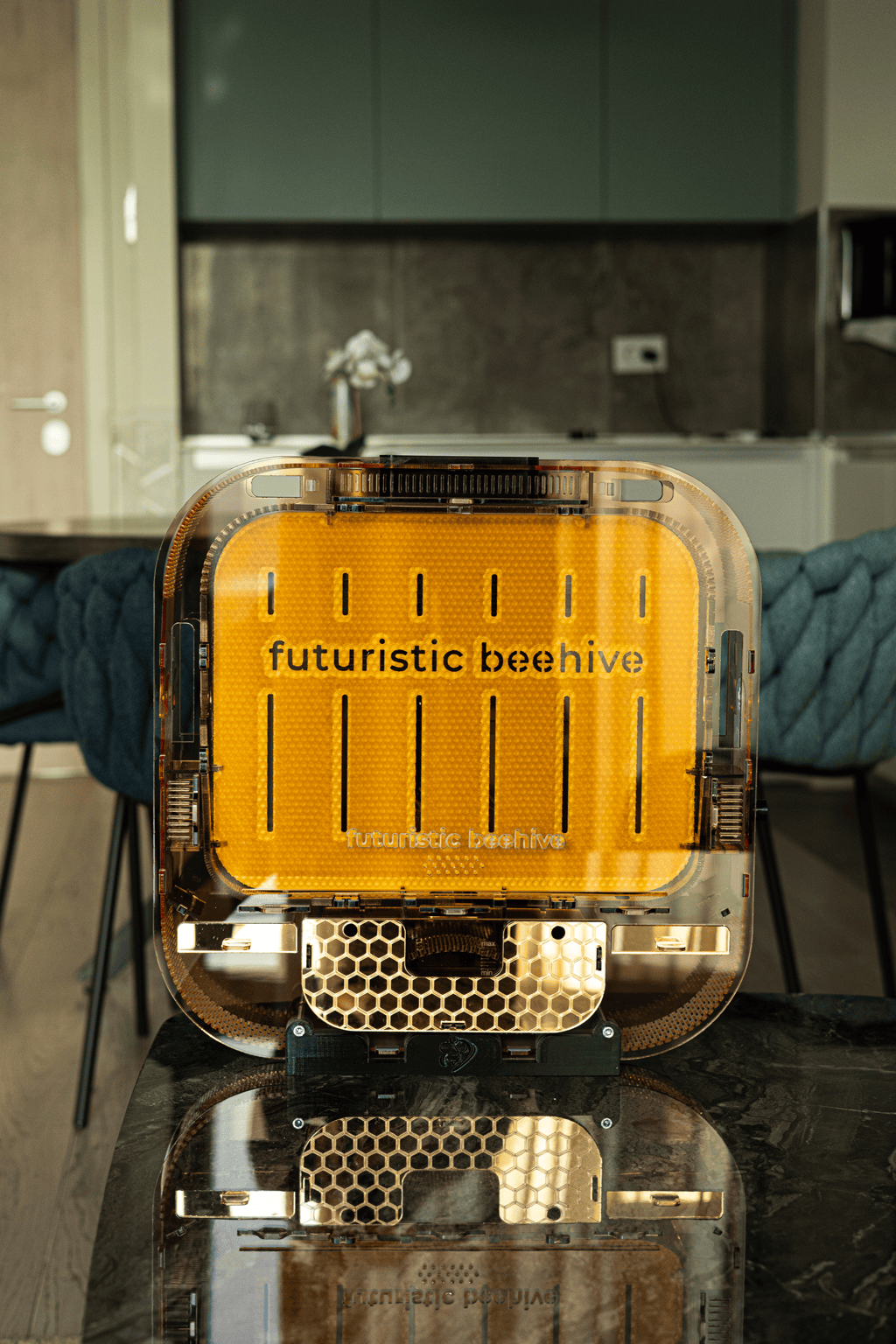
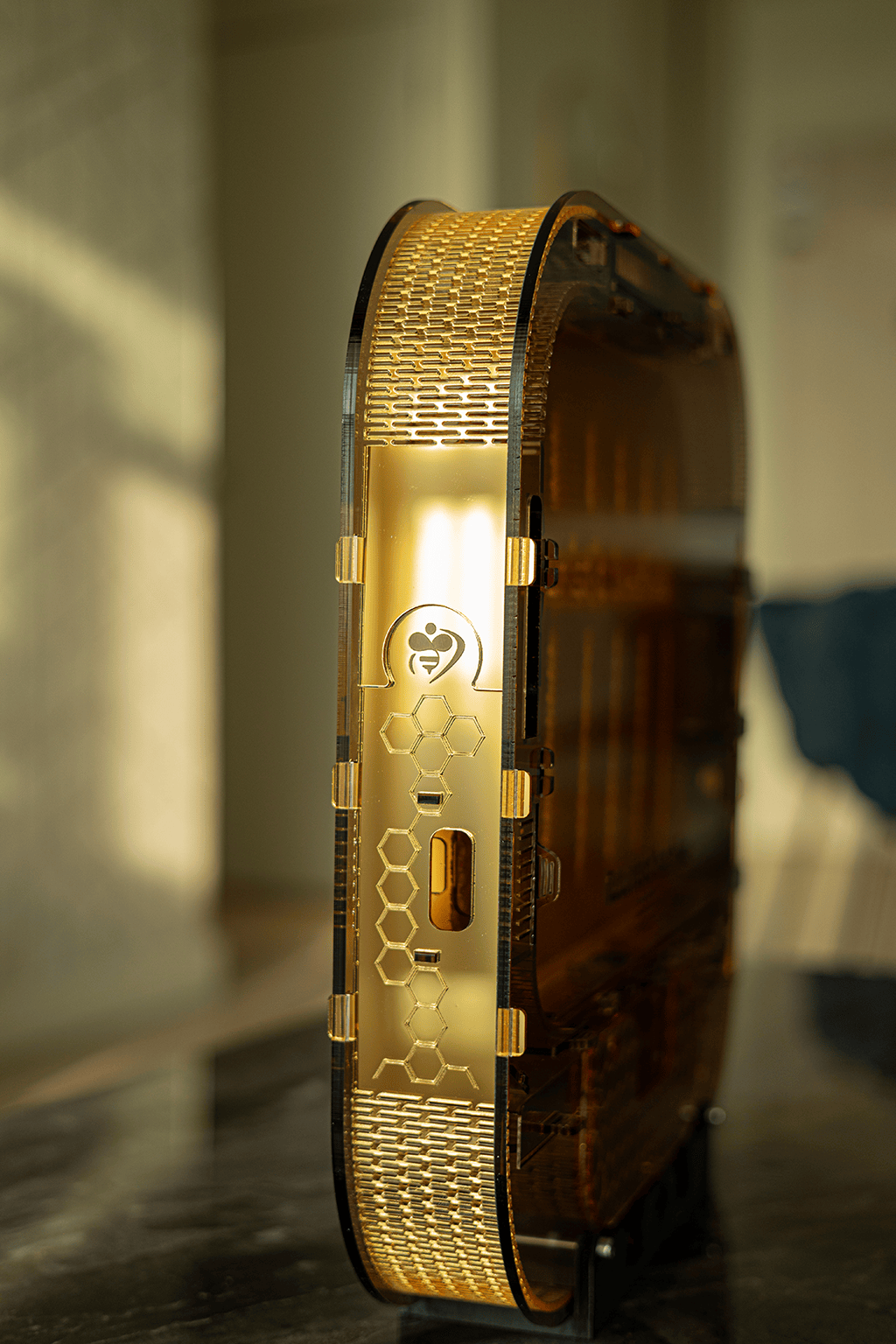
The design language is deliberately removed from anything that looks like traditional beekeeping equipment. The housing is a rounded rectangle in warm amber and gold tones, with honeycomb-patterned laser-cut metal accents on the side panels and the brand’s bee logo etched into the frame. It looks less like agricultural equipment and more like a high-end decorative object — something between a piece of functional art and a living terrarium.
The honeybee problem it is designed to address
The product exists against a backdrop of genuine ecological concern. Honeybee populations have been in documented decline across North America and Europe for over two decades, driven by habitat loss, pesticide exposure, parasites, and disease. Urban environments, with their flowering plants, reduced pesticide use compared to agricultural land, and relatively stable temperatures, have in some cases proven more hospitable to bee colonies than rural areas.
Futuristic Beehive frames the Symbiotic partly as a response to that situation. The company notes that “honeybees are endangered and require our intervention,” and positions indoor keeping as a way for individuals to take a direct role in supporting colony survival — while also benefiting from the pollination activity that a colony produces in its surrounding environment and the honey it generates over time.
Whether a single indoor colony meaningfully addresses pollinator decline at scale is a separate question, but the framing connects individual ownership to a larger ecological context that resonates with the product’s target audience.
Hardware: What you are looking at
The Symbiotic is a product built with more visual and material care than most functional objects in its category. The main body is constructed from layers of tinted acrylic — amber and smoke tones — with internal structural elements visible through the translucent panels. The side profile shows the hive’s depth: a relatively slim 8 cm (about 3 inches) that allows it to mount close to a wall without projecting aggressively into a room.
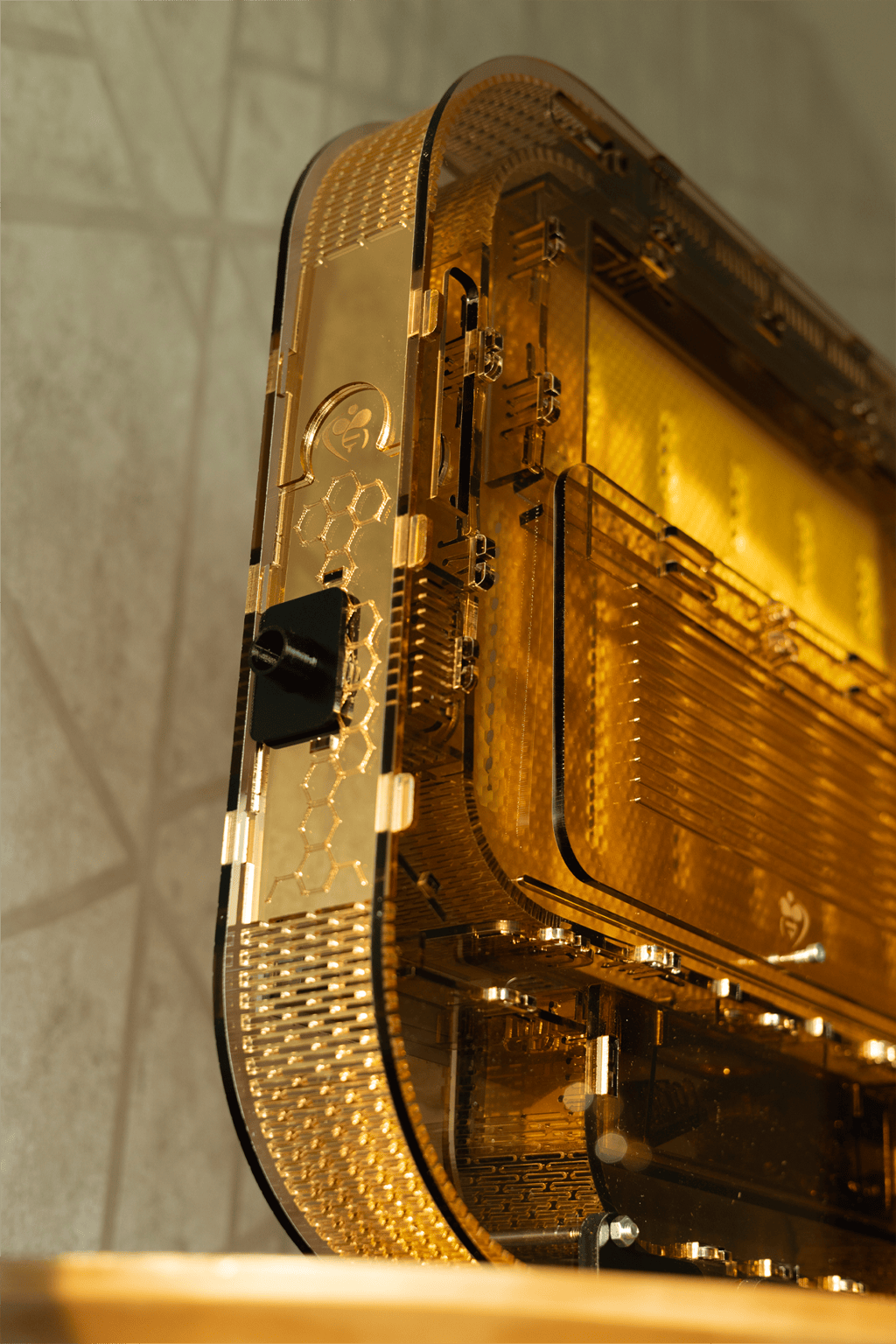
The perimeter framing incorporates tightly spaced laser-cut ventilation patterns — small rectangular slots arranged in a repeating grid — that serve both a functional and aesthetic purpose. The side panels feature larger honeycomb-shaped cutouts etched into the metal layer, and the brand’s logo appears on both the front face and side panel.
The base of the unit houses the entrance/exit mechanism: a gold-toned metal plate with hexagonal cutouts through which the colony’s flight tube connects to the wall. This component is visible in the reflection on polished surfaces, underscoring how cleanly the hardware integrates into contemporary interior settings.
Installation: What it requires
Setup requires two things: a 20mm hole through the exterior wall and approximately 20 minutes of time. The company compares the installation effort to “mounting a picture on the wall, a little more time.” A 20mm drill bit or core drill handles the wall penetration; the tube is then passed through and the gap sealed with silicone or another appropriate material. The hive unit itself attaches to the interior wall surface.
There is no electrical connection required. The Symbiotic is a passive system — ventilation, temperature regulation, and the colony’s natural behavior handle the internal environment. The integrated feeder is the only consumable input the owner regularly manages, alongside colony monitoring.
For renters or those in buildings where wall penetration is a concern, the installation requirement is worth noting carefully. A 20mm hole is relatively small — roughly the diameter of a large coin — but it does constitute a structural modification that may require landlord permission or, in some buildings, is not permitted at all.
Getting a colony
The Symbiotic ships as hardware only. The bee colony is sourced separately by the buyer — a common approach in the beekeeping world, but one that may be unfamiliar to the product’s target audience of first-time keepers.
Futuristic Beehive’s guidance on this is practical: search for “queen bee for sale” or “bees for sale” in your local area, or contact a local beekeeper directly. The colony requirements are specific — a minimum of 1,000 grams of bees or at least five frames if purchased as part of an existing hive. The company also recommends having a beekeeper present during the initial transfer into the Symbiotic, and notes that queen selection matters: a well-bred queen “significantly affects the quality” of the resulting colony.
This is the step that introduces the most variability for new users. Sourcing a healthy, appropriately sized colony requires some local knowledge, and the quality of bee suppliers varies widely by region. The company offers support through its team for beekeeping questions, which partially addresses this gap — but it does mean that the price of Symbiotic is not the full cost of getting started, and the ease of setup depends partly on factors outside the product itself.
Limitations worth considering
A few practical realities deserve honest attention before purchase.
The wall penetration requirement rules out the Symbiotic for a meaningful segment of apartment renters, co-op residents, or anyone in a building that restricts structural modifications. The 20mm hole is small, but it is permanent unless patched.
Colony sourcing adds cost and effort that the product page does not prominently foreground. Depending on location and the time of year, finding a viable colony of the required size may take time, and the initial transfer is not a solo beginner task — the company recommends beekeeper involvement.
The Symbiotic is also, at its core, a living system. Colonies require ongoing attention: feeding, monitoring for disease, managing population health, and seasonal considerations. The product lowers the barrier to entry significantly, but it does not eliminate the responsibilities of beekeeping. Users who approach it purely as a decorative object may find that the living component requires more engagement than anticipated.
Finally, regulations on urban beekeeping vary considerably by city and state. Some municipalities have permitting requirements or restrictions on hive placement. Prospective buyers in the U.S. should check local ordinances before purchasing.
Pricing and availability
The Futuristic Beehive Symbiotic is currently priced at $799 (regularly $999) with free worldwide shipping. It is available directly through the company’s website.
Source: Futuristic Beehive