Most people have played some version of Snake. The concept is simple: move, collect, grow, and don’t run into yourself. It has been a fixture of mobile gaming since the late 1990s and has found its way onto everything from Nokia handsets to app stores. BattleKart, a Belgian entertainment company, has taken that same concept and rebuilt it at full scale — on a projection-mapped arena floor, inside electric go-karts, with up to twelve players competing simultaneously. The result is BattleSnake, one of six game modes offered at BattleKart centers currently operating across fourteen countries.
What BattleKart is and where it comes from
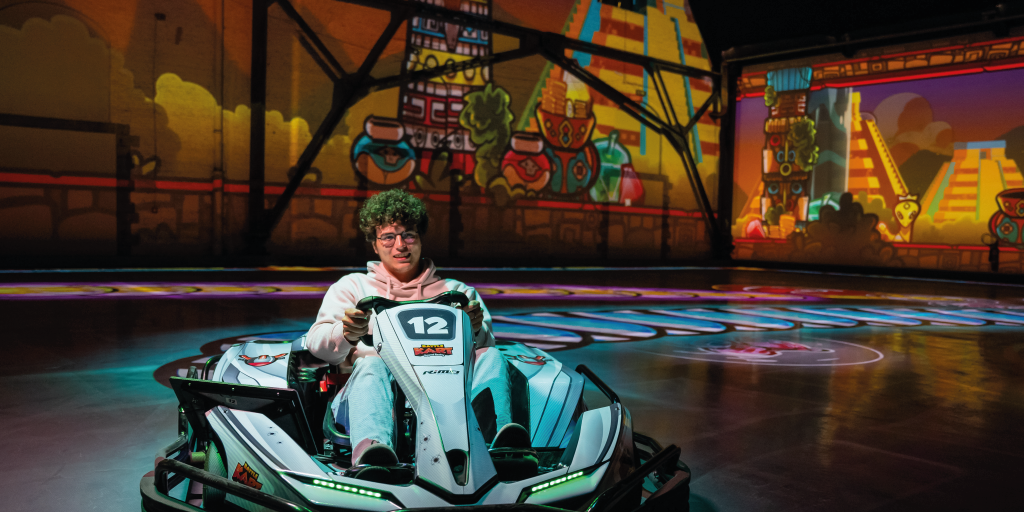
BattleKart Entertainment is headquartered in Dottignies, Belgium, and describes its core concept as “the perfect combination of electric karting, video games and augmented reality.” The setup at each center involves a large indoor arena floor onto which game graphics, track boundaries, collectible items, and interactive elements are projected in real time. Riders drive electric karts around this projected environment, and their movements interact with the game layer directly — the kart is simultaneously a vehicle and a controller.
The company has grown to more than 50 centers across 14 countries, including the United States, the United Kingdom, Australia, Germany, France, the Netherlands, and the UAE, and reports more than 2.6 million players served to date. Each session runs 15 minutes, with groups of 2 to 12 players (some centers cap at 10). The minimum height requirement to participate is 1.45 meters, or approximately 4 feet 9 inches — which opens the experience to most school-age children and older.
BattleSnake is one of six permanent game modes on offer, alongside BattleRace, BattleColor, BattleVirus, BattleFoot, and BattlePool. Seasonal modes for Halloween and Christmas are also available at select centers during those periods.
How BattleSnake works
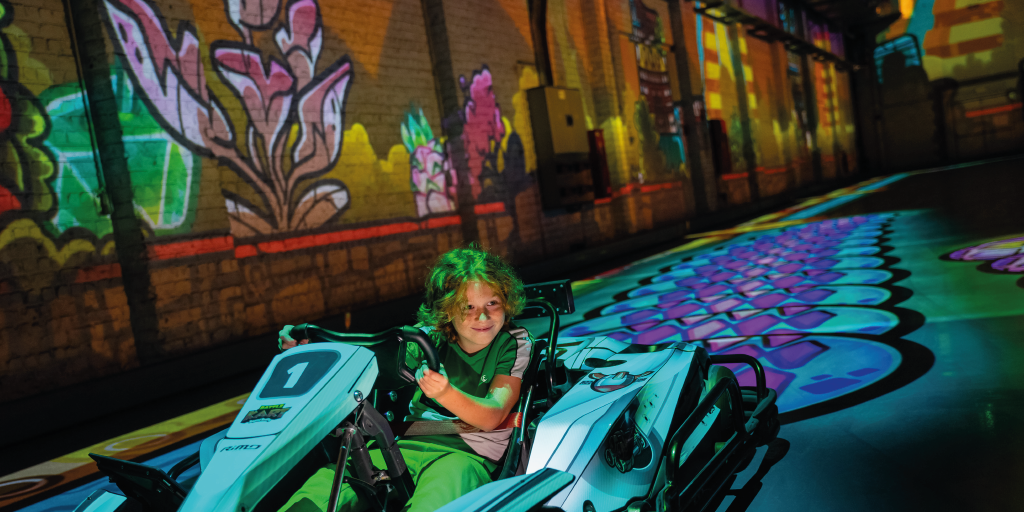
The rules translate directly from the classic game. Each driver’s kart represents a snake moving through a projected Mayan jungle environment — colorful temple scenery, animated foliage, and glowing fruits scattered across the arena floor. The objective is to collect as many fruits as possible over the course of the session, with each collected item extending the player’s visible “tail” — a projected trail that follows the kart around the floor.
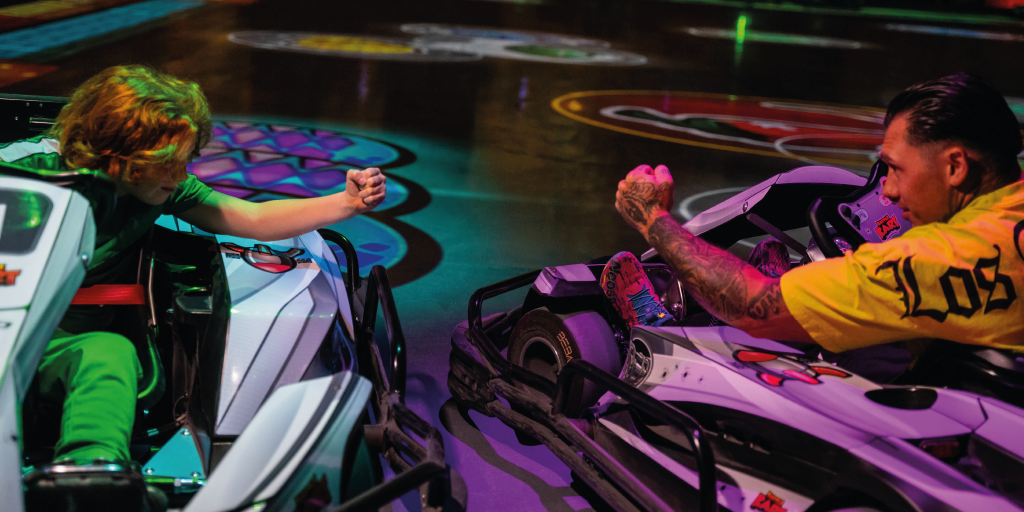
The competitive mechanic comes from the tail itself. If a player’s kart crosses their own projected tail, or runs into another player’s tail, they lose all accumulated progress and half their collected fruits drop back onto the floor for other players to claim. The penalty is immediate and visible to everyone — a sudden shrink back to zero, with the lost fruits materializing as collectibles for competitors nearby.
This creates a dual dynamic that separates BattleSnake from a straightforward racing or collection game. Players are simultaneously trying to accumulate fruits efficiently and using their growing tail as a spatial obstacle to trap or cut off opponents. A longer tail covers more of the floor, making it harder for other players to navigate safely around you.
The three tactical levers
BattleKart identifies three key strategies that shape how competitive players approach the mode.
The first is the Nitro boost. Players can sacrifice one collected fruit to trigger a brief speed burst. This is a calculated trade — burning a fruit for positioning, either to reach a cluster of collectibles before a rival or to escape a tight situation where another player’s tail is closing in.
The second is deliberate blocking. A player with a long tail can steer to position it across likely paths, effectively setting a trap. If an opponent drives into that section of trail, they lose their progress. This introduces a spatial and strategic dimension beyond simple collection speed.
The third is continuous movement. Standing still, even briefly, causes the player to shed fruits passively. Staying in motion is not just tactically useful — it is mechanically necessary to maintain score.
The arena environment
The BattleSnake arena is fully projection-mapped, meaning the game visuals cover not just the floor but the walls and surrounding surfaces. The Mayan temple theme uses warm, saturated colors — oranges, greens, purples — and the effect at full intensity creates a visually enclosed environment where the boundary between the physical arena and the projected game layer is deliberately blurred.
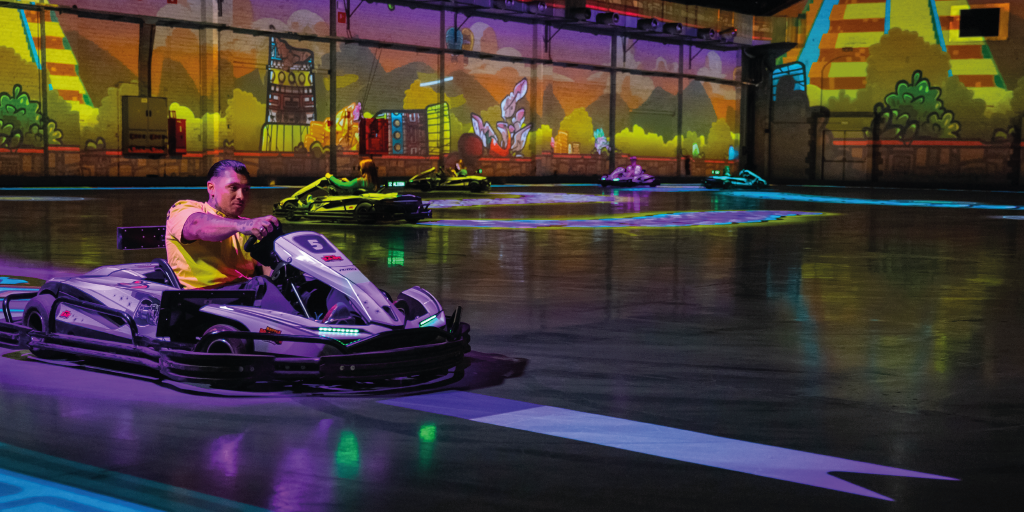
The karts used across BattleKart centers are electric, purpose-built vehicles with onboard LED lighting that responds to game events. They are low-profile and maneuverable, built for the kind of close-quarters movement that modes like BattleSnake require. The projection system tracks kart positions in real time and updates the game state accordingly — the trailing visual following each kart is generated dynamically based on actual movement.
Who it is designed for
BattleSnake sits in a useful middle ground among BattleKart’s game modes. Unlike BattleRace — which rewards driving skill and reflexes — BattleSnake is legible to anyone familiar with the original game concept, which covers a wide age range. The mechanics are easy to explain in under a minute, but the live competitive element with multiple players creates enough variation that repeat sessions play differently each time.
The experience is positioned for families, friend groups, corporate team events, and bachelor or bachelorette parties — all categories BattleKart markets to directly. Because sessions are 15 minutes and groups can chain multiple sessions, the format works for both casual visitors and groups looking to fill a longer evening.
Pricing and availability
Pricing at BattleKart centers varies by location. At BattleKart Sheffield, UK, weekday pricing starts at £19 per person for a single session, while weekend pricing starts at £23 per person. Players can also purchase multi-session packages, with weekday rates reaching £60 for four sessions and weekend rates reaching £69 for four sessions. Group discounts are available for parties of eight or more players, reducing the per-person cost slightly. Each package includes multiple 15-minute game sessions, with total play time ranging from approximately 30 minutes to over 90 minutes, depending on the option selected.
Players must be at least 4 ft 9 in (1.45 m) tall to participate. Since pricing is set independently at each BattleKart center, visitors should check their local venue for current rates and offers. BattleKart centers are currently operating across 14 countries including the United States, United Kingdom, Australia, France, Germany, the Netherlands, and the UAE. Full center listings, bookings, and gift card purchases are available at BattleKart’s official website.
Source: BattleKart