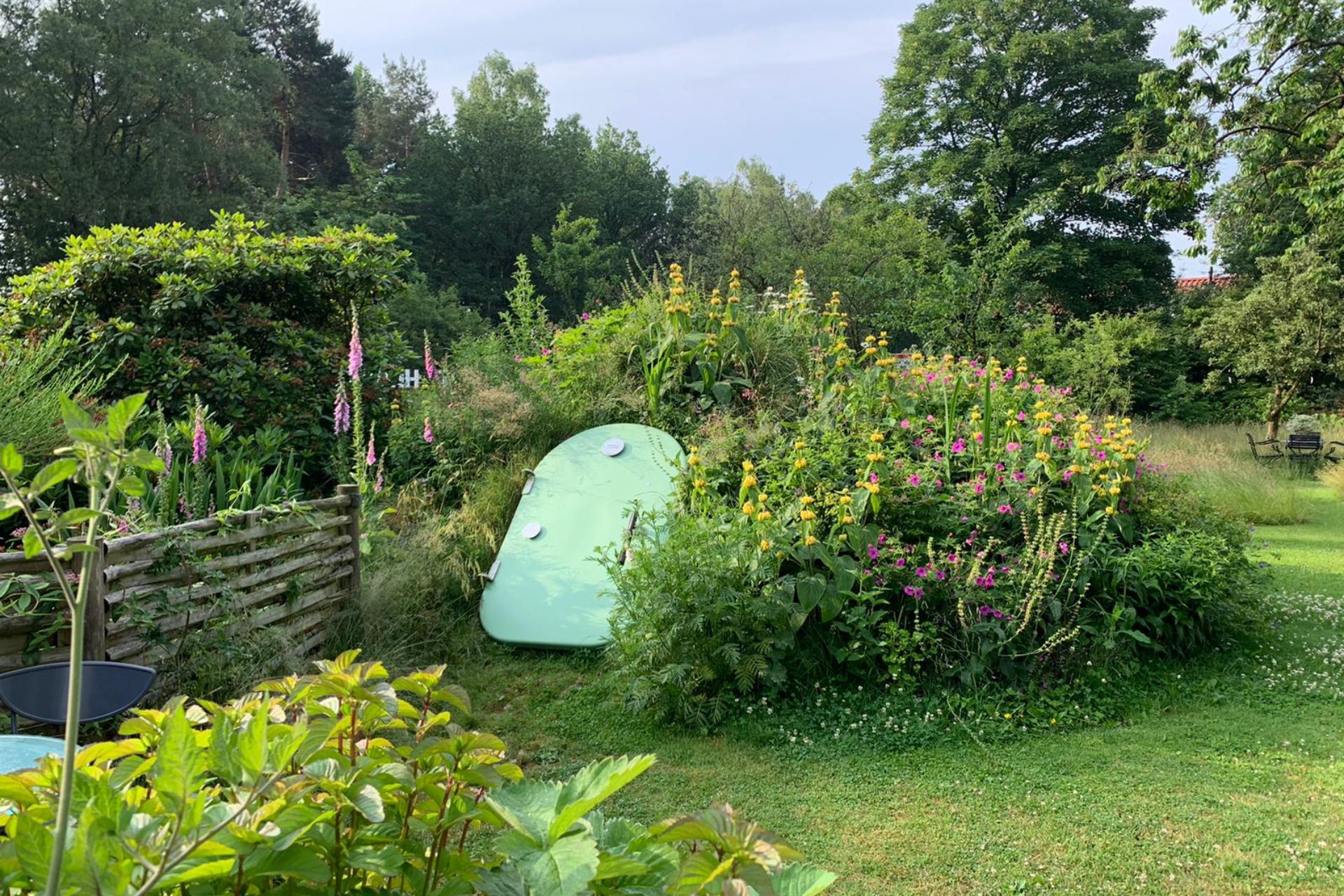
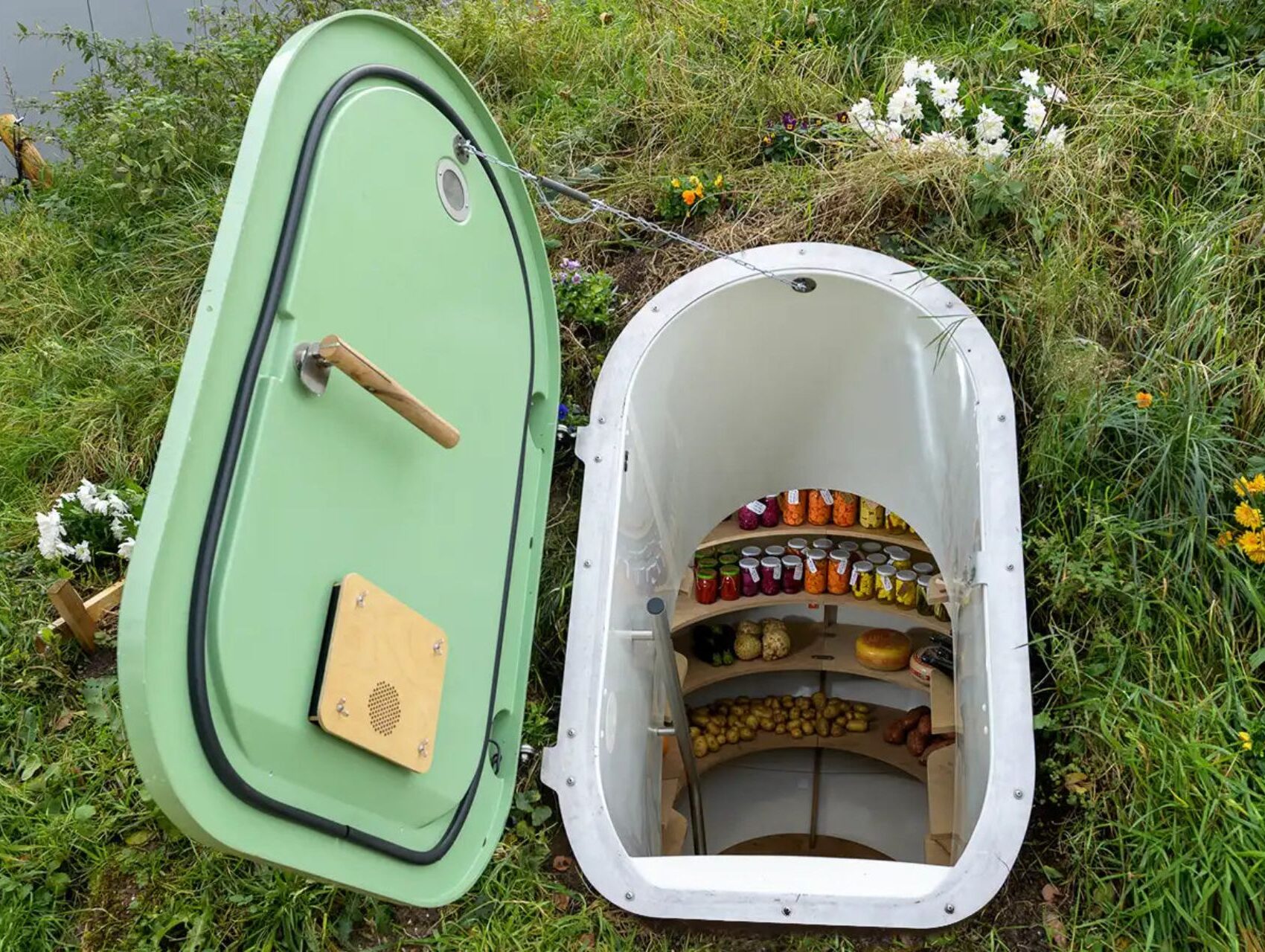
It looks like the entrance to a tiny bunker hidden beneath a garden. Open the insulated green door, however, and a staircase leads into a walk-in chamber lined with curved wooden shelves.
This is the Groundfridge, a prefabricated underground cellar designed to keep produce, drinks and pantry supplies cool without a conventional refrigeration system or mains electricity connection.
Rather than using a compressor and refrigerant, the Dutch-designed structure relies primarily on the relatively stable temperature of the soil around it. A planted mound provides shade and insulation, while a small solar-powered ventilation system can bring in cool air at night.
Despite its name, Groundfridge is not a replacement for the refrigerator in a kitchen. Its temperatures are considerably higher, making it a modern interpretation of the traditional root cellar rather than an appliance for storing meat, milk or other highly perishable food.
The ground does most of the cooling
Air temperatures can change dramatically between day and night, but soil responds much more slowly. At a depth of approximately one meter, short-term outdoor fluctuations have less influence, allowing the buried chamber to remain cooler and more stable than the surrounding air during warm weather.
Groundfridge says the temperature inside its units in the Netherlands typically remains between 8 and 15°C (46–59°F). The actual figure depends on the local climate, ground temperature, soil, groundwater, sunshine and how frequently the door is opened.
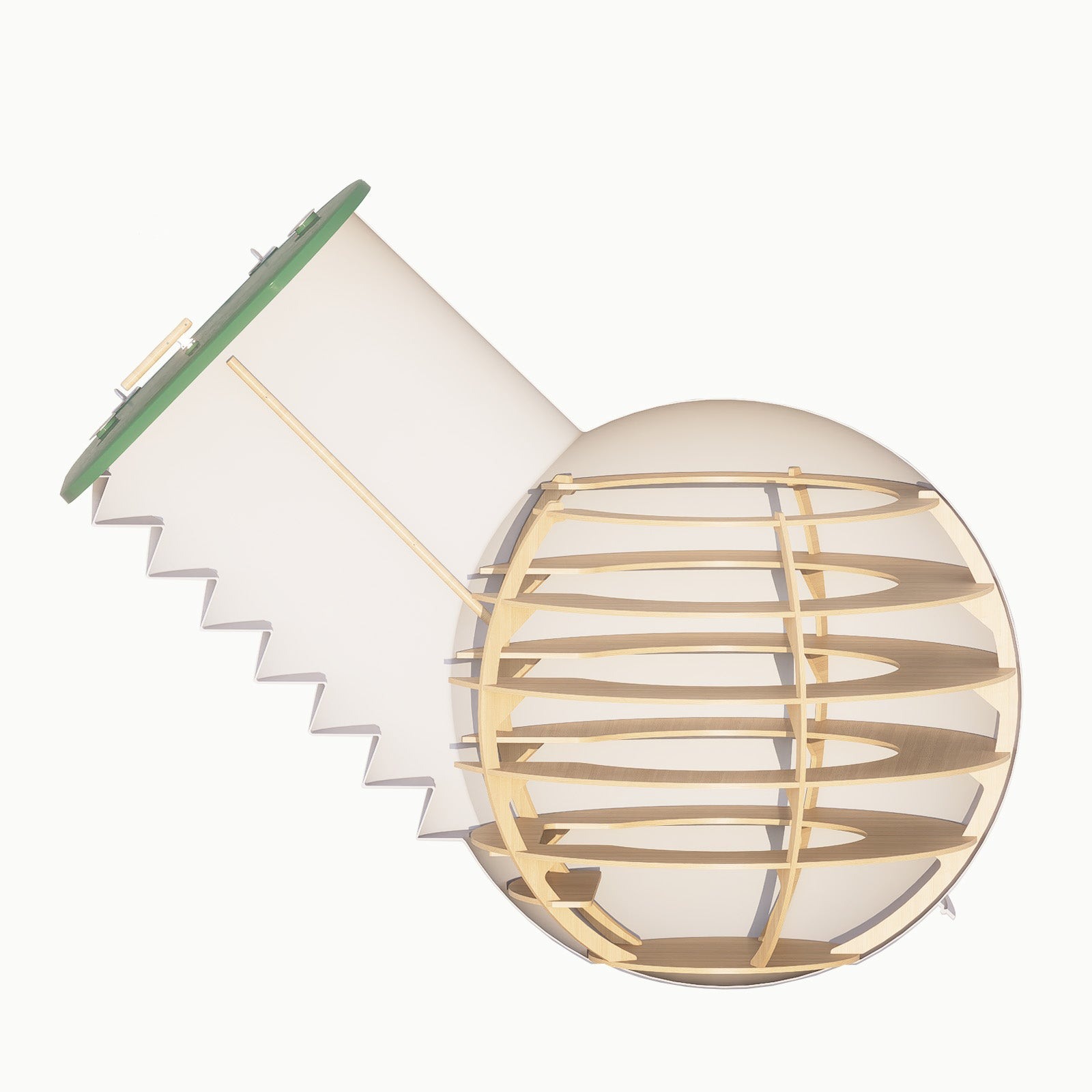
The installation should ideally face north and remain shaded by trees or other landscaping. Its thickly insulated door limits heat entering through the exposed entrance, while plants covering the mound prevent direct sunlight from heating bare soil. Moisture evaporating through those plants can provide some additional cooling.
A fan built into the door can be scheduled to ventilate the chamber during the coolest part of the night. The fan’s battery is charged by a supplied solar panel, so the installation does not need a power cable. A motion-activated interior LED uses its own battery.
The frequently repeated claim that Groundfridge “uses no electricity” therefore needs a little context. It requires no grid electricity for active refrigeration, but its ventilation fan and light are still electrical devices.
A full-size cellar inside a molded shell
The current Groundfridge has a total internal volume of 7.8 cubic meters and an internal diameter of 2.25 m (7.4 ft). Including its angled staircase, the installed structure measures approximately 3.75 m (12.3 ft) long and 2.33 m (7.6 ft) wide.
Most people can stand upright inside. Groundfridge says the central chamber can accommodate someone up to approximately 2.10 m (6.9 ft) tall, although clearance is lower above the stairs.
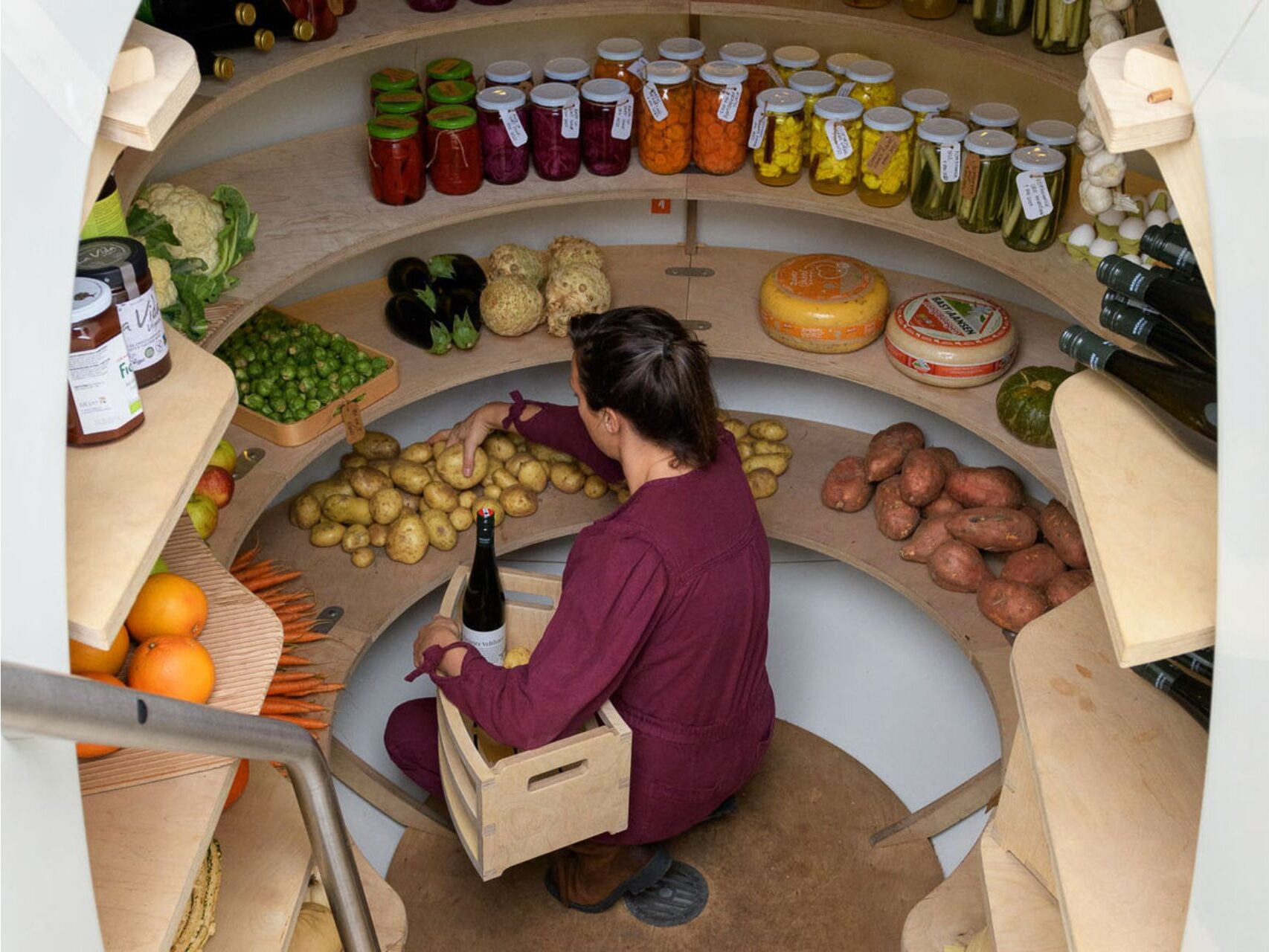
The complete Original model has an interior storage system made from 21-mm untreated birch plywood. Its curved shelves are intended for crates, bottles, jars and pantry supplies. The shell is manufactured from fiberglass-reinforced polyester, with stainless-steel fittings and structural components.
Older descriptions give the product a usable storage capacity of approximately 3,000 liters and say it can hold around 500 kg (1,100 lb) of food. That does not necessarily conflict with the new 7.8-cubic-meter specification: the smaller number describes usable storage, whereas 7.8 cubic meters is the total volume of the chamber.
Comparisons claiming that one Groundfridge replaces 20 refrigerators are less useful. They compare volumes rather than cooling performance, and the underground cellar does not reach ordinary refrigerator temperatures.
What can go inside?
The space sits between a temperature-controlled refrigerator and a room-temperature pantry. Groundfridge recommends it for products including:
- Potatoes, citrus fruit, tomatoes and other suitable produce
- Preserves, canned food, honey and juice
- Olive oil, pasta, eggs and pantry staples
- Wine and specialty beer
- Certain cheeses

Storage conditions still need to suit the individual food. Different fruits and vegetables prefer different temperatures and humidity levels, and some produce releases ethylene that accelerates ripening in nearby items.
Most importantly, an interior temperature of 8–15°C is not cold enough for foods that must be refrigerated at approximately 4°C (39°F). Meat, seafood, milk, soft cheeses and other temperature-sensitive products still require suitable mechanical refrigeration.
Groundfridge also does not offer the precise temperature and humidity regulation of a commercial cold room. Its usefulness will be greatest in temperate regions where the natural ground temperature matches the intended storage conditions.
Installing it takes more than digging a hole
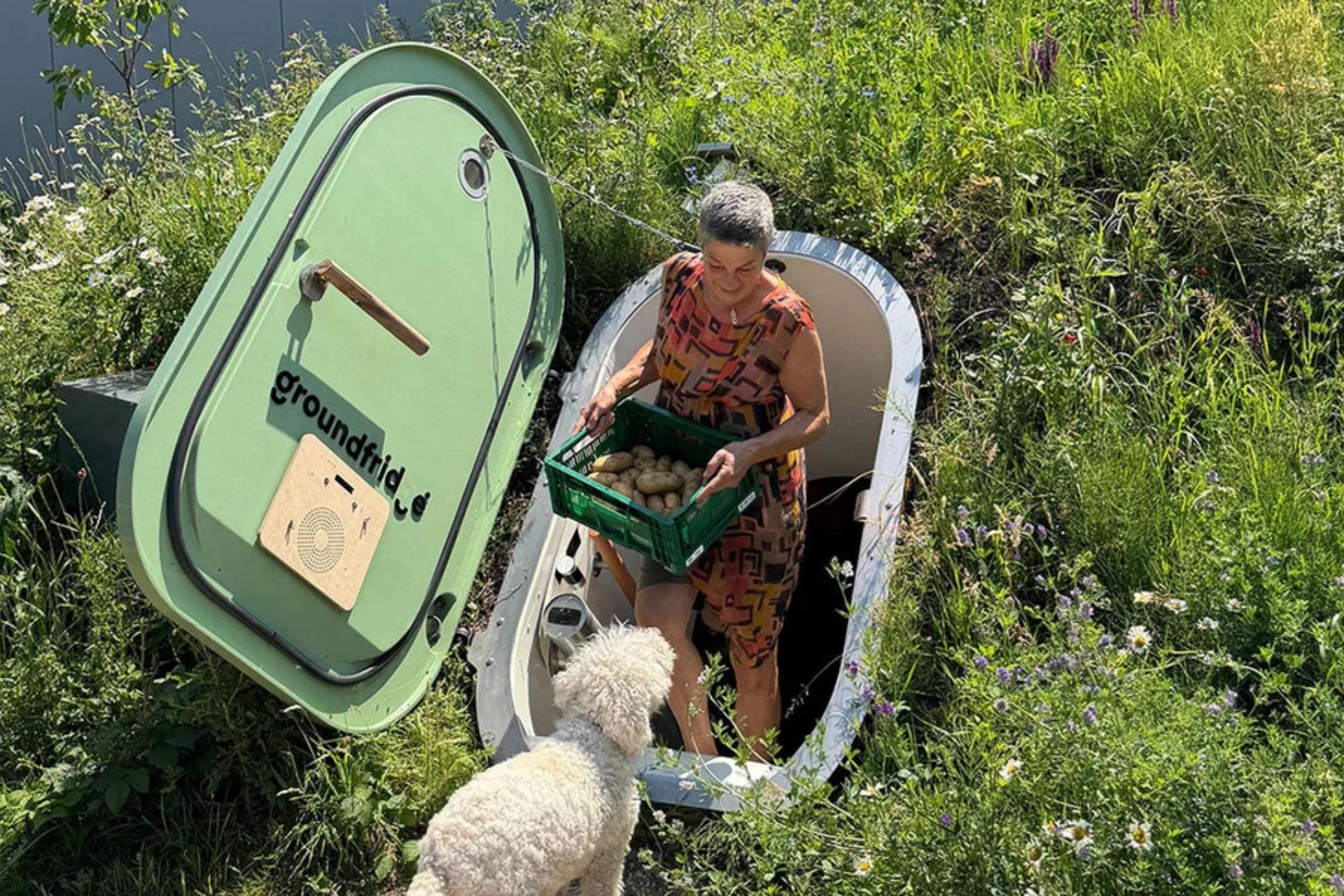
Although the chamber arrives largely assembled, installing it is a significant landscaping project. The company recommends using experienced contractors, at least three people and a suitably rated excavator. Its current installation manual prefers an approximately 10-ton machine, while a summary on the website refers to an 8-ton excavator.
The central excavation is roughly 1.85–2 m (6–6.6 ft) deep. A bed of fine construction sand supports the shell, which must be lowered, leveled and backfilled evenly to avoid concentrated pressure. Excavated earth is then shaped over the chamber to create approximately one meter of insulation.
The completed mound can rise about 1.5 m (4.9 ft) above the original ground level and occupy a footprint around 5 m (16.4 ft) across. Groundfridge recommends allowing approximately 25 sq m (269 sq ft) for the installation and landscaping.
Groundwater requires particular attention. Like other hollow buried structures, an unanchored Groundfridge can become buoyant when the water table rises. For high-groundwater locations, the company recommends securing it to concrete slabs with stainless-steel cables attached to its lifting points.
Before work begins, the owner and contractor need to assess soil stability, seasonal groundwater, surface drainage, underground utilities, equipment access and local building or planning requirements. Groundfridge says permits may not be required in many areas, but buyers remain responsible for checking local rules.
Two main versions
The Groundfridge Original is the complete version, supplied with the shelving system, handrail and solar-powered ventilation. It weighs approximately 560 kg (1,235 lb).
The Groundfridge Empty weighs about 450 kg (992 lb) and includes the handrail but not the wooden storage system. Buyers can design their own interior and choose whether to include the solar ventilation system.

The Groundfridge Original is priced at US$21,995, while the Empty model costs US$17,759 with solar-powered ventilation or $16,574 without it. A separate storage system is listed at approximately US$5,332.
Those prices exclude transport and installation. Excavation, machinery, unloading, concrete anchors, drainage work and landscaping can add substantially to the completed cost.
Groundfridge says it can deliver almost worldwide. European deliveries typically travel by truck and require a forklift or crane for unloading. For destinations outside Europe, three units can reportedly fit inside a 40-foot high-cube shipping container. Local contractors normally handle installation outside the company’s established service areas.
An old idea in a factory-built form
Dutch designer Floris Schoonderbeek developed Groundfridge in 2012 after seeking a better way to store locally grown produce at his former home in Arnhem.
Today, the product is assembled and distributed by a team based at Fiction Factory in Amsterdam-Noord. Fiction Factory is also behind Wikkelhouse, a modular building system constructed using layers of cardboard. Schoonderbeek remains involved in Groundfridge’s development.
The appeal is easy to understand. Groundfridge provides a large, cool and dark storage space without the energy demand of a refrigerated room, while its planted mound can blend into a garden instead of resembling a piece of industrial equipment.
It is nevertheless a premium, permanent installation rather than an alternative for every home. Its performance depends on the local ground temperature, and the project needs considerable land, heavy machinery and careful planning.
For gardeners, small farms, community projects, hospitality properties or households with large harvests, that trade-off could make sense. Groundfridge takes a storage method that predates electricity and packages it as a product that can arrive on a truck—then lets the earth handle most of the work.
Source: Groundfridge