

Dyson is best known for vacuum cleaners, fans and hair-care products, but the family behind the technology company also operates one of Britain’s most unusual strawberry farms.
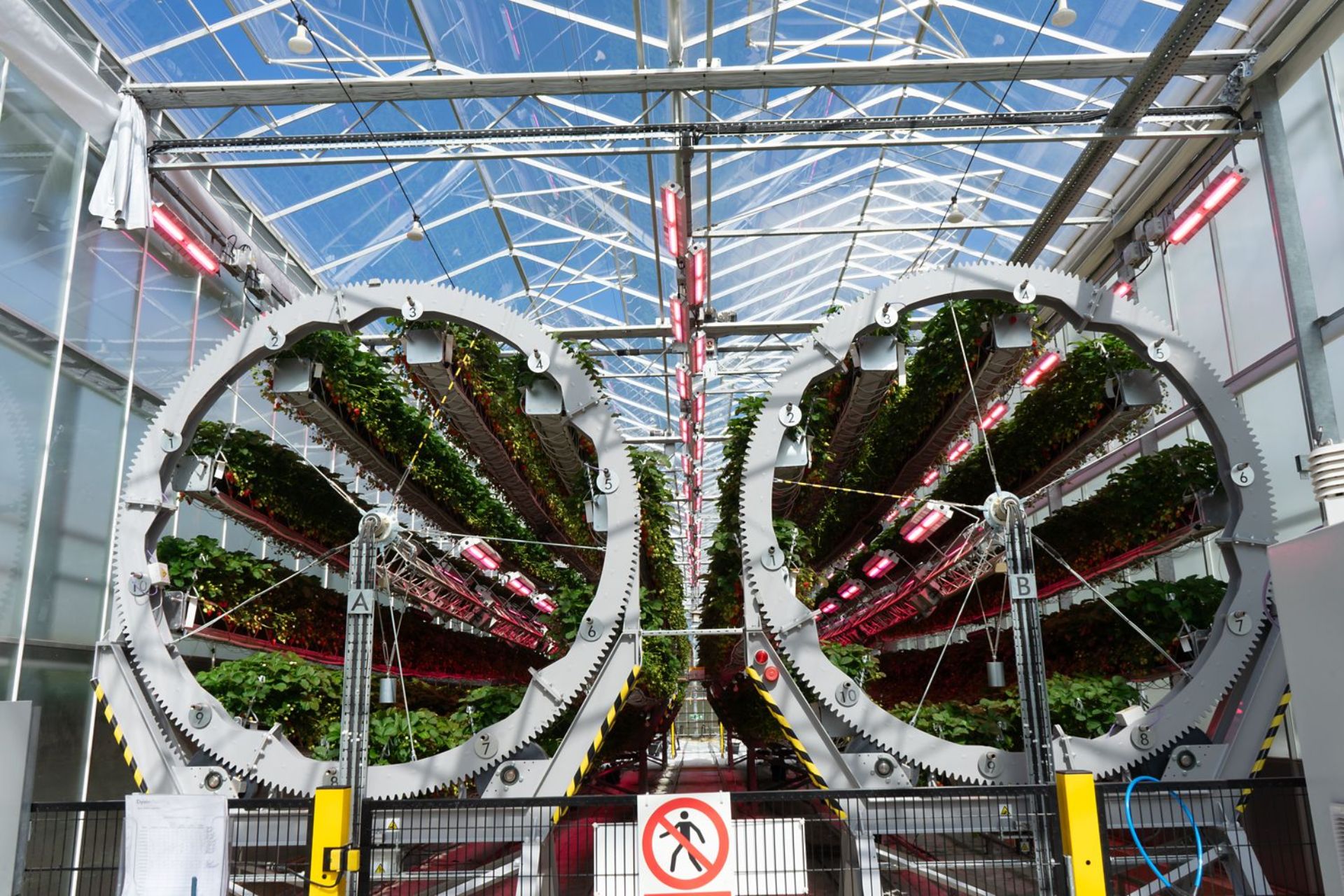
Inside a 26-acre glasshouse at Carrington in Lincolnshire, Dyson Farming grows strawberries throughout the year using renewable energy, artificial lighting, sensors, robots and a pair of enormous rotating structures that resemble Ferris wheels.
The glasshouse contains approximately 1.225 million strawberry plants and is designed to produce more than 1,250 tonnes (1,378 US tons) of fruit annually.
Not all those plants are mounted on the rotating machines, however. The wheels form a trial system called the Hybrid Vertical Growing System. Dyson says its engineers built two prototype rigs holding roughly 6,000 plants between them, while the wider glasshouse uses a combination of other elevated growing arrangements.
Why put strawberry plants on rotating wheels?
Each aluminium rig measures approximately 24 m (79 ft) long and 5.5 m (18 ft) tall. Ten rows of strawberry plants are arranged around each wheel.
As the structure turns slowly, different rows move through positions where they can receive more natural sunlight. LED fixtures supplement daylight during darker winter periods, while a specially designed irrigation and drainage system continues supplying the roots as the plants rotate.
The purpose is not simply to create an eye-catching machine. Raising plants through several vertical levels allows Dyson Farming to place more growing area within the same section of glasshouse. At the same time, rotation helps address one of vertical farming’s central problems: upper rows can shade the plants beneath them.
Dyson reported that the recently completed trial produced 2.5 times the yield available from the same footprint under its comparison setup. That is a result reported by the company from this particular trial, rather than proof that every farm adopting rotating equipment would achieve the same improvement.
Robots handle harvesting, mold and pests
The rotating rigs are only one part of the glasshouse’s technology.
Robotic harvesting systems use cameras to inspect the fruit and identify strawberries that have reached the correct stage of ripeness. Mechanical arms can then cut and collect selected berries while leaving unripe fruit attached to the plants. Dyson Farming has previously reported that its harvesting robots picked around 200,000 strawberries in one month.
Other robots travel along rails after dark and expose the plants to ultraviolet light to suppress mold. Beneficial predatory insects are also distributed around the crop to control pests such as aphids, reducing the farm’s reliance on conventional crop-protection chemicals.
Sensors and AI-powered decision-support software monitor conditions inside the glasshouse, help optimize the growing environment and forecast when fruit will become ready for harvest.
Humans have not disappeared from the operation. Staff still oversee plant health, equipment, crop management, packing and the decisions that surround the automated systems. The robots are intended to handle repetitive or difficult jobs and help cover seasonal labor shortages rather than turn the site into a completely unattended farm.
Waste heat helps extend the growing season
Growing British strawberries in winter requires more than robotic pickers and moving trays. The glasshouse needs heat, electricity, light, water and carefully controlled atmospheric conditions.
An anaerobic digester beside the facility breaks down crops using microorganisms, producing biogas that powers generators. The resulting electricity supports the farming operation, while surplus heat and carbon dioxide are piped into the glasshouse to help maintain suitable growing conditions.
Material left after digestion is returned to surrounding farmland as fertilizer. Rainwater collected from the glasshouse roof is also used for irrigation, adding another loop to Dyson Farming’s attempt to integrate food and energy production.
The glasshouse began producing strawberries in 2021 and has since been expanded, so the operation itself is not brand-new. The Hybrid Vertical Growing System is a more recent experimental addition, unveiled after a year-long development program and trial.
It remains to be seen whether machines of this scale will prove economical enough for widespread commercial use. Their value will depend on construction and maintenance costs, energy demand, crop prices and whether the yield increase persists when the system is deployed more broadly.
Even so, the Lincolnshire glasshouse provides a striking working example of how controlled environments, biological pest management, renewable energy and robotics can be combined to grow local fruit outside its traditional season.
Sources: Dyson, Financial Times, The Independent


