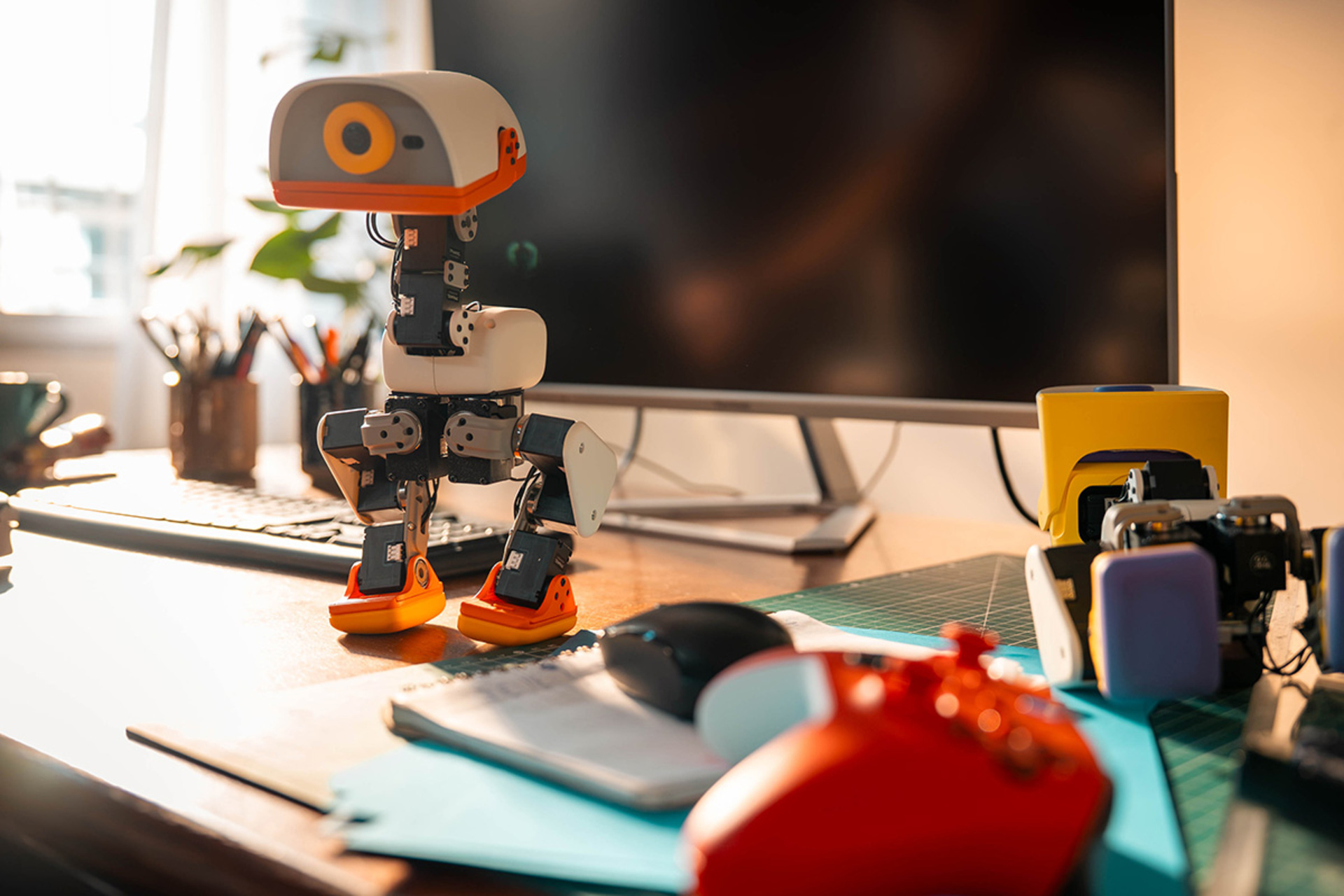
Most small consumer robots are designed to sit on a desk, answer questions or act as animated companions. Pollen Robotics’ new MicroDuck takes a more physical approach. The duck-like machine walks with an endearing waddle, picks up lightweight objects in its beak, kicks a ball, recovers from falls and can even move around on miniature roller skates.
Beneath the playful appearance is a compact platform for experimenting with physical artificial intelligence. Its makers want developers, students and robotics enthusiasts to train movements in a simulator, transfer them to the real robot and then refine the behavior when reality does not quite match the virtual world.
The 25-cm-tall (9.8-in) biped was created by Pollen Robotics, the Bordeaux-based robotics company that became part of Hugging Face in April 2025. It follows Reachy Mini, Pollen’s expressive desktop robot, but has been designed around movement rather than conversation.
A 15-motor robot weighing less than 800 grams
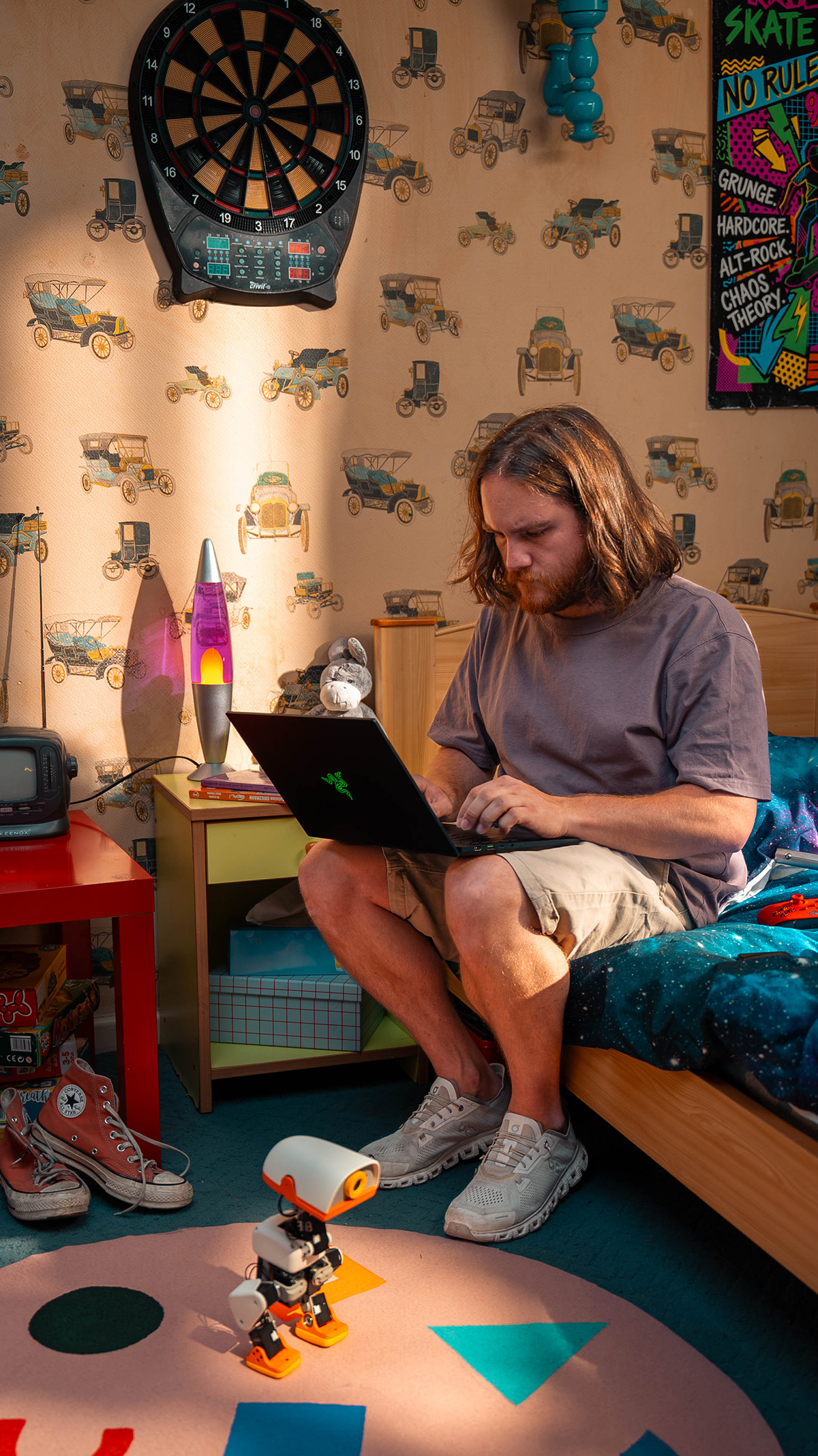
MicroDuck stands 25 cm tall, measures approximately 14 cm (5.5 in) wide and weighs about 780 g (1.7 lb). Fifteen motors provide articulated movement through its legs, head and neck. Its proportions and walking gait naturally produced the duck-like character, according to Pollen, which chose to emphasize the look rather than disguise the exposed joints and mechanisms.
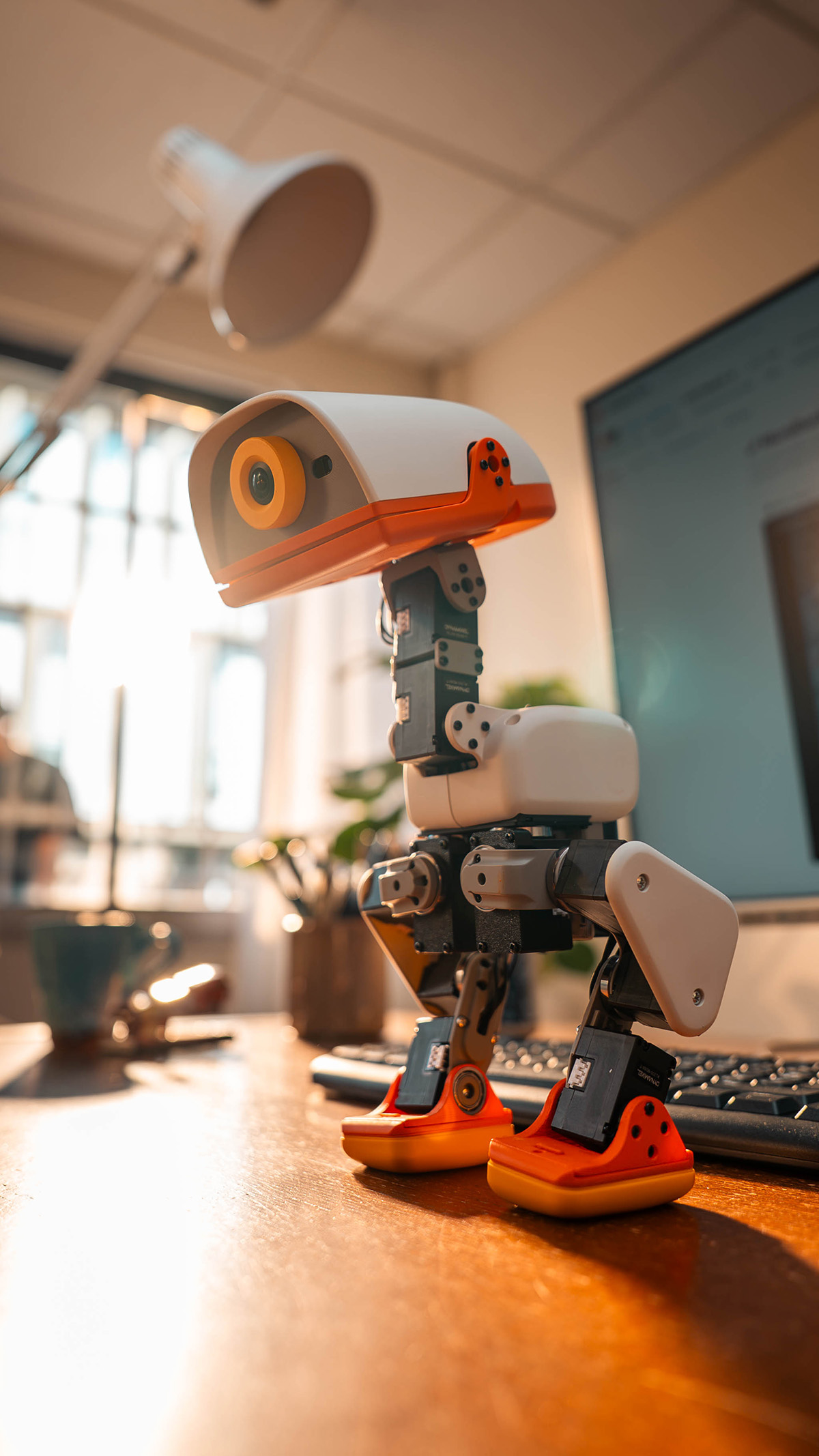
The robot can walk, sit, stand, crouch and kick. It can also right itself after ending up flat on its back and recover from several other common fall positions. That self-recovery is especially useful during machine-learning experiments, since failed attempts do not always require a person to stop the process and reset the robot manually.
Its orange-edged beak is more than decoration. The articulated structure works as a small gripper: MicroDuck lowers its whole body, closes the beak around an object and stands again. Demonstrations show it collecting items such as markers and socks, though its size and lightweight construction mean it should not be mistaken for a household robot capable of carrying substantial loads.
Cameras and sensors help it understand its surroundings
The robot uses a front-facing camera, an 8 × 8 time-of-flight LiDAR sensor and two inertial measurement units. One IMU sits in the body and another in the head, helping the control system estimate orientation and movement. A dedicated indicator illuminates when the camera is operating.
Two NFC antennas—one in the head and one in the beak—allow tagged objects to trigger programmed interactions. MicroDuck also includes microphones, a speaker, Wi-Fi and Bluetooth. Rather than speaking like a conventional voice assistant, each unit is intended to communicate through creature-like sounds. Pollen says a generated audio identity is assigned when the robot first wakes up and remains associated with that machine.
Onboard processing comes from a Rockchip RK3566 system with an AI accelerator, supported by 1 GB of RAM and 32 GB of storage. Pollen says learned policies run locally at 50 Hz. A removable 2,600-mAh NP-F550-style camera battery provides approximately one hour of operation, depending on how the robot is being used.
Some details are not final. The company’s press material says the precise camera resolution and field of view, LiDAR range, radio versions, supported SDK languages and recommended user age are still being determined.
Training new movements in simulation
MicroDuck arrives with seven learned movement policies, including walking, sitting and standing, kicking, grabbing, roller-skating and getting back up. An included game controller lets owners use the robot without writing code. It can also follow a laser point, react to its surroundings and perform autonomous behaviors.
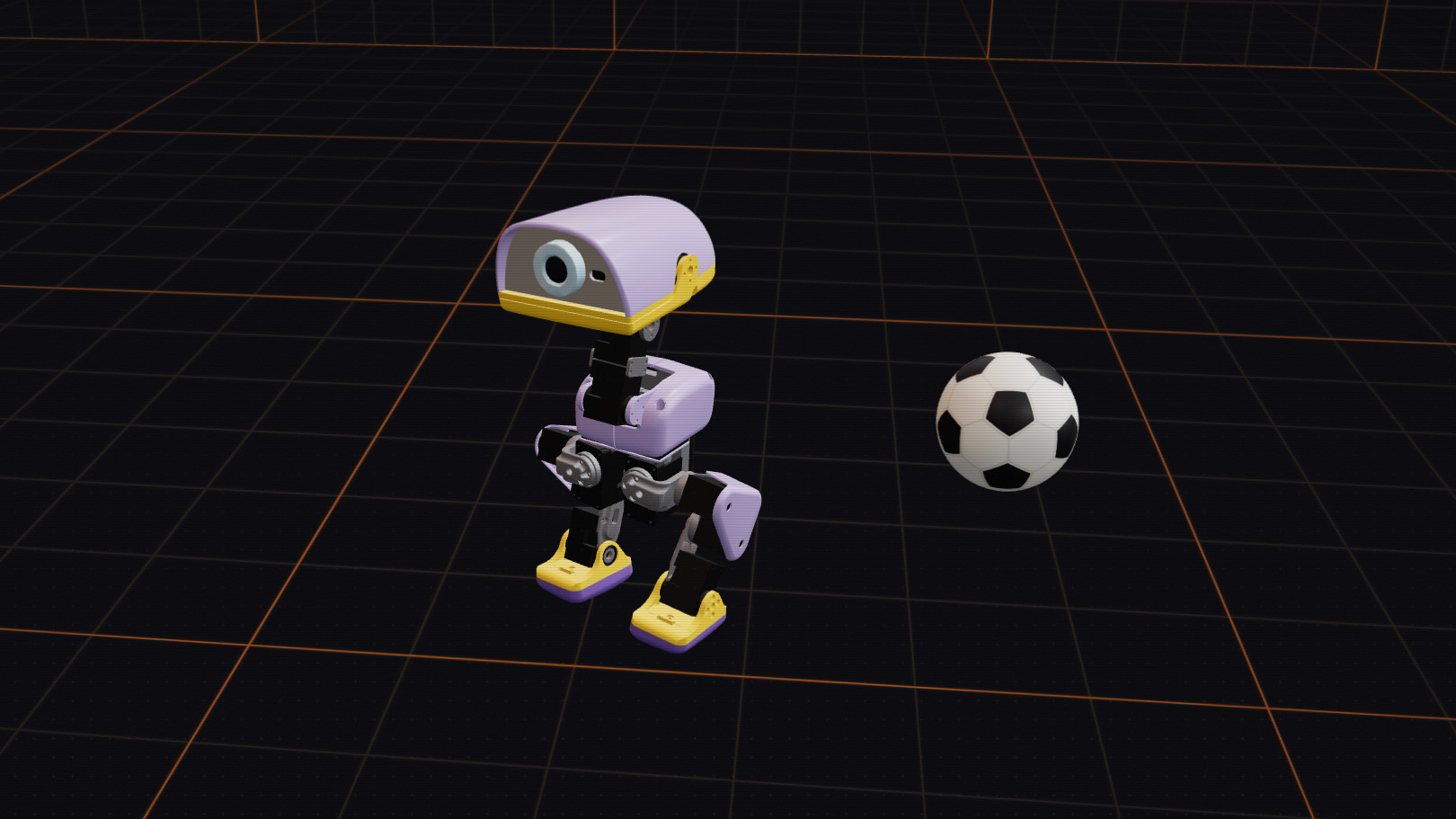
The deeper purpose is to make reinforcement learning and “sim-to-real” development more approachable. A developer can create or retrain a behavior inside a MuJoCo physics simulation, test it repeatedly without damaging hardware, and then deploy the resulting policy to MicroDuck. Differences observed on the physical robot can be used to adjust the simulation before another round of training.
This approach matters because teaching a legged robot to move involves repeated failures. On a large humanoid, a poor action can damage expensive hardware or create a safety risk. A sub-800-g machine is easier to catch, reset and operate on a desk, floor or classroom workbench.
Pollen plans to release the SDK, simulation environments, reinforcement-learning scripts and deployment tools before the first robots ship. The software stack will use the permissive Apache 2.0 license, allowing developers to inspect, modify and share it through GitHub and Hugging Face.
There is an important distinction, however: MicroDuck is open-source software, not fully open-source hardware. Pollen’s press kit explicitly states that the mechanical and electronic design files are not included in the open-source release.
Why the roller skates matter
Tiny clip-on rollers form part of an optional accessory pack. They turn the robot’s stepping motion into a skating gait, allowing it to travel more quickly across a smooth surface. The pack also includes a ball, laser pointer, NFC tags and an NFC-enabled “polaroid” prop.
Roller-skating is visually entertaining, but it also demonstrates the platform’s broader idea: the same body can learn substantially different movement policies. Instead of relying only on manually scripted sequences, behaviors are trained in simulation and then executed through the robot’s motors.
The base MicroDuck package includes the robot, one battery, a USB-C cable and a game controller. Optional packs add spare batteries, a dual charger, replacement motors and cables, NFC tags, tools and the skating accessories.
Price and availability
MicroDuck opened for preorder on August 27, 2026, at an introductory price of US$399 before taxes and shipping. Pollen Robotics is targeting its first deliveries before Christmas 2026, although that remains a target rather than a guaranteed date.
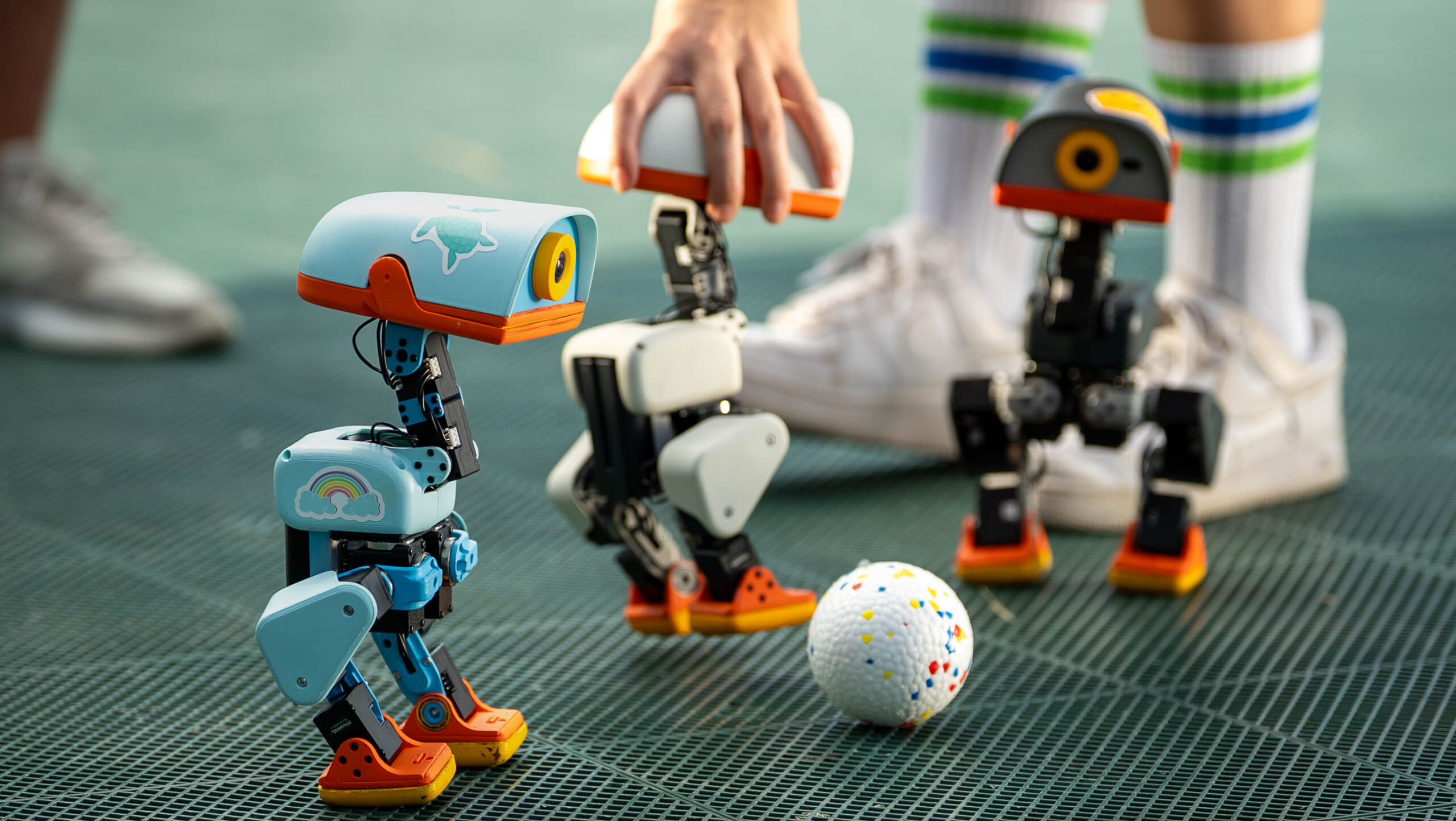
Four color combinations are offered: Cream, Graphite, Lavender and Sky. Launch markets include the United States, Canada, the European Union, United Kingdom, Norway, Switzerland, Japan and South Korea. The company says other countries will be added later.
Pollen Robotics was founded in 2016 by former researchers from France’s Inria computer-science institute. Since joining Hugging Face, the team has continued developing open robotics platforms including the full-size Reachy 2, the desktop-sized Reachy Mini and now MicroDuck.
MicroDuck will not fold laundry, carry groceries or replace a general-purpose humanoid. Its usefulness lies elsewhere: it packages locomotion, sensing, reinforcement learning and real hardware into a small machine that is relatively safe and accessible to experiment with. The duck styling makes it charming, but the more consequential feature may be the opportunity to train physical AI without needing a robotics laboratory—or worrying that every failed step will become an expensive fall.
Source: Pollen Robotics MicroDuck