

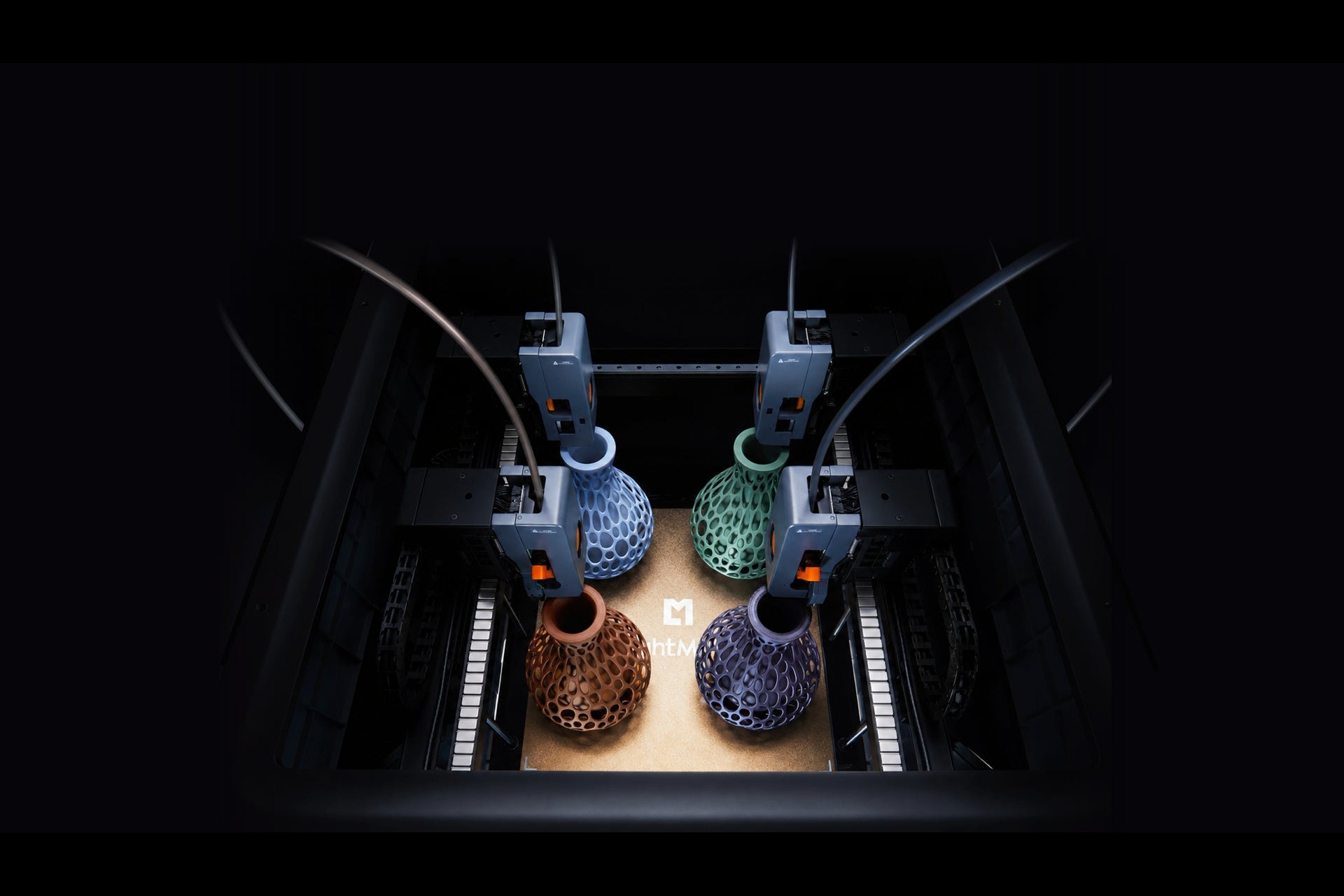
Most desktop 3D printers have one print head. Even multi-color systems commonly feed several filaments through the same nozzle, forcing the machine to unload, reload and purge material whenever it changes color.
The LightMake L4 takes a very different approach. It places four independently controlled print heads inside one machine, allowing each nozzle to remain loaded with a different color or material.
During a multi-color job, one head can stop and another can take over without flushing the previous filament from a shared nozzle. LightMake says the handover takes approximately one second and that a four-color test model required less than one gram of purged material. A small amount is still produced while priming and cleaning the nozzles, so “near-zero waste” is more accurate than zero waste.
The four heads can also work in parallel. In batch mode, each operates within its own section of the build plate to produce as many as four identical objects simultaneously. The company says a failure affecting one part can be isolated while the remaining heads continue their jobs.
Linear motors replace conventional belts
Instead of the belts and pulleys found in most consumer printers, the L4 uses eight sets of direct-drive linear motors across its X and Y motion system. Closed-loop control continuously monitors position, while a die-cast frame and software-based vibration compensation are intended to maintain stability.
LightMake claims a maximum printing speed of 500 mm/s, travel speeds up to 1,000 mm/s and acceleration of 20,000 mm/s². It also quotes motion precision of ±1 micrometer and a linear-motor life exceeding 50,000 operating hours. Those are manufacturer figures that will need to be confirmed through long-term testing of production machines.
Each toolhead has a 5-mm lifting mechanism and automatic Z-axis calibration. Optical sensors scan a calibration print to compensate for offsets between the four nozzles, with claimed alignment accuracy of up to 30 micrometers. Mechanical nozzle blockers help prevent idle hotends from dripping plastic onto the model.
Three different printing modes
Available printing space changes with the selected mode:
- Single color: 354 × 370 × 386 mm
- Multiple colors or materials: 354 × 350 × 386 mm
- Four-part batch mode: approximately 178 × 195 × 386 mm per zone
The printer measures 610 × 620 × 675 mm before its top cover and external filament holders are added. It weighs approximately 43 kg (95 lb), making it substantially larger and heavier than many hobby-level desktop machines.
Its standard 0.4-mm hardened-steel nozzles can reach 320°C, while the PEI-coated heated bed reaches 110°C. LightMake lists support for PLA, ABS, PETG, TPU, ASA, PVA, PET and carbon-fiber-reinforced PLA or PETG. PA and PC are also printable, although these materials can require careful drying, adhesion and temperature control.
The standard machine is open-framed. An optional Thermo Top Kit is being developed to create an actively heated enclosure targeting approximately 65°C. A separate FEDS filament expansion and drying system is intended to increase capacity from four colors to as many as 16.
LightMake Slicer is based on OrcaSlicer and adapted for the machine’s multi-head workflows. Other proposed software features include dual-camera failure monitoring, natural-language slicing, networked print-farm management and automatic job scheduling.
Kickstarter pricing and availability
The LightMake L4 is currently offered on Kickstarter from US$1,299, compared with a stated future retail price of $2,399. A Thermo Pack is priced from $1,469, while a seven-color Thermo Pack starts at $1,789. Reward availability and prices can change as campaign tiers fill.
LightMake expects shipments of the main printer to begin in November 2026, followed by some accessories between December 2026 and March 2027. The complete printer carries a stated one-year warranty, with different coverage for consumables and certain regions.
As with any crowdfunding campaign, a pledge is not the same as purchasing an established retail product. Production schedules, final specifications and software can change, while ambitious claims about precision, reliability and speed remain to be independently validated.
Even with those qualifications, the L4 presents an intriguing solution to two persistent 3D-printing problems. Dedicated nozzles could eliminate most color-change waste, while four-way parallel printing could give small studios and print farms considerably more output without buying four separate machines.
Sources: Kickstarter, LightMake


