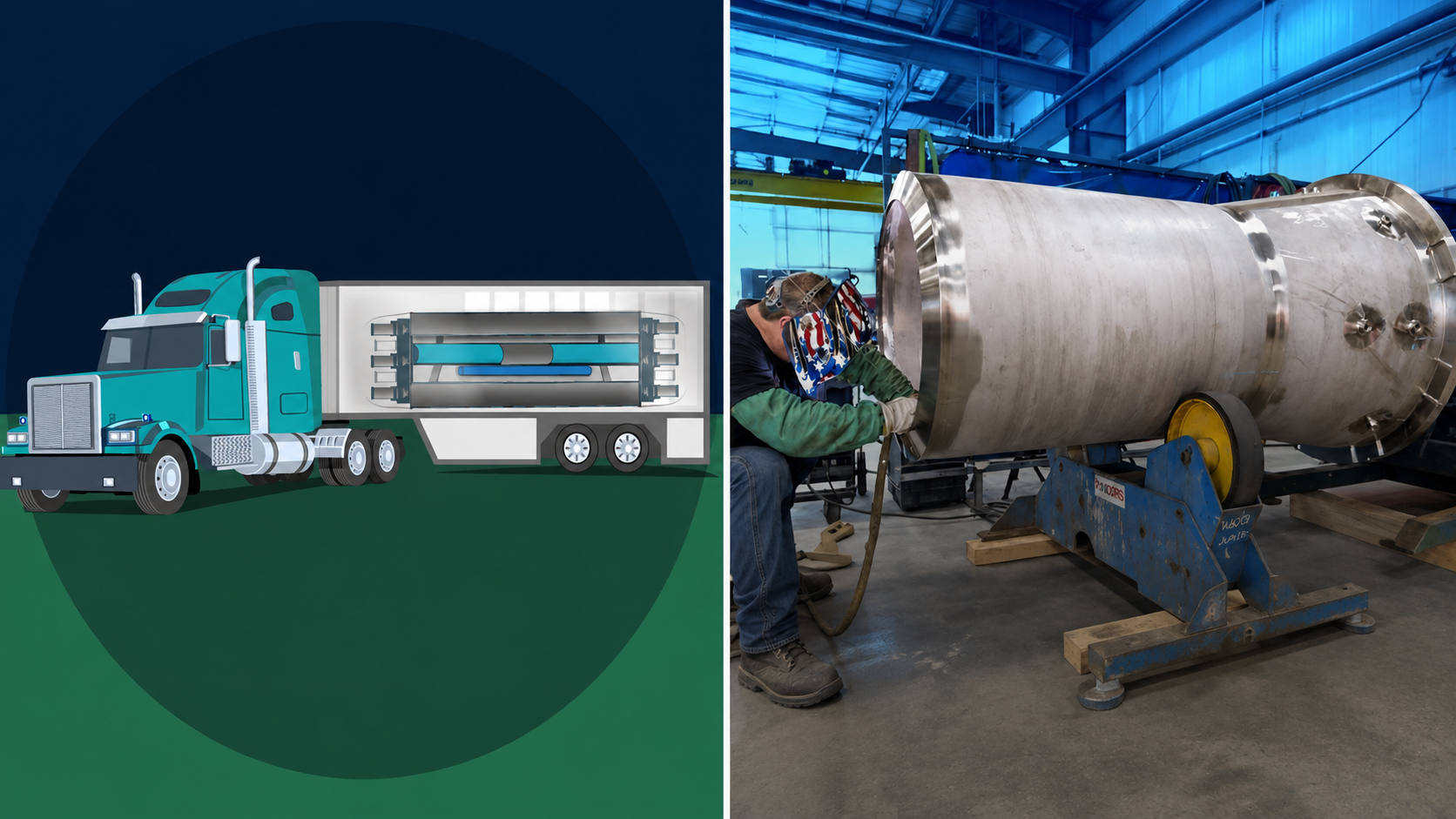
Nuclear power plants are normally associated with enormous buildings, complex construction projects and decades of operation in one location. A developing class of reactors aims to package some of that technology into systems compact enough to be transported by truck.
Known as microreactors, these small nuclear systems are intended to be manufactured and assembled largely in factories before being shipped to the places where their heat or electricity is needed.
Nuclear power designed for transport
The U.S. Department of Energy says most proposed microreactor designs would produce approximately 1–20 megawatts of thermal energy. That heat could be used directly for industrial processes, district heating, water desalination or hydrogen production, or converted into electricity.
Electrical output would be lower than the reactor’s thermal rating because no heat-to-electricity conversion process is perfectly efficient. The precise difference would depend on the reactor and its power-conversion equipment.
Portability is one of the central ideas. DOE describes microreactors as factory-fabricated systems that could be transported by truck, rail, aircraft or ship. In practice, the transport arrangement would vary by design: some developers plan containerized reactors, while others may ship the reactor and supporting equipment as multiple modules.
That could make the technology useful in remote communities, mines, military installations, data centers, disaster-recovery operations and industrial sites that cannot rely on a strong electrical grid. Microreactors are also being considered as alternatives to diesel generators in places where regularly delivering fuel is expensive or difficult.
Long core life—but not the same for every reactor
DOE says some microreactor concepts could operate for up to 10 years without refueling. At the end of the fuel cycle, the reactor or its core could be removed and returned for refueling or replaced with another unit.
However, that figure should not be treated as a specification for every microreactor. Proposed designs differ considerably. Radiant’s containerized Kaleidos reactor, for example, is designed for a five-year operating cycle, while Westinghouse says its eVinci concept could run for eight years or longer before refueling.
The compact reactors are also expected to use passive safety features and simplified controls, although individual designs will still have to demonstrate their performance and satisfy the applicable nuclear safety, security and licensing requirements.
A new place to test the technology
The technology reached an important milestone on April 8, 2026, when the Department of Energy announced the completion of the Demonstration of Microreactor Experiments, or DOME, at Idaho National Laboratory.
DOME repurposes the containment structure of the former Experimental Breeder Reactor-II. The 100-ft-tall, 80-ft-wide facility is designed to host fueled experimental reactors producing up to 20 MW of thermal energy, allowing developers to collect real operating data for design verification and future licensing work.
Radiant’s Kaleidos Demonstration Unit is scheduled to be the first reactor tested there. Opening the facility does not mean truck-delivered commercial reactors are already widely available; DOME exists specifically to move experimental designs through testing and toward possible deployment.
Important questions also remain around cost, licensing, fuel availability, site security, spent-fuel handling and public acceptance. Many proposed systems require specialized nuclear fuel, and every installation would still need suitable infrastructure and regulatory oversight.
Microreactors therefore remain an emerging technology rather than a miniature power plant that communities can order today. But if developers can validate their designs, the ability to manufacture a reactor in a factory, transport it by road and operate it for years between refueling cycles could expand where nuclear energy can realistically be used.
Sources: U.S. Department of Energy, DOE DOME announcement, Idaho National Laboratory