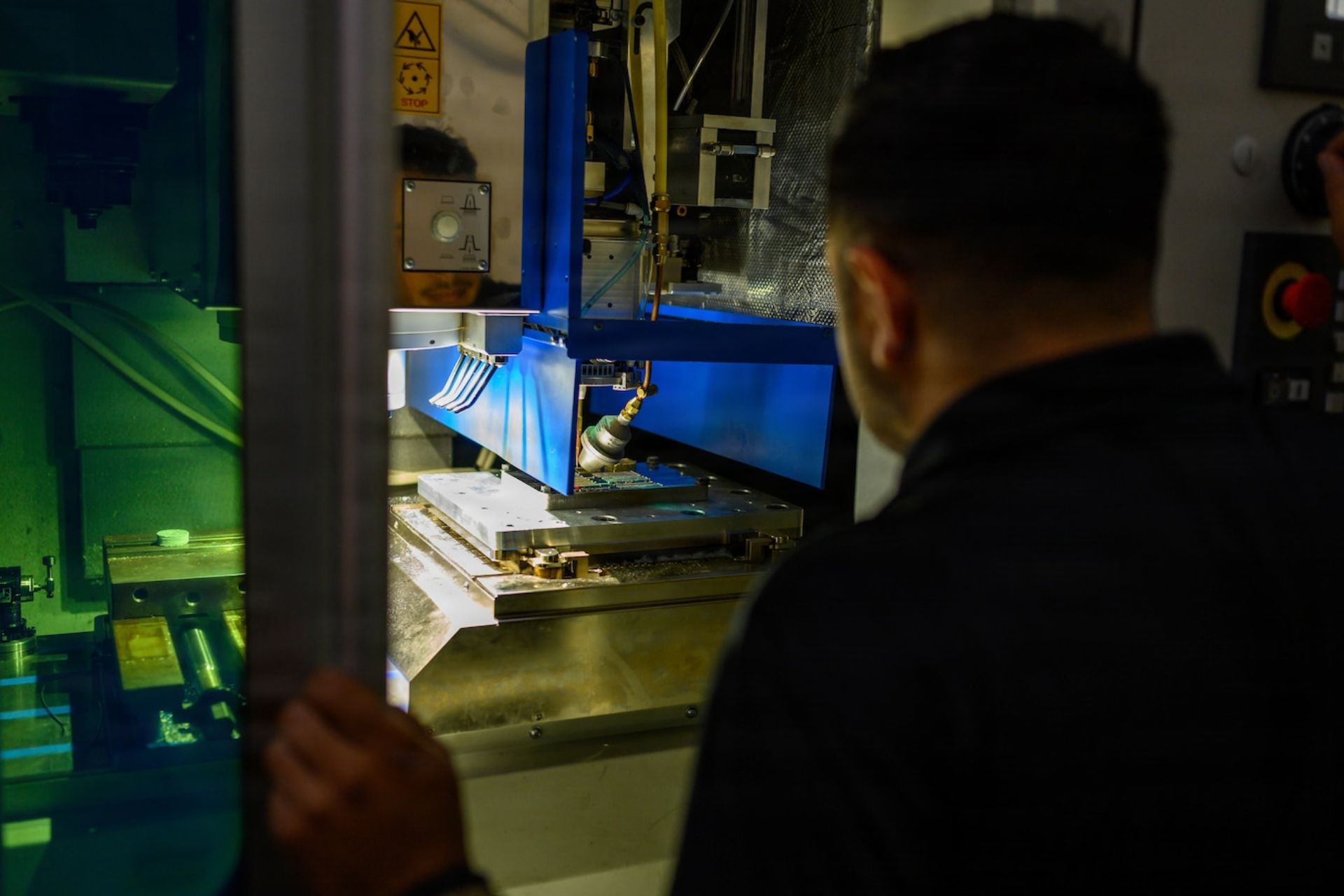
The U.S. Navy has tested a containerized metal-manufacturing system aboard one of its aircraft carriers, bringing selected replacement-part production closer to the equipment that may need repairing.
The ADDiTEC HYBRiD-X was deployed in the hangar bay of the Nimitz-class USS Theodore Roosevelt during Exercise Rim of the Pacific, or RIMPAC 2026. The Navy documented personnel operating the machine in the Pacific while the carrier was travelling to the exercise in June, and formally announced its use on July 3.
According to Commander, U.S. 3rd Fleet, it was the first deployment aboard a U.S. Navy aircraft carrier of a portable, containerized manufacturing platform capable of producing and repairing critical metal components.
A 3D printer and machine shop in one container
HYBRiD-X does more than conventional 3D printing. The system combines laser directed-energy deposition, liquid-metal jetting and CNC machining inside a deployable platform.
Its additive processes build or restore a component by depositing metal from wire feedstock. CNC machining can then remove material to produce the required surfaces and dimensions. Housing both capabilities together means a suitable part can potentially be printed, repaired and finish-machined without being transferred between separate workshops.
The system also supports dual deposition heads and multi-material processing, according to additive-manufacturing industry publication Metal AM.
The carrier trial formed part of a wider advanced-manufacturing network led by the Naval Postgraduate School’s Consortium for Advanced Manufacturing Research and Education, with support from FLEETWERX and the Marine Innovation Unit.
The broader RIMPAC demonstration connected manufacturing equipment aboard several vessels with facilities on land. The aim was to explore how digital production requests could be routed to available machines, with completed items either used onboard or delivered where required.
Why manufacture replacement parts at sea?
A carrier operating far from a depot may otherwise have to wait for a component to move through the normal supply chain and reach the ship by aircraft or replenishment vessel. If an approved digital design and compatible material are available, onboard manufacturing could shorten that delay.
The Navy says the capability is intended to support faster repairs, greater unit-level self-sufficiency and improved readiness during extended deployments. Aviation Structural Mechanic 1st Class Scott Barber said the central idea was to diagnose a problem, develop a solution and significantly reduce replacement-part lead time.
However, the deployment does not mean USS Theodore Roosevelt can print anything it needs. Parts must suit the system’s materials, deposition processes and machining envelope. They must also pass the Navy’s applicable engineering, inspection and safety requirements—particularly when failure could affect an aircraft, propulsion equipment or another critical system.
The Navy’s announcement did not provide a list of specific carrier parts produced, manufacturing times or qualification results from the HYBRiD-X trial. The most defensible conclusion is therefore that RIMPAC demonstrated the deployment and operation of the hybrid metal-manufacturing platform aboard a carrier, rather than proving that it can replace the ship’s conventional supply chain.
Even with those limits, putting a compact metal printer and precision machine shop inside a transportable container could give deployed ships another option when the right replacement part is urgently needed and shore support is far away.
Sources: Commander, U.S. 3rd Fleet, U.S. Navy, Metal AM