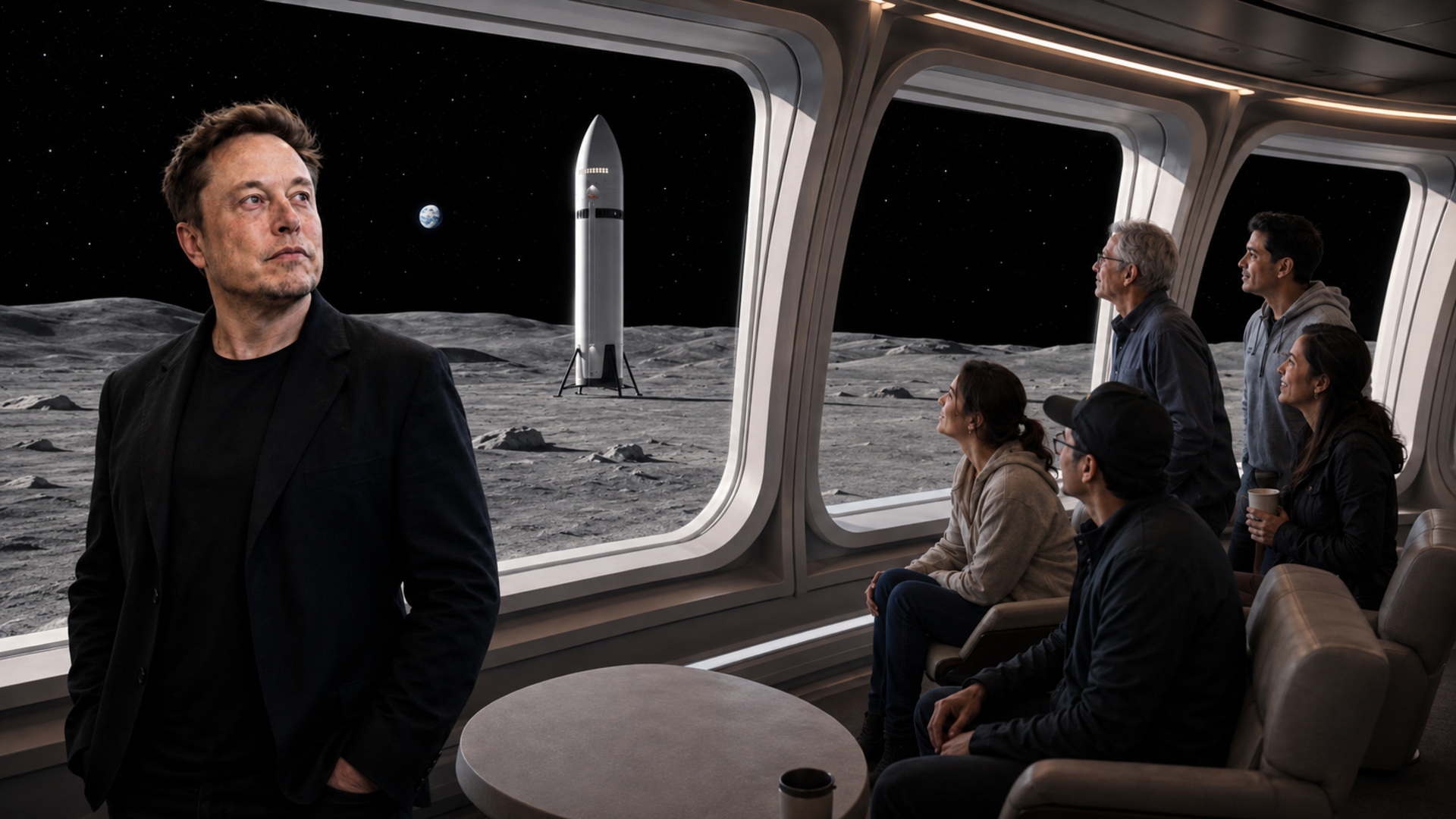
Elon Musk says SpaceX ultimately wants travel to the Moon to become available beyond the small group of professional astronauts currently able to make the journey.
“Moonbase Alpha will be so cool,” Musk wrote on X on August 11. “And we want to make it so that anyone can go to the Moon if they want.”
The statement describes a long-term ambition rather than a passenger service with published dates and ticket prices. Achieving it would depend heavily on Starship, SpaceX’s enormous reusable launch and spacecraft system, together with a network of tanker vehicles and orbital propellant depots.
Starship is designed to move infrastructure, not only people
SpaceX says Starship could use refueling in Earth orbit to deliver up to 100 metric tons (220,000 lb) directly to the lunar surface. That capacity is intended to carry equipment such as habitats, rovers, supplies and other hardware needed to establish a permanent presence.
For lunar missions, tanker versions of Starship would launch propellant into orbit. A depot would store that fuel, while a lunar Starship would fill its tanks before departing for the Moon. This architecture is essential because a fully loaded lunar lander cannot complete the planned mission using only the propellant it carries from its initial launch.
SpaceX’s current Moon page says cargo flights to the lunar surface could begin no earlier than 2028. It also invites prospective customers to contact the company about human spaceflight missions, including lunar flybys and landings. However, SpaceX has not published a routine passenger schedule, public seat price or eligibility process.
NASA will test the lander before attempting a crewed landing
SpaceX is separately developing a specialized Starship Human Landing System for NASA’s Artemis program. Unlike an Earth-returning Starship, the lunar version does not require atmospheric re-entry flaps or a vehicle-wide heat shield. It adds equipment for operating on and around the Moon, including crew-support systems, airlocks and an elevator for reaching the surface.
NASA revised its Artemis architecture in 2026. Artemis III is now planned as a crewed demonstration in low Earth orbit in mid-2027, where Orion will test rendezvous and docking with trial versions of commercial landers from SpaceX and Blue Origin.
The agency is targeting early 2028 for Artemis IV, which is intended to make the program’s first crewed lunar landing. NASA says the readiness of the competing commercial landers will determine which provider transports the astronauts to the surface.
Before carrying people down to the Moon, Starship must still complete major milestones. These include reliable launches, extended operations in space, large-scale orbital propellant transfer and at least one uncrewed Starship landing on the lunar surface that meets NASA’s requirements.
That makes Musk’s vision considerably more ambitious than the already difficult task of completing NASA’s first Starship-assisted lunar mission. A permanent base would require repeated cargo deliveries, dependable power, life support, surface transportation, radiation protection and a sustainable way to maintain equipment far from Earth.
For now, “anyone” should therefore be read as a statement of intent rather than literal present-day access. SpaceX is developing the transportation system and accepting inquiries, but ordinary members of the public cannot yet select a date and book a conventional trip to the Moon.
Sources: Elon Musk on X, SpaceX, NASA