

Running delivers an efficient cardiovascular workout, but every stride also sends the body into the ground. Cycling removes those repeated foot strikes, although its seated motion can feel very different to someone accustomed to running.
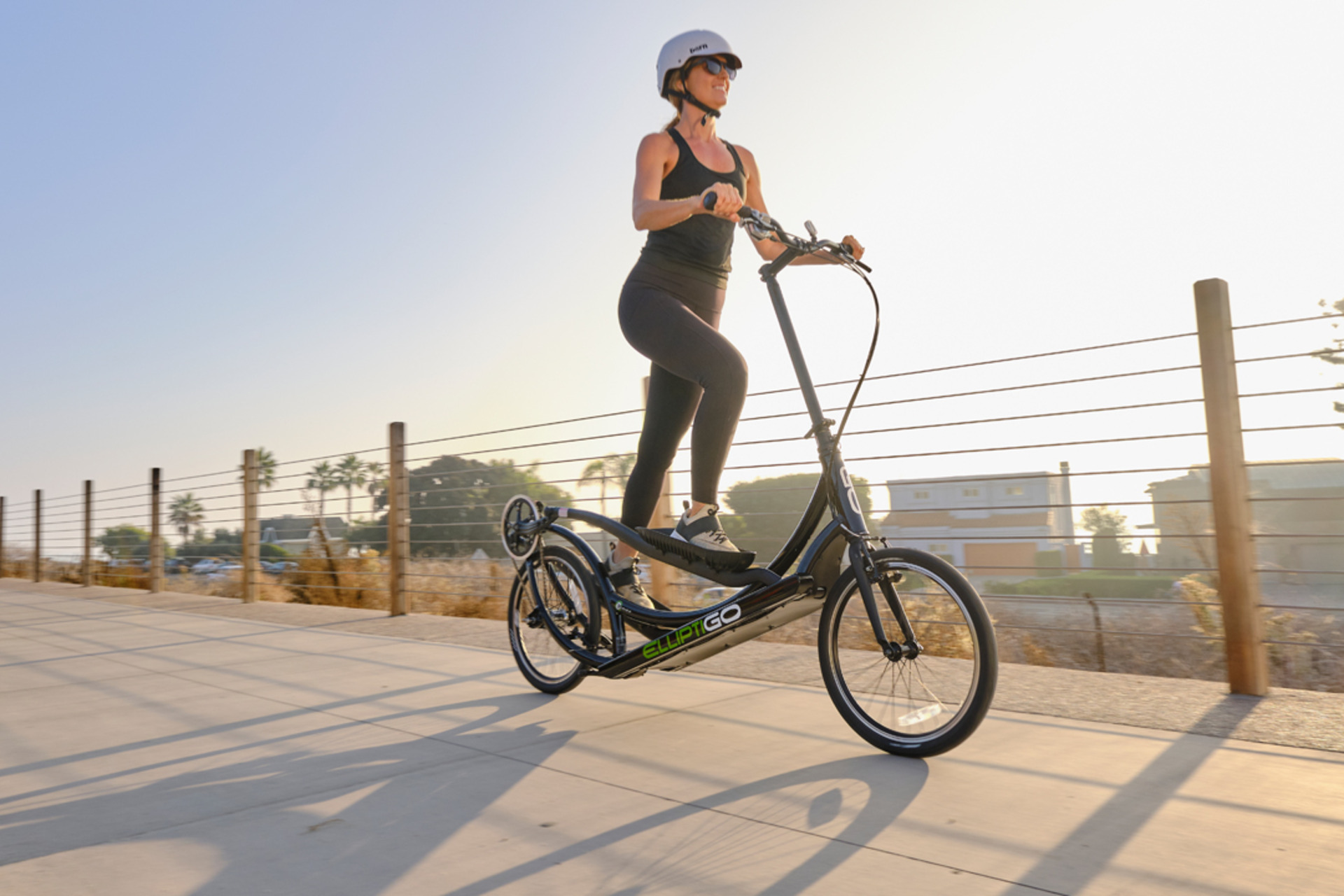
California company ElliptiGO created another option: a two-wheeled outdoor elliptical ridden while standing upright. Its foot platforms slide forward and backward to create a running-style motion while the machine supports the rider’s weight.
An elliptical trainer that leaves the gym
The ElliptiGO 8C is the company’s central long-stride model. Each foot stands on a large platform connected to the patented Elliptidrive system. The adjustable stride measures approximately 16–25 inches (41–64 cm), allowing the legs to move through a longer path than conventional bicycle pedals provide.
There is no saddle. Riders stand tall, steer through an adjustable handlebar column and use hand-operated brakes. Eight internal gears prepare the 8C for both flat routes and hills.
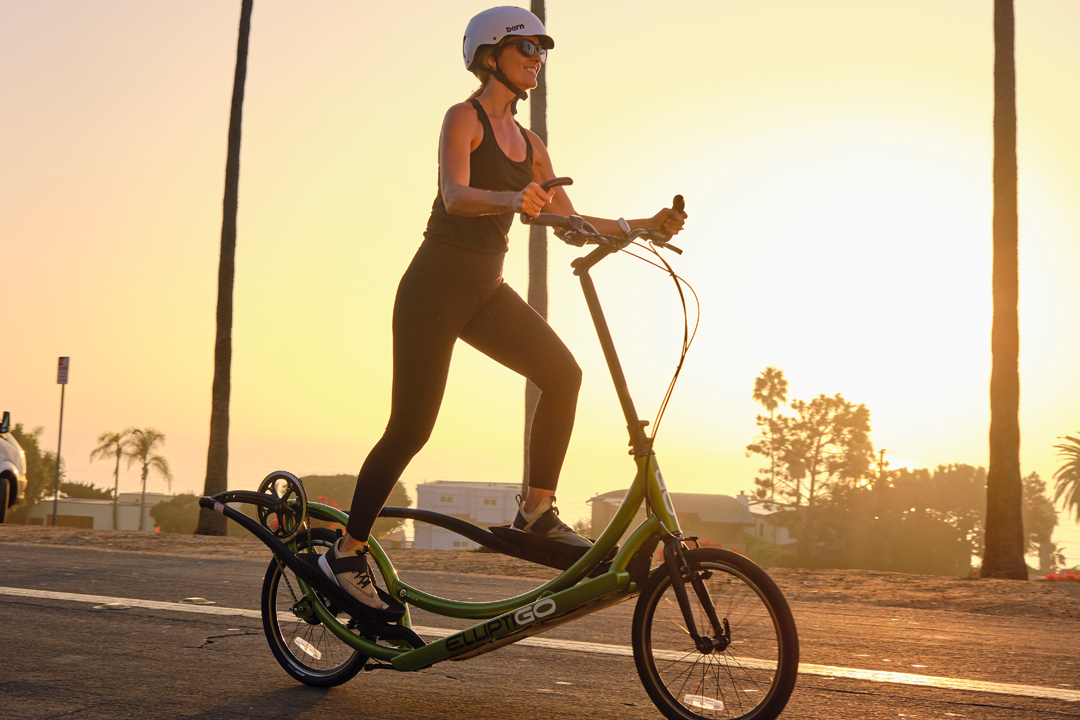
The elevated position eliminates bicycle-seat pressure but creates more aerodynamic drag, so it cannot match a road bike’s efficiency. ElliptiGO says most riders travel at around 12–16 mph (19–26 km/h).
Why runners use it for cross-training
ElliptiGO says its bikes are used by hundreds of elite runners and more than 300 university and high-school programs. The attraction is straightforward: athletes can continue accumulating cardiovascular training time without adding the repeated ground impact of another run.
A small peer-reviewed crossover study provides some support for that use. Twelve experienced runners completed separate four-week blocks of ElliptiGO-only and run-only training, producing broadly similar maintenance or improvement across several physiological and performance measures. The limited sample and duration do not establish injury prevention or universal results.
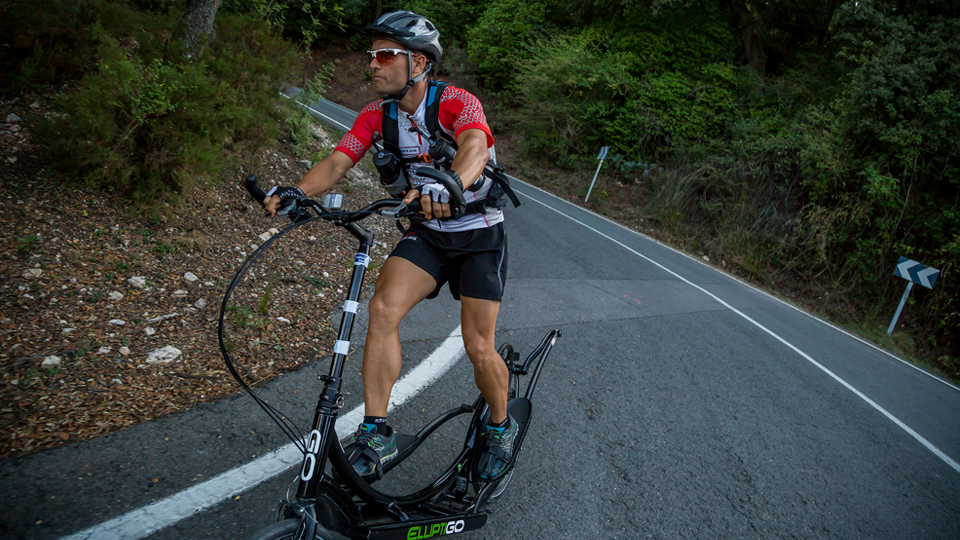
Separate metabolic testing conducted at the University of California, San Diego found that riding an ElliptiGO required about 33% more energy than conventional cycling at the same speed. That comparison is speed-specific—not a promise that every ride will burn exactly one-third more calories. Body weight, pace, wind, hills and fitness all affect the result.
More than one kind of stand-up bike
ElliptiGO’s long-stride family includes the three-speed 3C, eight-speed 8C and lighter 11-speed 11R. The premium 11R adds carbon-fiber drive arms, a broader gear range and a folding steering column.
The RSUB road bike and suspension-equipped MSUB mountain bike retain the upright position but use circular pedals. Adjustable controls accommodate riders from roughly 4 ft 11 in to 6 ft 8 in (1.5–2 m). Weight limits are 250 lb (113 kg) for long-stride models and 300 lb (136 kg) for the stand-up bikes.
Practical compromises include the machines’ unusual length, limited compatibility with standard bicycle racks and the need to clean the tracks and load wheels on long-stride models. ElliptiGO also requires bicycle-style balancing and road awareness, making a test ride worthwhile before buying.
Pricing and availability
ElliptiGO’s US website lists the 3C at $2,499, the 8C at $2,999 and the 11R at $3,999. The circular-pedal RSUB and MSUB are listed at $1,499 and $1,799, respectively. Temporary promotions may reduce these prices.
An optional $599 Fluid 365 trainer converts the bikes for stationary indoor use, while $1,399 electric conversion kits add pedal assistance and a throttle to compatible models. For runners who want an outdoor workout that feels more familiar than seated cycling, however, the unpowered long-stride mechanism remains ElliptiGO’s most distinctive idea.
Source: ElliptiGO bike range


