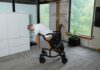
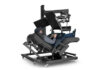
Long hours at a desk, extended journeys and periods of limited mobility can all leave the feet and lower legs doing very little. FitFoot is a compact exercise pedal designed to introduce controlled ankle movement without requiring the user to leave their chair.
Instead of using a motor, batteries or electrical stimulation, the device relies on a rocking platform and elastic resistance bands. Pressing the front of the foot down and then drawing the toes upward moves the ankle through plantarflexion and dorsiflexion—the same basic directions involved in familiar ankle-pump exercises.
At just 0.6 lb (272 g), FitFoot is considerably smaller than a conventional under-desk cycle. It folds for transport, includes a travel bag and is intended for use at home, at work or while traveling. Its manufacturer, TS Medical, also positions it for rehabilitation and athletic recovery, although those uses should be discussed with an appropriate healthcare or fitness professional.
A rocking pedal rather than an exercise bike
FitFoot is designed around one specific motion. The user places a foot on its platform and alternates pressure between the ball of the foot and the heel. This rocks the platform forward and backward against the resistance bands, engaging muscles around the foot, ankle and calf.
That makes it different from a miniature bicycle. There are no circular cranks, flywheel or linked pedals, and the written instructions describe exercising one foot at a time.
The setup process is intentionally simple. The user unfolds the device, clicks its supporting legs into position and places it on the floor. TS Medical recommends sitting with the legs at approximately a 90-degree angle before positioning a foot on the pedal. Non-slip surfaces on the platform and feet are intended to help keep the unit stable.
FitFoot is strictly a seated exerciser. The manufacturer explicitly warns users not to stand on it, so its 0.6-lb weight should not be mistaken for a platform designed to support a person’s full body weight.

Resistance can be changed with elastic bands
The standard FitFoot uses four blue silicone-based bands, each described by the company as offering 6 lb of resistance. Optional black bands are rated at 9 lb each and can replace or be mixed with the standard bands for a more demanding movement.
Those individual ratings should not simply be added together and advertised as one total resistance figure. The force produced by an elastic band changes as it stretches, and TS Medical does not publish a complete resistance curve for the pedal’s range of motion.
The adjustable arrangement nevertheless gives FitFoot an advantage over an unsupported ankle pump: users can introduce resistance and change the challenge as their requirements evolve. Someone using it as part of rehabilitation should follow a clinician’s recommendation rather than automatically choosing the heaviest configuration.

Why move the ankles while sitting?
Contractions of the calf muscles help return blood from the lower legs toward the heart, which is why the calf-muscle pump is sometimes called the body’s “second heart.” Repeated ankle flexion and extension activates these muscles instead of leaving the lower legs completely inactive.
The general principle is well established. The US Centers for Disease Control and Prevention advises people on long journeys to move their legs frequently and exercise their calf muscles. Its suggested movements include extending the legs and flexing the ankles by drawing the toes toward the body. When possible, it also recommends getting up and walking every one to two hours.
FitFoot packages that familiar movement into a guided, resistance-based device. Potential users include office workers, passengers, older adults and people whose mobility makes regular walking more difficult. The compact design could also make it easier to keep the exerciser nearby instead of storing a larger machine elsewhere.
It is important, however, to distinguish evidence for ankle movement generally from evidence for this particular product. TS Medical says FitFoot supports circulation, mobility, range of motion, strength and stability, but no peer-reviewed clinical trial evaluating FitFoot itself was found during our research. Customer testimonials concerning swelling, neuropathy, pain or post-surgical recovery are personal reports, not controlled medical evidence.

Possible uses beyond the desk
TS Medical promotes FitFoot for several settings. Travelers can pack the folded unit in its supplied bag and use it when space and transport rules permit. People who spend the day at a computer can place it beneath a desk, while athletes may incorporate resisted ankle movement into a warmup or cooldown.
The company also markets it to physical-therapy and rehabilitation users. Its variable resistance and controlled movement may be useful in a professionally designed program, but suitability depends on the person’s injury, strength, range of motion and medical history.
FitFoot should not be regarded as a substitute for walking, whole-body exercise, prescribed physical therapy, compression garments or medication. It concentrates on a relatively small group of lower-leg movements and cannot reproduce the cardiovascular or musculoskeletal demands of getting up and moving around.
People recovering from surgery or living with vascular disease, a previous blood clot, severe swelling, neuropathy, impaired sensation or a significant orthopedic or neurological condition should obtain medical advice before beginning resisted ankle exercise. Unexplained one-sided swelling, warmth, redness or leg pain requires medical assessment rather than self-treatment with an exercise product.

Designed by a surgeon and made in the USA
FitFoot is produced by TS Medical LLC, a woman-owned company based in McLean, Virginia. The official website says the product was designed by a doctor but does not identify the individual on its principal product pages. An intellectual-property profile published by law firm Jones Robb names surgeon and entrepreneur Dr. Mary Anne Tarkington as the inventor behind FitFoot.
The device is designed and manufactured in the United States. TS Medical describes its construction as “medical-grade” and says it has been tested for repeated use. The website does not provide a specific FDA clearance number or independent certification corresponding to the term, so it is most accurate to treat “medical-grade” as the manufacturer’s product description.
TS Medical also holds design patents relating to the appearance of its portable foot, ankle and leg exerciser.
Pricing and availability
FitFoot is currently listed for $89.95 through its Amazon product listing. Amazon prices and availability can change, so buyers should confirm the final price and delivery estimate before ordering.
TS Medical provides a 90-day warranty against defects in materials or workmanship. Customers who are simply dissatisfied have 30 days from receipt to request a return. The company’s policy says orders are normally processed within one to three business days and standard UPS Ground delivery takes approximately six to ten business days.
FitFoot is ultimately a straightforward device: a portable platform that adds resistance and structure to seated ankle pumps. Its small size and lack of electronics are its clearest practical strengths. The most responsible way to view it is as a convenient movement aid—not as a replacement for walking or a proven treatment for circulatory and neurological conditions.
Source: FitFoot