Mobility aids generally fall into well-defined categories. Walkers help users maintain balance while walking. Wheelchairs provide seated mobility. Lift chairs assist with standing up. For individuals whose mobility needs span multiple situations throughout the day, switching between different devices can become cumbersome.
The Zeen mobility device was designed to bridge some of those gaps by combining several mobility functions into a single platform. Developed by Exokinetics, the device allows users to walk, sit, stand, coast, or receive assistance from a caregiver while remaining in the same mobility system.
The concept is unusual enough that many first-time observers struggle to categorize it. It is not quite a walker, not quite a wheelchair, and not simply a standing aid. Instead, it combines elements of all three.
Designed for more than walking
At its core, the Zeen is intended to support people who have difficulty walking due to weakness, balance issues, neurological conditions, injury recovery, or age-related mobility challenges.
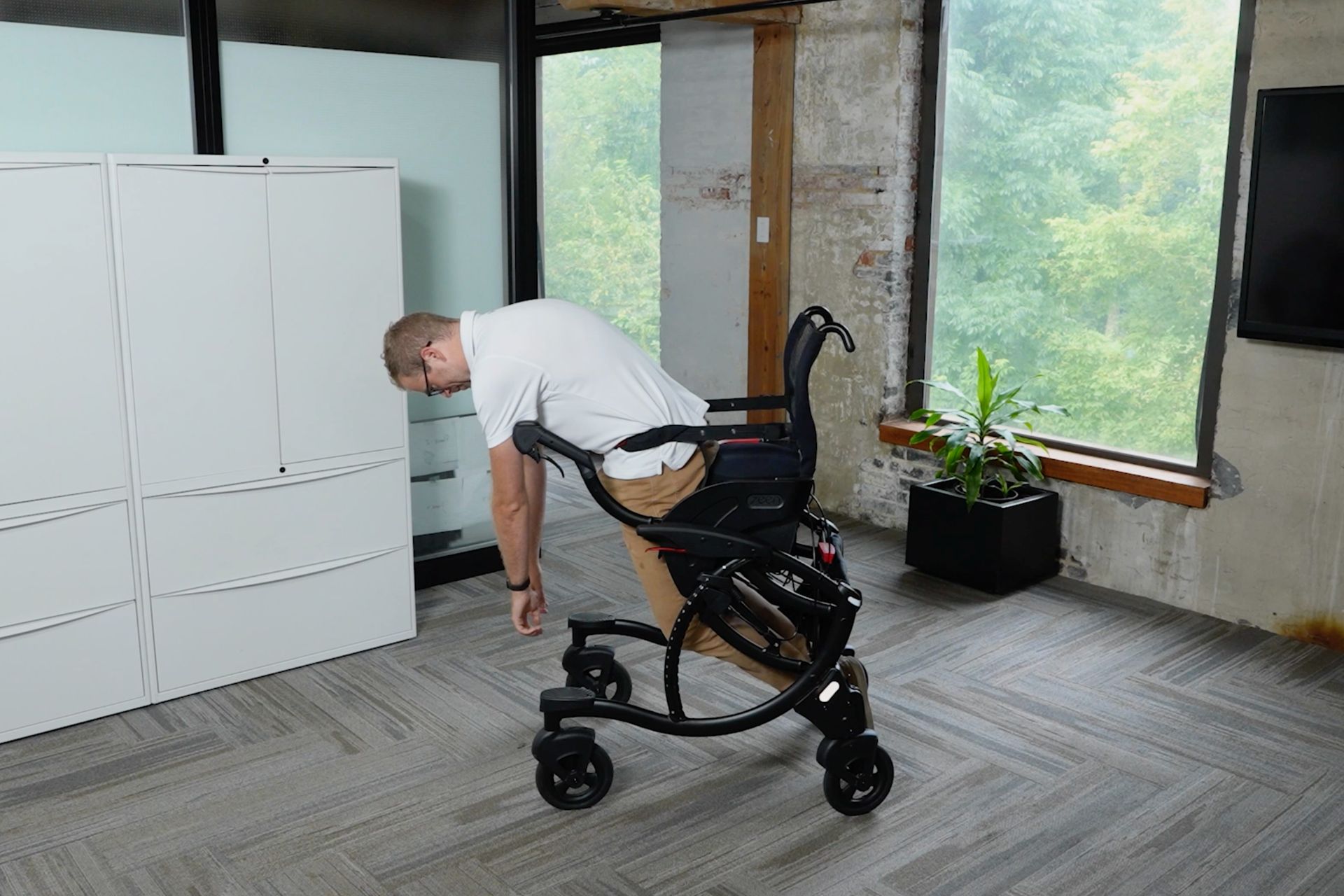
Unlike traditional walkers that require users to support themselves through their arms and hands, the Zeen incorporates a suspended seat and support harness. This allows users to remain upright while reducing the amount of body weight carried by their legs.

One of the most noticeable features is that users can often walk while keeping both hands free. This creates a more natural walking posture and allows them to perform simple tasks, carry light items, or interact with their surroundings while moving.
The design aims to provide mobility support without forcing users into a permanently seated position.
Built-in fall prevention
Falls are a major concern for individuals with mobility limitations. Traditional walkers can improve stability, but they do not necessarily prevent a fall if a user loses balance completely.
The Zeen addresses this issue through an integrated safety system that includes a supportive seat and belt arrangement. If the user stumbles, the device is designed to catch and support them before they reach the ground.
This approach allows users to move with greater confidence, particularly during rehabilitation or when recovering from injuries that affect balance and coordination.
The fall-prevention capability is one of the device’s defining characteristics and distinguishes it from many conventional mobility aids.
Mechanical lift assistance
Standing up from a seated position can be one of the most physically demanding daily activities for people with reduced strength.
To help address this challenge, the Zeen incorporates what the company describes as Assistive Lift Technology.
Rather than relying on electric motors, batteries, or powered actuators, the system uses a mechanical design that can support up to 75 percent of a user’s body weight during sit-to-stand transitions.
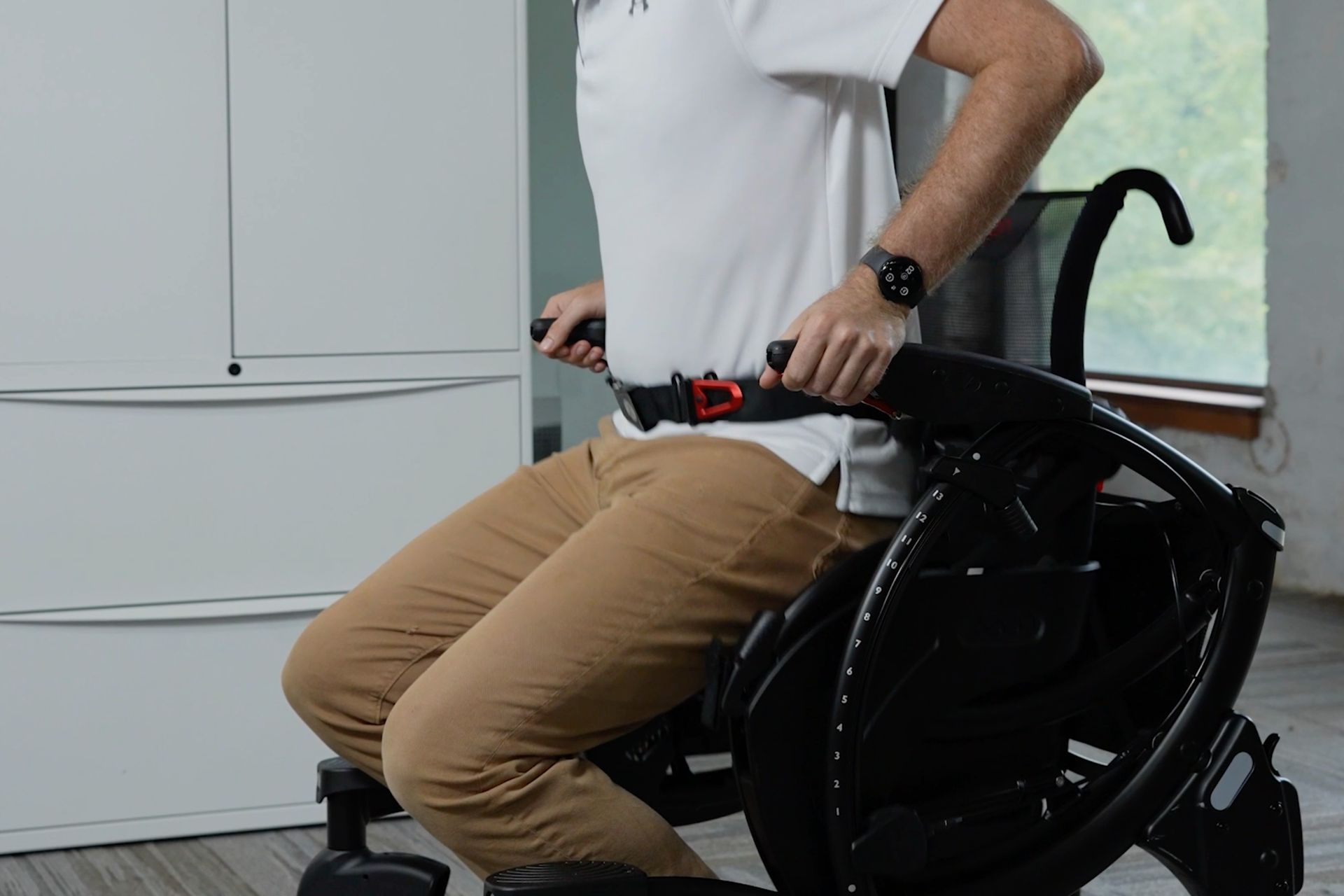
The user activates the system by squeezing a lever, helping reduce the effort required to stand up independently.
Because the mechanism is mechanical rather than motorized, it avoids many of the maintenance and charging requirements associated with powered mobility equipment.
A mobility aid that can coast
One of the most unusual capabilities of the Zeen is its ability to transition from walking support into a coasting mode.
When users become fatigued, they can shift more of their weight into the suspended seat and glide forward using the device’s wheels.
This allows individuals to continue moving while conserving energy, which can be particularly beneficial for people living with conditions that cause fatigue, muscle weakness, or reduced endurance.
The ability to alternate between walking and coasting throughout the day can provide flexibility that is difficult to achieve with a conventional walker.
Adjustable seating for daily activities
The Zeen is also designed to function as a mobile seat.
Its adjustable seating height allows users to sit at different levels depending on the situation. This can help during meals, social gatherings, recreational activities, or other everyday tasks where remaining at eye level with family and friends is important.

Rather than transferring to another chair, users can often remain in the Zeen and adjust their seating position as needed.
This reduces the number of transfers required during the day, which can be beneficial for individuals with limited strength or mobility.
Support for caregivers
The device also includes a caregiver push mode.
When a user becomes tired or requires additional assistance, a caregiver can push the Zeen similarly to a transport chair.
This feature provides flexibility in situations where independent mobility may not be practical for the entire duration of an outing.
The ability to switch between self-directed mobility and caregiver-assisted transport helps broaden the range of environments where the device can be used.
Who is it designed for?
According to the company, the Zeen has been used by individuals living with a wide range of mobility-affecting conditions.
These include Parkinson’s disease, Multiple Sclerosis, Cerebral Palsy, Ataxia, Muscular Dystrophy, Spinal Muscular Atrophy, Spina Bifida, stroke recovery, and other neurological or physical conditions that impact balance, walking ability, or endurance.
As with any mobility aid, suitability depends on an individual’s specific condition and needs, but the broad range of supported use cases highlights the device’s versatility.
Filling a gap between walkers and wheelchairs
Many mobility products focus on a single task. Walkers help users walk. Wheelchairs help users travel while seated. Standing aids help users transition between positions.
The Zeen attempts to combine several of these functions into one device.

Whether that approach makes sense for a particular user depends on their mobility goals and physical requirements. However, the concept itself addresses a challenge that many people face: needing different levels of support throughout the day rather than a single solution.
By allowing users to walk, coast, sit, stand, and receive caregiver assistance when necessary, the Zeen occupies a niche that has remained relatively underserved in the mobility market.
For individuals seeking a mobility device that offers flexibility beyond a traditional walker or wheelchair, the Zeen represents an interesting example of how mobility technology continues to evolve toward more adaptable and user-centered designs.
Pricing and availability
The Zeen mobility device is available directly from the manufacturer’s website, with pricing starting at $4,840 for the Standard model and $5,420 for the Deluxe one-handed control version. Buyers can choose from several configurations based on user weight and mobility requirements, and the company also offers online and in-person product demonstrations.
Source: Zeen