If the prospect of a 22-hour non-stop flight from Sydney to London sounds appealing, the timeline just moved forward. Airbus has announced the maiden flight of the A350-1000ULR — Ultra Long Range — a widebody twin-engine jet with a range of nearly 10,000 nautical miles, and the aircraft that will form the backbone of Qantas’s Project Sunrise programme.
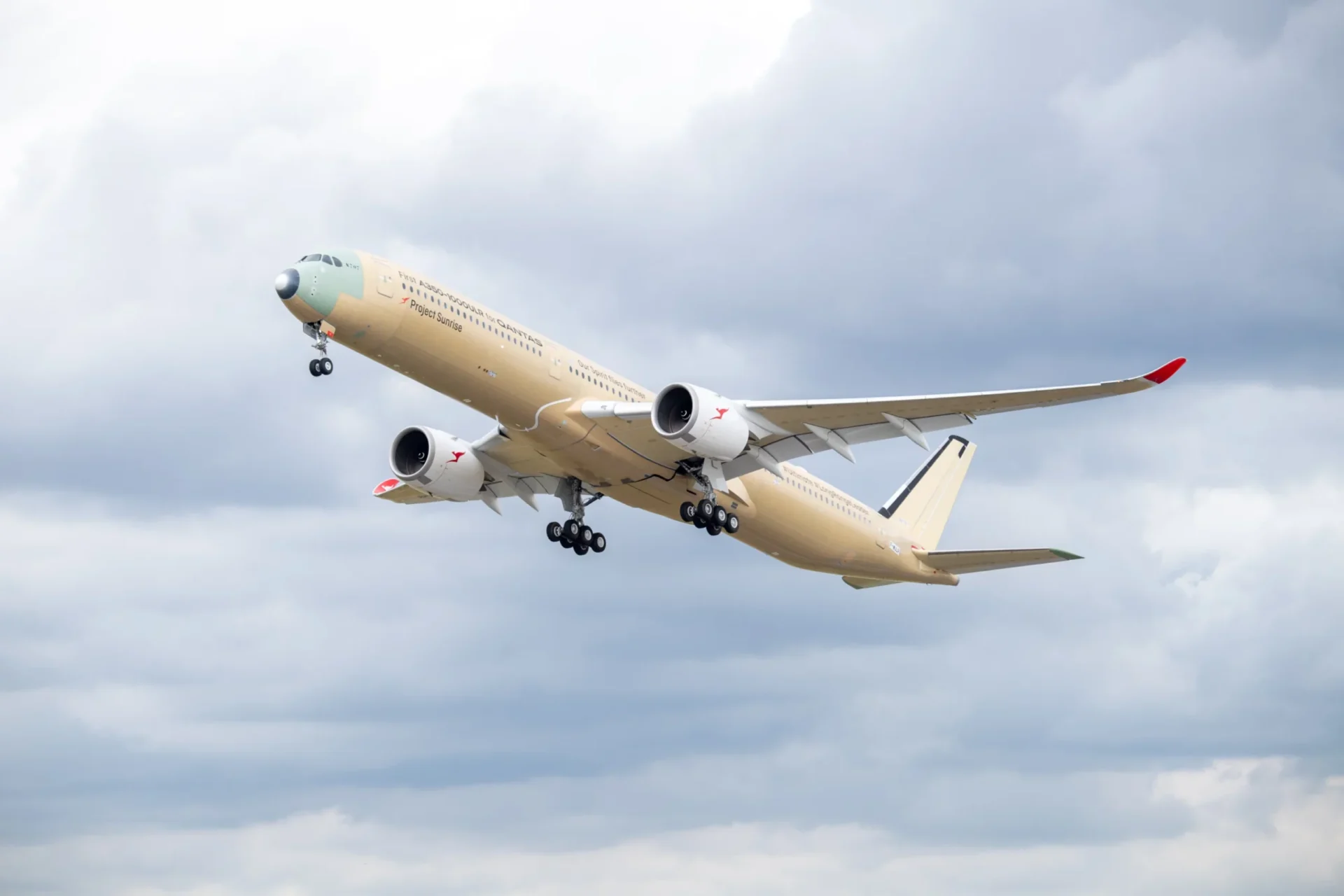
Image caption: The Airbus A350-1000ULR during its maiden flight from Toulouse on June 2, 2026 — the aircraft that will eventually operate Qantas’s non-stop antipodal routes.
Flying between Australia’s east coast cities and destinations such as London or New York has always demanded patience and planning. In the post-war years, the journey by steamship could take up to four weeks. Seaplanes offered a faster option — around 12 days with nine stops along the way. When jet airliner services launched in 1959, the trip was cut to 33 hours with three refuelling stops. Decades of further development have compressed the journey further, but even today, routes between Sydney or Melbourne and London or New York still require at least one stopover — typically at hubs such as Singapore, Dubai, Los Angeles, or Dallas — adding up to four hours to the total travel time, along with the familiar frustrations of connections, customs, delayed baggage, and potential missed flights.
That is precisely the problem Qantas set out to solve with Project Sunrise. The airline’s ambition goes beyond shaving hours off the journey. It sees ultra-long-haul non-stop routing as a way to attract more premium-fare passengers, reduce exposure to foreign airport regulations, landing-slot restrictions, and regional geopolitical disruptions, and to modernise its long-haul fleet in one step.
The aircraft at the centre of that plan — the A350-1000ULR — lifted off from Airbus’s Toulouse facility on June 2, 2026, for a maiden test flight that lasted three hours and 43 minutes and reached an altitude of 41,000 ft (12,500 m). It is a derivative of the standard A350-1000, modified primarily through the addition of a new 20,000-litre (5,283 US gallon) rear centre fuel tank. That extra capacity extends the aircraft’s operational range by approximately 1,000 nautical miles over the baseline variant, bringing the total to nearly 10,000 nautical miles (about 11,500 miles / 18,500 km). In its planned Qantas configuration, the aircraft will carry 238 passengers across four cabin classes. A lighter galley cooling system using high-efficiency refrigeration units has also been incorporated, prioritising energy consumption and cabin odour management on flights that will routinely exceed 20 hours.
Airbus says that once the flight test campaign is completed, the test aircraft will be retrofitted into Qantas’s commercial configuration. Meanwhile, a second aircraft is already at an advanced stage of final assembly and is currently being painted in Qantas livery before moving on to cabin installation and engine fitting. That aircraft is expected to become the first delivered to Qantas in April 2027. The airline plans to operate a fleet of 12 ultra-long-range variants. Whether 22 hours in a single cabin — however well-appointed — constitutes an improvement over a brief stopover in Singapore remains, perhaps, a matter of personal preference.
Source: Airbus