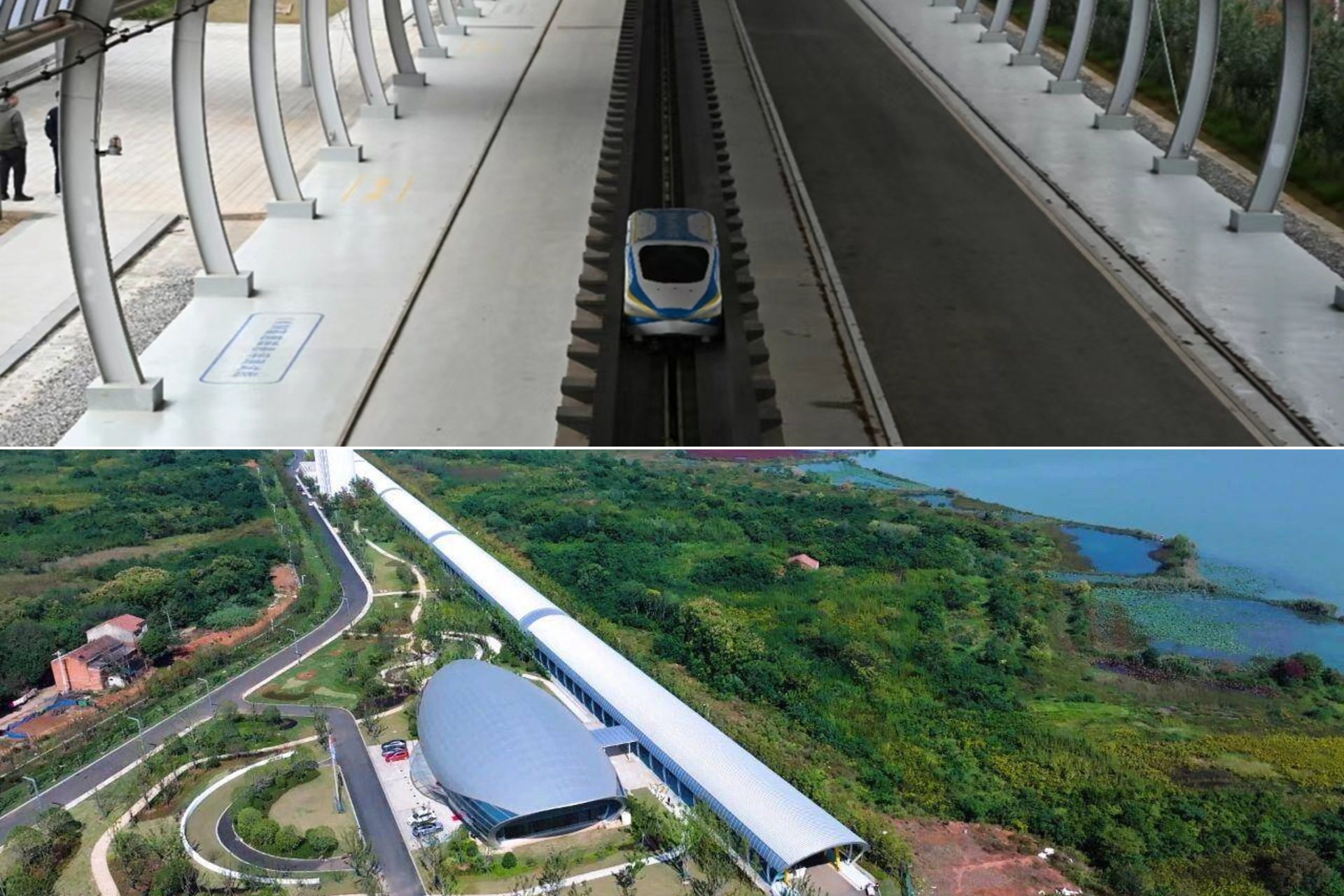
A 1.11-tonne vehicle accelerating from rest to nearly 500 mph in little more than five seconds sounds more like a missile launch than a train test.
But that is what researchers at East Lake Laboratory in China’s Hubei province say they achieved with an experimental magnetic-levitation vehicle.
The streamlined model reached 800 km/h (497 mph) in 5.3 seconds on a purpose-built track measuring just 1,000 m (3,281 ft) long.
It is an extraordinary acceleration figure, although the machine should not be confused with a passenger-carrying train or a railway system ready for commercial service.
It reached top speed after about 600 meters
According to Xinhua, the 1,110-kg (2,447-lb) model reached its maximum speed near the 600-m (1,969-ft) point. The entire run lasted approximately eight seconds, with the vehicle braking to a controlled stop before reaching the end of the one-kilometer test line.
Converting 800 km/h gives a speed of approximately 222 m/s. Based simply on the change in velocity over 5.3 seconds, that represents an average acceleration of roughly 41.9 m/s², or 4.3 times Earth’s gravitational acceleration.
That calculation does not mean the acceleration remained perfectly constant throughout the run, but it illustrates why this platform is suitable for unmanned model testing rather than carrying passengers in its present form.
The result was achieved using what East Lake Laboratory describes as a permanent-magnet electric suspension guidance system combined with electromagnetic propulsion.
Instead of conventional wheels supplying traction against rails, magnetic forces support and guide the vehicle while linear motors propel it along the track. Removing wheel-to-rail contact avoids the adhesion limits and mechanical friction associated with ordinary trains, although aerodynamic drag becomes increasingly severe at such high speeds.
The laboratory increased the record three times
The 800-km/h run was the culmination of a series of progressively faster tests on the same platform.
East Lake Laboratory publicly demonstrated a 1,030-kg (2,271-lb) vehicle reaching 650 km/h (404 mph) on June 16, 2025. The research team raised the figure to 700 km/h (435 mph) on July 14 before reaching 800 km/h on November 24.
Science and Technology Daily reported that researchers spent the following month conducting repeated tests of speed-control accuracy, high-speed levitation stability, efficiency, reliability and overall system operation before the result was announced.
The team says this was its third world record on the same type of short-distance platform within six months. That claim comes from the laboratory and Chinese state media; publicly available reporting does not identify an independent international record-certification body.
Why build such a short and fast test track?
A conventional high-speed test line needs a long distance to accelerate, collect data and stop. East Lake Laboratory’s approach concentrates those processes into one kilometer using powerful electromagnetic propulsion and highly precise position and speed control.
The platform is intended primarily as a research tool. It can expose models and equipment to extreme speed, acceleration, aerodynamic forces and vibration without requiring researchers to construct tens of kilometers of track.
Xinhua says the system had to address several difficult problems, including aerodynamic stability at very high speed, low-latency wireless communication and precise control of the linear motors.
East Lake Laboratory plans to make the test line available as an open research platform. Potential applications include next-generation maglev transportation, aerodynamic model testing, ultra-high-speed electromagnetic sleds and electromagnetic launch research for aerospace systems.
That does not mean commuters will soon travel at 800 km/h on a train that accelerates this quickly. A passenger system would require much gentler acceleration, a substantially longer route and extensive work on safety, comfort, infrastructure, switching, emergency procedures and commercial viability.
What the test demonstrates is narrower but still significant: a one-tonne experimental vehicle can be magnetically supported, accelerated to 800 km/h and safely stopped within a track only one kilometer long.
Source: Xinhua