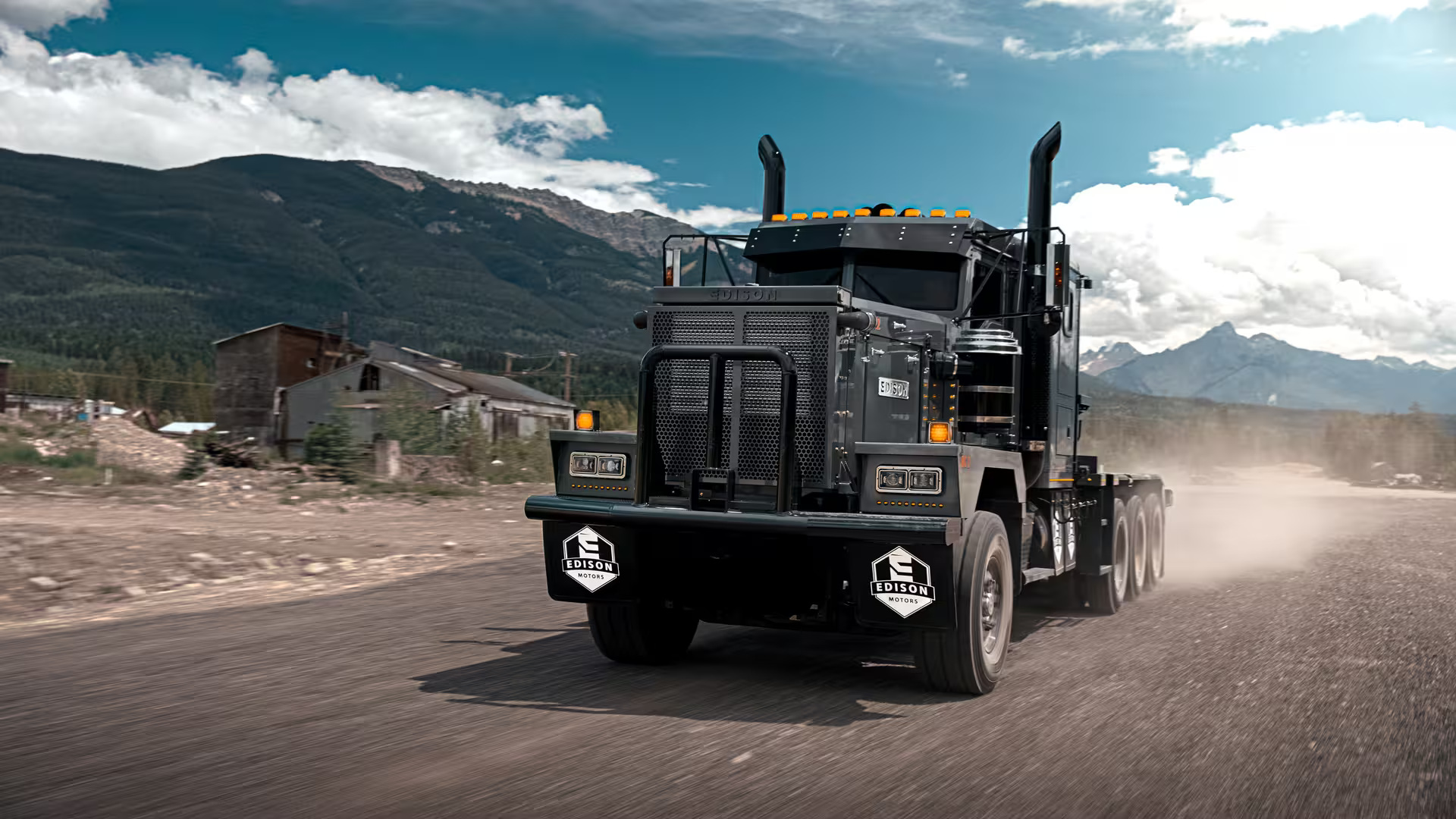
Battery-electric trucks can work well on predictable routes with reliable charging, but logging, oilfield hauling and snow clearing frequently take place far from high-power chargers.
Canadian startup Edison Motors is taking a different approach. Its BDE-Series diesel-electric semi uses a diesel engine to generate electricity, while electric motors provide the actual driving force at the wheels.
The company’s most powerful proposed configuration is a tri-drive truck with three powered electric axles. Edison lists combined peak output of up to 2,400 hp (1,800 kW) and as much as 150,000 lb-ft (203,374 Nm) of torque at the wheels.
Those are manufacturer specifications for the complete three-axle electric-drive system—not independently verified performance figures or measurements taken at the diesel engine’s crankshaft.
The diesel engine does not drive the wheels
A conventional diesel truck mechanically connects its engine to the driven axles through a transmission and driveshaft.
Edison’s diesel-electric configuration works more like a series-hybrid locomotive. Its diesel engine powers a generator, which supplies electricity to the truck’s battery and electric drivetrain. Electric motors incorporated into the axles then turn the wheels.
This arrangement gives the truck the immediate low-speed torque associated with electric motors without requiring it to depend entirely on charging infrastructure.
The diesel-electric BDE is specified with a Scania diesel generator producing up to 500 kW, a 110-kWh lithium manganese oxide battery, a 740-volt electrical system and CDTL 5000 electric axles.
The battery acts as an energy buffer. It can provide additional power when the truck is climbing, accelerating or moving a heavy load, while the generator can operate more steadily and replenish the battery.
Because the 500-kW generator cannot supply the truck’s full 1,800-kW peak output by itself, maximum power would necessarily draw heavily from the battery and could only be sustained for a limited period. Edison has not published how long the complete system can maintain its maximum claimed output under load.
Up to three powered electric axles
Edison lists three diesel-electric configurations:
- Single axle: up to 800 hp and 50,000 lb-ft of wheel torque
- Tandem axle: up to 1,600 hp and 100,000 lb-ft of wheel torque
- Tri-drive: up to 2,400 hp and 150,000 lb-ft of wheel torque
The company also gives the tri-drive system a continuous power rating of 1,600 hp (1,200 kW). That appears to describe the combined capability of the electric axles rather than the generator’s continuous energy output.
Wheel-torque numbers also include the torque multiplication created by axle gearing. They therefore should not be directly compared with the engine-torque figures normally quoted for conventional diesel trucks.
Regenerative braking could suit mountain work
Logging trucks often climb mountain roads empty and descend carrying a much heavier load. Edison’s system can use regenerative braking during the descent, turning the electric drive motors into generators and returning energy to the battery.
That could reduce reliance on friction brakes and help recover some of the energy that would otherwise be lost as heat.
Edison is also targeting heavy hauling, oilfield work and snow clearing—applications where strong low-speed pulling power, controlled descents and long operating hours can matter more than highway efficiency.
The truck still consumes diesel and produces exhaust emissions. Its environmental and operating-cost benefits will ultimately depend on duty cycle, payload, terrain, generator efficiency and how much energy can be recovered through regenerative braking.
Edison says diesel allows the vehicle to be refuelled in approximately five minutes, giving it an advantage in remote locations where megawatt-scale truck charging is unavailable.
Designed to be repaired without software subscriptions
Another part of Edison’s pitch is serviceability. The company says it uses common, off-the-shelf components wherever possible and wants operators to be able to diagnose and repair their trucks without proprietary software subscriptions.
The BDE uses a traditional metal cab, flat glass, butterfly-opening hood and heavy vocational chassis. Its published chassis specifications include a 20,000-lb steering axle, Neway AD 390 suspension and single- or double-frame options.
However, not every BDE uses the diesel-electric system.
Edison also offers a mechanical BDE powered by a 605-hp Cummins X15 diesel engine connected to an Eaton 18-speed manual transmission and conventional Meritor rear axles. The Royal Oilfield truck featured in Edison’s recent detailed walkthrough is this mechanical version, so its drivetrain should not be confused with the 2,400-hp diesel-electric configuration.
Customer trucks are now being built
Edison built its first diesel-electric logging-truck prototype in 2023 and subsequently licensed and tested it on Canadian public roads.
In May 2026, the company announced that it had received approval from Environment and Climate Change Canada to manufacture Class 8 diesel-electric hybrid trucks in Canada. Edison then celebrated the opening of its new factory in Donald, British Columbia, in June.
The company’s current order-book page shows five vehicles being built or planned: a mechanical tri-drive winch tractor and four diesel-electric trucks, including a quad-wagon logger, a snowplow and another tri-drive winch tractor.
Edison previously said three additional vehicles were expected to be delivered during 2026 and that the new facility could eventually support production of up to 125 vehicles annually, depending on orders.
The BDE therefore remains an early-production vehicle rather than a widely proven commercial truck. Its fuel savings, durability and headline performance figures will need to be demonstrated across customer fleets and demanding real-world duty cycles.
But its underlying idea is straightforward: use electric motors for the difficult work at the wheels, retain diesel for rapid refuelling and extended operation, and build the system from components that operators can repair in the field.
Sources: Edison Motors BDE-Series, Edison Motors manufacturing update, Truck News