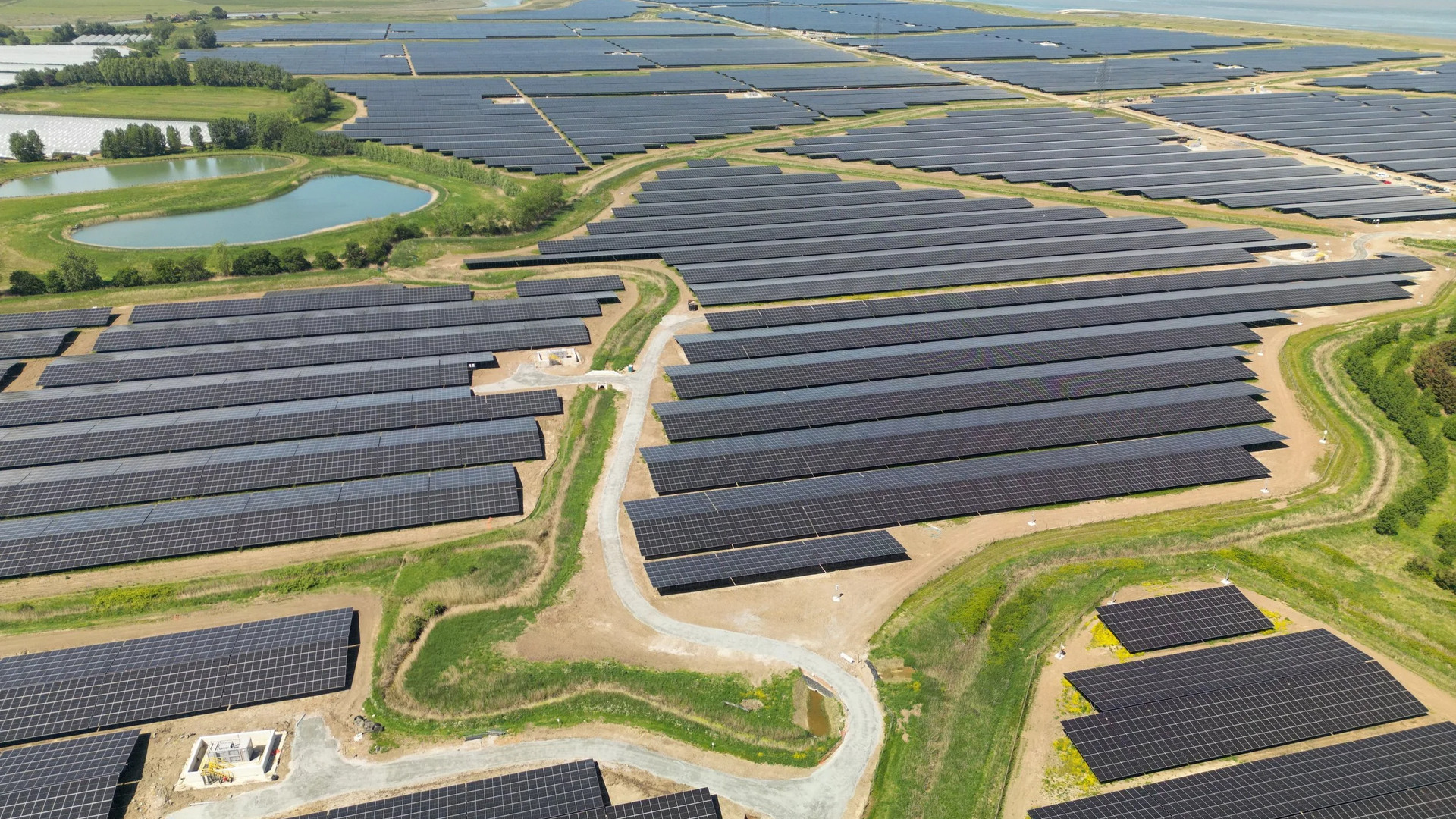
The UK’s largest operational solar farm covers roughly 900 acres of the north Kent coast and contains more than 560,000 photovoltaic panels.
Known as Cleve Hill Solar Park, the project has been commercially generating electricity since July 2025. Its solar installation has a rated capacity of 373 MWdc, making it considerably larger than any other solar farm currently operating in the country.
Developer Quinbrook Infrastructure Partners says the electricity generated over a year is equivalent to the annual consumption of more than 102,000 UK homes.
That comparison does not mean the solar farm continuously supplies a fixed group of 102,000 properties. Its output changes with daylight and weather, while the electricity it produces feeds into the wider national grid.
Built beside the Kent coast
Cleve Hill is located near Faversham, approximately one mile northeast of the town and three miles west of Whitstable.
The project uses east-west-facing bifacial solar panels, which can generate electricity using light reaching both sides of each module. Arranging the panels in opposing directions can also spread generation across a greater portion of the day instead of concentrating output around midday.
Commercial operations were announced at the end of June 2025, with the solar asset fully operational from July.
During commissioning in May 2025, Quinbrook reported that electricity exports from Cleve Hill briefly reached a level equivalent to approximately 0.7% of UK electricity demand at that time.
That was a comparison with demand during a particular period, rather than the solar farm providing 0.7% of the country’s electricity continuously.
A 300-MWh battery is still being commissioned
Although the solar farm is operational, work on its associated battery-storage system is continuing.
The co-located installation is designed to provide 150 MW of power and 300 MWh of energy storage. In simple terms, that is enough stored energy to operate at its full 150-MW output for approximately two hours, although its real operating pattern will depend on grid requirements.
The battery will allow electricity to be stored when generation is high and released at a more useful time. It may also help provide grid-balancing services as electricity supplies and demand fluctuate.
An earlier estimate on the project website suggested that the battery would be completed in early 2026. However, a more recent project update published in June 2026 said commissioning was still progressing and that the first phase of energisation was planned for the fourth quarter of 2026.
The solar portion and battery should therefore be treated as separate parts of the development: one is already commercially operational, while the other remains under commissioning.
Part of the land is being managed for wildlife
The approximately 900-acre development includes a dedicated 138-acre (56-hectare) habitat-management area.
This land is intended to support bird species including lapwings, golden plovers, brent geese and marsh harriers. Quinbrook says it is targeting a biodiversity net gain of more than 67% over the project’s operating life.
Cleve Hill received development consent in May 2020. Quinbrook acquired the project in September 2021, and construction began in early 2023.
Its position as Britain’s largest operational solar farm may eventually be overtaken as larger approved projects are constructed. For now, however, Cleve Hill demonstrates the increasing scale of British solar generation—and its planned battery shows how future renewable-energy sites may combine generation and storage in the same location.
Sources: Cleve Hill Solar Park, June 2026 battery update, Quinbrook Infrastructure Partners