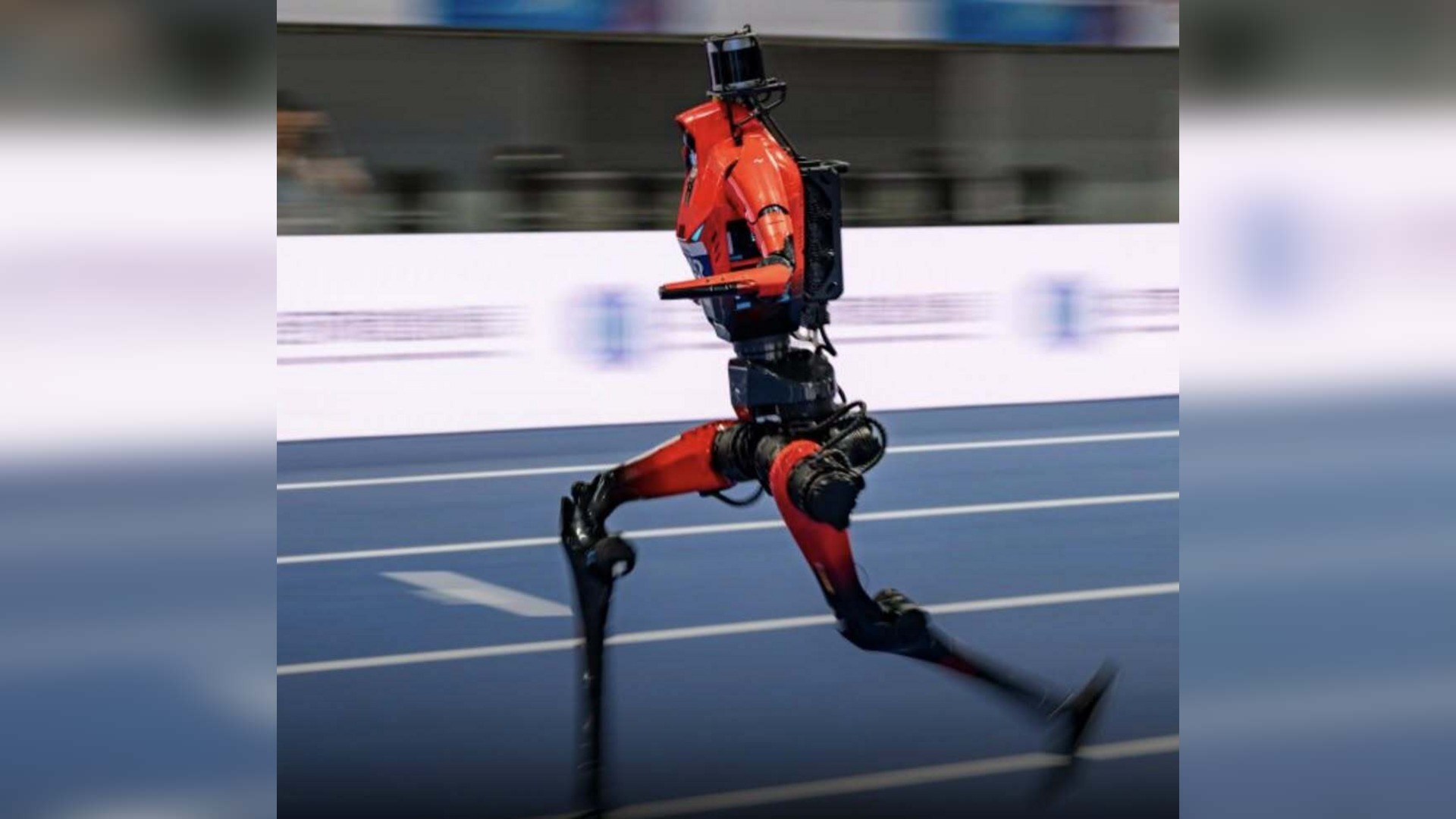
Thousands of humanoid robots have descended on Beijing for a competition that looks part Olympic Games, part engineering laboratory and part technology trade show.
The second World Humanoid Robot Games is being held at Beijing’s National Speed Skating Oval from August 22–26, 2026. Organizers say the event has attracted 2,056 robots from 666 teams across 16 countries, making it considerably larger than its inaugural edition in 2025.
Sports are only part of the competition
The program contains 51 events and 1,301 individual contests. Thirty events focus on sports and performance, while 21 use scenarios designed to resemble real workplaces and public environments.
Robots are sprinting, playing soccer and table tennis, lifting weights, kickboxing, dancing and navigating obstacle courses. Other machines are being asked to sort packages, assemble components, tighten screws, provide hotel and restaurant services, complete household tasks and respond to simulated emergencies.
The practical challenges may ultimately be more important than the headline-grabbing races. Running quickly on a prepared track demonstrates mechanical power, balance and motion control. Connecting a cable, identifying an unfamiliar object or recovering when a package shifts requires perception, dexterity and decision-making of the kind robots would need in factories, warehouses and homes.
Autonomy is also receiving greater emphasis. According to Huawei, a technology partner for the Games, more than 40% of the events require fully autonomous operation. Beijing’s official event information says almost all track competitions require robots to finish without real-time human control.
China dominates the entry list
Although teams from the United States, Germany, Japan, Brazil and other countries are participating, official figures show how heavily the field is concentrated in China.
Chinese participants account for 641 of the 666 teams and 1,975 of the 2,056 robots—approximately 96% of each total. The domestic entries represent 157 companies and 200 universities and research institutions, including 27 prominent Chinese universities.
That scale matters because humanoid robotics depends on more than artificial-intelligence software. Developers also need electric motors, actuators, batteries, sensors, gearboxes, drive electronics, precision manufacturing and the ability to repeatedly build and repair physical machines.
China’s large automotive, electronics and industrial supply chains provide access to many of those components. A competition involving hundreds of teams also creates a public testing environment where developers can expose failures, compare designs and improve hardware and control systems under pressure.
The event has expanded rapidly. The first Games in 2025 featured 280 teams, more than 500 robots and 26 events. This year’s 666-team field is 138% larger, while the number of registered robots has roughly quadrupled.
Scale does not automatically mean technological leadership
The numbers do not prove that China leads every area of humanoid robotics. Several American companies remain prominent in artificial intelligence, autonomous systems and advanced robot development, while specialist teams in Europe, Japan and elsewhere continue to produce important research.
The Games also reveal how far the technology still has to go. Robots fall, struggle to stop after sprinting and can find seemingly simple manipulation tasks surprisingly difficult. A spectacular demonstration is not the same as a machine capable of working safely, reliably and economically for thousands of hours.
Even so, the World Humanoid Robot Games illustrate something strategically important: China is building a broad ecosystem in which companies, universities, suppliers and government-backed institutions can develop and test humanoids at considerable scale.
Whether that produces a lasting commercial advantage will depend on reliability, cost and genuine demand. But the size of the 2026 field suggests China is not treating humanoid robots merely as laboratory curiosities—it is trying to turn them into an industry.
Sources: Beijing Municipal Government, Reuters, Xinhua