Most adjustable desks solve one problem: they let you stand instead of sit. Ōtthsaw (pronounced “Oathsaw”), a small furniture company based in Coastal California, takes that idea further. Its hand-crafted wooden desks are built around a notched rail system that lets the work surface slide from standing height all the way down to the floor — designed not just to reduce sitting, but to bring the full range of human movement into the workday. The company is a family operation, founded by artist and yoga teacher Alisa Reynolds, who has personally built and shipped over 100 desks since she began the project at a local makerspace in 2014.
The name is an acronym: Ode to the Human Spirit at Work.
A desk built around movement, not just posture
The premise behind Ōtthsaw is straightforward, though it starts from a different place than most ergonomic furniture. Reynolds, who describes herself as a yoga teacher who felt herself getting unwell during long desk sessions, wasn’t just looking for a way to stand up — she was looking for a way to incorporate a floor practice into her working life.
“After years at a desk and experiencing both physical and mental health declines from inactivity, I started asking ‘What else could I be doing during my desk time to avoid the health decline?'” Reynolds explains on the company’s website. “As a yoga teacher, I realized a floor practice was missing.”
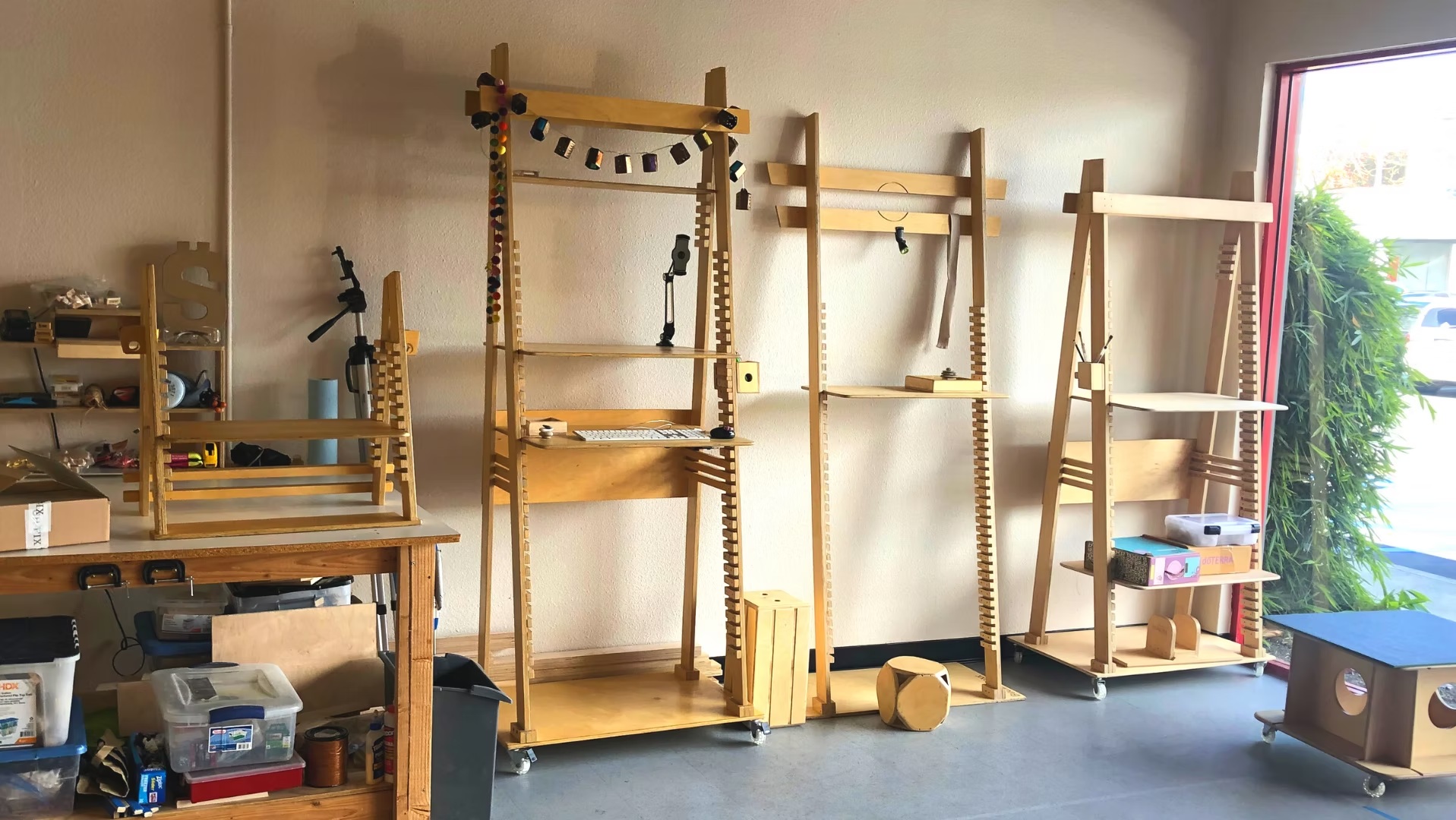
That insight shaped the core design. Rather than building a desk that moves up and down mechanically, Reynolds developed a system of toothed vertical rails — essentially a tall wooden ladder-like frame — where shelves and work surfaces can be manually repositioned at dozens of different heights. The range runs from floor level, where a user can sit cross-legged or in a kneeling position, through seated chair height, and up to a full standing configuration. Photos of the desks in use show yoga mats and bolsters positioned in front of them, suggesting users are meant to move between postures throughout the day, not just pick one ergonomic setting and stay there.
How the design works
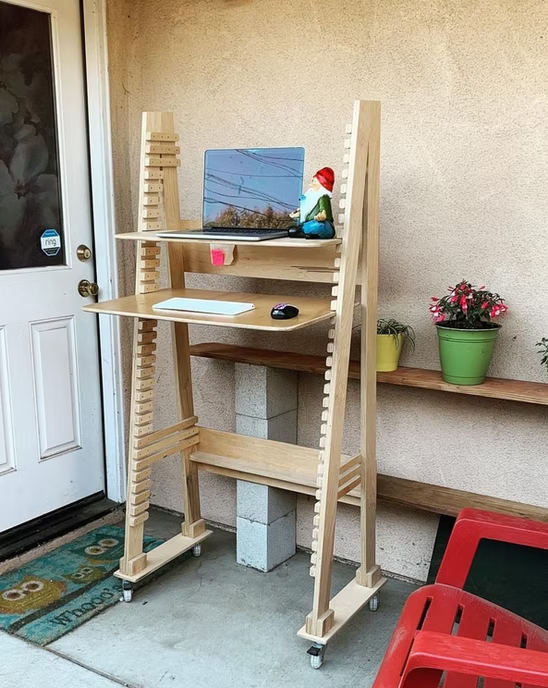
Each Ōtthsaw desk consists of two vertical uprights milled with evenly spaced notches running their full height. Shelves slot into these notches at whatever position the user needs, and can be moved without tools. The frame sits on four caster wheels — two of which lock — making the whole unit easy to reposition around a room.
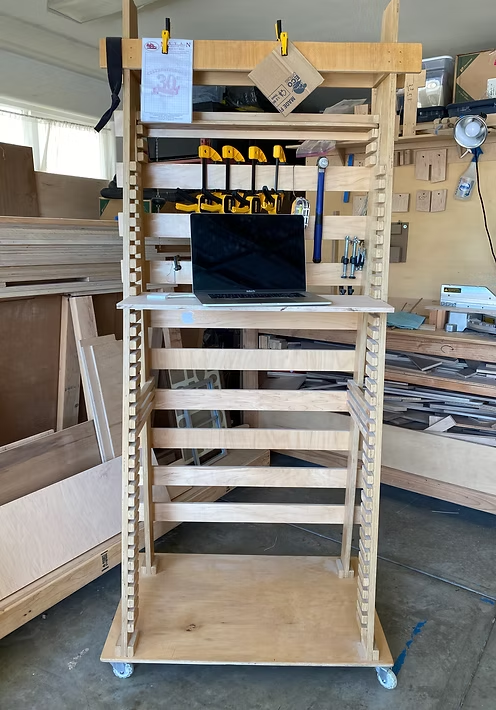
The construction is wood throughout, with a clean, minimalist aesthetic that reads more like furniture than office equipment. The natural wood finish visible across the product line is consistent with Reynolds’s stated emphasis on quality and sustainability, though specific material details (species of wood, finish type) are not listed on the site.
Custom widths and heights are available on request, and Reynolds notes she is happy to schedule a Zoom or phone call to help buyers figure out which desk and configuration best fits their space and needs.
The lineup
Ōtthsaw currently offers six desk models, ranging from a compact entry-level option to a fully featured flagship. The most accessible entry point is the Caterpillar Desk at $749, which appears to be the smallest configuration in the range.
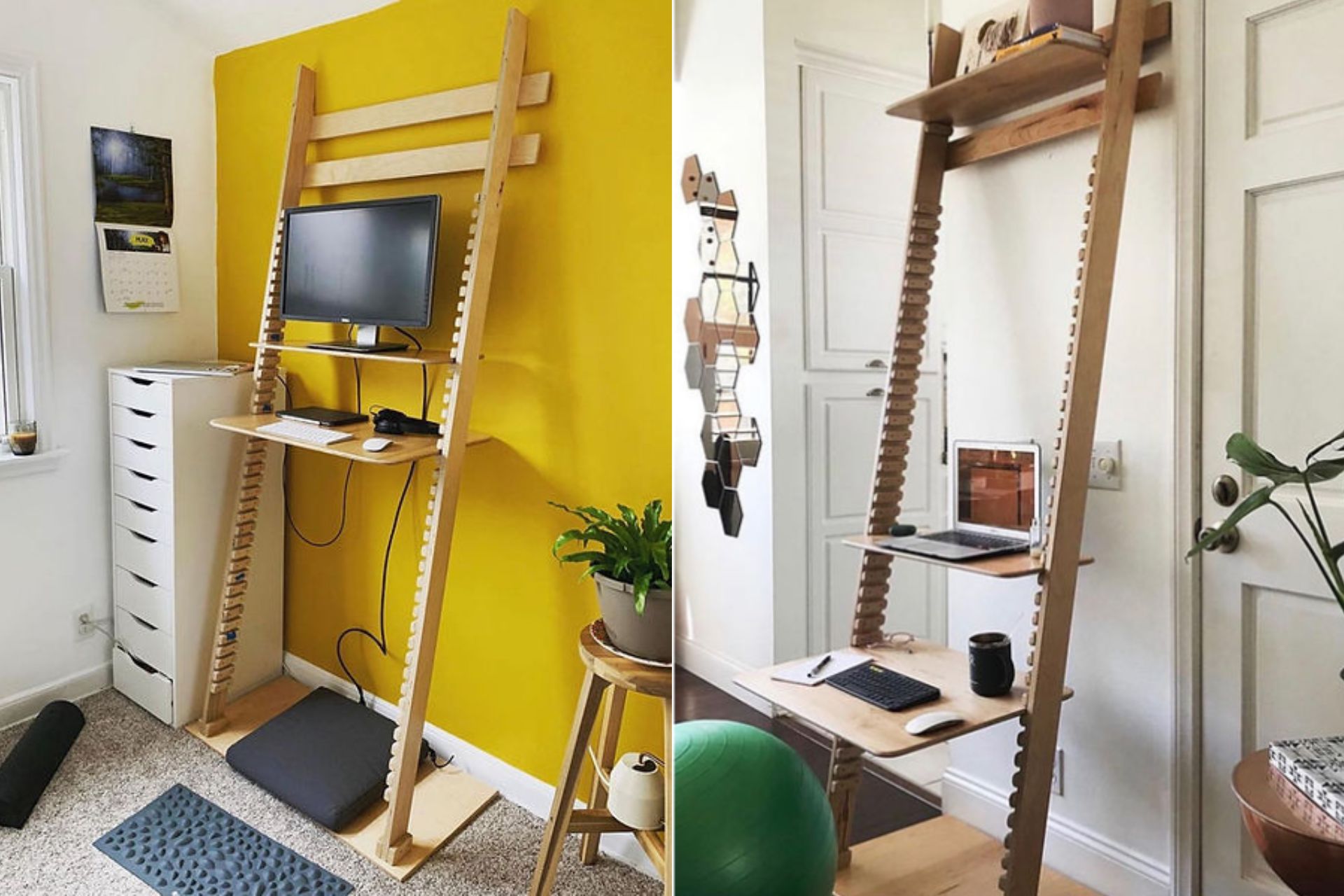
The Leaning Desk ($799) is a wall-leaning variant — a lighter, narrower design that rests against a wall rather than standing independently on a full A-frame. It works well in tighter spaces and shows up in several photos positioned in apartment home offices alongside standing lamps and plants.
The Zippy Desk ($1,499) is one of the more frequently photographed models — a compact freestanding unit on casters, shown in use on a porch, in a home kitchen area, and at what appears to be a fitness-focused trade show. It has a smaller footprint than the Standard, with fewer shelf positions but the same rail-based adjustability.
The Standard Desk ($1,799) is the core full-size offering — a taller, wider frame with multiple shelf levels and the full height range from floor to standing. A Standard Desk 2.0 is also listed at $2,099, though specific differences from the original Standard are not detailed on the site.
The Joyful Desk ($1,999) sits near the top of the lineup and, based on product photos, appears to be a wider dual-column configuration suited to larger setups or users who want more surface area.
Accessories
Ōtthsaw sells a range of add-ons designed to extend what the desks can do. Extra shelves are available in multiple widths: small (10 inches / 25 cm) at $65, medium (14 inches / 36 cm) at $70, and large (18.5 inches / 47 cm) at $75. A Caterpillar-specific extra shelf is $60. Single and double side shelves are also available ($50 and $100, respectively), adding lateral workspace to any desk.
For users who work with physical drawings, prints, or artwork, desk easel attachments are offered in two sizes: a Caterpillar Desk Easel at $125 and a Tall Desk Easel at $150.
Other accessories include the 9×9 Helper Block ($125), the Pi Perch ($175), and a Yoga Mat Stand for easy access ($65) — reinforcing the floor-practice ethos built into the design from the start.
A small operation with a long track record
Ōtthsaw is explicitly not a factory operation. Reynolds built the first prototype at SLO Makerspace in San Luis Obispo, California in 2016, and has made every desk by hand since. Her son, William Paulovitz, now helps with production and is described on the site as the only other person who has built all the Ōtthsaw designs. Together they describe themselves as a family-owned and run business.
That scale has practical implications. Buyers order by emailing Alisa directly; there is no shopping cart or automated checkout. Reynolds typically responds within 48 hours and offers consultations by phone or video call before confirming an order — an approach better suited to a custom, handmade product than a mass-market one. It also means lead times are worth asking about before ordering if timing matters.
Things to consider
Because Ōtthsaw desks are made to order and shipped from a small workshop, buyers should factor in production and shipping time, particularly for larger models. The ordering process is conversational rather than transactional, which works in buyers’ favor for customization but requires more communication than a standard online purchase.
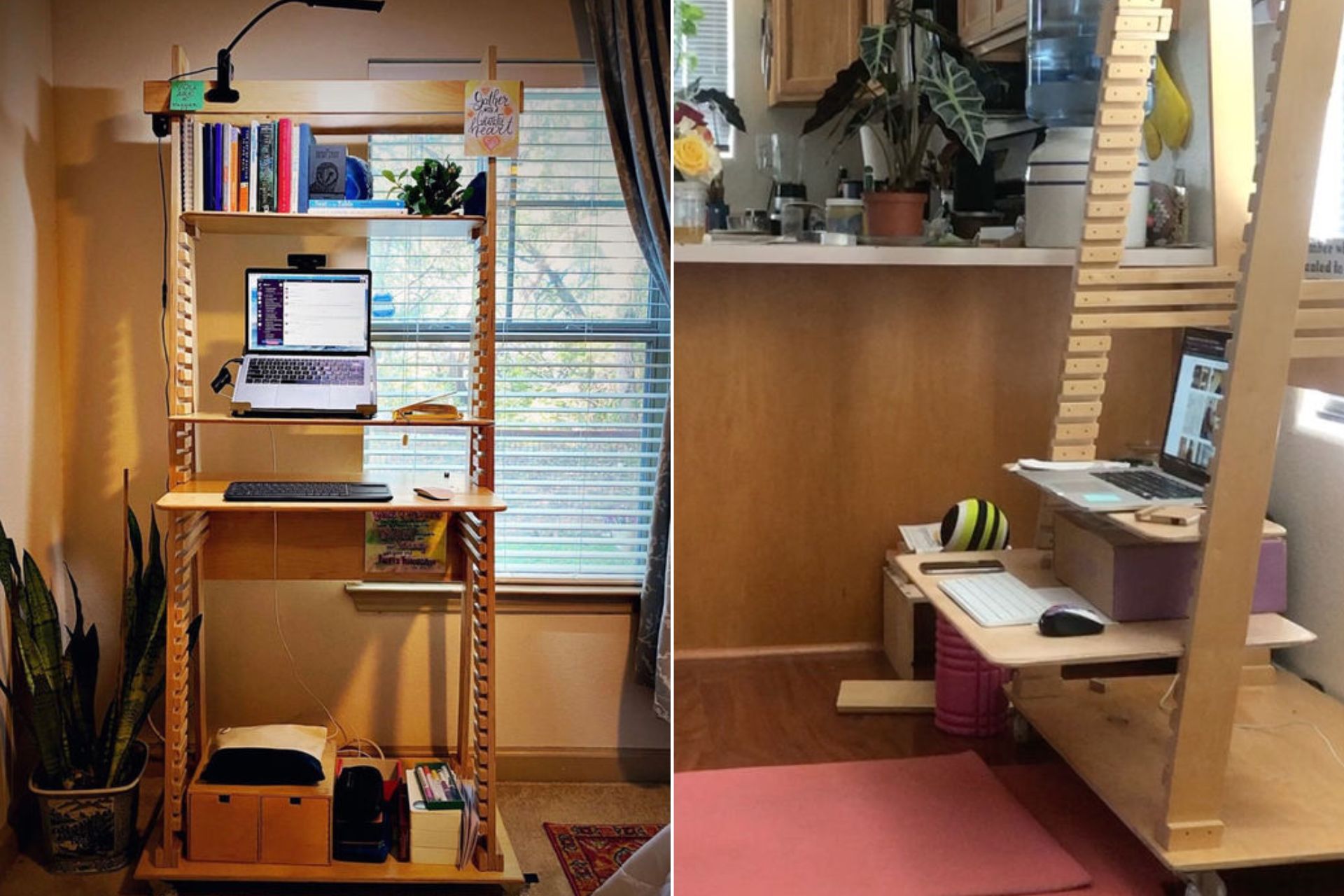
The floor-level functionality — one of the design’s more distinctive features — may not appeal to or suit everyone. The desks are built around a philosophy of movement that involves getting down to and up from the floor regularly, which benefits some users but may not be practical for others depending on mobility or workspace type. Reynolds’s background as a yoga teacher is evident in the design logic, and buyers who share that orientation are likely the primary audience.
On the aesthetic side, the natural wood construction is well-suited to home offices and residential settings. Whether it fits a more traditional corporate office environment is a question of context.
Pricing and availability
All Ōtthsaw desks are made to order. Pricing is as follows:
- Caterpillar Desk — $749
- Leaning Desk — $799
- Zippy Desk — $1,499
- Standard Desk — $1,799
- Joyful Desk — $1,999
- Standard Desk 2.0 — $2,099
All desk orders include four caster wheels, two of which lock. Custom widths and heights are available — contact Alisa for details. Accessories are priced separately, ranging from $50 for a side shelf to $175 for the Pi Perch.
Source: Ōtthsaw