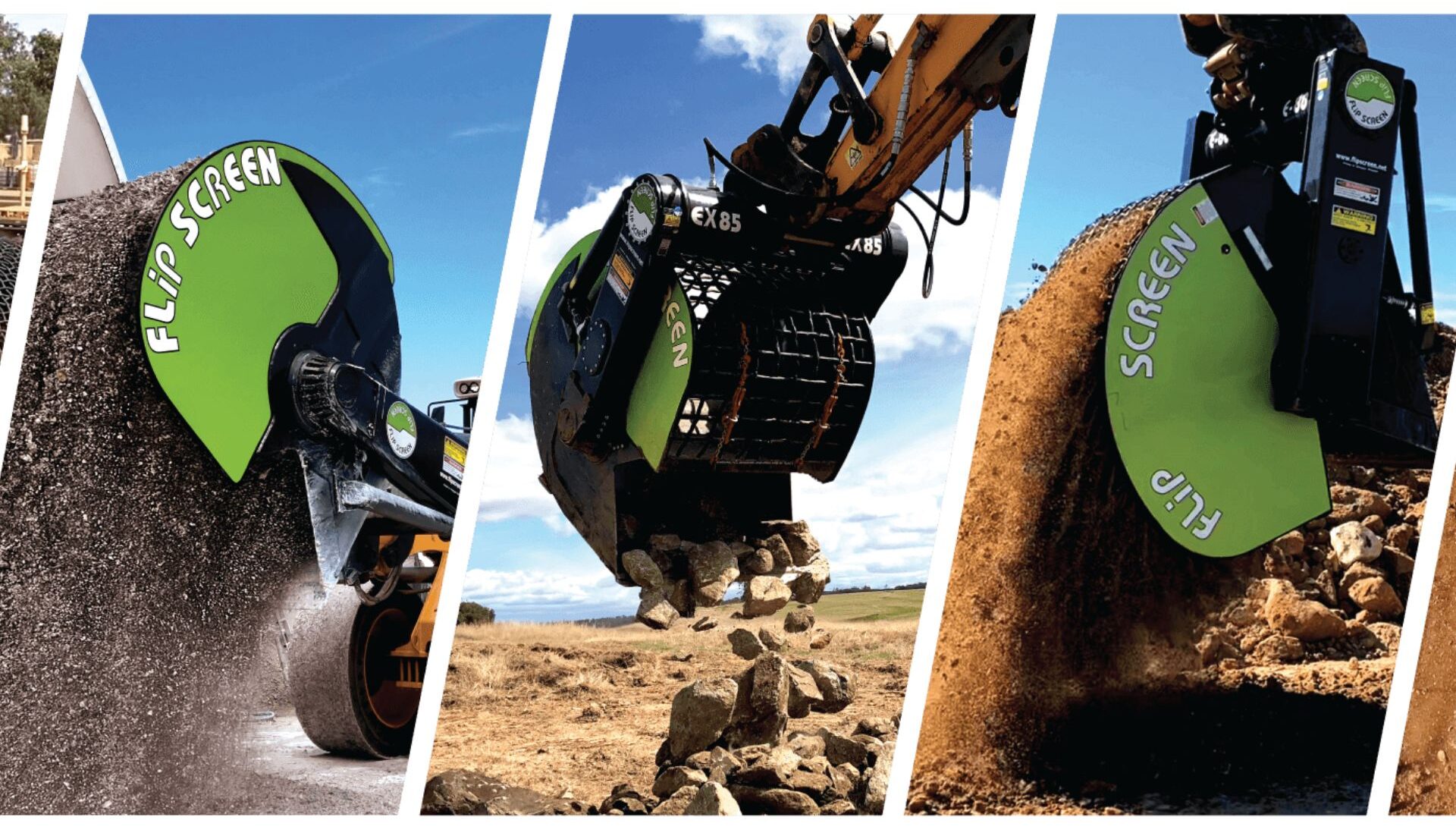
On most construction, mining, or demolition sites, material screening is a two-step process: dig the material up with one machine, then run it through a separate screening plant to sort it. That plant needs to be hauled in, set up, and eventually hauled out — adding cost, time, and logistical complexity to what is otherwise a straightforward task.
FlipScreen, an Australian-founded equipment manufacturer headquartered in Wagga Wagga, NSW, built its product line around eliminating that second step. Its screening buckets attach directly to excavators, loaders, skid steers, and telehandlers as standard hydraulic attachments — and perform the screening function in the same motion as the dig. The operator scoops material, the bucket rotates and screens it on the spot, and the separated fines fall through the mesh while oversized material stays in the bucket. No separate plant. No additional crew. No transport.
The company operates offices in Australia, the United States (Waxahachie, Texas), and Europe (Switzerland), and serves more than two dozen industries including mining, construction, demolition, scrap metal, landfill, landscaping, civil works, and agriculture.
How the flipping action works
The core mechanism is the rotation that gives the product its name. After the bucket scoops material, the inner drum inverts the load onto the mesh screen repeatedly — approximately every 2.5 seconds per cycle. During the first 7.5 seconds, material is processed gently. Larger lumps are then lifted and dropped back onto the mesh with enough force to break up clumps and push fines through the openings.
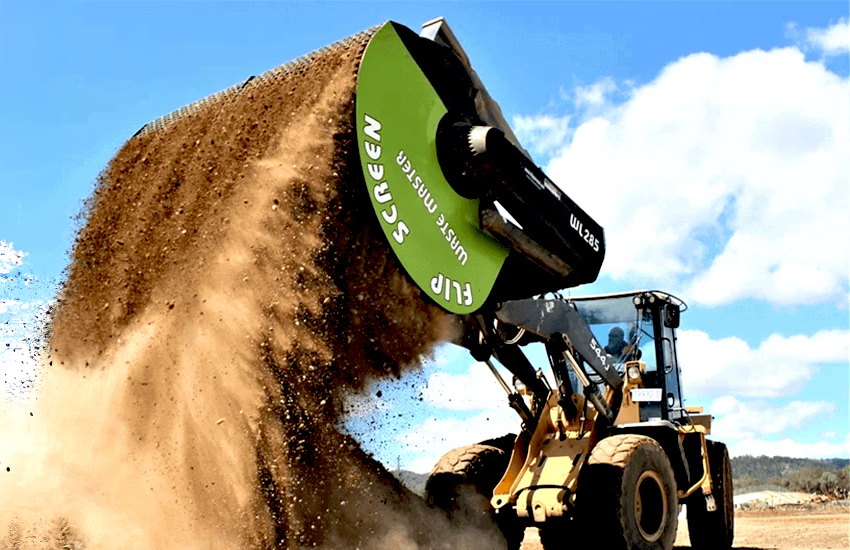
The mesh is made from mining-grade, high-tensile steel. Standard aperture sizes run from 6.3mm to 150mm — that’s ¼ inch to 6 inches — with custom sizes available for specific applications. Mesh changes can be done on-site in approximately five minutes with no tools required, letting operators adjust separation size between jobs without calling in a technician.
The base of the FlipScreen mirrors the profile of a standard excavator or loader bucket. This allows the attachment to break into unexcavated ground the same way a conventional bucket would, and it stays watertight during travel — meaning a fully loaded bucket can move across a site without spilling, something most competing screening attachments cannot do.
Plug-and-play hydraulics
One of the more practically significant features is how the FlipScreen moves between machines. The attachment uses a smart valve system that allows it to transfer between different carriers — excavator to loader to telehandler — without hydraulic modifications or the need for a hydraulic technician to reconfigure pressure and flow settings for each new machine.
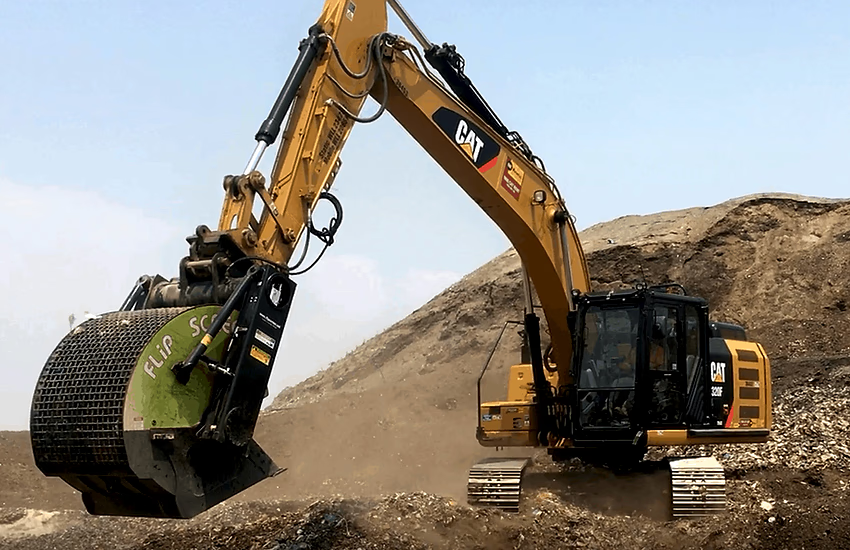
The system can also compensate for machines delivering incorrect hydraulic pressure or flow, maintaining correct screening speed and action across variation between carriers. For contractors running mixed equipment fleets, or renting machines from different suppliers across projects, this reduces the setup friction that typically comes with hydraulic attachments.
26 models, four carrier types
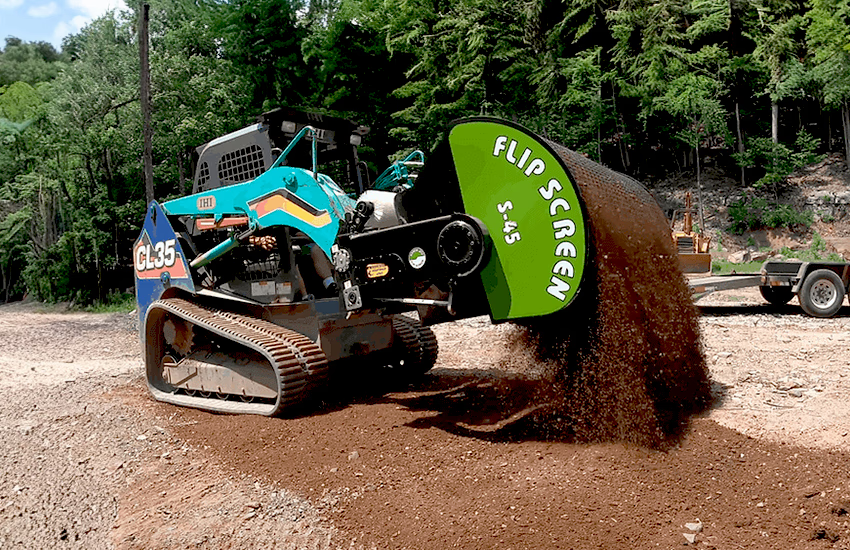
FlipScreen offers 26 models across excavators (small, medium, large), wheel loaders (small, medium, large), skid steers (stand-on and medium), telehandlers (small, medium, large), and track loaders. The company’s website includes a machine-matching tool that maps specific carrier makes and models to the correct FlipScreen attachment, including safe working load verification.
The 26-model range is designed specifically so that every carrier-attachment pairing stays within safe working load tolerances — FlipScreen notes that some competing products use overly broad carrier weight ranges that can result in dangerous overloading in practice.
Most models include a reversible, bolt-on cutting edge that can be replaced in the field without welding, extending the operational life of the attachment over time.
Beyond screening
The attachment’s inward spiraling rotation allows it to function as a mixer when the mesh is replaced with a FlipScreen mixing plate — useful for blending concrete constituents, soil amendments, or other materials that need to be homogenized on-site before use.
FlipScreen’s Duocone steel-on-steel seals allow the bucket to be fully submerged in water, enabling it to operate as a mobile wash plant for materials requiring wet processing. A specialized “Fert Screen” variant is designed for fertilizer and salt environments — corrosive applications where standard steel components would degrade rapidly.
Things to know before buying
FlipScreen attachments are industrial equipment priced accordingly — no list prices are published on the website, and quotes require direct contact with a regional representative. Buyers looking for upfront pricing will need to initiate a consultation first.
The 26-model range is broad, but operators with older, unusually sized, or very small machines may find compatibility narrower than expected. The machine-matching tool and expert consultation process are designed to address this, but it is worth verifying fit before assuming compatibility.
For very high-volume, sustained throughput at industrial mining scale, FlipScreen operates a separate entity — FlipScreen Mining — which addresses that segment specifically.
Source: FlipScreen