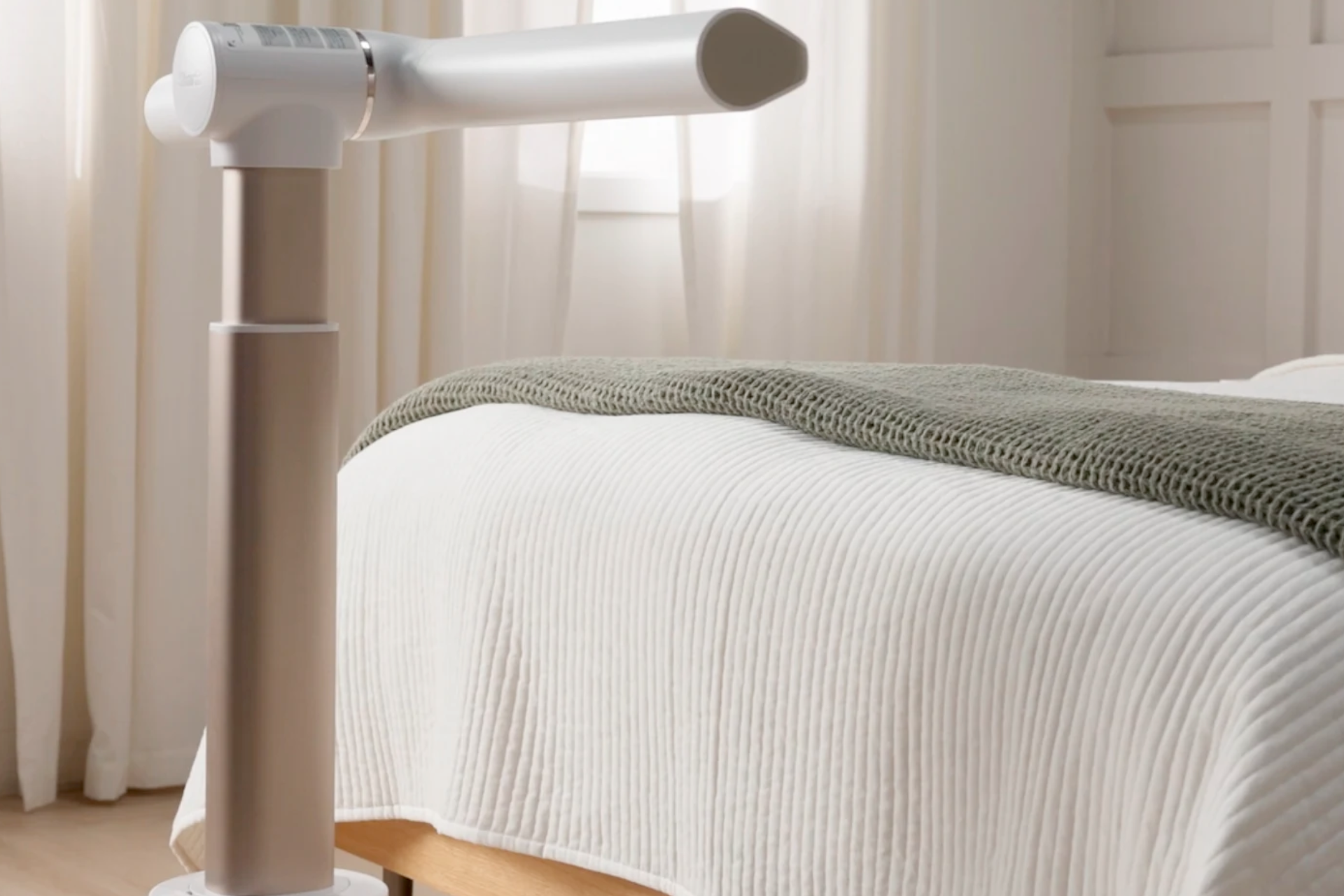
The Shark TurboBlade (model TF202S) is positioned as a premium bladeless tower fan, but its defining feature is not just its power or design—it’s how the airflow can be directed and reshaped depending on the situation. Instead of functioning as a fixed upright fan, the unit can pivot from a traditional vertical tower orientation to a horizontal position, allowing it to distribute air across a broader surface area, such as a bed or seating space.
At its core, the TurboBlade uses bladeless airflow technology, meaning it draws air in and projects it outward without exposed blades. This design is often associated with easier cleaning and safer operation, particularly in households with children or pets. Shark describes the product as an “ultra-customizable bladeless tower fan,” emphasizing its ability to adapt airflow rather than simply increase intensity.
One of the most noticeable aspects of the TurboBlade is its pivoting mechanism. In its upright form, it behaves like a conventional tower fan, circulating air forward into the room. However, when adjusted horizontally, it changes the direction and spread of airflow, enabling it to move air across a wider plane rather than focusing it in a single stream. This approach shifts the experience from direct cooling to more distributed airflow.
Beyond the pivoting feature, the fan is designed for wide coverage. Official specifications note that airflow can reach up to approximately 80 feet (around 24 meters), suggesting it is intended for full-room circulation rather than localized cooling. The unit also supports up to 180° oscillation, further extending its ability to distribute air evenly. Shark highlights a dual-blade airflow system that contributes to broader coverage, although the airflow itself remains bladeless from a user-facing perspective.

Customization is another key part of the TurboBlade’s design. The fan offers 10 speed settings along with 10 noise levels, allowing users to fine-tune both airflow intensity and sound output. Depending on the region, it may also include preset modes such as sleep or relaxation settings, as well as a natural breeze mode that varies airflow patterns over time. According to the company, users can “choose between 10 speeds and noise levels for all sleep and relaxation modes,” indicating a focus on adaptability for different environments, including nighttime use.
In practical terms, this level of control can make a difference in how the fan is used. Lower speeds and quieter modes may be suitable for overnight operation, while higher settings can be used for rapid cooling or air circulation during the day. However, as with most fans, higher airflow settings may result in increased noise, something users may want to consider depending on their sensitivity to sound.
The TurboBlade also incorporates what Shark calls DustDefense technology, intended to reduce dust buildup inside the unit. While detailed technical explanations of this feature are limited, it aligns with the broader goal of minimizing maintenance requirements. The absence of exposed blades further simplifies cleaning, as there are fewer surfaces where dust can accumulate.
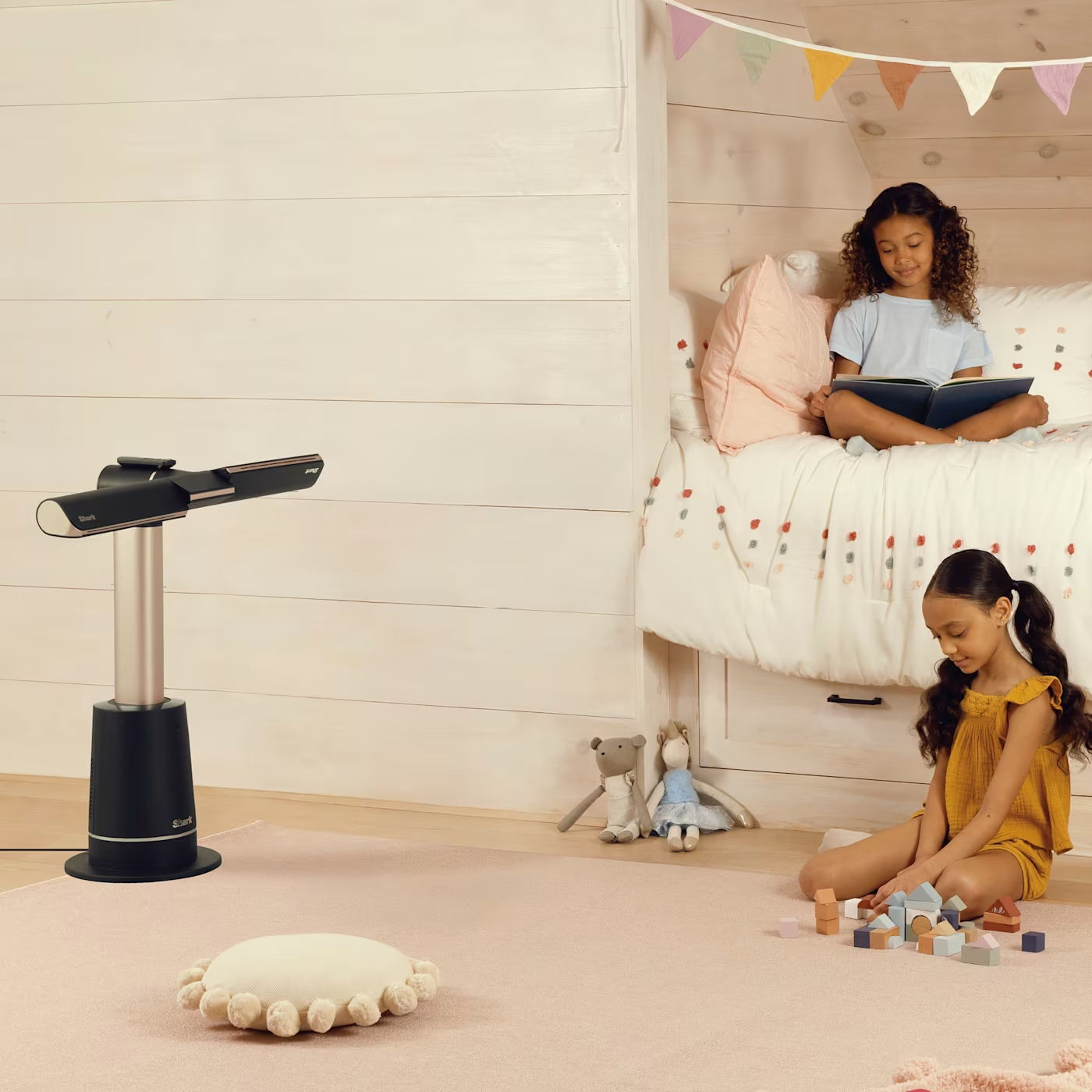
In terms of physical specifications, the fan measures approximately 130 cm in height, 25 cm in width, and 29.6 cm in depth when in its vertical configuration. When pivoted horizontally, the footprint changes significantly, with dimensions of about 96 cm by 80 cm by 29.6 cm. The unit weighs around 6.5 kg and is powered by a 90W motor. It also includes a remote control for convenient operation, and the adjustable vents can be twisted in multiple directions to fine-tune airflow.
The TurboBlade is available through Shark’s official website and major retailers in markets such as the United States and Australia. In the U.S., it is listed at $249.99 with a two-year limited warranty and free shipping on orders above $99. It’s also currently available on Amazon with a $50 discount, bringing the price down to around $199.99 at the time of writing. In Australia, the recommended retail price is $499.99 AUD, though it has been listed at discounted prices around $349.99 AUD depending on promotions.
Overall, the Shark TurboBlade stands out less for raw specifications and more for how it delivers airflow. By combining a bladeless design with a pivoting structure, it offers a different approach to room cooling—one that focuses on coverage and flexibility rather than simply increasing fan speed. For users looking for more control over how air moves through a space, particularly in settings like bedrooms or larger living areas, this design introduces a different way to think about everyday cooling.
Product page: Shark TurboBlade