Heavy-duty trucks may not have to abandon the internal combustion engine to stop burning diesel.
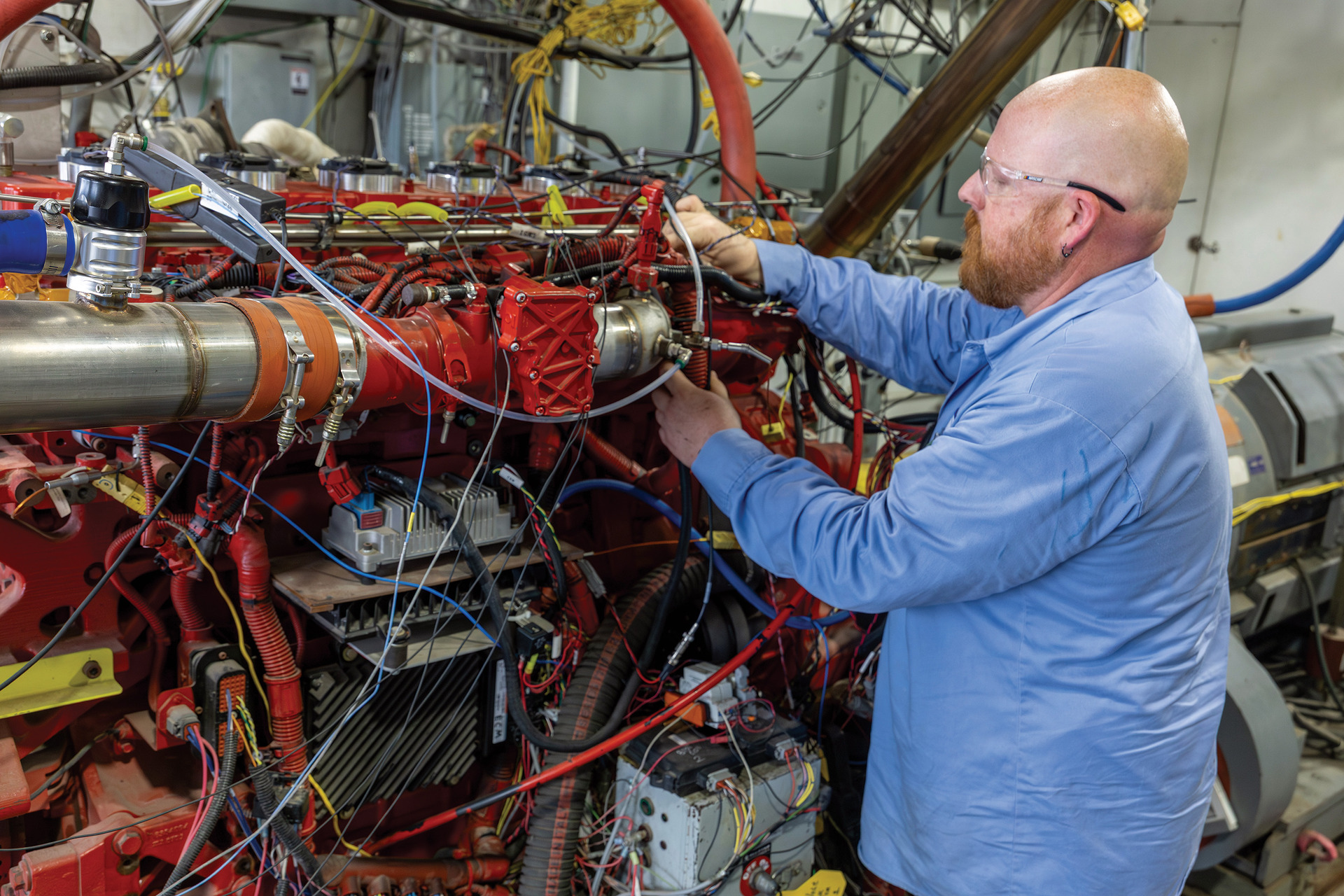
Engineers at the Southwest Research Institute (SwRI) have upgraded an experimental truck engine that runs entirely on hydrogen. With its latest boosting system, the engine now produces 440 horsepower and 2,386 Nm (1,760 lb-ft) of torque — figures that place it within the range of many modern long-haul diesel engines.
The project is not a fuel-cell vehicle. Hydrogen is burned inside cylinders to create mechanical power, much like gasoline or diesel in a conventional engine.
A natural-gas engine converted to hydrogen
SwRI began with a Cummins X15N natural-gas engine and converted it to run on 100% hydrogen. The completed engine was installed in a Class 8 demonstration truck.
According to the institute, roughly 90% of the base engine’s parts were retained. The conversion required hydrogen injectors, a new intake manifold, upgraded ignition and engine controls, active crankcase ventilation and a different boosting system.
The original demonstrator produced 370 hp and 2,025 Nm (1,494 lb-ft) of torque. Its efficiency remained above 40% and peaked at 43%.
SwRI later worked with a commercial supplier on a mechanically driven turbocharger tailored to the engine. Its shaft is linked to the crankshaft through a variable drive, allowing the system to deliver boost pressure when the engine needs it.
That upgrade raised output to 440 hp, increased peak torque to 1,760 lb-ft and pushed peak efficiency to 44%.
SwRI says modern long-haul heavy-duty engines typically produce 400–500 hp and 1,450–1,850 lb-ft, putting the experimental hydrogen engine in comparable territory on headline output.
Why the extra airflow matters
Hydrogen presents different combustion challenges from diesel. It ignites easily, making it more susceptible to pre-ignition — combustion that begins before the intended spark and can lead to knocking, reduced performance or engine damage.
The engine also needs sufficient airflow during rapid acceleration to control abnormal combustion and limit nitrogen oxide (NOx) formation. The mechanically driven turbocharger can supply boost on demand instead of relying only on exhaust flow.
SwRI has separately developed testing methods to investigate stochastic pre-ignition in hydrogen engines. Its research points to lubricant-oil volatility and compression ratio as important influences, and the institute is studying ways to detect and mitigate these events.
Almost no fuel-derived CO2, but not zero impact
Because hydrogen contains no carbon, burning it produces virtually no fuel-derived carbon dioxide at the tailpipe. SwRI measured 1.5 g of CO2 per horsepower-hour over the Federal Test Procedure, a 99.7% reduction compared with a similar diesel engine. Trace emissions can come from sources such as lubricating oil.
Hydrogen combustion can still create NOx when high temperatures cause nitrogen and oxygen in the air to react. SwRI therefore fitted a hydrogen-specific urea selective catalytic reduction system. With aged catalysts, the earlier demonstrator recorded 0.008 g/hp-hr of NOx on composite test cycles.
The tailpipe figures also do not describe hydrogen’s full climate impact. That depends heavily on how the fuel is produced, transported and stored. Hydrogen made using fossil fuels can carry substantial upstream emissions, while low-carbon production remains more expensive and less widely available.
A familiar route to lower-carbon trucking
Hydrogen combustion could let manufacturers reuse more of the factories, supply chains and servicing knowledge already built around piston engines. It may also suit demanding applications where vehicle weight, range and fast refueling make battery-electric operation difficult.
For now, SwRI’s Class 8 truck remains a research and demonstration vehicle, not a production model. The latest results nevertheless show that a hydrogen engine can approach diesel-like power and torque while dramatically reducing tailpipe carbon emissions.
Product information: Southwest Research Institute