

Grass, gravel, cobblestones, ramps, uneven pavement — surfaces that most people navigate without a second thought can make a routine outing genuinely difficult for someone in a manual wheelchair. The caster wheels at the front of most manual chairs are small and hard to roll over anything that isn’t flat and smooth, and getting through rough terrain typically means either a physically demanding effort from the user, reliance on a caregiver, or simply not going there at all.
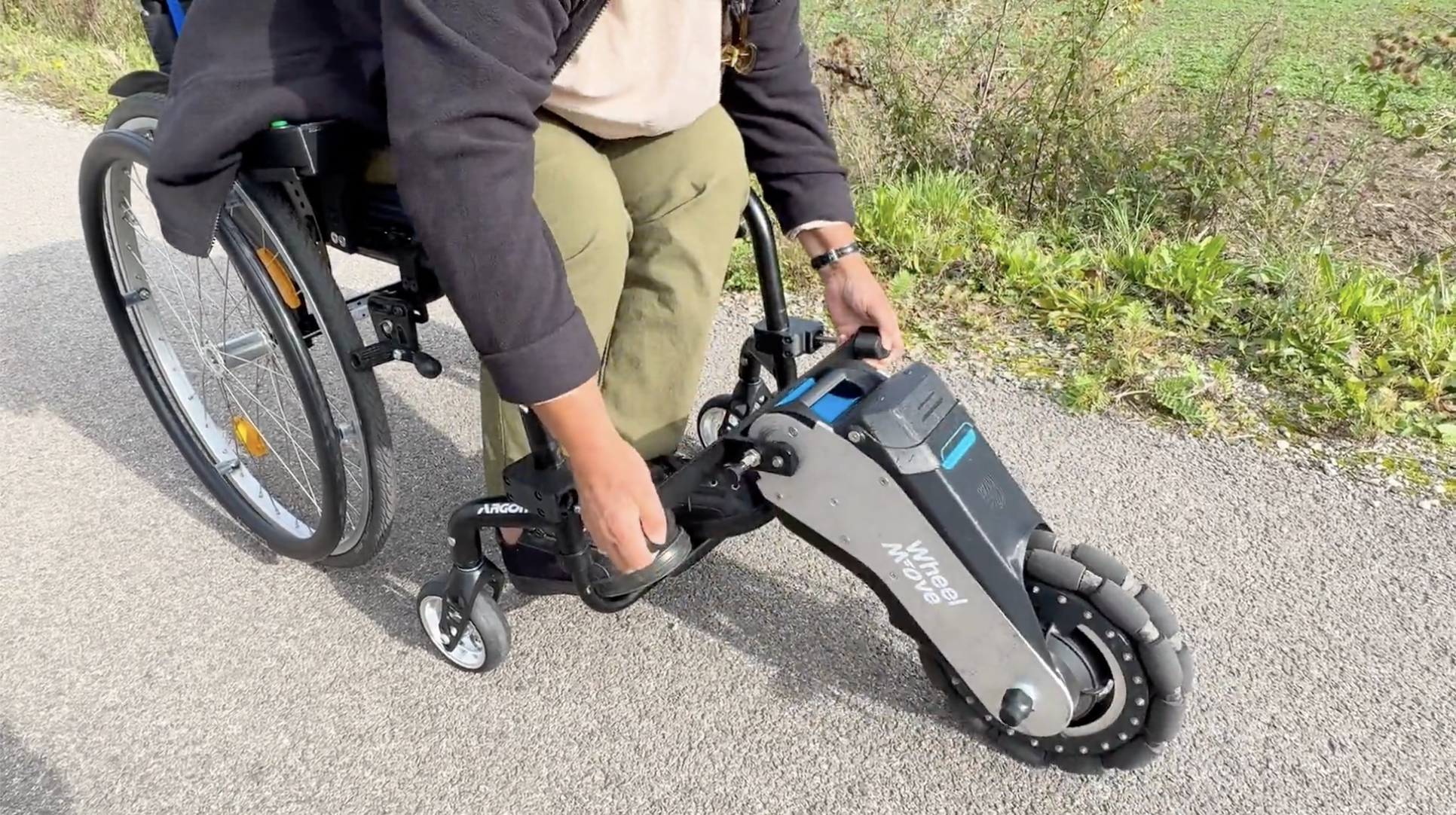
WheelMove, a startup founded in Compiègne, France, has developed a patented electric power-assist attachment designed to change that equation. The device clips onto the front of any manual wheelchair in seconds, lifts the small front caster wheels clear of the ground, and provides motorized drive assistance — giving the user the ability to navigate terrain that would otherwise be inaccessible. The company brought the product to CES 2026 in Las Vegas in January, marking its first major international showcase, and has since been building toward commercial distribution in Europe and, eventually, the United States.
Where the idea came from
WheelMove was founded by two French engineers with backgrounds in the automotive industry: Kévin Surbled (COO/CTO) and Amaury Dupas (CEO/CFO). Surbled trained as an electrical and mechanical engineer at ENSEM Nancy and spent 14 years working in automotive powertrain and transmission development, including seven years in R&D, testing, and validation management at Poclain. Dupas studied general engineering at ICAM Lille and built a career across quality, industrialization, mechatronics, and finance at companies including Toyota, Valeo, and Plastic Omnium.
The project began with a personal experience: one of the co-founders had a family member in a wheelchair who encountered difficulties getting off the beaten track, even if only to go onto the grass. From that frustration grew a shared goal — building a practical, accessible solution for manual wheelchair users who find standard terrain limiting.
The product was co-developed with input from more than 200 wheelchair users, caregivers, occupational therapists, and medical device distributors, shaping its design around real-world needs rather than engineering assumptions alone.
How it works
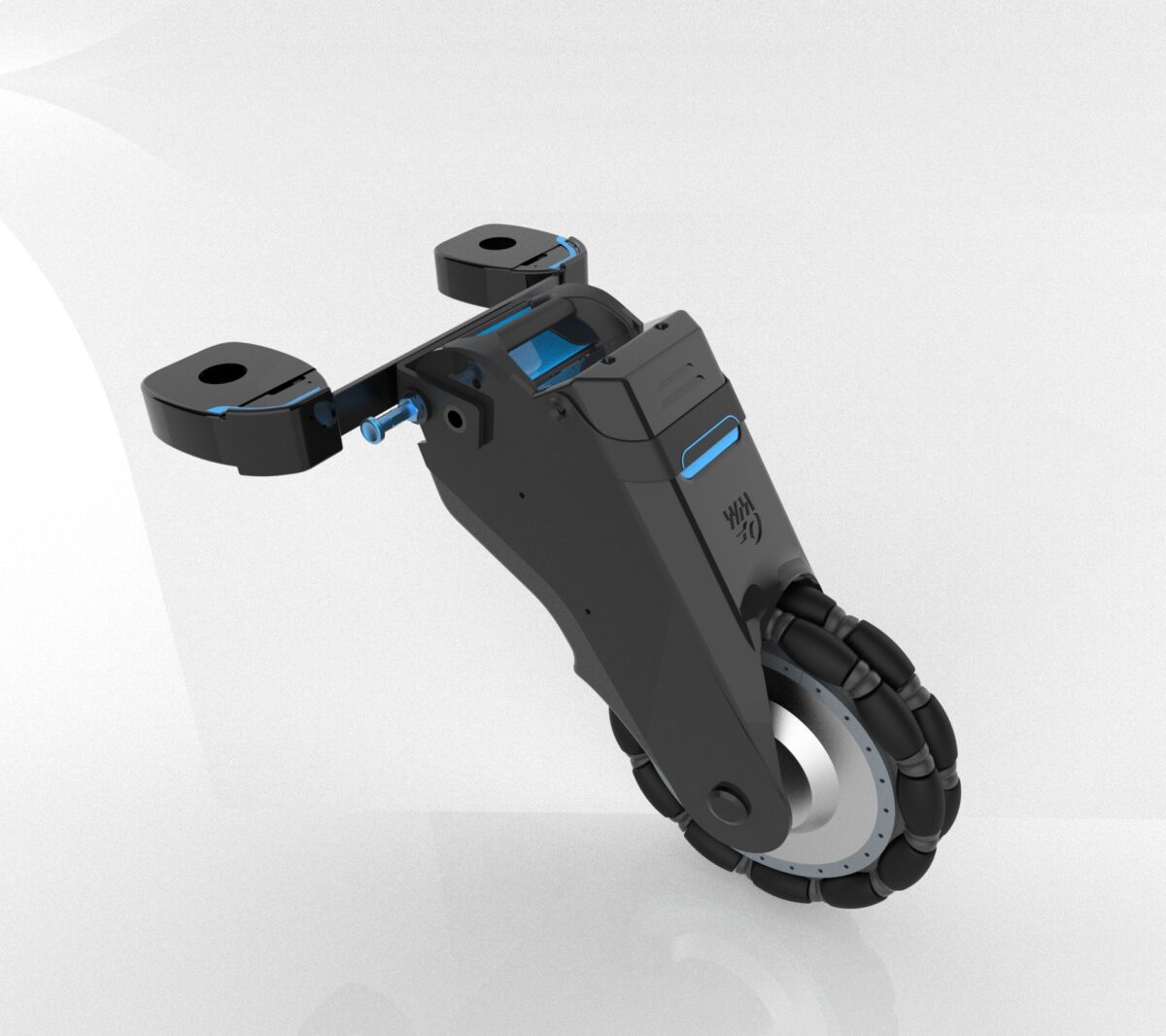
The WheelMove device attaches to the front of a manual wheelchair using quick-release brackets and a telescopic rod. It clips onto the front of a manual wheelchair using simple brackets the user can install independently. The user presses the included Bluetooth remote’s power button to automatically raise the front casters. With the casters lifted, the large rear drive wheels remain in full contact with the ground and the user retains complete maneuverability.
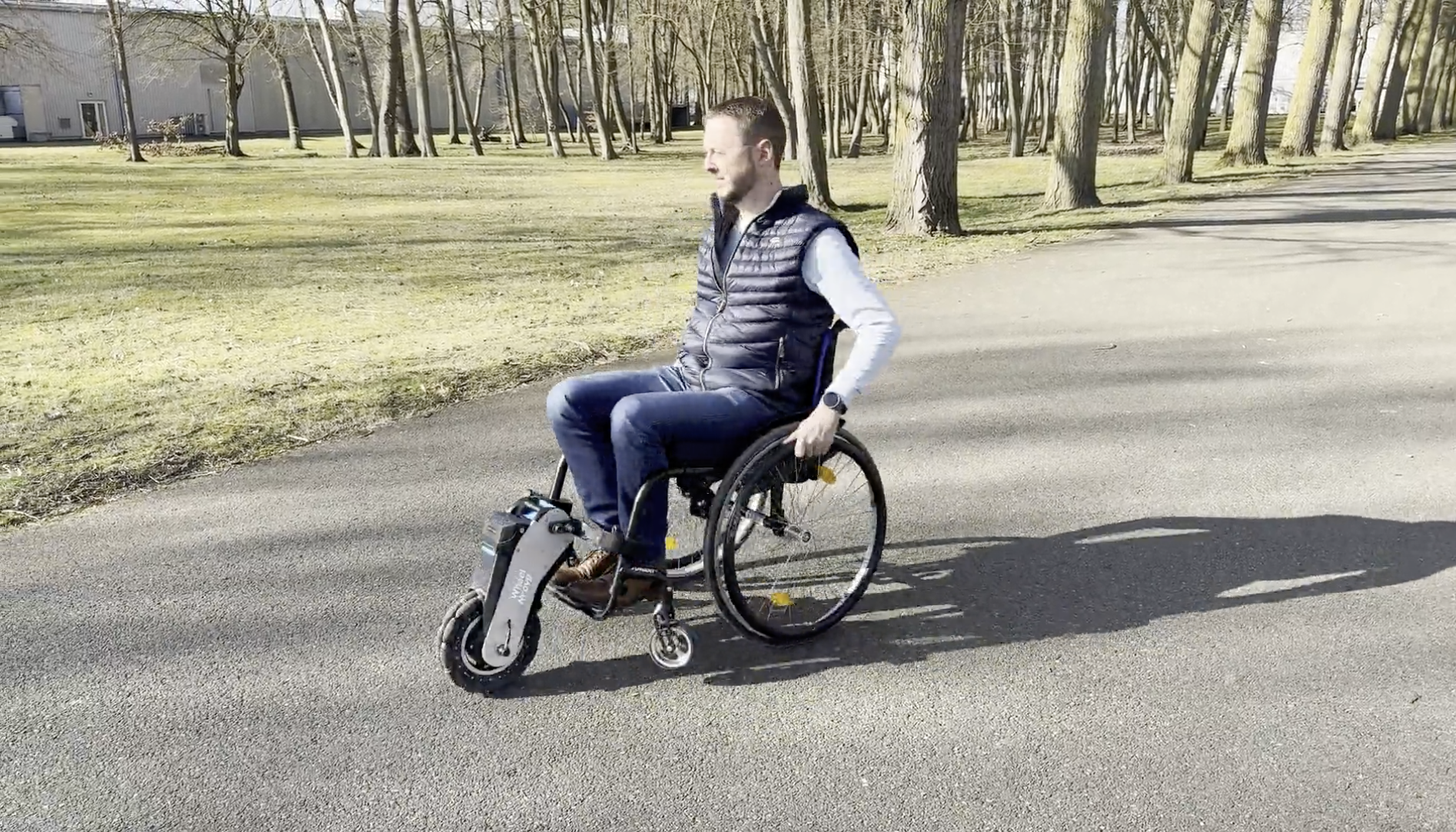
From there, the user controls forward speed, deceleration, and gentle reverse through the remote. To stop the electric assistance, one can either press the stop button on the remote or apply heavy manual braking. The steering and turning behavior of the wheelchair remain unchanged — the user pushes and steers as normal, with the motor providing the propulsive force.
The telescopic rod design means the system adapts to different wheelchair frames without requiring permanent modifications or drilling.
Terrain capability
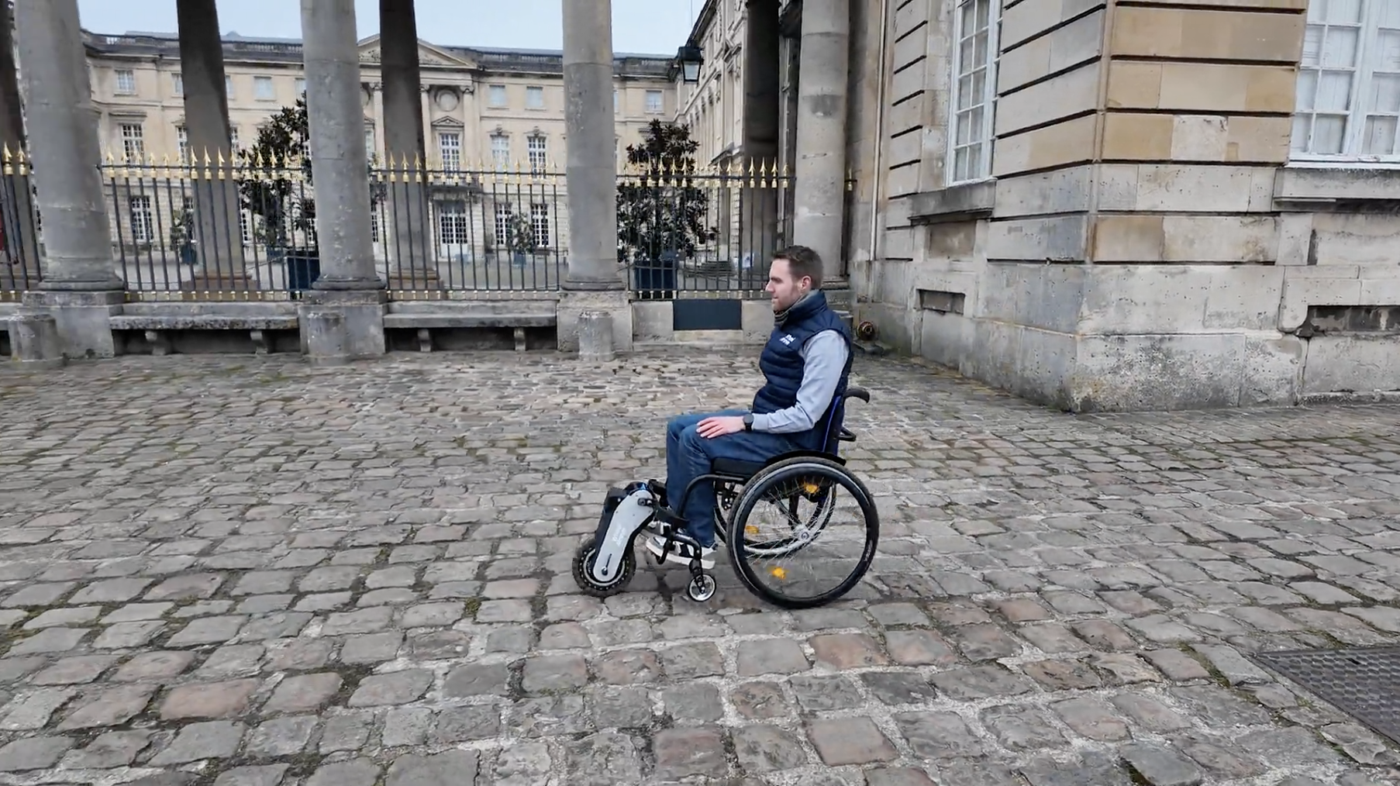
WheelMove positions the device as an all-terrain solution, not just a smooth-surface power assist. The product has been noted for handling paving stones, gravel, and uneven ground — surfaces that routinely defeat standard caster wheels. The minimum ground clearance required for installation is 4 cm (about 1.6 inches), and the device is rated for slopes up to 6 degrees.
The key to the all-terrain performance is the combination of the motorized drive and the lifted front casters. In a standard manual wheelchair, those small front wheels are the first thing to catch on a curb edge, sink into grass, or skip across uneven paving. With them raised, the chair effectively operates on its two large rear wheels, which roll far more readily over varied surfaces.
Technical specifications
The WheelMove unit weighs under 8 kilograms (approximately 17.6 pounds), including the removable battery. Its footprint measures 550 × 320 × 280 mm (approximately 21.7 × 12.6 × 11.0 inches) — compact enough to carry in the included bag.
The removable battery provides up to 25 km (approximately 15 miles) of range on a single charge and is removed simply by lifting the handle. A second battery can be swapped in to extend range on longer outings. The battery charges from a standard wall outlet in approximately one to one and a half hours. The Bluetooth wireless remote is charged via USB-C.
The maximum supported user weight is 125 kg (approximately 276 pounds), and top speed is capped at 10 km/h (approximately 6 mph). The system is compatible with all manual wheelchairs.
Each unit ships with the WheelMove device, one battery, one charger, and a carry bag. The purchase includes free delivery, a 30-day return window, and a two-year warranty covering manufacturer defects, excluding wear parts.
CES 2026 and early traction
WheelMove was one of seven startups selected to represent the Hauts-de-France region at CES 2026 in Las Vegas in January — a selection that gave the company its first significant exposure to the U.S. market and international press.
Presales launched in June 2025, and the company already has more than 15 orders for WheelMove, plus letters of intention from resellers in Spain, Belgium, Germany, and Australia. Early adopters are scheduled to receive their products by summer 2026.
The company has accumulated a substantial network of institutional partners and backers, including BPIFrance (the French public investment bank), Handilab (a disability-focused incubator), APF France Handicap, HEC Challenge+ Paris, and the Fondation Hopale, among others.
U.S. availability and the road to 2028
Surbled says the company will first manufacture and sell WheelMove to medical device resellers and distributors in France. In 2026-27, it plans to begin distribution in Europe, followed by the United States in 2027-29, in time for the 2028 Los Angeles Paralympic Games.
The company plans to be ready for U.S. Food and Drug Administration regulatory approval as a medical device sometime this year. In the U.S., medical devices that provide powered mobility assistance typically require FDA clearance before they can be sold through conventional healthcare channels, which is the pathway WheelMove is pursuing for its American market entry.
Pricing and availability
The recommended public price is listed at €3,990 (approximately $4,635 USD). The package includes one battery, one charger, and a transport bag. An upgraded model will come with one additional long-range battery and an additional mounting kit that can be used on a second wheelchair.
A launch offer is currently available via quote request through the company’s website. WheelMove’s products are not yet available through retail channels in the United States. For more information or to register interest, visit their official website.
Source: WheelMove


