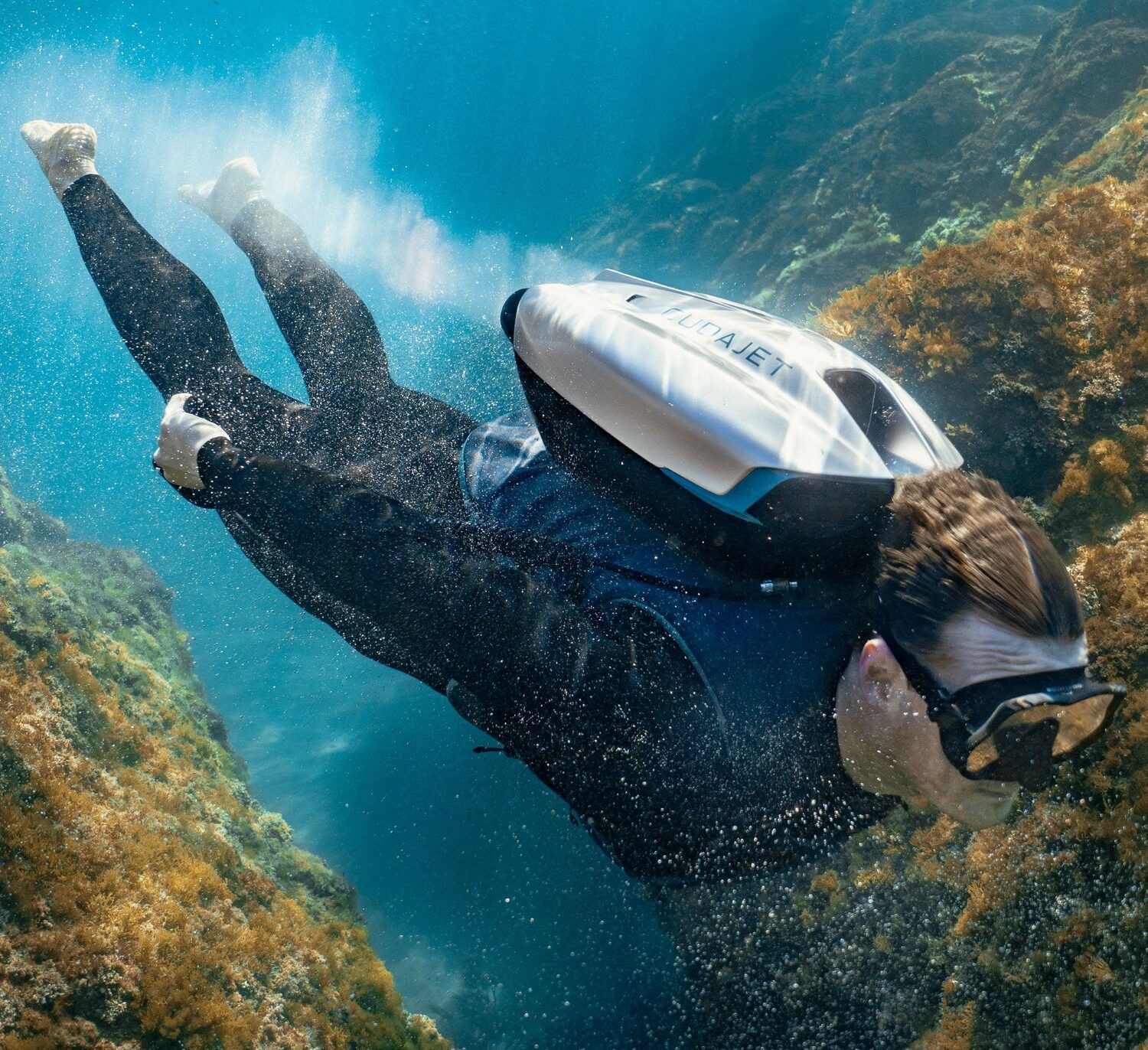
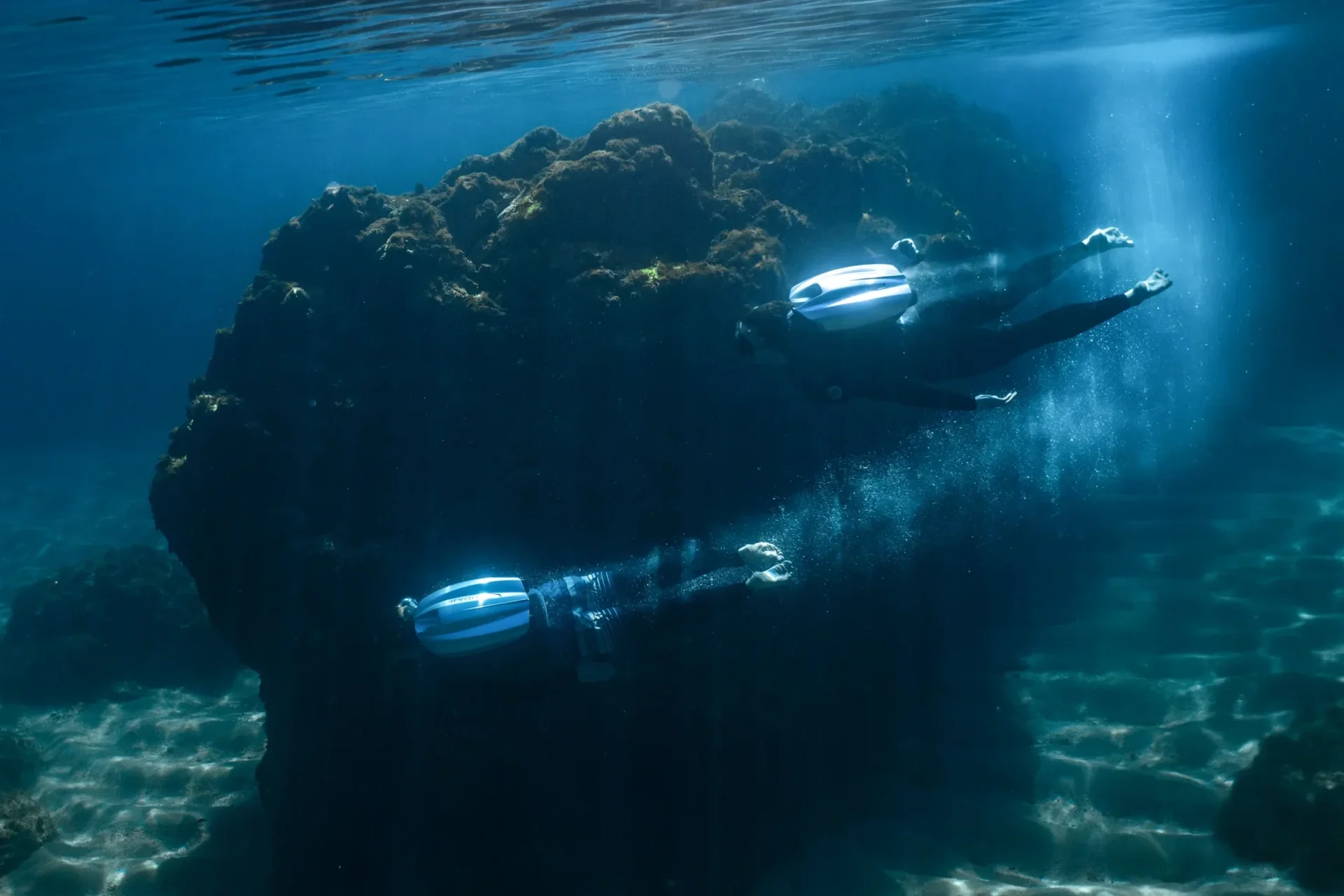
For decades, underwater propulsion has meant one of two things: a handheld torpedo-style device that pulls a diver through the water at modest speed, or the physical effort of swimming with fins. Neither option gives a freediver or snorkeler anything close to the range, speed, and freedom of movement that a genuinely wearable, self-powered system could provide. CudaJet, a company based in England, has built what it describes as the world’s first underwater jetpack — a back-worn propulsion unit that reaches speeds up to 3 meters per second, runs for 90 minutes on a single charge, and can be carried overland to remote coastline entry points that no boat can reach.
Where it comes from
CudaJet was founded by Archie O’Brien and operates its own manufacturing facility in England. The company works with over 60 British suppliers and handles production from raw materials through to finished units entirely in-house — including the manufacturing of its own tooling. That level of end-to-end production is uncommon in consumer watercraft, where most brands rely heavily on overseas component assembly.
The harness — one of the more technically demanding parts of the system — is built using precision textile processes that the company associates with aerospace manufacturing standards. The harness frame uses a carbon fibre skeleton chosen for its stiffness-to-weight characteristics, while the outer material is a custom neoprene. As CudaJet describes it: “Sustainable and the highest quality neoprene in the World.”
Each CudaJet unit is individually made to order, with limited production capacity each year. The company re-invests in research and development on an ongoing basis, and the current platform reflects a series of iterative engineering refinements — including improved handling stability, better energy efficiency, and optimised battery performance compared to earlier versions.
How it works
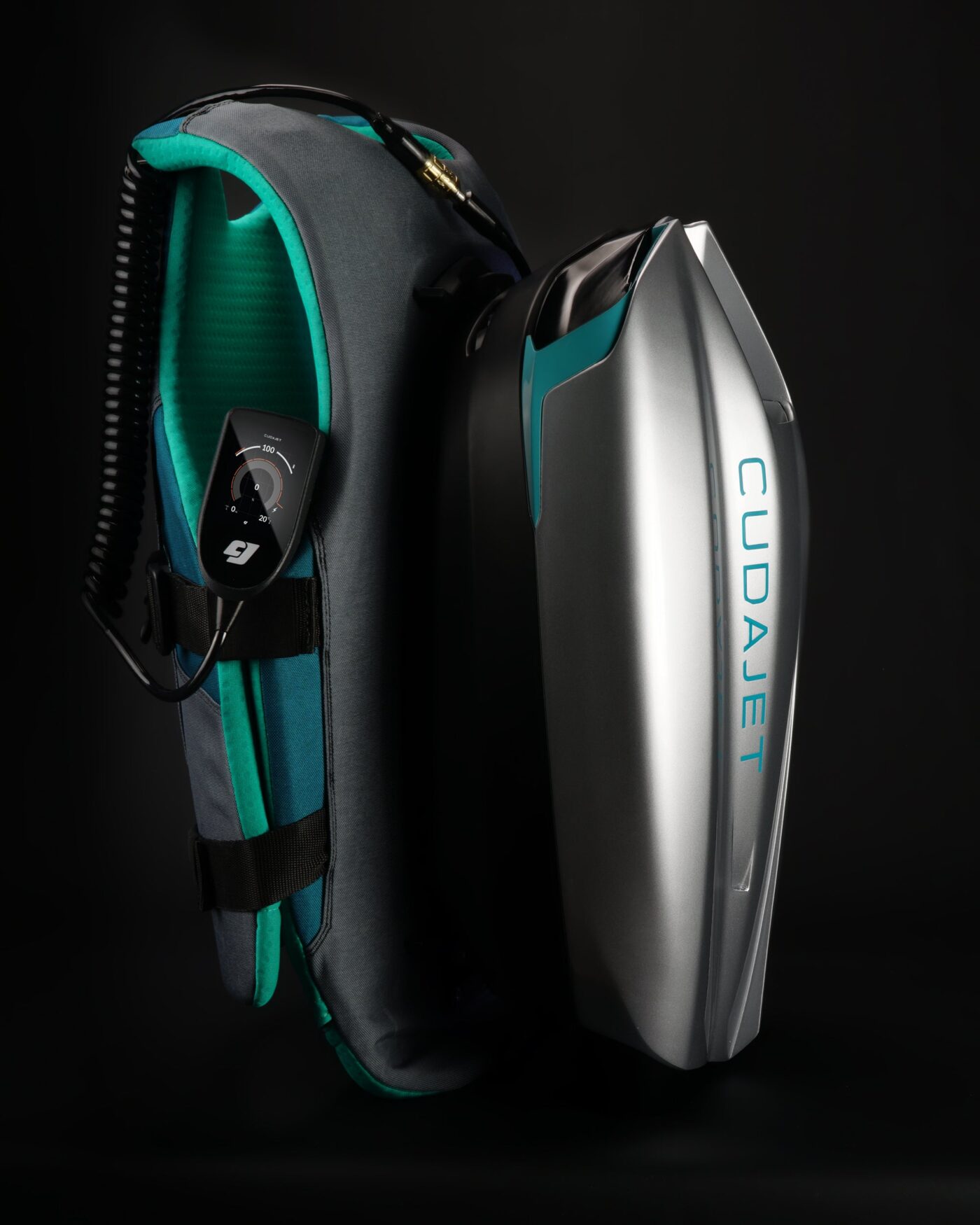
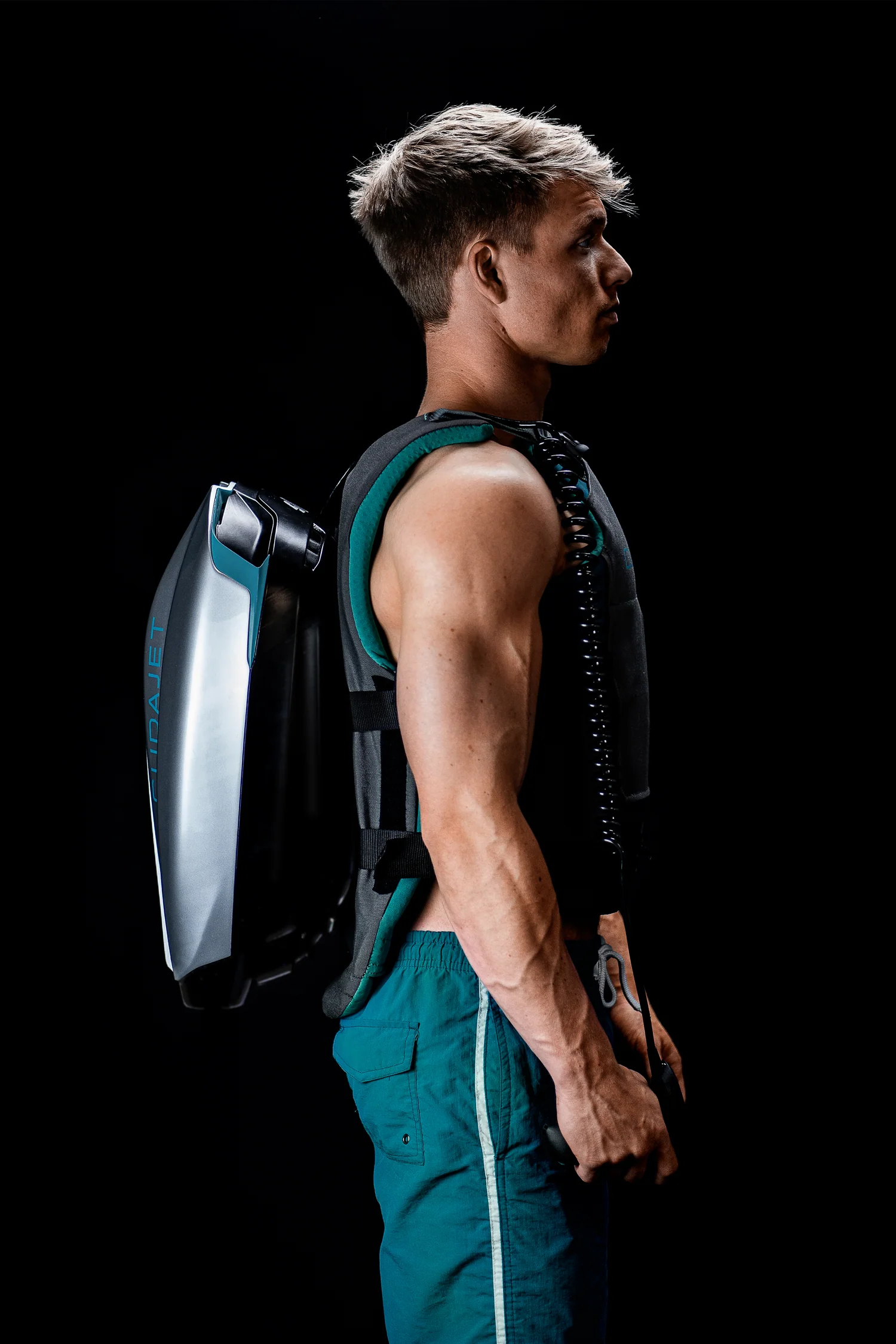
The CudaJet is worn on the back using a quick-attach harness system that fits chest sizes from 32 to 60 inches (81 to 152 cm) and can be put on or taken off in seconds. Once in the water, the rider controls speed through a compact handheld controller connected to the jetpack by a coiled cord, which keeps the controller tethered to the user’s wrist without restricting hand movement. Direction is managed entirely through body movement — the rider tilts and turns to steer, which means the learning curve is shorter than devices requiring dedicated steering inputs. CudaJet says confident underwater flight typically comes naturally within a single session.
The controller features a full-colour display showing live data and uses a smooth throttle with 1,000 micro-steps for precise, progressive speed control. There are no abrupt power changes — the system is designed to feel intuitive from the first use.
The propulsion system is patented. CudaJet describes it as “the heart of its innovation, making the entire device possible,” and states that the power-to-weight ratio of 3:1 surpasses that of comparable handheld underwater propulsion devices on the market. The system is entirely self-contained — no air lines, no surface cables, and no support vessel is required during operation.
Because the device functions as a wearable backpack both in and out of the water, users can hike across rocky terrain, descend cliff paths, and cross rough shoreline to reach entry points that would be inaccessible by boat. CudaJet describes this directly: “The CudaJet Jetpack is designed to move with you, on land, over rocks, and through surf. Reach remote locations and launch from places no other watercraft can.”
Key specifications
The CudaJet reaches a top speed of 3 meters per second — which is faster than any competitive swimmer and fast enough to cover meaningful underwater distances within a single 90-minute session. The fast charger included with the unit restores a full charge in 75 minutes, making back-to-back sessions practical when charging facilities are available.
The jetpack weighs 14 kg (approximately 31 lbs) and carries a maximum certified depth rating of 40 meters (131 feet). Out of the factory, the unit ships with a safety depth limit set to 3 meters — adjustable through the device’s settings as the user’s experience grows. The harness accommodates chest measurements from 81 cm to 152 cm, covering a broad range of body types. The outer shell is deliberately low in volume to reduce drag, a design choice that CudaJet says also enables agile manoeuvres including barrel rolls that would be difficult with a bulkier profile.
What’s included
Every CudaJet ships as a complete kit. The package includes the underwater jetpack unit, the handheld controller, one harness in the buyer’s selected size, a fast charger, a rugged hard case, a charge key, a product manual, and a standard 2-year warranty. The hard case is designed to protect the unit during air freight transit and to store cleanly aboard a yacht tender or in a vessel equipment bay.
Units are shipped with a partial charge for safe transit. Buyers are required to bring the battery to storage charge on receipt before first use, and a signed warranty form must be returned within 14 days to activate the 2-year coverage. A Founder’s Edition variant is also available for buyers who prefer lifetime warranty coverage in place of the standard term.
Portability and wildlife encounters
One practical distinction between the CudaJet and most competing underwater propulsion devices is how it behaves outside the water. Traditional handheld dive propulsion units are designed for pool decks or boat platforms — they’re awkward to carry over distance and completely dependent on easy water access. The CudaJet’s backpack format changes that equation. Users can approach the water on foot from locations that have no marina, no dock, and no launch ramp, which opens up a significantly wider range of dive and snorkel environments.
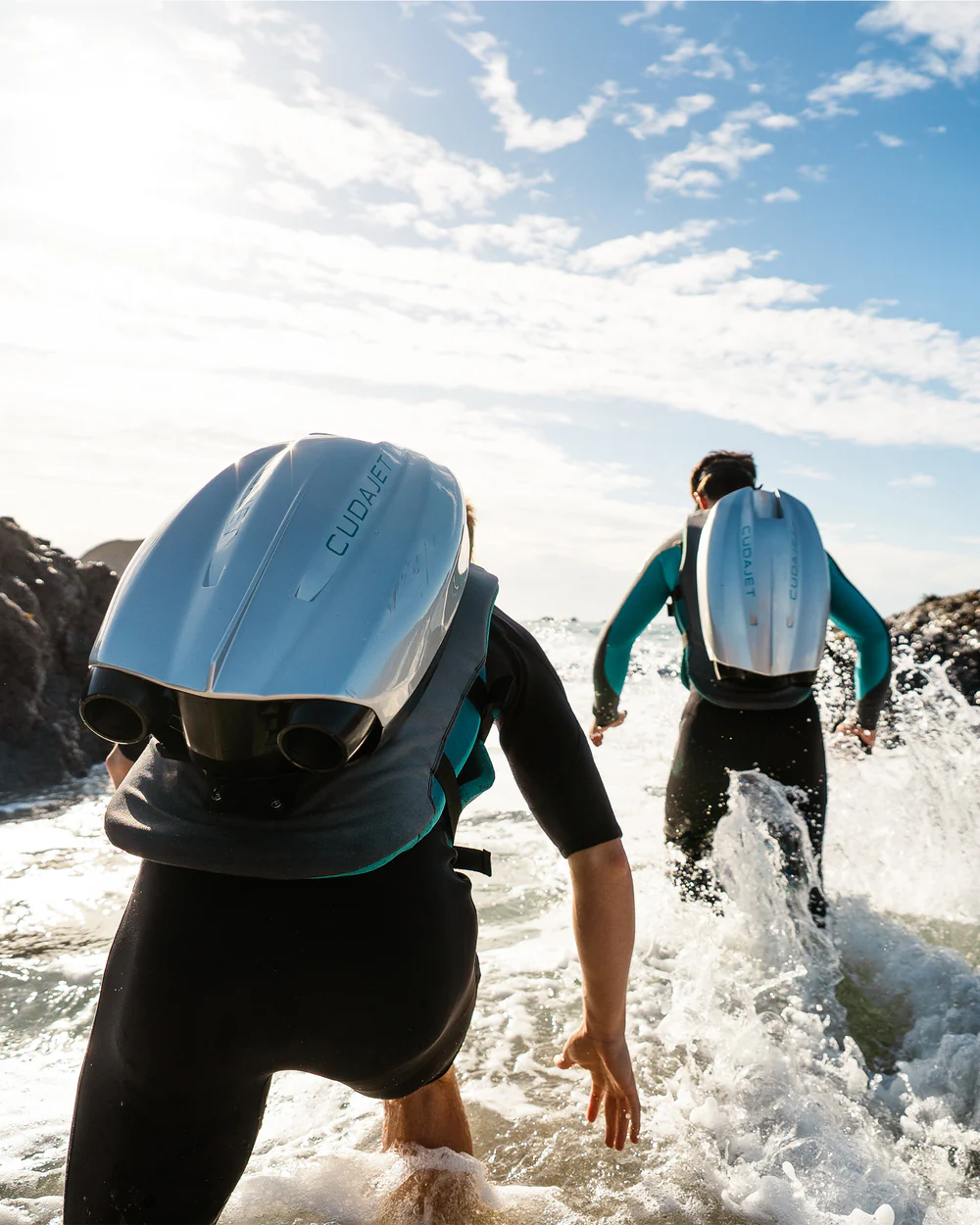
CudaJet also maintains a dedicated page on its website documenting real-world encounters between users and wild dolphins during open-water sessions. The company’s position is that a device which moves the way a swimmer moves — quietly, without surface noise — creates conditions where marine animals are more likely to approach. Several documented encounters show dolphins swimming alongside CudaJet users at close range in open ocean. As CudaJet puts it: “Technology that brings you closer to nature. When your movement feels natural, everything else follows.”
Who it suits
The CudaJet is a practical fit for superyacht and private vessel owners who want a high-capability water activity that goes beyond the standard paddleboard or jet ski offering, and for experienced freedivers who want extended range and speed without the planning and weight requirements of full scuba equipment. Its portability on land makes it genuinely useful at remote locations — an advantage that becomes meaningful in the Mediterranean, Caribbean, and similar sailing regions where the most interesting underwater terrain is often well away from a marina.
For superyacht operators, the self-contained kit, the rugged hard case, and the 90-minute run time make the CudaJet easy to stow, deploy, and retrieve between anchorages. The company notes the product is positioned as a superyacht toy for 2026, targeting the high-end leisure market across the Mediterranean, Middle East, and Florida.
The device is less suited to cold-water dive environments, technical diving applications that require integrated air supply, or buyers who need an off-the-shelf purchase with immediate delivery. The made-to-order process requires direct communication with CudaJet before production begins, and lead times vary depending on order volume at the time of enquiry.
Limitations worth noting
At 14 kg (31 lbs), the jetpack has real weight on land, though underwater buoyancy offsets much of that load during use. Post-session maintenance is also more involved than most watercraft: CudaJet specifies that all parts must be fully submerged in freshwater after every use, with the motor slowly run to flush out saltwater residue before air drying. The battery must not be stored at full charge, and the unit must not be operated out of water under any circumstances.
Buyers importing to certain international markets should verify local customs regulations before placing an order, as clearance can introduce delays and additional costs beyond the standard 7-to-10-day air freight window. The company’s website notes plainly: “Please check your local laws on importing.”
The annual production limit also means availability is not guaranteed at any given time. Prospective buyers are advised to contact CudaJet directly to confirm current lead times before committing.
Pricing and availability
The CudaJet Underwater Jetpack is priced at £22,500 GBP (approximately US$28,500). All purchases are made through direct inquiry via the company’s official website — there are no third-party retailers or distribution partners currently involved in the sales process. A Founder’s Edition with lifetime warranty coverage is separately listed on the company’s website for buyers who want extended protection. CudaJet is active across the Mediterranean, Middle East, and Florida as of 2026.
Source: CudaJet