

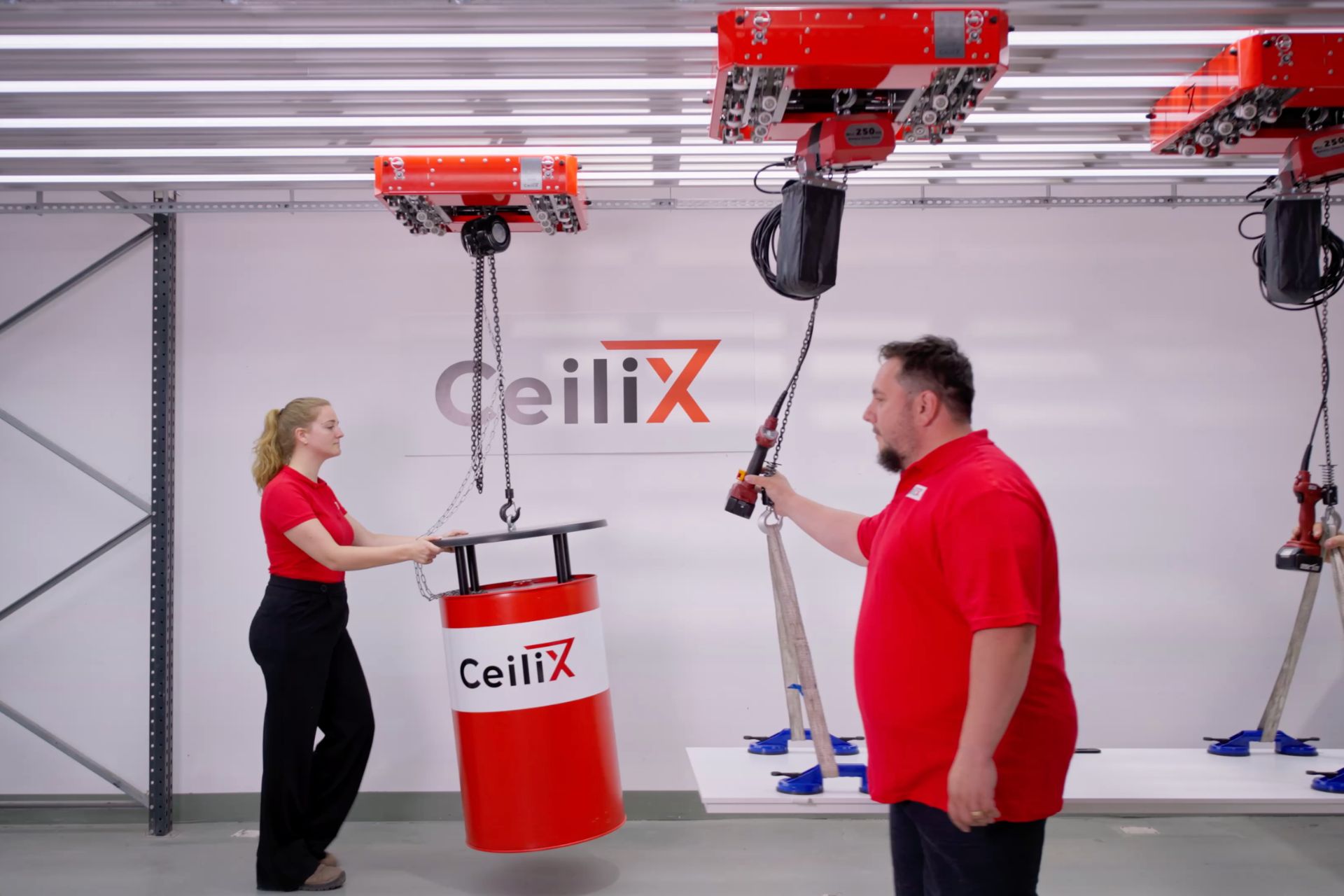
Cranes in factories and warehouses typically work the same way they have for decades: a hoist runs along a fixed overhead beam, moving loads in a straight line between two points. If a pillar is in the way, you route around it at the floor level. If you need to move something diagonally, you move it in stages. The floor remains crowded, and the ceiling stays unused. A German startup called CeiliX is building a system designed to change that. Its InfinityCrane product is a ceiling-mounted modular rail network paired with autonomous overhead vehicles — called SkyRunners — that can move loads in any direction, around any obstacle, through any room shape, simultaneously and without the vehicles blocking each other.
The company’s stated ambition extends well beyond the crane market. CeiliX also offers a SkyBot platform that adapts the same overhead vehicle system to carry robots and tools, effectively turning the ceiling of a factory or warehouse into a mobile robotics layer.
The core problem: Cranes that can only go straight
Traditional overhead cranes — whether bridge cranes, gantry cranes, or monorail systems — are constrained by their rails. They move loads in one or two axes, and they cannot navigate around obstacles in their path. In a production hall with pillars, pipes, or machinery in the way, this creates dead zones where overhead handling simply doesn’t work, forcing facilities to supplement with forklifts and floor-level transport that compete with workers for floor space.
CeiliX addresses this with a combination of a flexible rail infrastructure and omnidirectional vehicle technology. The SkyRunner vehicles grip the ceiling rail from multiple sides simultaneously, which allows them to change direction freely within the rail network — including through turns, corners, and junctions — rather than being locked to a single axis of travel.
How the system works
The foundation of the InfinityCrane is the CeiliX Elements modular rail system. The rails come in five standard length modules — CLX-20, CLX-15, CLX-10, CLX-5, and CLX-2.5 — all sharing a uniform width of 3.7 feet (1.2 meters). The lengths correspond to approximately 20 ft (6m), 15 ft (4.5m), 10 ft (3m), 5 ft (1.5m), and 2.5 ft (0.75m). Two additional specialized elements, the CLX-CutRight and CLX-CutLeft, are designed specifically to route the rail network around fixed obstacles like structural pillars or ceiling-mounted pipes.
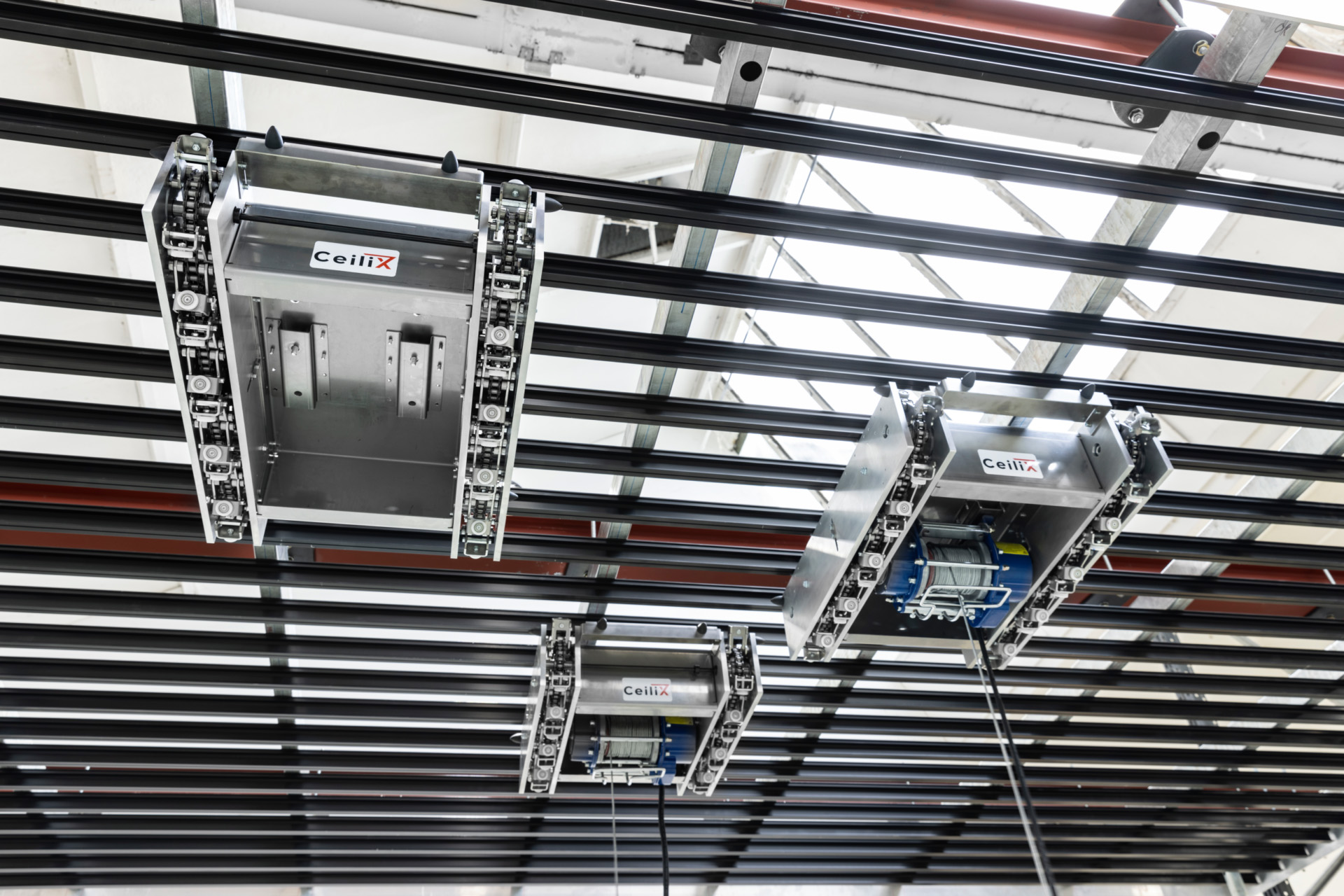
Because the modules connect and can be rearranged, the system can start in one area of a facility and be expanded incrementally as needs change. CeiliX says the elements are designed to be easy to install, which is relevant for existing buildings where major structural modifications are not practical.
The SkyRunner vehicle runs along this rail network. Its current version supports a payload of 250 kg (approximately 550 lbs). Versions rated for 500 kg (1,100 lbs) and higher are described as being in development. For heavier single loads, multiple SkyRunners can be operated collaboratively, with two or more vehicles sharing the weight. When three or more SkyRunners work together, the system can also rotate the load — changing the orientation of an object in mid-air — which the company says can simplify assembly and production steps that would otherwise require repositioning by hand.
The company states that in many cases, loads can be moved “with a fingertip,” implying very low resistance to movement for manually-guided operation alongside the automated capabilities.
Multiple vehicles, no collisions
One of the more practically significant aspects of the InfinityCrane is how multiple SkyRunners coexist in the same ceiling network. The system is designed to allow several vehicles to operate simultaneously in the same facility, in tight spaces, without blocking or interfering with each other. Each SkyRunner can carry a full payload in its segment of the ceiling independently of what other vehicles are doing elsewhere in the network.
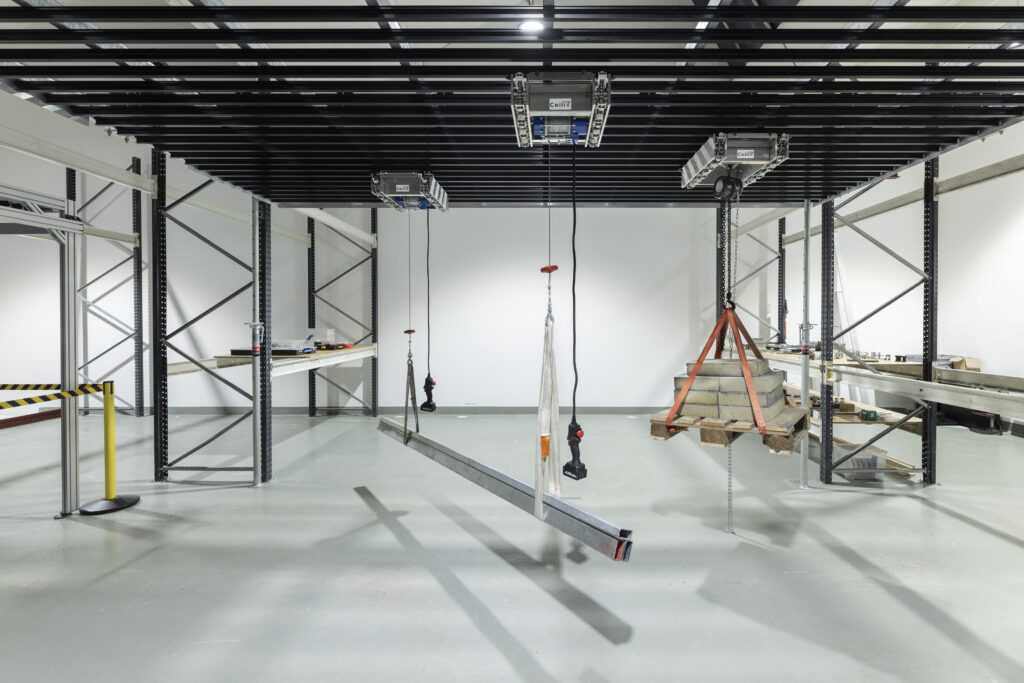
This is a meaningful departure from conventional crane systems, where a single bridge crane typically occupies its bay entirely and cannot share space with another crane on the same rail without complex sequencing logic. The InfinityCrane’s omnidirectional capability means vehicles can route around each other within the network, rather than waiting for a shared lane to clear.
Beyond craning: The CeiliX SkyBot
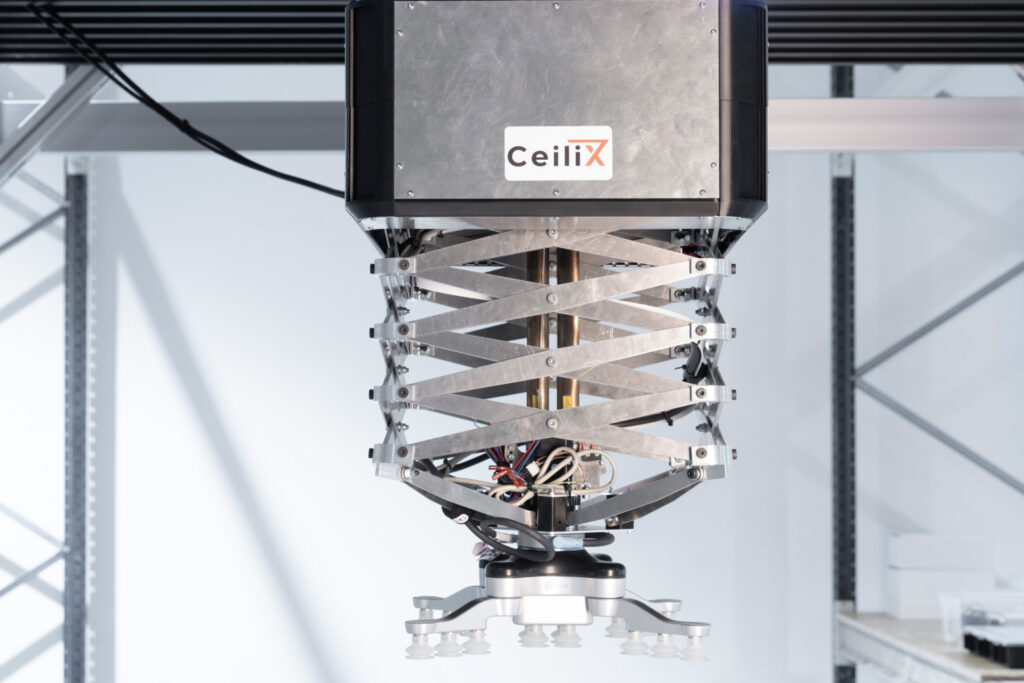
CeiliX is positioning its ceiling rail and vehicle technology as a platform, not just a crane. The SkyBot product line extends the SkyRunner vehicle to carry robotic arms, tools, sensors, or other payloads instead of — or in addition to — loads on a hoist.
The practical implication is that ceiling-mounted robotic systems could move freely through a production space to wherever they are needed, rather than being fixed to a single location. CeiliX says this approach could free up 30 to 50 percent of floor space in production and warehouse environments by relocating transport and robotic operations overhead — removing the need for floor-level autonomous mobile robots (AMRs) or automated guided vehicles (AGVs) that currently share floor space with workers.
The company is positioning this as a B2B offering aimed at robot manufacturers rather than end users directly. Its pitch is that robot companies can integrate the CeiliX drivetrain and rail infrastructure into their products to enable ceiling-mobile versions of existing robots without rebuilding the robot itself. Interested robot manufacturers are invited to contact CeiliX to discuss co-development arrangements.
What to keep in mind
The InfinityCrane is a capital equipment product aimed at industrial buyers — factories, warehouses, and production facilities — rather than a consumer or small-business product. The system requires ceiling installation and custom configuration for each facility. CeiliX does not publish pricing; quotes are handled on a project basis through direct inquiry.
The current SkyRunner is rated for 250 kg. For facilities handling very heavy loads — heavy machinery components, palletised goods above 500 kg — the higher-capacity versions are listed as under development, meaning buyers with those requirements would need to confirm timelines. The collaborative multi-vehicle lifting capability partially addresses this, but the coordination requirements for heavy collaborative lifts add operational complexity compared to a single high-capacity hoist.
The system is also described as suitable for any room shape, but facilities with non-standard ceiling heights, irregular structures, or specific fire suppression systems overhead may require additional engineering assessment before installation.
Source: Ceilix


