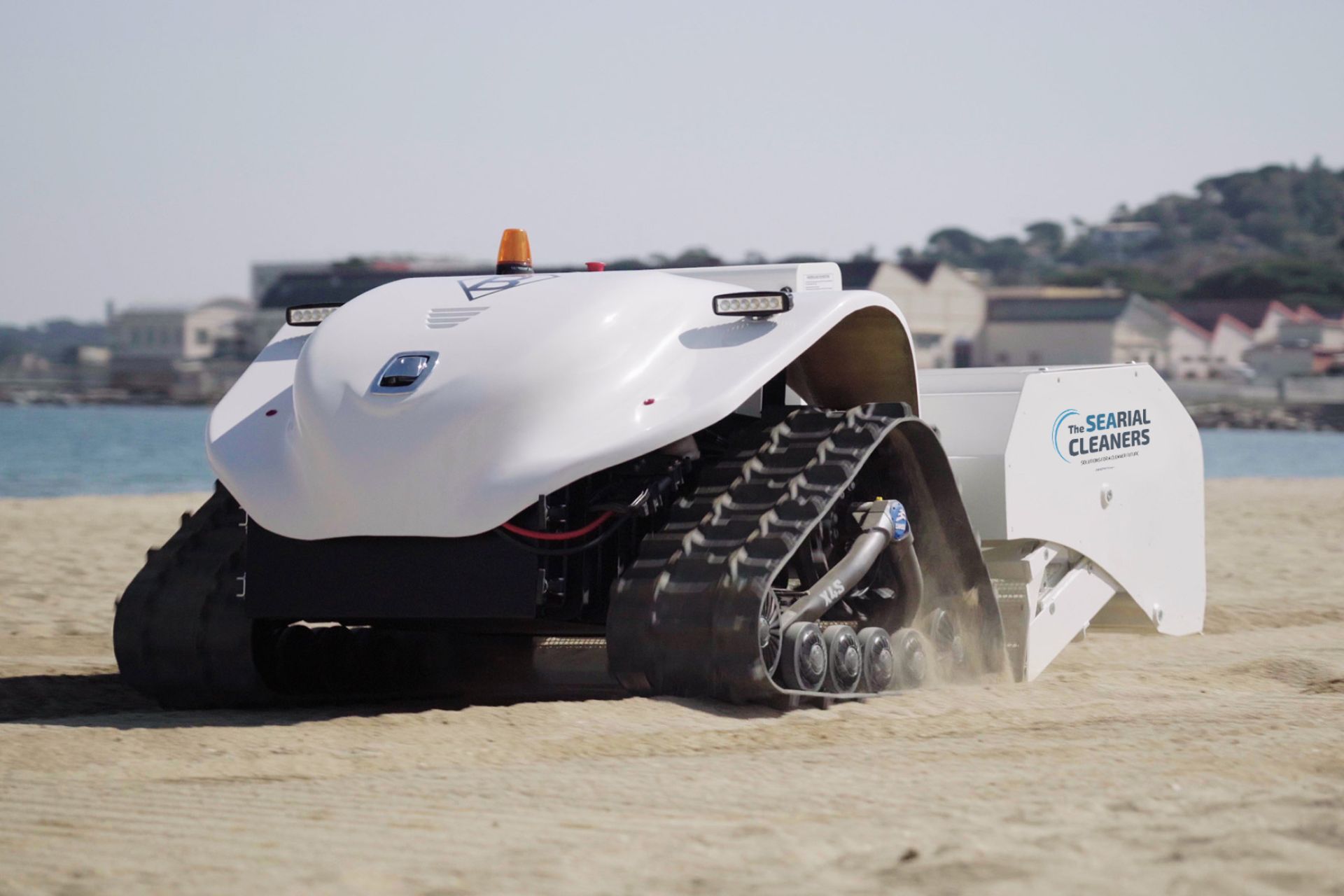
Most beach cleanups end the same way: a line of volunteers walks the shore, bends over thousands of times, and still leaves behind the smaller debris that has worked its way under the surface. A compact, tracked robot called BeBot is designed to handle that buried layer. Built and marketed by The Searial Cleaners, a Wearth Group company, BeBot screens sand to pull out trash that hands and rakes tend to miss, and it does so on battery and solar power alone.
The machine has already been put to work on beaches in the United States and Southeast Asia, where operators use it to supplement, rather than replace, human cleanup crews.
What BeBot actually does
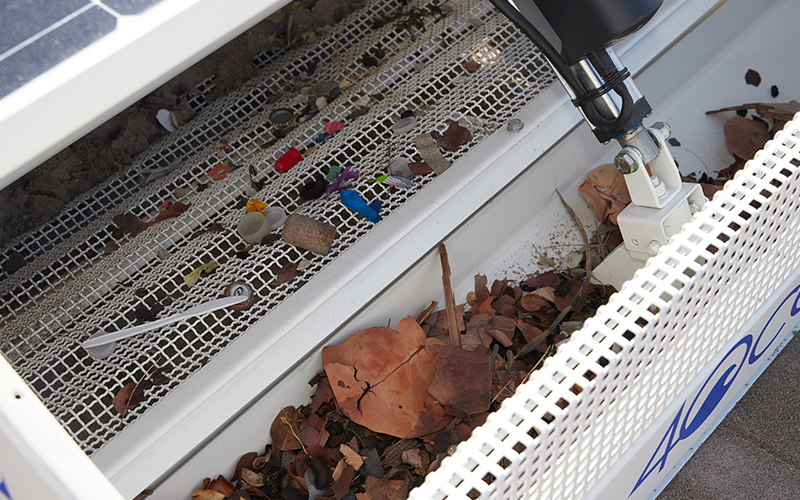
BeBot is a beach-screening robot. As it moves across sand, it sifts the top layer and separates out waste, while also performing groundskeeping tasks. According to The Searial Cleaners, BeBot “screens sand, rakes seaweed, levels out expanses of beach, and lifts and carries loads. It collects all waste buried in the defined area.”
The targets are the everyday items that accumulate on shorelines: plastic bottles, cigarette butts, packaging, bottle caps, cardboard, and cotton buds. Because it digs slightly below the surface, it reaches debris that surface-level pickups leave behind.
The company positions the robot for public and private beaches, nature reserves, playing fields, and golf courses. It is built to handle sloped terrain, and to protect plant and animal life as well as the sand itself while it works.
How it works: The specifications
BeBot is operated by remote control from up to 150 meters away (roughly 490 feet), so a single person can run it from a distance rather than walking behind it.
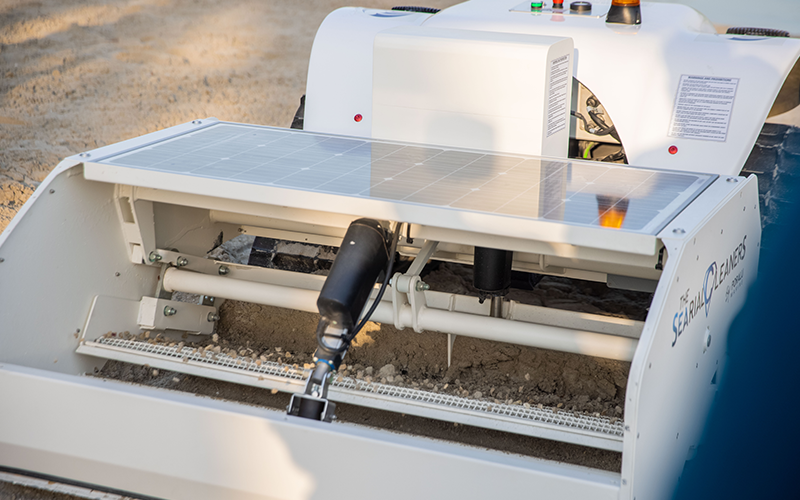
Power comes entirely from electricity, using a combination of batteries and solar panels. The company states the all-electric BeBot emits no harmful or greenhouse gases, and its quiet operation means it can run at any time of day or night. A full charge takes about eight hours and delivers up to three hours of runtime.
Movement is deliberately slow and controlled. Top speed is 2.7 km/h (about 1.7 mph), it can manage obstacles and inclines up to 20 degrees, and it can pull loads up to 400 kilograms (roughly 880 pounds).
The screening system clears a path 130 centimeters wide (about 51 inches) and works to a depth of 10 centimeters (about 4 inches). The company lists a cleaning capacity of 3,000 square meters (around 32,000 square feet, or about three-quarters of an acre), with an onboard collection capacity of 100 liters (about 26 gallons).
For safety, BeBot includes an emergency stop button and safety LEDs for visibility, with an optional warning light and audible alert. Available accessories include a rake, a mast and marketing flag, a professional-quality speaker, and battery-monitoring apps.
Where it has been used
Two operators offer firsthand accounts of the robot in the field.
In the United States, ECO-CLEAN Solutions brought BeBot to Lake Tahoe. As CEO JB Harris put it: “Volunteer cleanups are essential, but waste often remains buried beneath the sand, and picking up tiny pieces by hand is slow, laborious work. That’s why, in 2022, ECO-CLEAN Solutions was proud to deploy BeBot on Lake Tahoe in a first for the West Coast of the United States! This solar-powered eco-friendly robot filters and screens the sand, efficiently removing trash and plastic debris from the beach before it gets to the water.”
In Indonesia, the beach club Finns described a similar experience: “At Finns, we believe in combining human effort and innovation. That’s why we introduced BeBot, the first solar-powered electric beach-cleaning robot in Bali. Since we launched BeBot, our teams have removed hundreds of kilograms of waste that would have been hard to collect by hand from our beaches. We’ve also sparked a lot of curiosity and raised awareness, leading to debates on innovation and responsibility.”
Both accounts point to the same role: a tool that catches what manual cleanups miss, while drawing public attention to the litter problem itself.
Part of a larger cleanup lineup
BeBot is one of several products from The Searial Cleaners, which describes itself as an expert in tackling marine pollution in inland and coastal waters worldwide. The company also offers the Jellyfishbot, a remote-controlled drone that skims floating waste from the water’s surface; the Collec’Thor, a fixed collector that gathers debris from a single point such as a marina; and the InvisiBubble, a bubble curtain used to block or redirect floating waste. Together, the lineup is aimed at intercepting trash on the sand, on the water, and at fixed collection points.
Significance, limits, and what comes next
BeBot’s appeal is straightforward: it reaches buried debris, runs on clean power, and operates quietly enough for any hour. For beach managers, that means a way to handle the slow, repetitive part of cleanup work without engine noise or emissions.
The limits are worth keeping in view. BeBot is remote-controlled rather than autonomous, so it still needs an operator. Its top speed is modest, runtime is capped at about three hours per charge, and its screening reaches only the top 10 centimeters of sand, leaving anything deeper untouched. The operators themselves frame the robot as a complement to volunteer efforts, not a replacement for them.
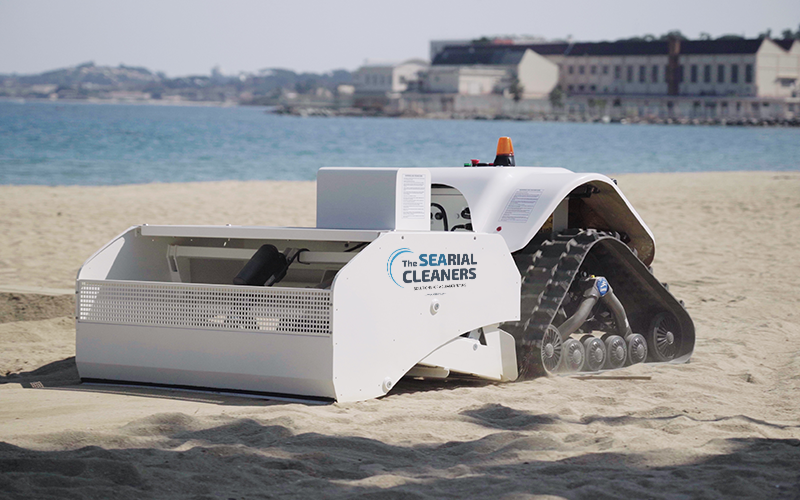
As coastal communities look for lower-emission ways to manage litter, machines like BeBot suggest where beach maintenance may be heading: a mix of human crews and electric tools that divide the work between them.
Availability
BeBot is sold directly through The Searial Cleaners, which handles inquiries and quotes through its website. No public retail price is listed; prospective buyers contact the company for pricing and deployment details. Technical sheets and a quick-start guide are available to download from the product page.
Source: The Searial Cleaners