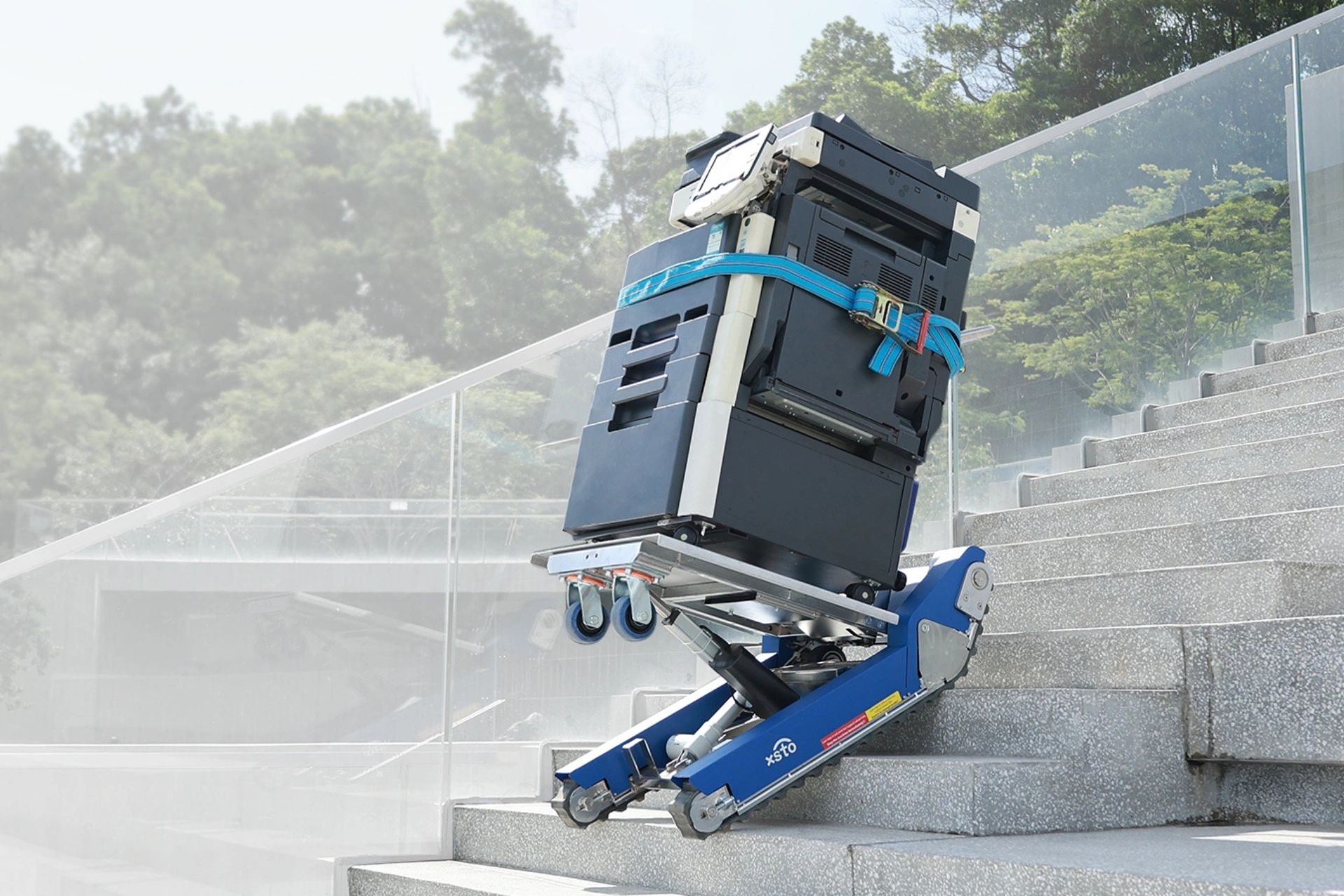
Moving a large copier, safe, commercial appliance, or piece of industrial equipment between floors can be a difficult and risky job. Conventional stair-climbing dollies reduce some of the physical strain, but they still depend heavily on an operator to balance, guide, and control the load.
The XSTO CT50 takes a more automated approach. Described by its manufacturer as an AI-powered stair-climbing robot, it is designed to transport heavy loads under its own power while actively stabilizing them and correcting its movement on the stairs.
With a rated load capacity of 420 kg, or approximately 925 lb, the CT50 is aimed at professional moving companies, equipment installers, logistics teams, and businesses that regularly need to move bulky machinery through buildings without elevators.
A robot rather than a conventional stair-climbing hand truck
The CT50 may resemble a large tracked stair climber, but its operating concept is different from that of a standard powered dolly.
Traditional machines typically require an operator to hold the handles, manage the angle of the load, and make constant adjustments as the equipment climbs. The CT50 is presented as a hands-free handling robot with intelligent control, automated balancing, and stair-climbing correction.
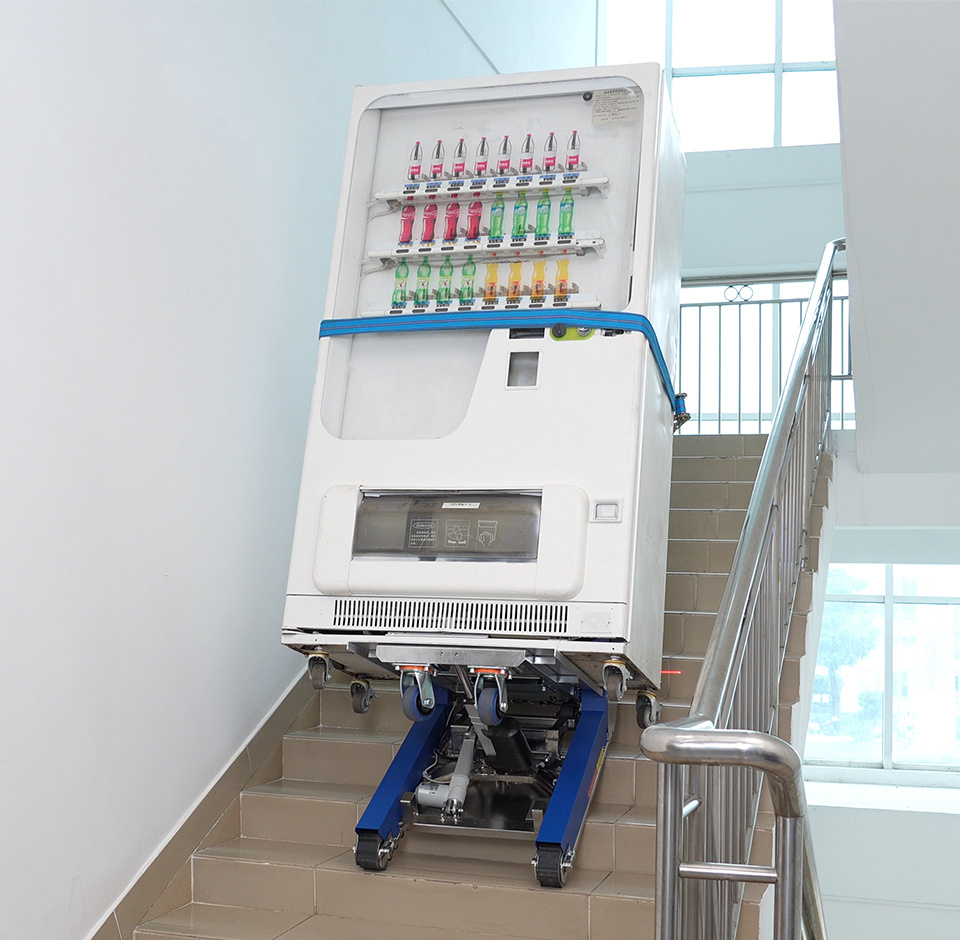
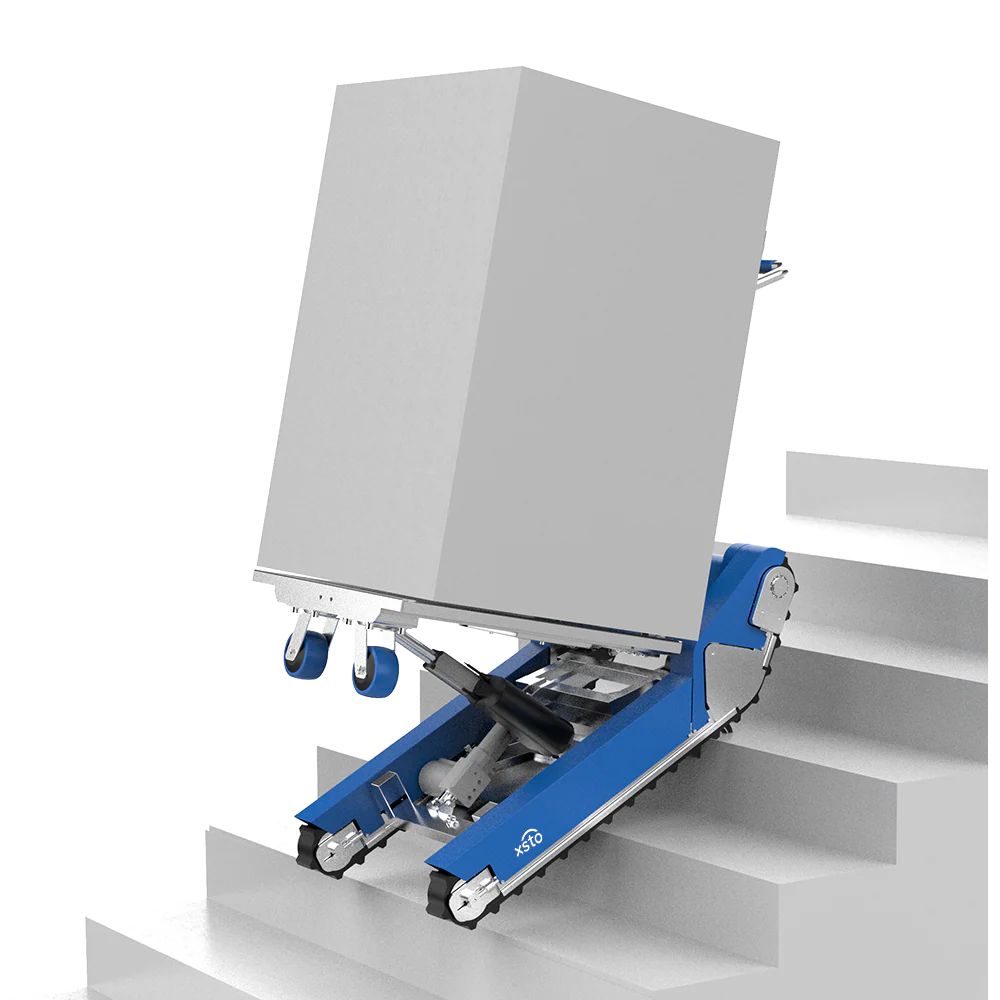
Once the cargo is secured to its platform, the machine uses its powered base and tracked climbing system to move across level surfaces and negotiate stairs. The robot’s structure tilts and adjusts as it climbs, helping keep the load within a stable operating position instead of relying on a person to counterbalance its weight manually.
That distinction is important. The robot is not simply assisting someone who is dragging a heavy machine upstairs. It is carrying and moving the load itself, while the operator supervises its progress and controls the task.
Intelligent balancing keeps the load stable
One of the CT50’s central features is what XSTO calls Intelligent Balance. The company says its self-developed balance technology provides fully automated load stabilization.
When a heavy object moves from flat ground onto a staircase, its center of gravity changes significantly. That transition can make conventional equipment difficult to control, particularly when the cargo is tall, top-heavy, or unevenly distributed.
The CT50 is designed to compensate for these changes by adjusting the position of its carrying platform. In demonstrations, the upper platform remains tilted relative to the tracked base as the robot climbs, helping the secured cargo stay closer to an upright and controlled orientation.
This could be especially useful when transporting sensitive or expensive equipment such as large photocopiers, medical devices, commercial electronics, vending machines, and industrial systems that may be damaged if they are allowed to lean too sharply.
The cargo still needs to be properly positioned and firmly secured. Automated balancing reduces the operator’s workload, but it does not remove the need for suitable restraints, route planning, and safe working procedures.
It can correct its path while climbing
Staircases are rarely perfect. Steps may vary slightly in height, the load may not be centered precisely, and the tracks may begin to drift toward one side during a climb.
To address this, XSTO equips the CT50 with Intelligent Deviation Correction. The company says the robot monitors its tracks and makes real-time adjustments to support safer stair climbing.
The published specifications list LiDAR and a gyroscope among its sensors. LiDAR can help the robot measure its surroundings, while the gyroscope provides information about its angle and orientation. Together with the robot’s control system, these sensors help it track its position and respond when the machine begins moving away from the intended path.
This does not necessarily mean the CT50 can independently navigate an entire building or select a route without supervision. Its automation appears focused primarily on balancing, movement control, and stair-climbing stability rather than unrestricted autonomous navigation.
Built to carry up to 925 pounds
The CT50 has a maximum rated load capacity of 420 kg, equivalent to roughly 925 lb. Its own listed weight is 100 kg, or about 220 lb, excluding the battery.
That makes it suitable for equipment that would normally require several workers, lifting straps, ramps, or specialized moving tools. Potential applications could include transporting:
- Large office copiers and printers
- Safes and secure cabinets
- Commercial refrigerators and appliances
- Vending machines
- Server and telecommunications equipment
- Laboratory and medical systems
- HVAC components
- Industrial machinery
The practical load that can be moved safely will still depend on its shape, center of gravity, attachment points, stair dimensions, and how securely it can be mounted to the robot.
A wide, low object may behave very differently from a tall machine of the same weight. Buyers would therefore need to confirm that their intended equipment and working environment fall within XSTO’s operating guidance.
Stair speed and battery endurance
XSTO lists the CT50’s climbing speed at up to 18 steps per minute. Its stated battery endurance ranges from 840 to 907 steps while travelling upstairs and from 1,785 to 1,890 steps while travelling downstairs.
Those figures suggest that a charged battery could support multiple jobs in many commercial settings, although actual endurance will depend on cargo weight, staircase design, operating speed, surface conditions, and battery age.
The robot uses a 48V 10Ah lithium battery.
Its maximum supported step height is listed as 210 mm, or around 8.3 inches. XSTO also gives a maximum slope figure of 40 degrees.
Before purchasing, operators would need to measure the stairs where the machine will be used. Narrow landings, curved staircases, unusually high steps, and confined corners may limit access even when the robot can technically handle the individual steps.
Space requirements on stairs and landings
A heavy-load robot needs room to turn and reposition, particularly at the top, bottom, or midpoint of a staircase.
XSTO lists a minimum turning radius of 850 mm in crawler-track mode and 905 mm in flat-ground mode. The company also specifies minimum platform areas of 2,000 x 1,300 mm for a U-shaped arrangement and 1,100 x 1,200 mm for an L-shaped arrangement.
These measurements are likely to be particularly relevant in older buildings, residential stairwells, and service areas where landings can be tight.
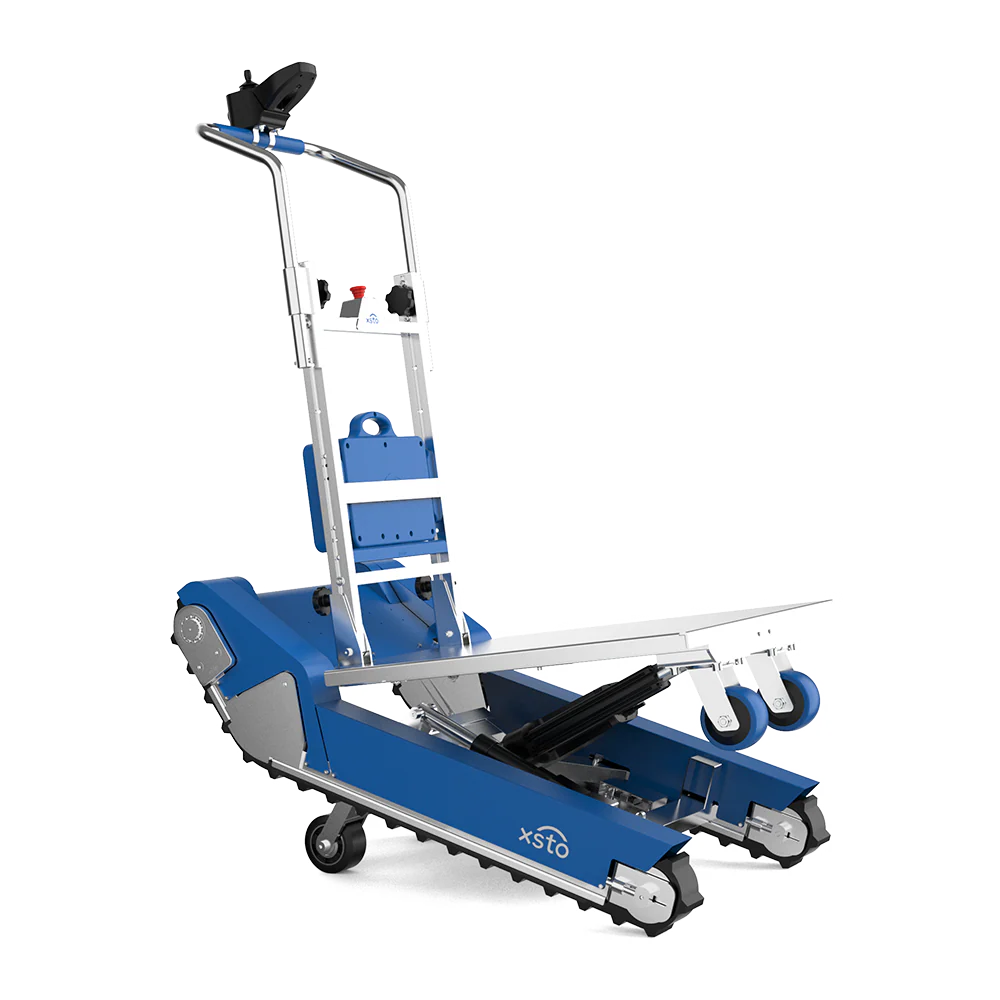
The CT50 measures 632 x 1,168 x 411 mm when folded. When unfolded, it measures 632 x 1,030 mm, with an adjustable height ranging from 1,020 to 1,244 mm.
Its foldable configuration should make storage and vehicle transport easier, although at around 220 lb without the battery, it remains a substantial piece of professional equipment rather than a portable hand truck that one person would casually lift into a van.
An expandable platform for specialized equipment
XSTO is also positioning the CT50 as more than a single-purpose moving robot.
The manufacturer says it includes open peripheral interfaces that can support accessories such as radar, cameras, robotic arms, gas detectors, thermal imagers, vacuum-cleaning modules, and satellite communication equipment.
This could allow organizations to adapt the platform for inspection, emergency response, industrial monitoring, hazardous-environment work, or other specialized tasks.
However, these modules should be viewed as possible integrations rather than standard equipment included with every CT50. Buyers interested in custom configurations would likely need to work directly with XSTO or an approved integrator.
Where the CT50 could be useful
The CT50 is likely to be most valuable in jobs where heavy equipment must regularly be moved through buildings that lack freight elevators or where elevator access is restricted.
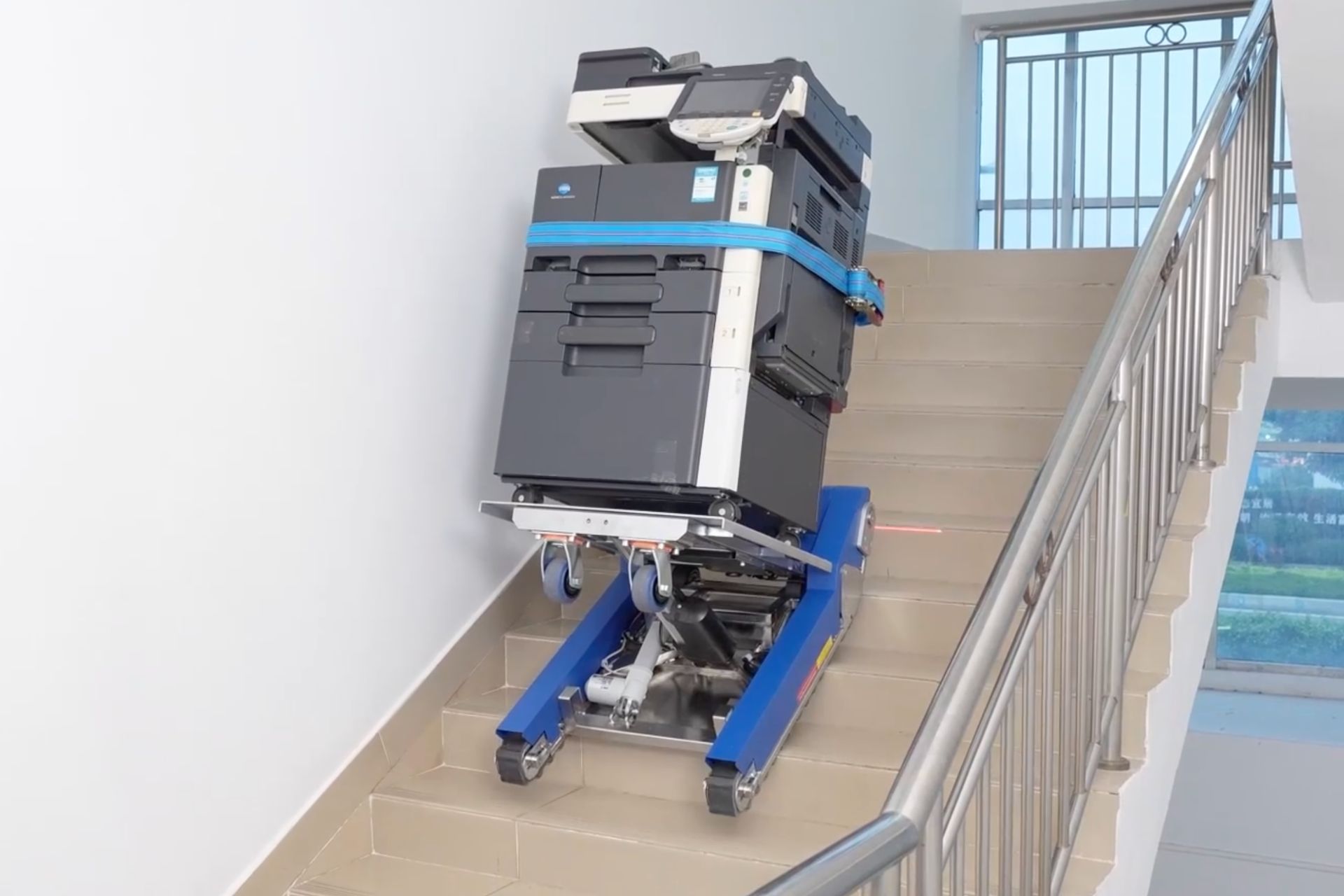
Office-equipment suppliers could use it to deliver and remove large copiers. Appliance installers might use it in apartment buildings. Industrial contractors could move machinery into basements, workshops, or mechanical rooms. Medical-equipment providers could use it when installing heavy systems in older facilities.
Its greatest benefit may be reducing the number of workers who need to remain physically close to an unstable load on a staircase. By controlling the lifting, balancing, and climbing functions, the robot could reduce manual effort and make demanding moves more repeatable.
It should not, however, be treated as a replacement for trained operators. Moving nearly half a ton on stairs remains a high-risk activity. Staff would need suitable instruction, a clear route, correctly rated restraints, and procedures for dealing with power loss, obstructions, or unexpected movement.
Pricing and availability
The XSTO Climbers online store lists the CT50 AI Electric Heavy Duty Stair Climbing Robot at US$7,199.
The product appears to be available for direct purchase through the company’s US-facing store, while the main XSTO website also provides an option to book a demonstration or contact the company for further information.
Prospective buyers should confirm shipping costs, delivery times, warranty coverage, local servicing, operator training, and whether any required accessories or cargo restraints are included in the listed price.
Product page: XSTO