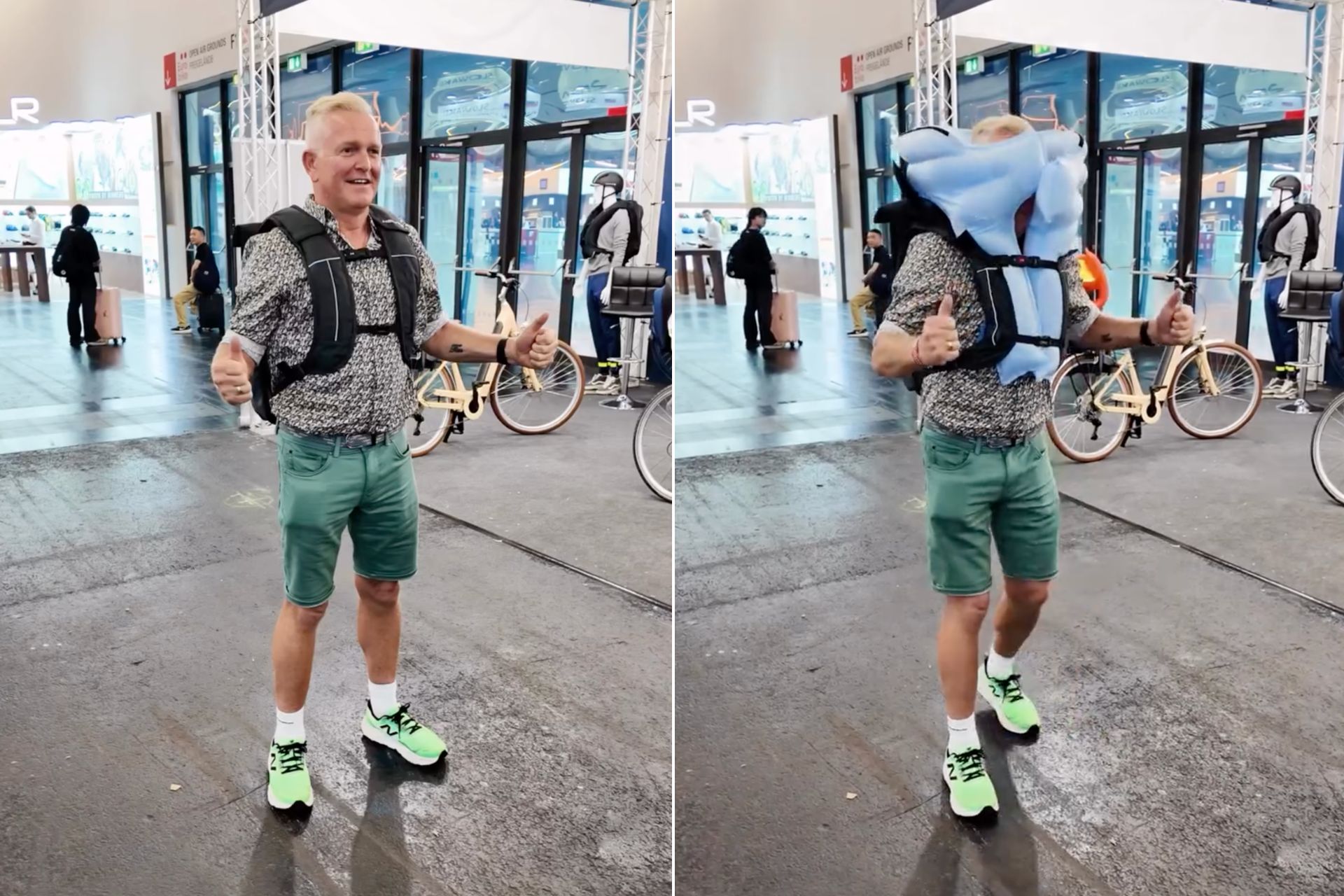
Cyclists regularly carry backpacks for laptops, clothing, tools and everyday essentials. Helite is now attempting to turn that familiar accessory into an additional layer of crash protection.
Unveiled at Eurobike 2026, the upcoming Helite Nomad Max is a roll-top cycling backpack featuring a built-in, fully electronic airbag system. It is designed to combine practical storage with wearable protection, allowing riders to carry their belongings without having to wear a separate airbag vest.
Helite Deutschland introduced the Nomad Max as a forthcoming product and confirmed that the backpack offers 28 liters of capacity. However, the company has not yet published a dedicated product page, complete technical specifications, pricing or a confirmed release date.
A practical backpack with hidden protection
Under normal riding conditions, the Nomad Max resembles a conventional roll-top backpack. Its expandable upper section should make it suitable for commuting, shopping and longer recreational rides where additional cargo space may be needed.
The defining feature is the electronic airbag integrated into the backpack.

Unlike mechanically triggered systems that use a tether connected to the bicycle, a fully electronic system is intended to detect a crash through onboard electronics. Helite has not yet explained which sensors or detection algorithms the Nomad Max uses, so its exact activation process remains unconfirmed.
The absence of a physical tether could make the backpack easier to use during everyday cycling. A rider would theoretically only need to put it on and activate the system rather than remembering to attach and detach a cable whenever getting on or off the bicycle.
Helite has not yet disclosed the Nomad Max’s inflation time or identified the precise areas of the body its airbag is designed to protect.
Designed for everyday cyclists
The combination of 28-liter storage and an electronic airbag suggests that the Nomad Max is aimed primarily at commuters and other riders who already use a backpack.
That could include people travelling to work by bicycle, e-bike riders covering longer distances and cyclists navigating busy urban roads. Instead of carrying a dedicated piece of protective equipment, the rider could potentially integrate the airbag into something they already wear.
The design also reflects a broader challenge surrounding wearable safety products: they need to be convenient enough that people will actually use them. By incorporating the system into an ordinary-looking backpack, Helite appears to be trying to make airbag protection easier to adopt as part of a daily routine.

Whether the final product remains comfortable when fully loaded will depend on factors such as its total weight, ventilation, shoulder-strap design and the amount of internal space occupied by the airbag components. Those details have not yet been announced.
Building on Helite’s airbag experience
Helite already produces wearable airbag systems for motorcycling, cycling and equestrian use. The company describes itself as an airbag-protection specialist with approximately 20 years of experience in the field.
The Nomad Max is not Helite’s first attempt to combine a backpack with an airbag. Its existing H-MOOV motorcycle backpack incorporates an airbag designed to protect areas including the back, neck, chest, abdomen and sacrum. The motorcycle model is available with electronic or mechanically triggered activation, depending on the version.
However, specifications from the H-MOOV should not automatically be applied to the Nomad Max. The new model is intended for cyclists and may use a different airbag shape, detection system, cartridge, back protector and inflation strategy.
Until Helite publishes the Nomad Max’s technical documentation, any direct comparison beyond the general backpack-airbag concept would be speculative.
What Helite still needs to reveal
Several important questions remain unanswered.
Helite has not announced the backpack’s total weight, battery life, charging time, inflation speed or protected body zones. It has also not explained whether the airbag can be reset by the user after deployment or whether components must be inspected or replaced.
Certification will be another important consideration. Buyers will need to know which European safety standards the product meets and whether the backpack will be offered in markets outside Europe.
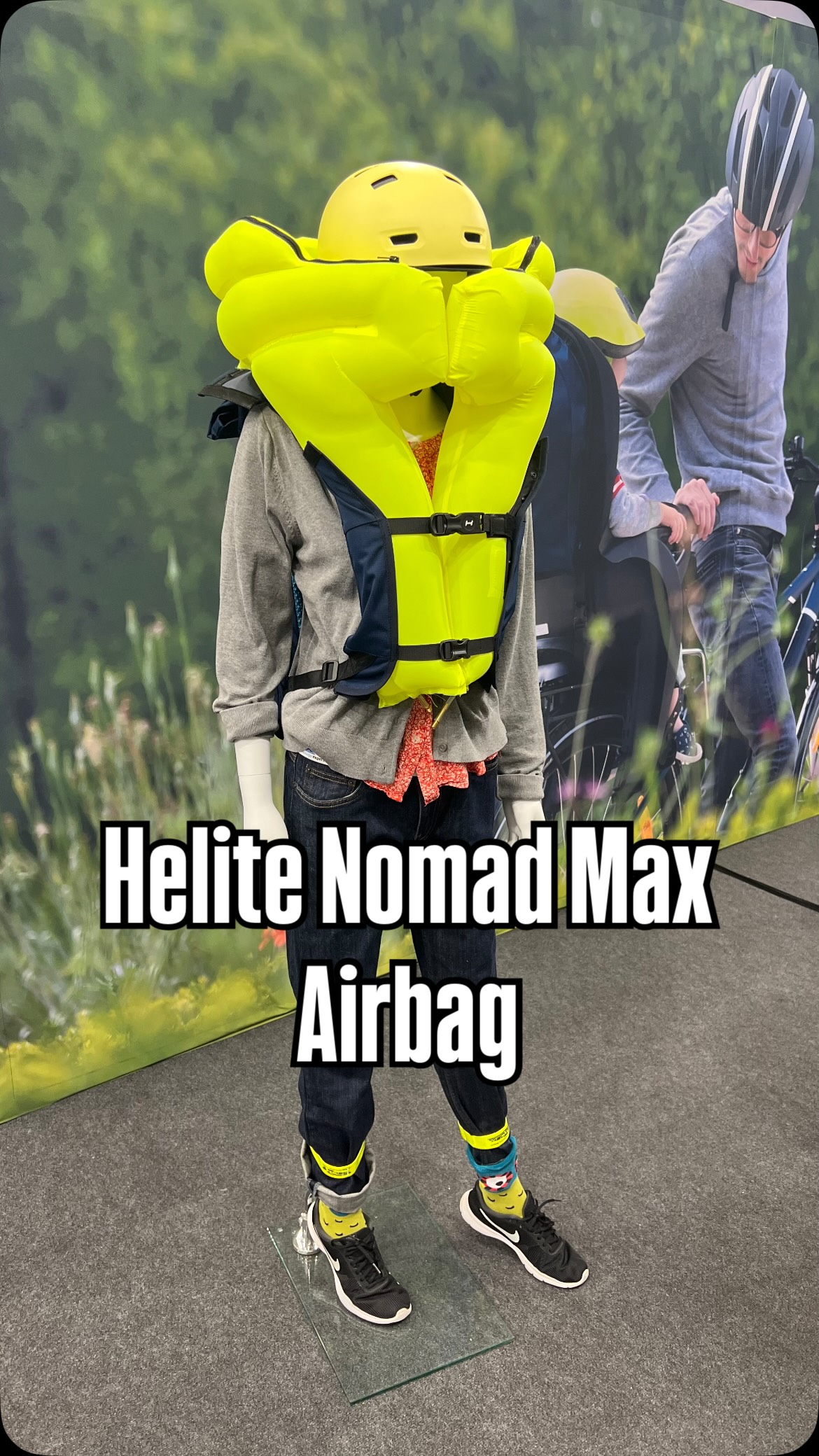
Pricing may ultimately determine how broadly the Nomad Max is adopted. Electronic airbag systems are generally more complex than conventional protective equipment, but integrating the technology into a practical backpack could make the purchase easier to justify for riders who would otherwise buy both items separately.
Availability
Helite currently describes the Nomad Max as coming soon. No retail price, ordering date or delivery schedule has been announced.
The backpack was previewed during Eurobike 2026, held in Frankfurt from June 24 to June 27, 2026. The event brought together around 800 exhibitors presenting products related to bicycles, ecomobility and urban transportation.
For now, the Helite Nomad Max should be viewed as a promising preview rather than a fully documented commercial product. Its combination of 28-liter storage and an electronic cycling airbag is compelling, particularly for commuters, but its real-world value will depend on the protection offered, comfort, certification, price and reliability of its crash-detection system.
Those details should become clearer once Helite publishes the official product page and confirms when the Nomad Max will reach customers.
Source: Helite (Instagram)