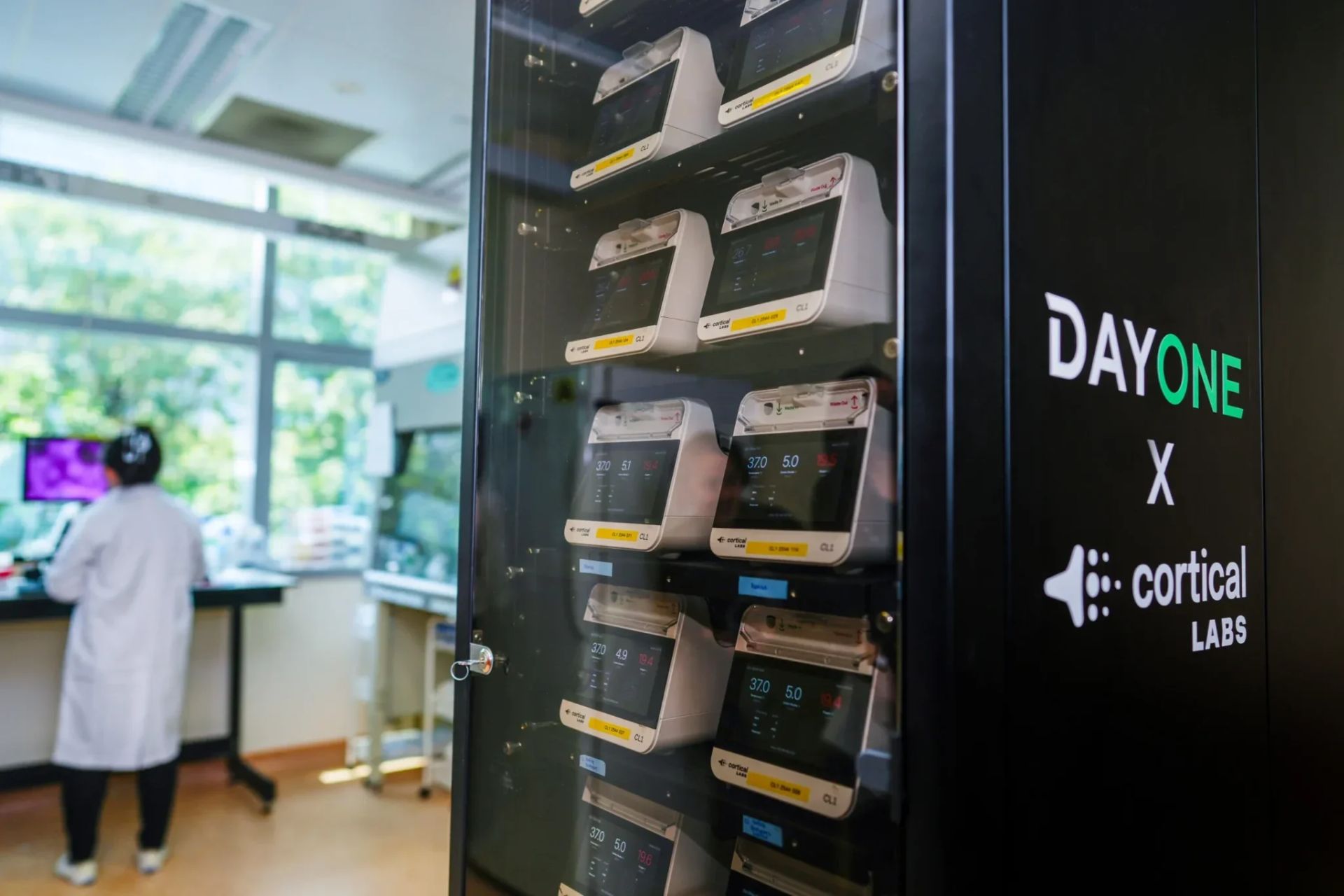
A server rack at the National University of Singapore is combining conventional electronics with something rarely found inside computing infrastructure: cultures of living human neurons.
The research prototype at the NUS Life Sciences Institute contains 20 Cortical Labs CL1 biological computers. NUS Medicine describes it as the world’s first independently operated biologically integrated server rack.
Each CL1 has been reported to use approximately 800,000 laboratory-grown neurons, which would put the rack’s combined total at roughly 16 million. That figure is a calculation based on the reported number of neurons per unit; NUS did not publish a total neuron count in its announcement.
The neurons are grown from human stem-cell lines and cultured on a microelectrode array connected to silicon electronics. The array sends electrical stimulation into the culture and records the resulting neural activity. Software then uses those signals to create a closed feedback loop between the cells and a simulated environment.
Cortical Labs calls this approach Synthetic Biological Intelligence. Its biOS software platform allows researchers to deploy code to the biological networks and study how they respond, reorganize and adapt.
Keeping the neurons alive requires considerably more support than cooling an ordinary processor. Each CL1 incorporates a life-support system that supplies nutrients, regulates temperature and gas levels, maintains fluid balance and removes waste. Cortical Labs says a culture can remain viable for up to six months.
The Singapore installation is still a research and validation platform—not a replacement for a conventional data center. NUS, Cortical Labs and infrastructure partner DayOne plan to investigate applications including drug discovery, neurological-disease modelling and AI systems that may learn from limited data.
Its potential efficiency is also a company and project claim that still requires meaningful benchmarking against conventional hardware. Nor should the cultures be mistaken for complete human brains: they are networks of neurons interfaced with electronics, without the anatomy or sensory systems of a brain.
Even so, the rack moves biological computing out of a single laboratory device and into a multi-unit research environment. What it ultimately proves will depend on the useful tasks it can perform, its repeatability and how researchers address the ethical questions surrounding increasingly capable living neural systems.
Sources: NUS Medicine, Cortical Labs, IEEE Spectrum