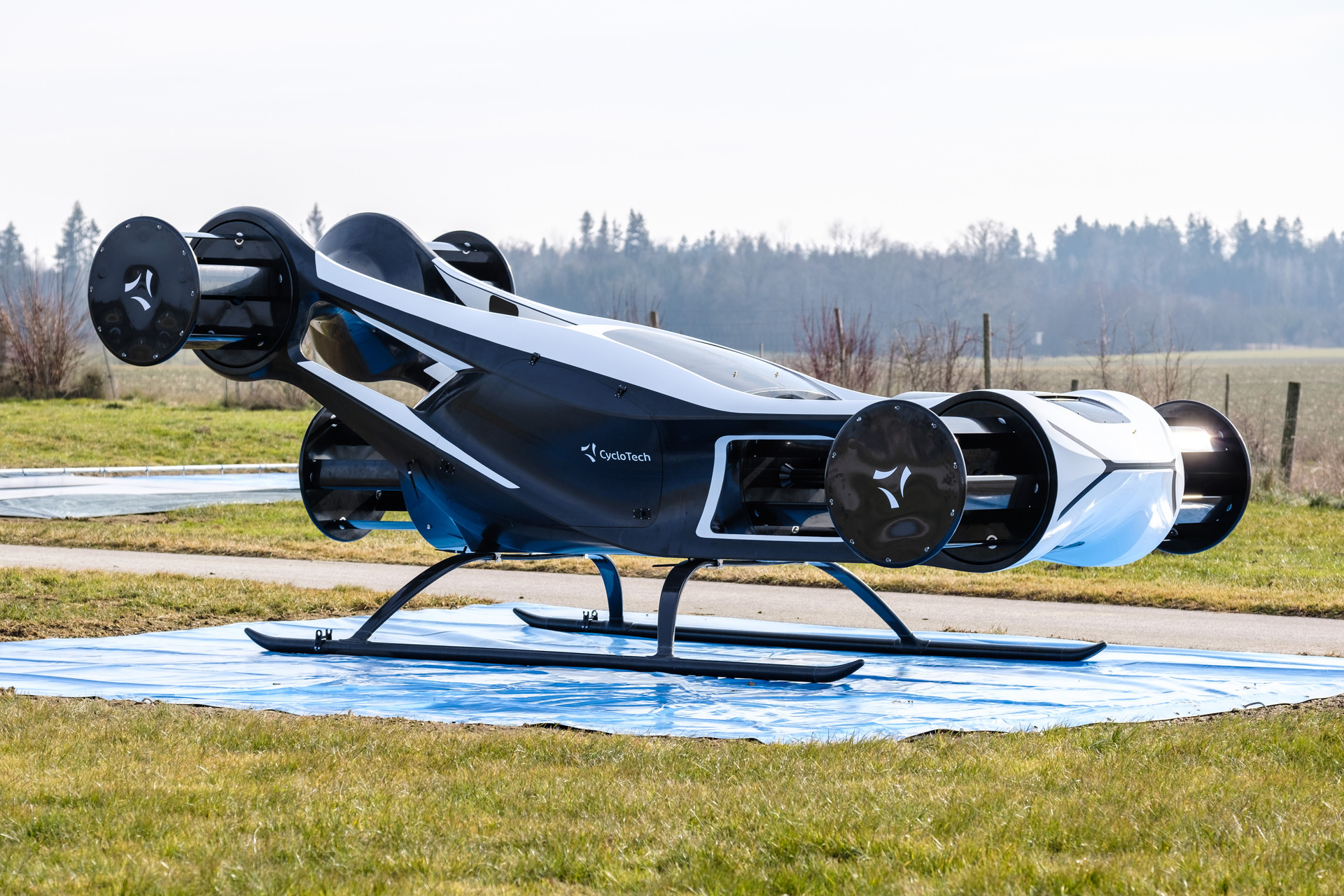
Most electric vertical-takeoff aircraft change direction by tilting their propellers, wings or entire bodies. CycloTech’s BlackBird takes a markedly different approach. Its six barrel-shaped propulsion units can redirect thrust around a complete circle, allowing the experimental aircraft to move sideways while remaining level—or tilt while holding approximately the same position.
The Austrian company has now completed its latest summer flight campaign with the battery-electric demonstrator. Across the wider two-year development program, CycloTech says the same aircraft participated in more than 400 tests, covering system checks, ground runs, tethered operations and free flight in temperatures from 0 to 35 °C (32 to 95 °F).
BlackBird is not a passenger aircraft or a production flying car. It is an uncrewed flying testbed built to validate CycloTech’s seventh-generation CycloRotor propulsion system, the software controlling it and the models engineers use to predict its behavior.
How a CycloRotor generates thrust
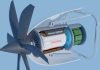
A CycloRotor resembles a horizontal paddle wheel enclosed between two circular end plates. Several parallel airfoil blades rotate around its central axis, but unlike fixed blades, each one continually changes pitch during every revolution.
The blades are mechanically connected to an eccentrically positioned hub. Moving that hub changes the timing and amplitude of their pitch cycle, altering both the strength and direction of the resulting airflow. CycloTech says this allows the rotor to direct thrust anywhere around 360 degrees, perpendicular to its rotational axis, while continuing to spin in the same direction and at a constant speed.
The underlying idea is related to the Voith Schneider propeller used on highly maneuverable ships, adapted for operation in the air. Because thrust direction is controlled through blade pitch rather than by rotating a heavy nacelle, the response can take place within fractions of a second.
BlackBird uses six CR-60 CycloRotors in two orientations. CycloTech lists each CR-60 as having a 600-mm (23.6-in) blade span, 500-mm (19.7-in) diameter, maximum thrust of 751 N and maximum rotational speed of 2,600 rpm. These are manufacturer specifications for the rotor, not independently verified BlackBird flight-performance results.
Moving and tilting become separate controls
Conventional multicopters normally move forward or sideways by tilting their bodies, which redirects part of their vertical lift horizontally. BlackBird’s rotor arrangement allows its flight path and attitude to be controlled more independently.
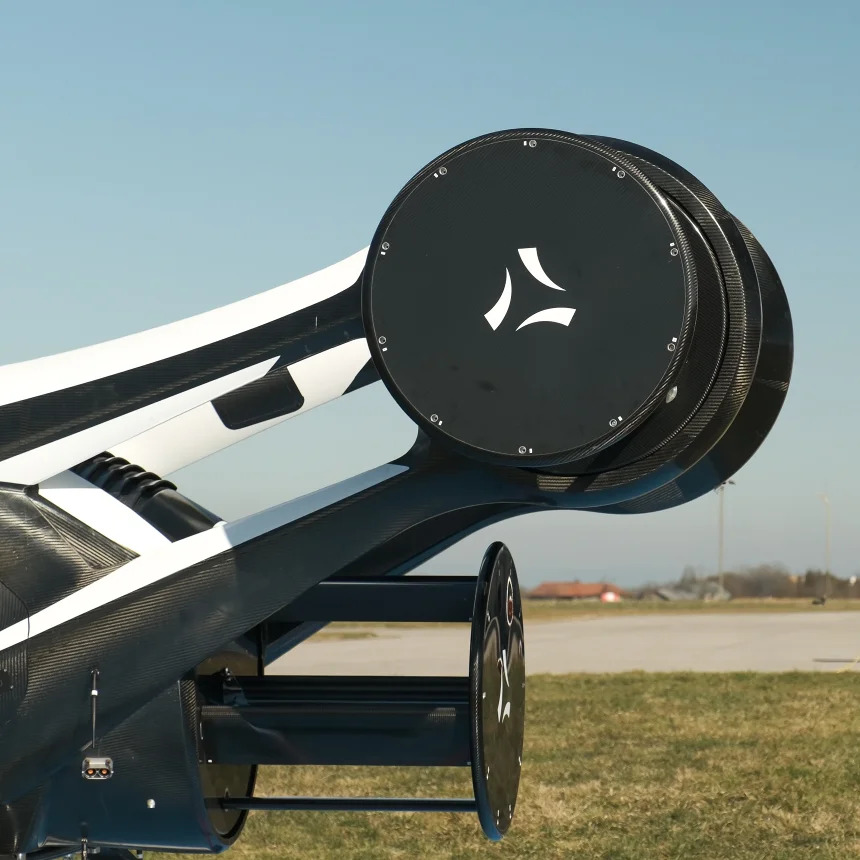
Four CycloRotors provide the main lift and directional forces, while two positioned along the aircraft’s longitudinal axis strengthen lateral and attitude control. The arrangement is designed to support vertical takeoff and landing, forward and backward movement, sideways translation, midair braking and fixed-position hovering.
CycloTech sometimes calls the sideways maneuver “parallel parking.” The phrase is descriptive rather than literal: BlackBird has no road wheels and is not a drivable car. The potential advantage is precise positioning in confined landing areas without requiring the complete aircraft to bank toward nearby obstacles.
The company also says BlackBird can hover at body pitch angles of up to 30 degrees and land on inclined surfaces. However, the latest public material does not establish the wind limits, landing-slope limits or certification conditions under which those capabilities would be available.
Building the flight controller step by step
An aircraft with six cycloidal rotors requires a control system very different from the software used by a typical quadcopter. CycloTech says it developed BlackBird’s flight controller from scratch, beginning with simulations and progressing through subsystem integration, ground testing and increasingly complex flights.
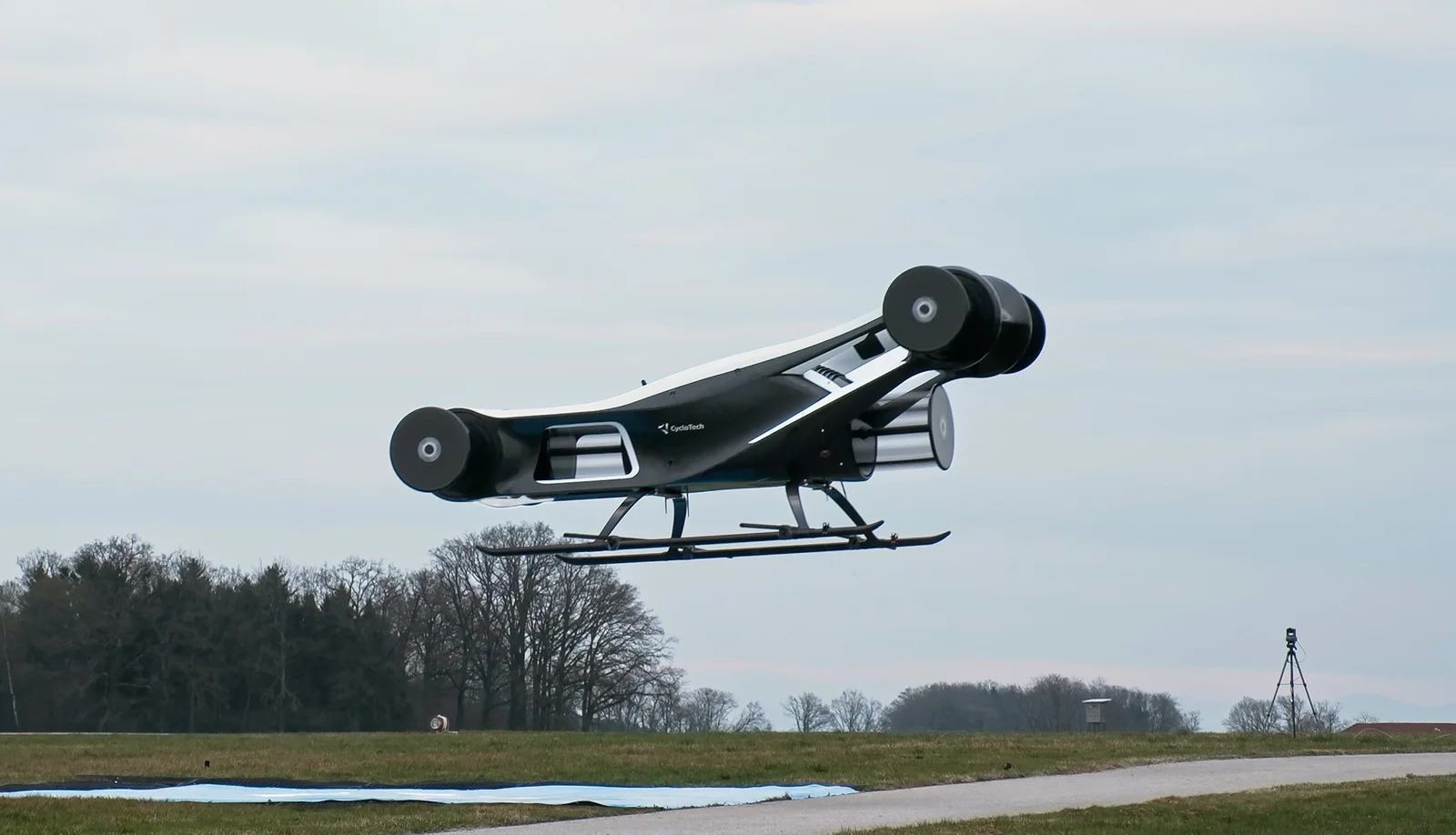
Engineers introduced the control functions in four broad stages. Attitude control came first, allowing the system to manage the aircraft’s orientation. Altitude control added climbing, descending and height holding. Velocity control then enabled commanded movement forward, backward and sideways. Finally, position control allowed BlackBird to maintain a fixed location.
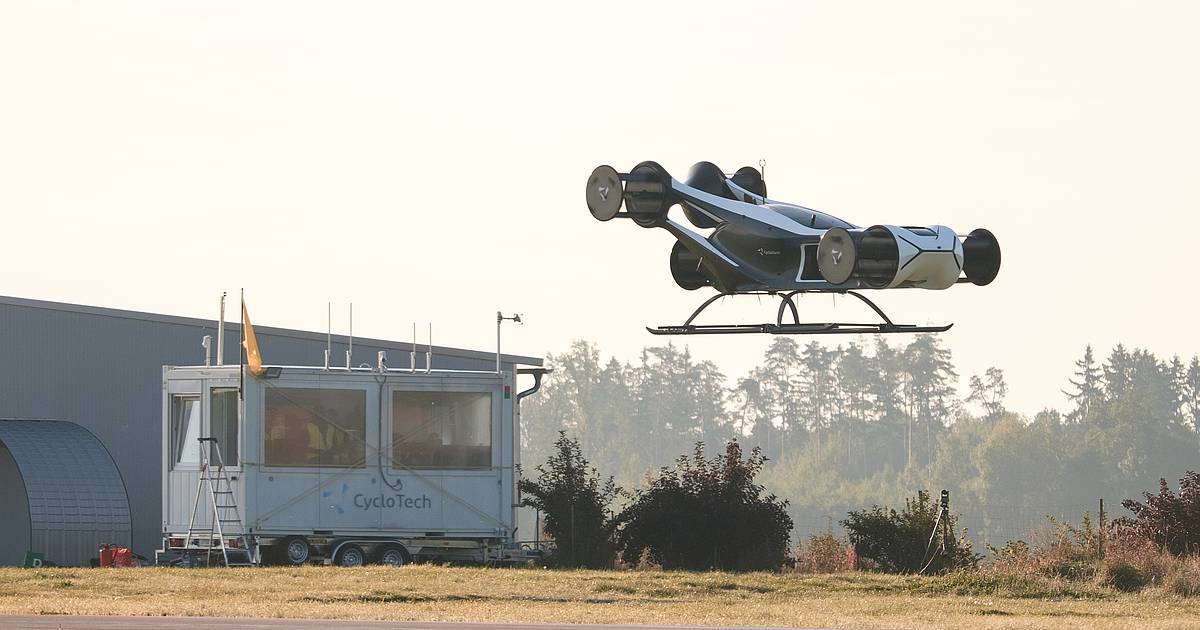
The latest footage demonstrates the result with level lateral movement, controlled tilting and stable hovering. These maneuvers may look modest beside the fast transition flights of some larger eVTOL prototypes, but they directly test the characteristic that distinguishes a CycloRotor from a conventional propeller: rapidly vectored thrust without tilting the propulsion unit.
CycloTech also compared physical flight data with simulations incorporating wind-tunnel results. The company says the correlation was sufficiently close to give it confidence in its digital models. Reliable models should make it easier to test new rotor arrangements, refine control laws and scale the system without building a complete aircraft for every iteration.
From concept to more than 400 tests
The BlackBird project began in April 2024. Its airframe was derived from CycloTech’s CruiseUp passenger-aircraft feasibility study and completed in approximately six months. The electric drive, battery modules, thermal-management system, wiring, avionics and software were developed concurrently, with final assembly completed in about 10 months.
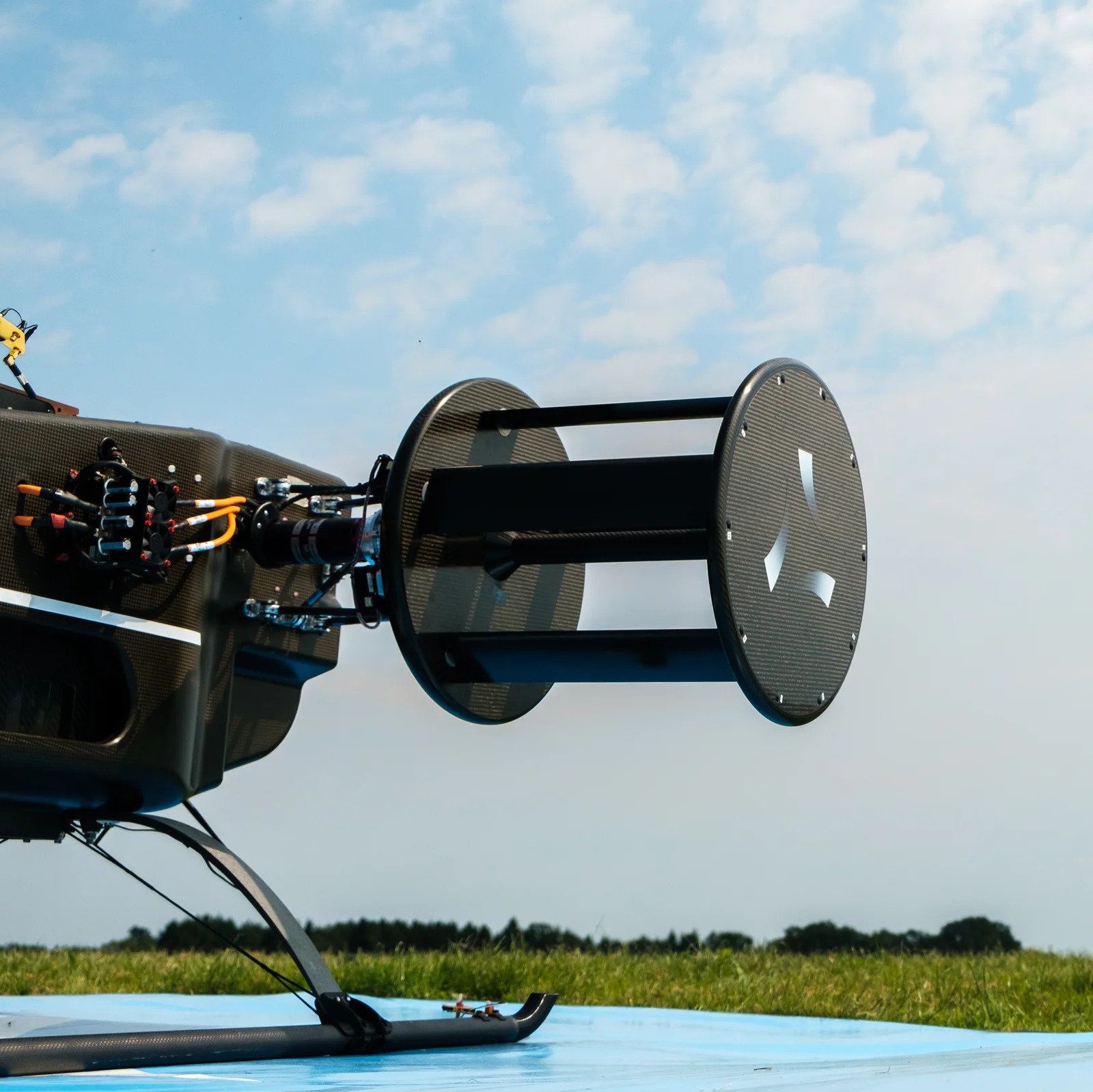
BlackBird made its maiden flight on March 27, 2025, 11 months after the project started. CycloTech describes it as the world’s first flying demonstrator equipped with six CycloRotors.
The recently reported figure of more than 400 tests also needs context. It covers the overall program—including system, ground and tethered work—not 400 untethered flights. CycloTech’s earlier four-rotor demonstrator completed more than 800 flights between 2021 and 2024, providing the foundation for the second-generation BlackBird.
BlackBird specifications
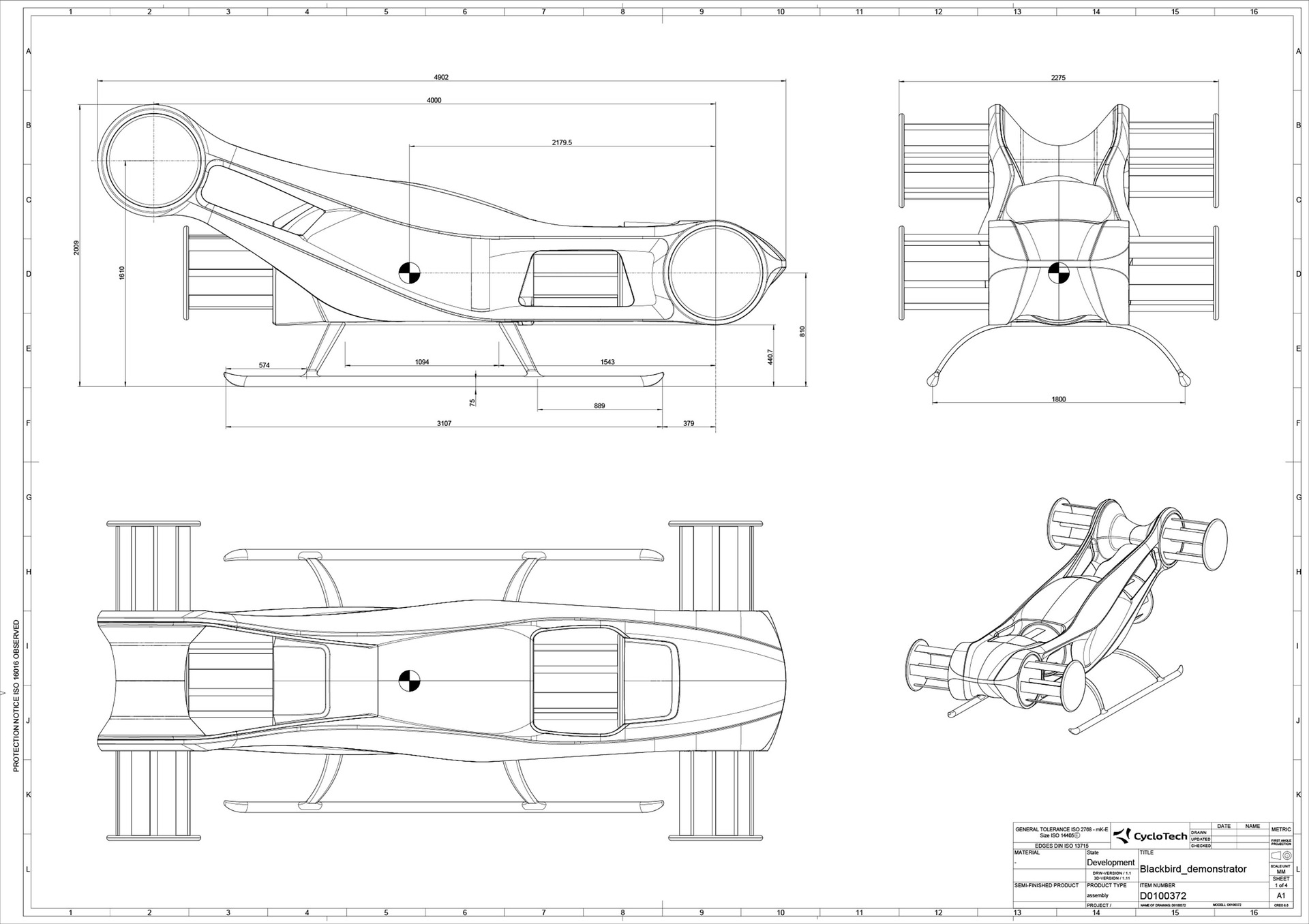
BlackBird measures 4.9 m (16.1 ft) long, 2.3 m (7.5 ft) wide and 2 m (6.6 ft) high, with a stated maximum takeoff weight of 340 kg (750 lb). CycloTech originally announced a maximum speed of up to 120 km/h (75 mph), but it has not said that the demonstrator reached this speed during the flights shown.
No battery capacity, motor output, endurance, range, payload, demonstrated maximum altitude or measured aircraft noise figure has been published. The company reports a sound level of 59 dBA at 100 m (328 ft) from an outdoor CycloRotor measurement.
Those omissions matter because maneuverability is only one requirement for a useful electric aircraft. CycloTech must also demonstrate competitive energy consumption, reliability, maintainability, structural life and noise across realistic operating conditions. The continuously changing blade pitch and associated linkages also introduce mechanical and control complexity that simpler fixed-direction propellers avoid.
A testbed, not a flying car
BlackBird resembles a smaller version of CycloTech’s proposed CruiseUp, but the two should not be confused. BlackBird has no passenger cabin and exists to develop propulsion and flight controls.
CruiseUp is a separate two-seat feasibility concept with proposed figures of 100 km (62 miles) of range, a 150-km/h (93-mph) maximum speed and 200 kg (441 lb) of payload. None of those figures applies to BlackBird, and CruiseUp is not presently a certified production aircraft.
CycloTech sees nearer-term opportunities in specialized drones, cargo positioning, shipboard operations, flying cranes and auxiliary thrusters that help other aircraft resist gusts or control suspended loads. The company’s current roadmap targets certification of CycloRotors as a primary propulsion system around the mid-2030s, while its vision of everyday passenger air cars extends into the 2050s.
The completed flight campaign therefore represents an important engineering milestone rather than an imminent product launch. BlackBird has shown that six CycloRotors can lift and control a 340-kg demonstrator in free flight while enabling unusual combinations of translation and attitude. The harder next step is proving that the same controllability can be delivered with the efficiency, durability, noise and safety required for commercial aviation.
Source: CycloTech