

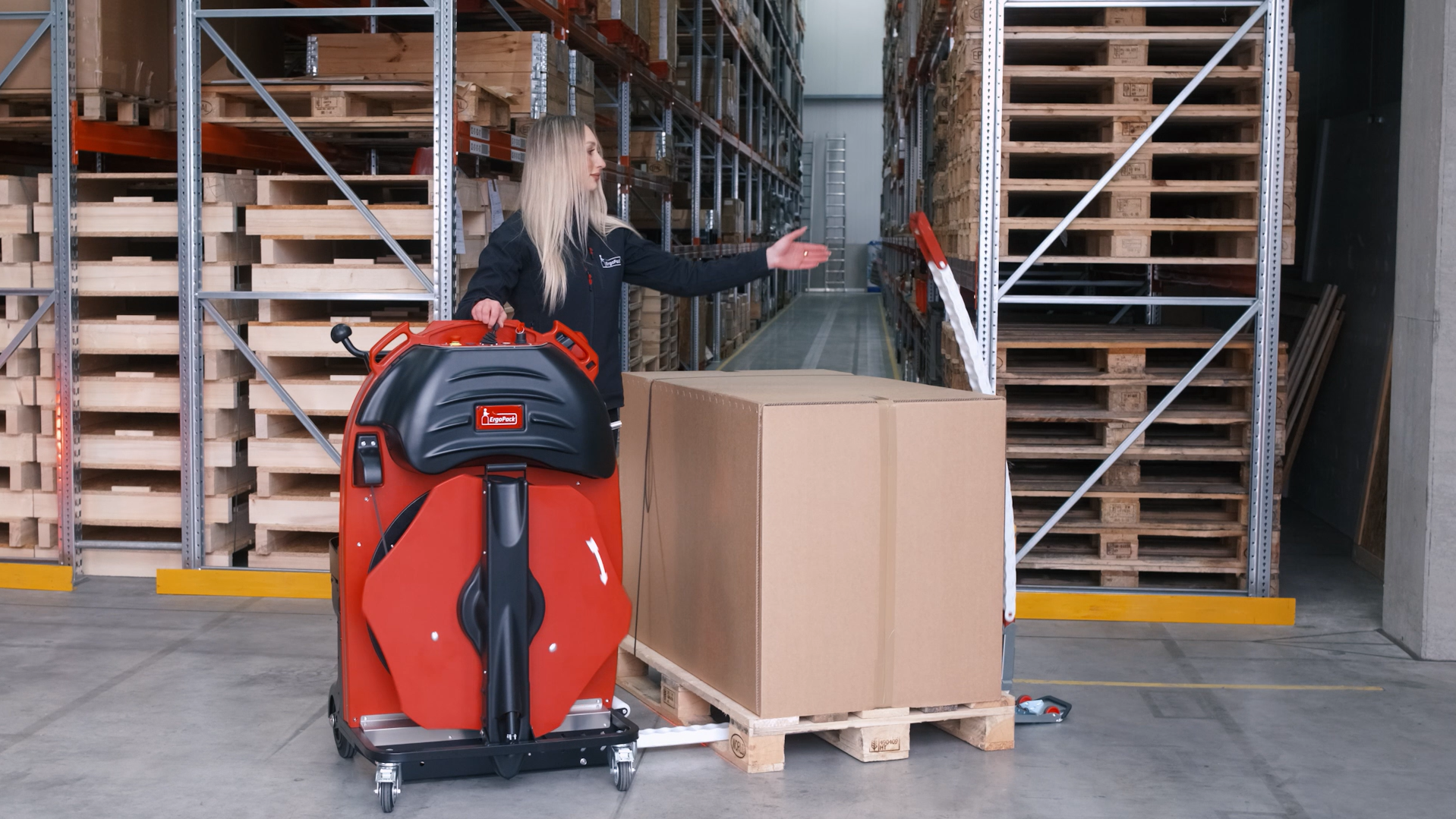
Strapping a pallet sounds straightforward. You wrap a band of polypropylene or polyester strap around a loaded pallet, tension it, and seal it. Repeat. In a typical warehouse or distribution center, that process might happen dozens or hundreds of times a day. What sounds routine, though, adds up to something that occupational health researchers have documented as a significant driver of workplace injury: thousands of deep, load-bearing bend overs per year, per worker.
ErgoPack, a German manufacturer based in Lauingen, has been building systems designed to remove that movement from the equation since the late 1990s. The company’s mobile pallet strapping machines use a patented chain-feed mechanism — the ChainLance — to thread the strap under and around the pallet automatically, so the operator never has to reach down. The worker stands upright. The machine does the bending.
With more than 15,000 systems sold across over 60 countries and a product line certified by Germany’s leading back health authority, ErgoPack occupies an unusual niche: industrial packaging equipment with a specific ergonomic claim at its core.
Why bending matters at scale
At 100 strapping cycles per day — a figure that’s modest by distribution center standards — workers perform 50,000 bend overs and 25,000 walk-arounds per year. At higher volumes, those numbers climb proportionally.
The physical toll is well established. Standard pallet strapping typically requires workers to crouch or hinge deeply at the hip to feed the strap beneath the pallet base, retrieve it on the other side, and then repeat the process on multiple axes. When done repeatedly over a full shift, the cumulative load on the spine, knees, and elbows is meaningful. The company cites an industry-wide average of five sick days per employee per year attributable to back pain alone.
ErgoPack frames this as a largely invisible problem — one that most operations accept as a fixed cost of the strapping process rather than something that can be engineered out.
The ChainLance: the core of how it works
The defining feature of every ErgoPack system is the ChainLance, a chain-guided strap-feed mechanism that was invented and patented by the company in 1999. It was the world’s first of its kind.
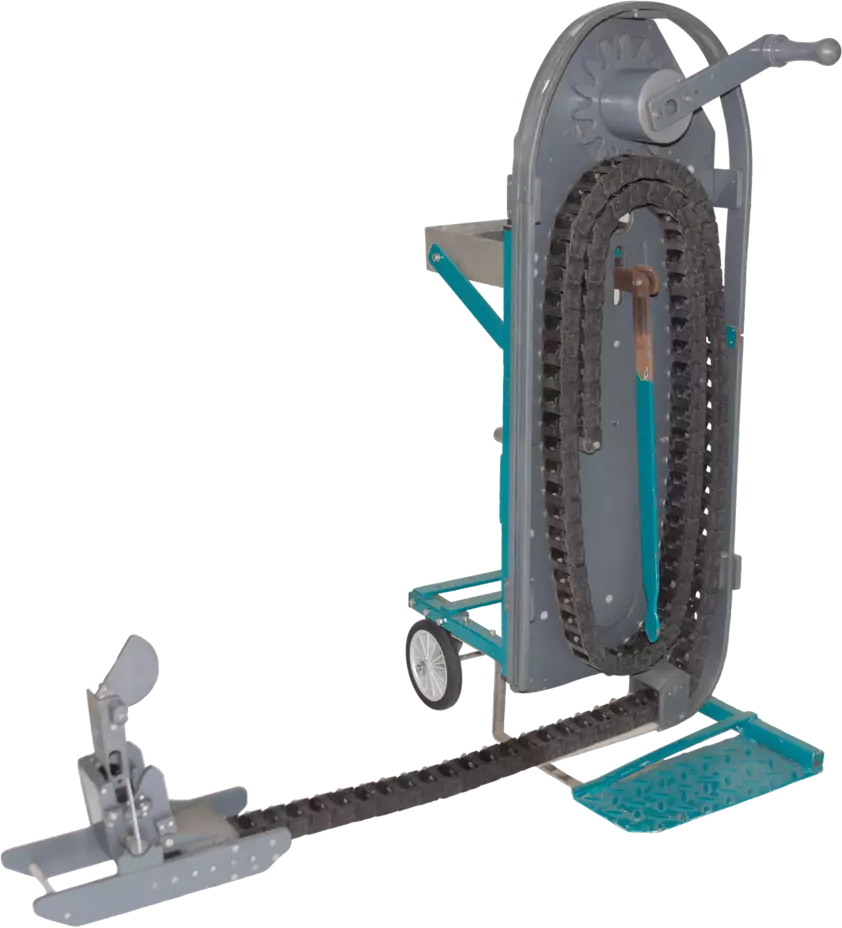
Rather than requiring the operator to manually route the strapping band under the pallet, the ChainLance feeds the strap horizontally through a channel that passes beneath the pallet on rails. The chain carries the strap’s leading end around the pallet’s perimeter and back up to the sealing head without the operator touching it at mid-route. The worker guides the machine into position from a standing posture and the rest of the feed cycle is handled mechanically.
This single design choice — removing the need to physically pass the strap beneath the pallet by hand — is what makes the upright posture possible. The operator remains standing throughout the entire cycle: positioning, strapping, tensioning, and sealing.
The X-pert Line: current flagship
ErgoPack’s current premium product line is the X-pert Line, introduced in 2019. It builds on more than two decades of iterative development and incorporates a dual-touchscreen interface — one on the sealing head and one on the strapping system itself — alongside updated electronics and redesigned ergonomic handles.
The sealing head is fully integrated into the machine body, reducing the physical weight the operator handles during positioning. A Tool-Lift mechanism allows work with a reduced-weight sealing head configuration for operations requiring extended use. An optional Triplex-Tool-Lift extends this further, enabling strapping from the top of the pallet in addition to the sides, without needing to remove or swap out the sealing head.
A line laser assists with precise positioning of the machine in front of the pallet — a practical feature in environments where the operator may be working quickly across many pallets in sequence.
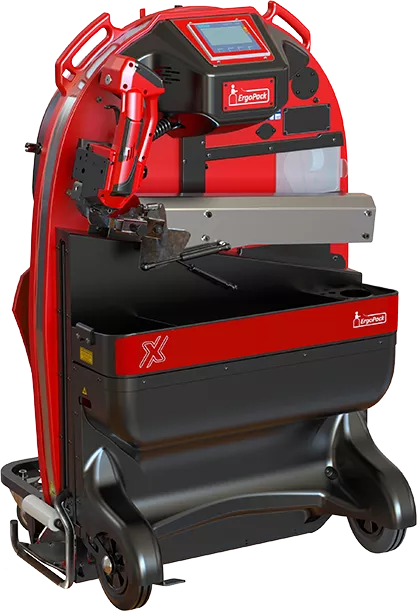
The touchscreens guide the user through each strapping cycle with an intuitive interface that the company says requires minimal training time. Configuring strap tension, selecting pallet width, and adjusting sealing parameters are all handled through the display rather than mechanical controls.
The company also offers the E-conomy Line, a more entry-level model that retains the core ChainLance ergonomics and has been in reliable production for nearly 20 years.
Speed as a secondary benefit
The ergonomic case for ErgoPack is the central one, but the time savings are significant enough that they factor heavily into how the company presents its value proposition to operations managers.
Even a skilled worker using a conventional strapping method takes about two minutes to strap a single pallet. With ErgoPack, the same task can be done in under 40 seconds — a 67% reduction in cycle time.
At 100 pallets per day, that translates to roughly 140 minutes of time saved daily, or approximately 49 labor hours per month. For operations strapping 50 or 150 pallets per day, the equivalent figures are about 24.5 and 73.5 labor hours per month, respectively. Over the course of a year, those figures add up to the equivalent of several full-time working weeks.
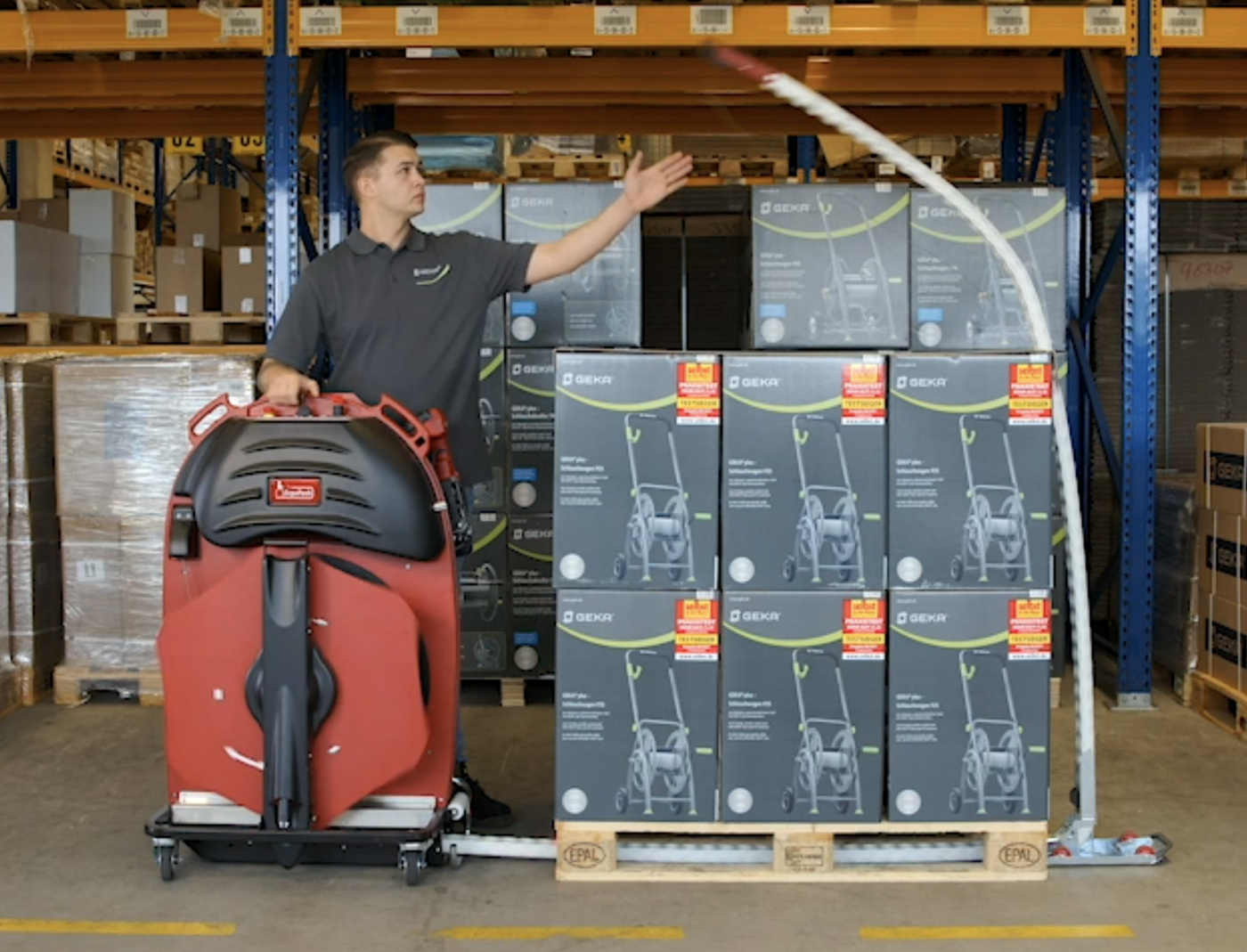
The speed improvement comes partly from the automated strap feed — which is faster than manual routing — and partly from the elimination of the walk-around step that conventional strapping requires. In a standard process, the worker has to walk to each side of the pallet to complete the strap circuit. With the ChainLance threading the strap beneath the pallet automatically, that full circumnavigation is replaced by a single stationary positioning step.
Certification and third-party validation
All ErgoPack models have received the AGR quality certification from “Aktion Gesunder Rücken e.V.” — a merger of the two largest German back health associations — following an extensive examination by its expert committee. The organization recommends the ErgoPack system as well designed for improved spinal health and employee safety in the workplace.
The AGR (which translates roughly as “Campaign for Healthier Backs”) is an independent German organization that tests and certifies products based on ergonomic criteria. Its certification is one of the more credible third-party endorsements available in the occupational ergonomics space in Europe.
The company also earned a gold medal at the International Exhibition of Inventions in Geneva and the German Inventor’s Award — both in 2002, for the ErgoPack 600 model — and has more recently received a Kununu Top Company award and recognition among Germany’s Top 100 companies.
25 years of product development
ErgoPack’s development history stretches back to 1998, when the first prototype was built using a scissor-lift mechanism. The ChainLance patent followed a year later. The first commercial model — the ErgoPack 300, for composite strapping — shipped in 2000, operated by a hand crank. A year later, the ErgoPack 500 extended the ChainLance to 5 meters for larger pallets, and in 2003 the crank was replaced by a battery-powered electronic drive.
The 2014 introduction of the ErgoPack Air added another capability: as the worldwide first and only mobile system designed to strap elevated pallets, it addressed a use case — pallets on raised platforms or loading bays — that the standard floor-level system couldn’t reach. The 2016–2017 model revision brought more than 40 new features. The 2019 X-pert Line introduced the current dual-touchscreen interface and elevated the ergonomic specifications further.
Who uses it and where
ErgoPack’s customer base spans warehousing, distribution, manufacturing, and industrial production. The variety of industries reflects the fact that pallet strapping is a universal step in outbound logistics across most manufacturing and distribution operations, regardless of what’s being shipped.
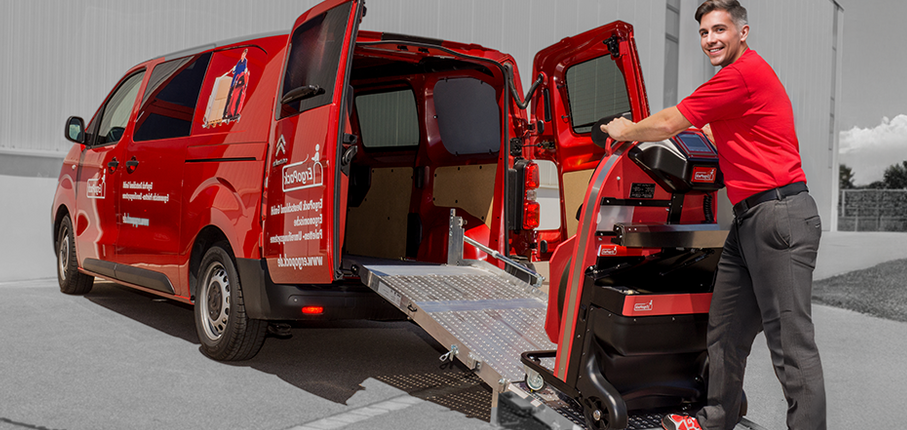
The system is sold across more than 60 countries. ErgoPack operates a U.S.-specific site at ergostrap.com and serves international markets through a global distributor network. The company offers free on-site demonstrations at the customer’s facility, with the demo unit brought by an ErgoPack representative to run on the customer’s own pallets and under their actual operating conditions.
Pricing and availability
ErgoPack does not list pricing publicly on its website, as configurations vary depending on model, accessories, strap type, and regional distributor. Pricing information is available through the company’s regional sales contacts or through an on-site appointment request. The company’s U.S. operations are accessible at ergostrap.com.
Source: ErgoPack


