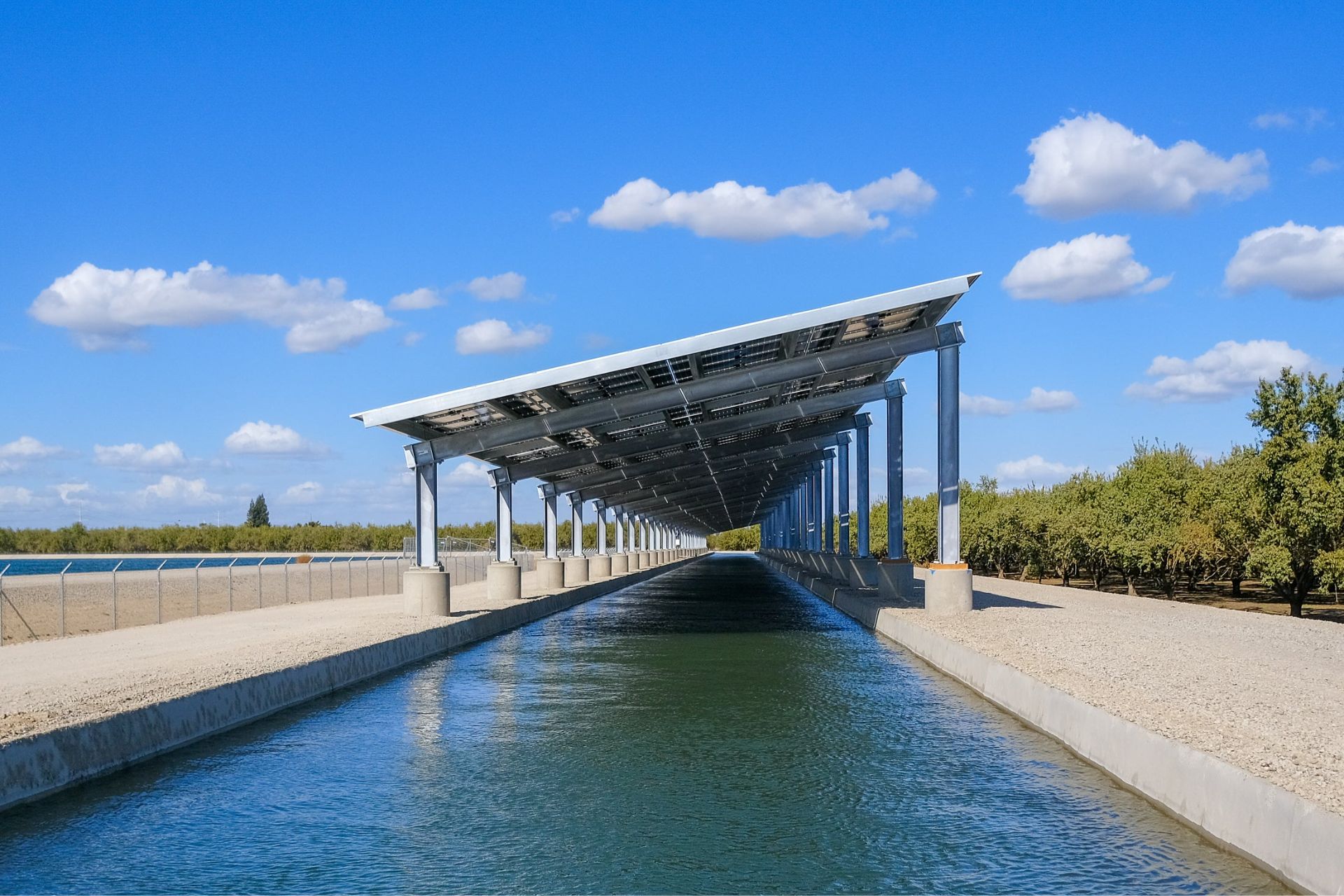
California has completed an unusual renewable-energy experiment that makes irrigation canals do two jobs at once.
Known as Project Nexus, the pilot places solar panels above two sections of canal operated by the Turlock Irrigation District in California’s Central Valley. The panels generate electricity without consuming additional farmland, while their shade helps protect the water flowing underneath.
The two installations provide more than 1.6 megawatts of solar capacity. The narrow-span site also includes two 75-kilowatt iron-flow batteries, allowing the project team to study how energy storage can work alongside canal-top solar generation.
Early results point to water and maintenance savings
UC Merced researchers are monitoring electricity production, evaporation, water quality, aquatic vegetation and the practical demands of maintaining the canals beneath the arrays.
Their early findings are encouraging. According to the university, the shaded sections experienced up to 70% less evaporation and 85% less aquatic weed growth during the initial monitoring period.
Both effects could matter in California’s hot, heavily farmed Central Valley. Water that does not evaporate remains available for delivery, while fewer weeds could reduce blockages and the labor required to keep canals flowing.
The figures should still be treated as preliminary. Project Nexus is a pilot involving two sites with different canal widths and structural designs, and UC Merced is continuing to assess performance over time. Its results do not mean every canal—or every climate—would produce identical savings.
Solar power without taking more land
The project’s other major advantage is its use of existing infrastructure. Conventional utility-scale solar installations require substantial areas of land. Mounting panels above canals could add generating capacity without converting farmland or natural habitat.
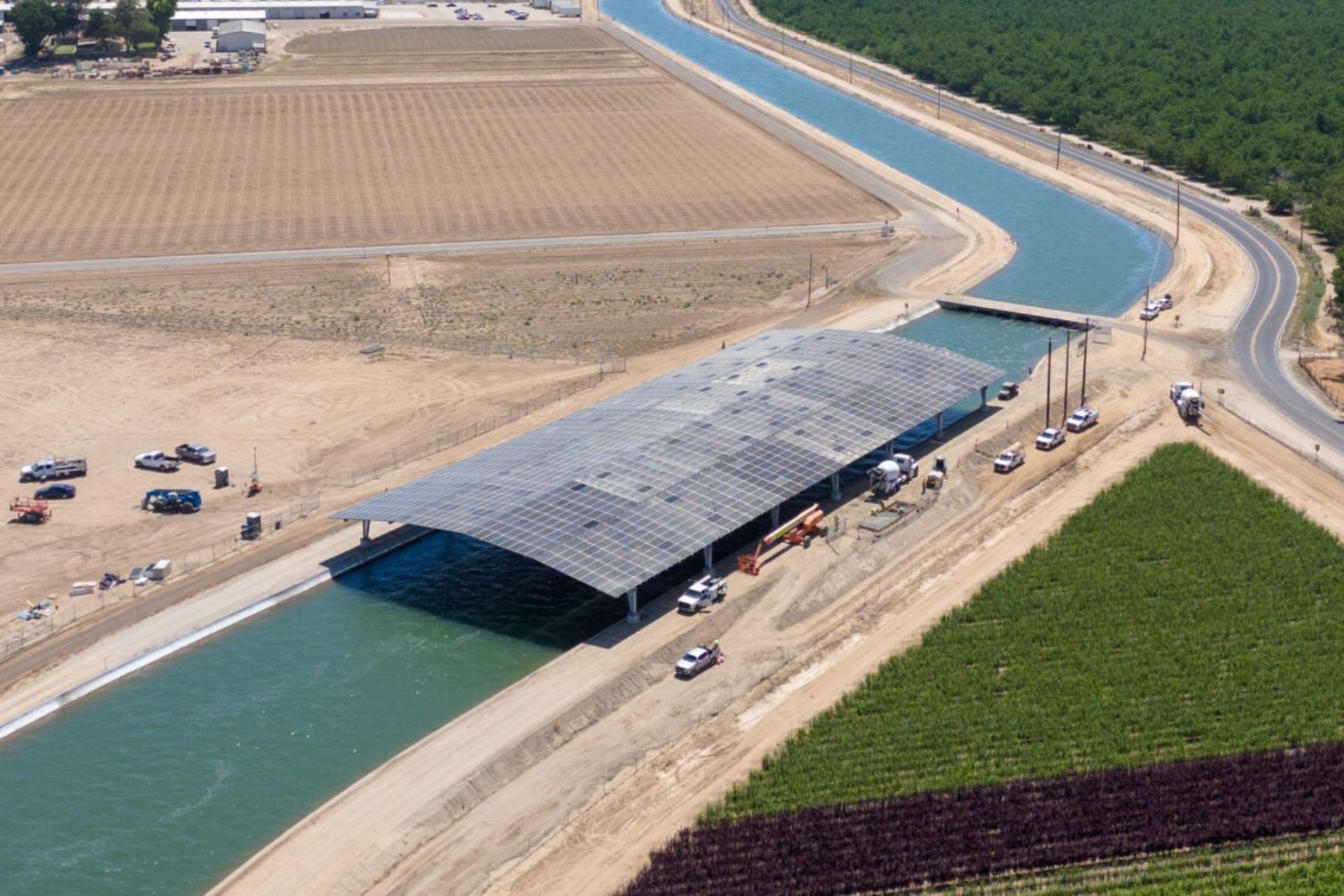
Project Nexus was developed through a partnership involving the Turlock Irrigation District, California Department of Water Resources, Solar AquaGrid and UC Merced. Its two sites were fully commissioned by August 2025, and the state supplied $20 million for the demonstration.
The idea is not that every canal should automatically be covered. Spanning waterways adds structural complexity, and operators must retain access for inspection, repairs and vegetation removal. The pilot is intended to provide real-world evidence about those costs and trade-offs as well as the potential benefits.
The statewide potential is much larger
Project Nexus grew from research led by UC Merced and published in Nature Sustainability in 2021. The study modeled solar installations across California’s roughly 4,000-mile (6,350-km) canal network.
Researchers estimated that widespread canal-top solar could support approximately 13 gigawatts of generating capacity and prevent about 63 billion gallons (238 billion liters) of water from evaporating each year.
Those numbers are modeled statewide estimates rather than results from the 1.6-MW pilot. Even so, Project Nexus now gives researchers a physical testbed for checking how well the concept performs outside computer models.
For now, the project offers a compelling example of infrastructure doing double duty: generating renewable electricity above while helping conserve water below.
Sources: UC Merced, Turlock Irrigation District, Nature Sustainability