

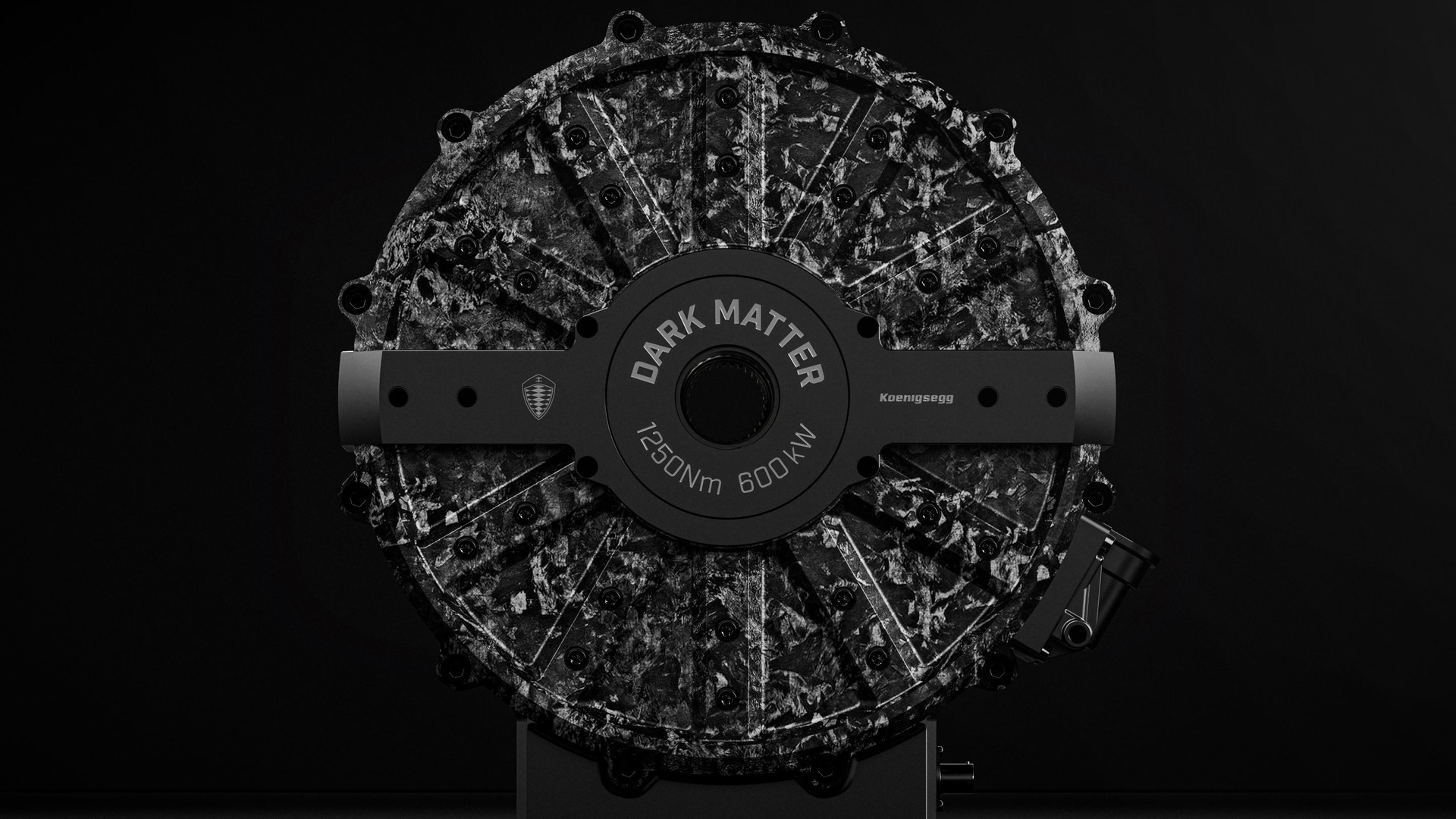
An electric motor small enough to fit within a roughly 15-inch-wide package produces as much power as several performance cars combined.
Koenigsegg’s Dark Matter motor weighs just 39 kg (86 lb), yet the Swedish automaker rates it at 800 hp (600 kW) and 1,250 Nm (922 lb-ft) of torque.
That works out to approximately 15.4 kW per kilogram—an extraordinary power-to-weight ratio for an automotive propulsion motor.
Dark Matter is not a newly announced concept. Koenigsegg unveiled it in 2023 as part of a major redesign of the four-seat Gemera’s powertrain. The technology is receiving renewed attention now that Gemera production has begun.
Almost as wide as it is tall—but only 5.3 inches deep
The motor measures 383.3 × 381.5 × 135.5 mm, or approximately 15.1 × 15 × 5.3 in. Its disc-like form is very different from the longer cylindrical shape associated with many conventional electric motors.
That shape comes from what Koenigsegg calls a “raxial-flux” architecture. The company’s patent-pending design combines characteristics of radial-flux and axial-flux electric motors in a single unit.
In a typical radial-flux motor, the magnetic flux acts outward from the shaft, and the rotor generally spins inside a surrounding stator. These motors are common in electric vehicles and tend to have a relatively narrow, cylindrical form.
An axial-flux motor arranges its principal magnetic interaction parallel to the shaft. This produces a flatter, wider “pancake” shape and can deliver high torque from a compact package.
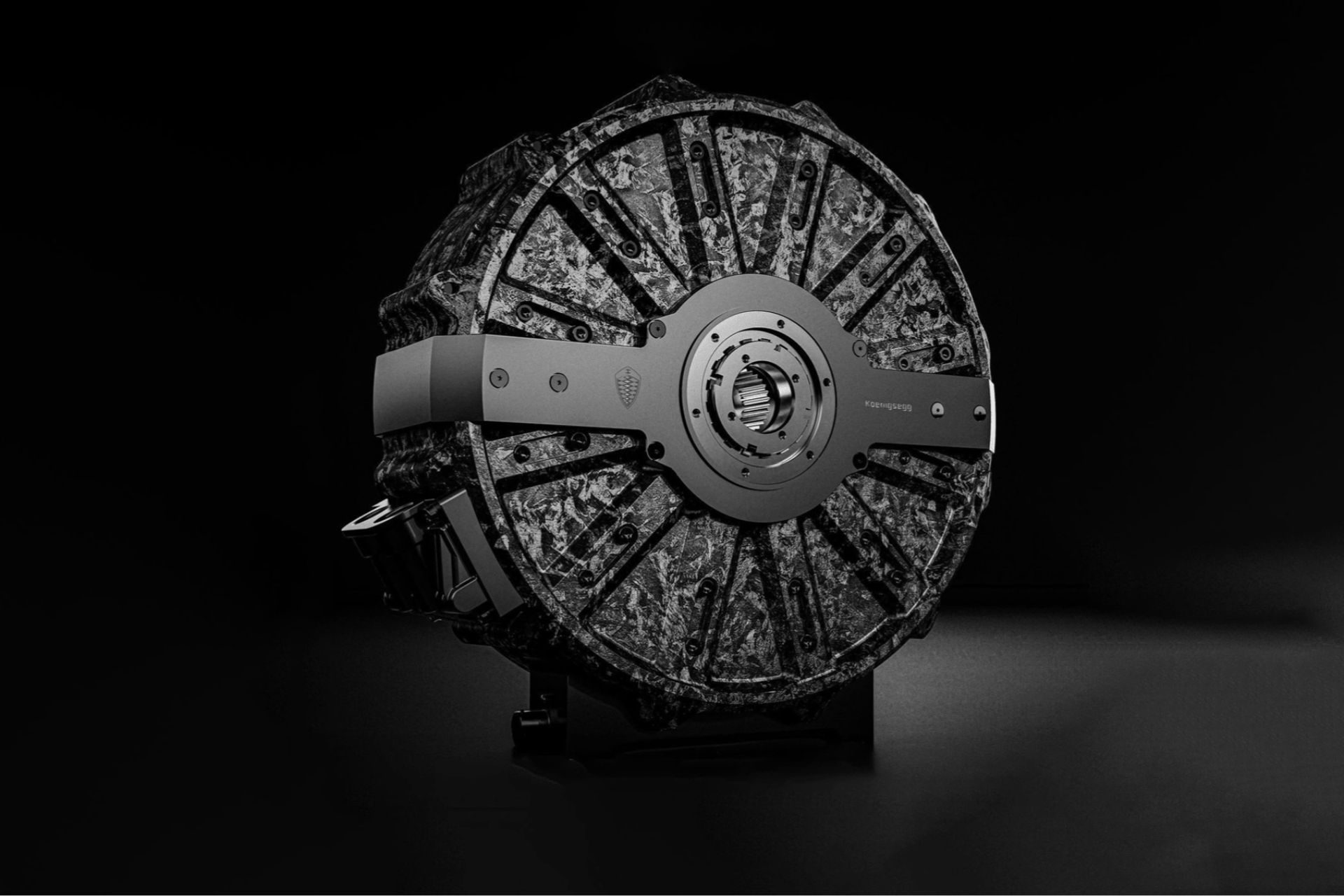
Christian von Koenigsegg has described Dark Matter as predominantly axial-flux with a smaller radial-flux contribution. The intention is to combine the torque density and compact length associated with axial-flux designs with useful characteristics of radial-flux machines.
Six electrical phases instead of three
Dark Matter also differs from most automotive motors in its electrical configuration.
Conventional electric-vehicle motors generally use three-phase alternating current. Dark Matter uses six phases, effectively arranged as two three-phase systems working together.
The arrangement allows the motor’s electrical load to be distributed across additional windings. It can also provide more closely spaced electromagnetic impulses, helping reduce torque ripple—the small variations in rotational force that occur as a motor turns.
Koenigsegg says the six-phase design contributes to smoother torque delivery while allowing lower current and reduced heat generation. The company has not publicly released a complete technical cross-section or all the detailed performance maps needed for independent analysis of the design.
Weight is reduced further through carbon-fiber construction and direct cooling. Koenigsegg has said even the rotor uses its hollow Aircore carbon-fiber technology, avoiding some of the mass that would come with more conventional structures.
The motor has a stated maximum speed of 8,500 rpm. Its combination of high torque and relatively moderate rotational speed also suits the packaging and transmission strategy developed for the Gemera.
Built for a 2,300-hp four-seat hypercar
The Gemera was originally presented in 2020 with three electric motors and Koenigsegg’s unusual three-cylinder Freevalve engine. Before production began, the company substantially redesigned the drivetrain around one Dark Matter motor and its Light Speed Tourbillon Transmission.
In the most powerful configuration, Dark Matter operates alongside Koenigsegg’s 1,500-hp twin-turbocharged 5.0-liter V8. Koenigsegg claims a combined system output of 2,300 hp and 2,750 Nm (2,028 lb-ft).
Those figures are not produced by simply adding every peak rating without limitation; they are Koenigsegg’s stated combined powertrain outputs for the Gemera HV8 configuration.
The single-motor arrangement reduces the number of electric machines compared with the original Gemera concept while still providing a substantial electrical contribution to the hybrid drivetrain. Koenigsegg says it gives the revised system a smaller footprint and lower weight.
Dark Matter remains proprietary technology developed for an extremely expensive, limited-production hypercar, so it should not be interpreted as a motor ready for mass-market electric vehicles. Cost, manufacturing complexity, cooling, inverter requirements and durability at scale are all important considerations beyond headline power density.
Even with those qualifications, fitting 600 kW into an 86-lb package demonstrates why electric motors are becoming increasingly valuable in high-performance hybrids. They do not merely provide quiet low-speed driving or improve fuel economy; carefully engineered electric units can add enormous torque and power without the mass of another combustion engine.
Sources: Koenigsegg, Design News, Car and Driver


