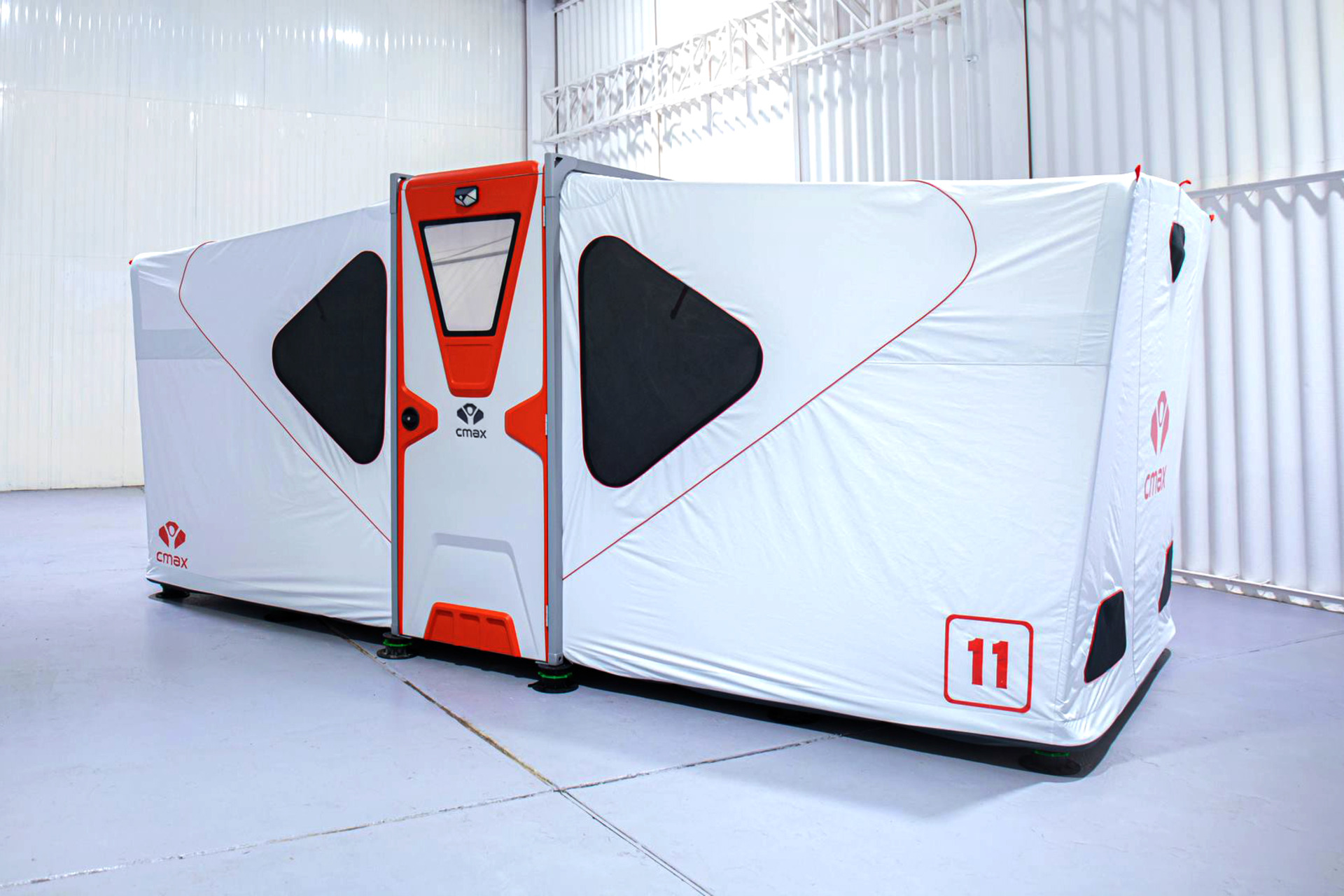
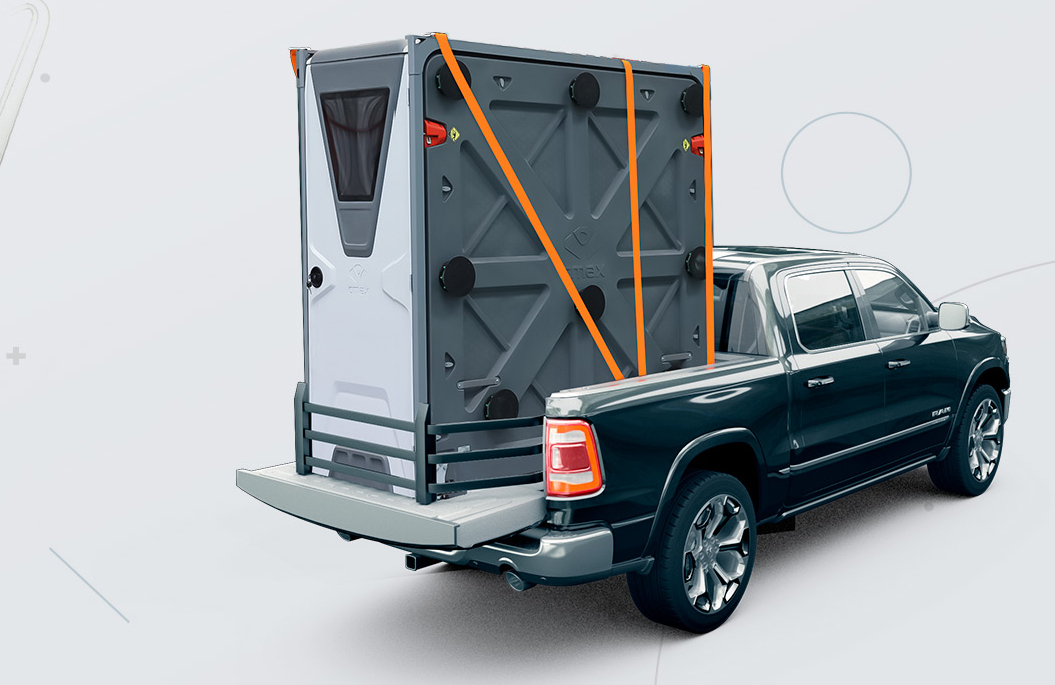
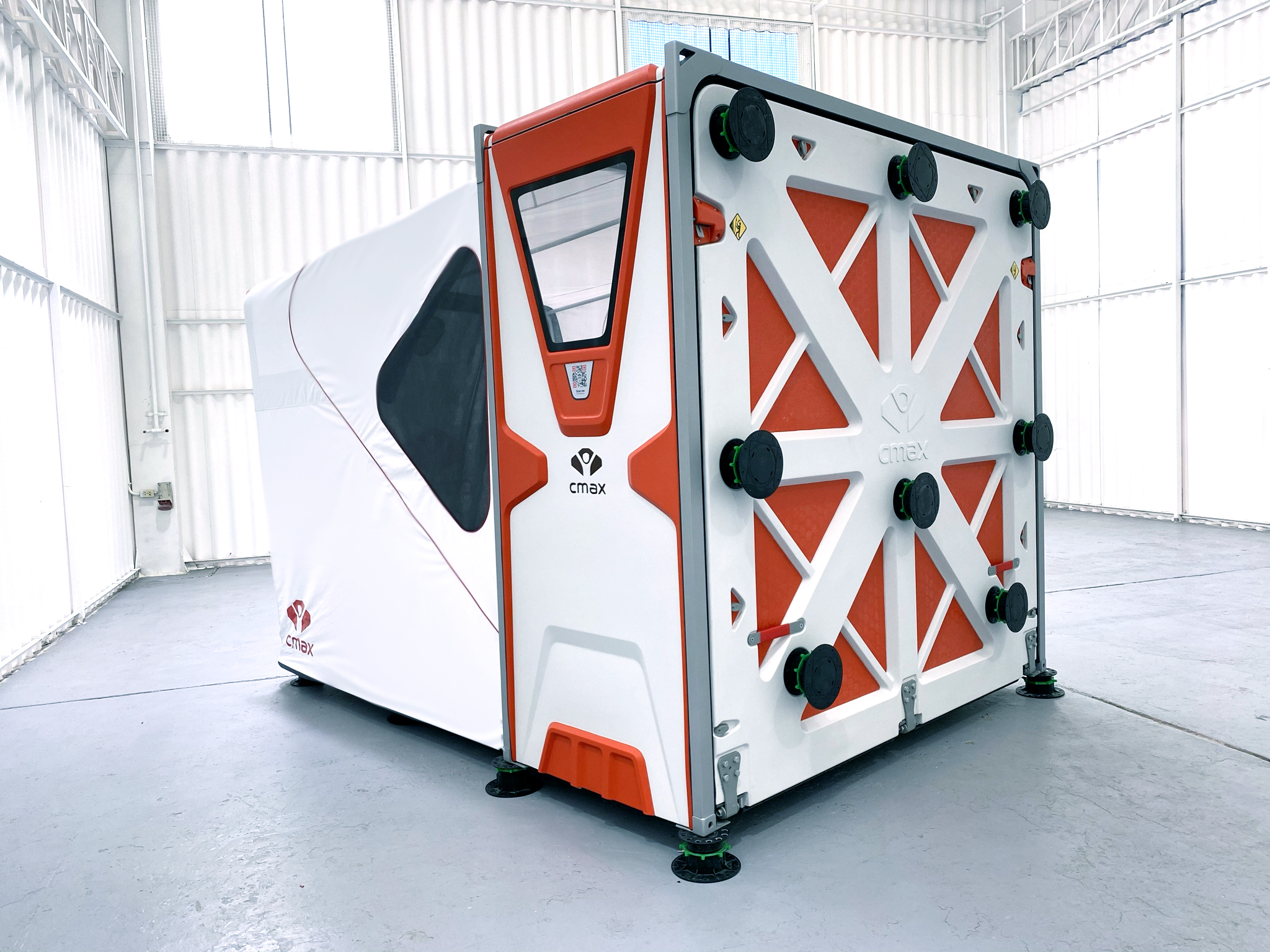
At first glance, the CMAX CX20 looks more like an oversized equipment case than a place where anyone could live. Its walls are folded vertically against a narrow central section, allowing the complete structure to ride in a pickup bed or on a small trailer.
Once it reaches its destination, however, two people can reportedly turn it into a weather-resistant temporary room in approximately 11 minutes—without power tools, cranes or conventional construction.
CMAX System developed the CX20 primarily as a rapid-deployment shelter for families displaced by disasters and conflict. The same adaptable structure is also promoted for mobile clinics, remote work sites, temporary offices, events, camping and glamping.
A floor that unfolds with the walls
Unlike a conventional tent, the CX20 does not place its occupants directly on the ground. Its narrow central module contains the entrance and main roof support, while the two large side sections fold downward to become rigid floors.
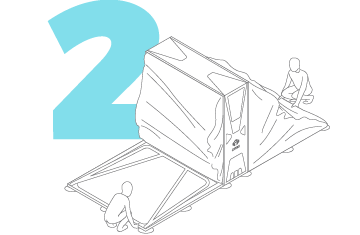
Deployment begins by positioning and leveling the central section. The crew unfolds both sides, adjusts the supporting feet and raises the main crossbar, which lifts the flexible enclosure into its finished shape. The cover is then tensioned and secured.
CMAX says the complete process requires two people, no tools and about 11 minutes. That is a manufacturer-quoted time under suitable conditions; unloading, positioning, anchoring and connecting optional utilities could add considerably longer.
The elevated floor is one of the shelter’s most practical features. It helps separate occupants from mud, surface water, cold soil and insects, while also giving the structure more rigidity than an ordinary ground tent.
Its threaded telescopic feet can compensate for approximately 2.36 inches (60 mm) of height difference. That makes modest leveling possible on grass, sand, concrete or compacted soil, but it does not mean the shelter can be safely installed on any slope. The site must still be reasonably flat, stable and properly prepared.
Large enough for eight—but with qualifications
Figures supplied to media in 2024 put the deployed CX20 at approximately 19 feet (5.8 m) long, 7.4 feet (2.25 m) wide and 7.2 feet (2.2 m) high. Its folded width is reportedly just 37 inches (94 cm), while the complete unit weighs about 330 lb (150 kg).
CMAX says the interior can sleep as many as eight people. That is best understood as maximum shelter capacity rather than spacious accommodation. The company does not publish a definitive standard-equipment list, and beds or bunks should not be assumed to come with the base unit.
Eight adults, their possessions and any necessary supplies would also make the approximately 141-sq-ft interior fairly crowded. A smaller group could instead use the available area for furniture, equipment, medical work or storage.
There is some uncertainty in the currently published dimensions. CMAX’s website says the shelter grows from a three-foot storage space into a 14-foot living space, but it does not explain how that measurement relates to the previously reported 19-by-7.4-foot footprint. Buyers should request the specification sheet for the exact production model being quoted.
Portable does not mean easy to carry
Folding the shelter into a narrow package should make it much easier and cheaper to transport than a rigid cabin of comparable size. CMAX shows the unit riding in a pickup and says it can also travel on a flatbed or small trailer.
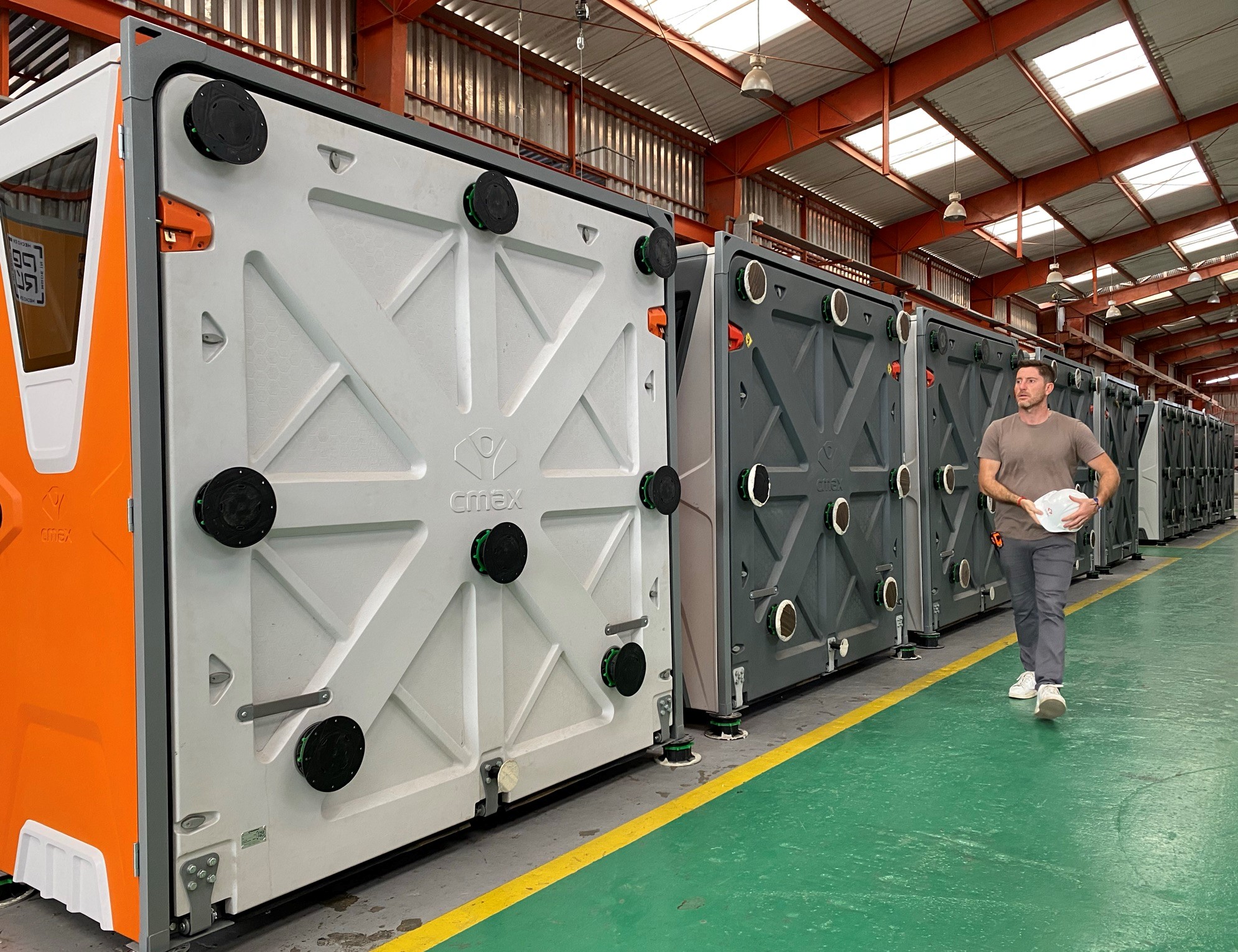
Nevertheless, a 330-lb shelter is not something two people can casually lift out of a truck. Delivery may require a ramp, liftgate, forklift, hoist or a larger handling crew. The CX20’s tool-free claim applies to unfolding the structure—not necessarily to unloading, anchoring it or installing its utilities.
The compact format could be particularly useful for disaster-response organizations, which need to move multiple shelters quickly and store them between emergencies. CMAX claims its flat-pack approach can reduce transport emissions by up to 90% compared with moving rigid shipping containers.
A basic shelter or an equipped field room
The base CX20 appears to include the folding platform, rigid flooring, adjustable legs, structural frame, fabric enclosure, ventilation openings and a lockable entrance.
CMAX has shown or mentioned optional air conditioning, solar panels, electrical charging and water-treatment equipment. Interior lighting, beds, medical equipment and other furnishings may also depend on the customer’s configuration.
Those distinctions matter. The CX20 does not automatically arrive as a complete off-grid home with a bathroom, kitchen, batteries and running water. It is better understood as a reusable shelter envelope that can be equipped for a particular mission.
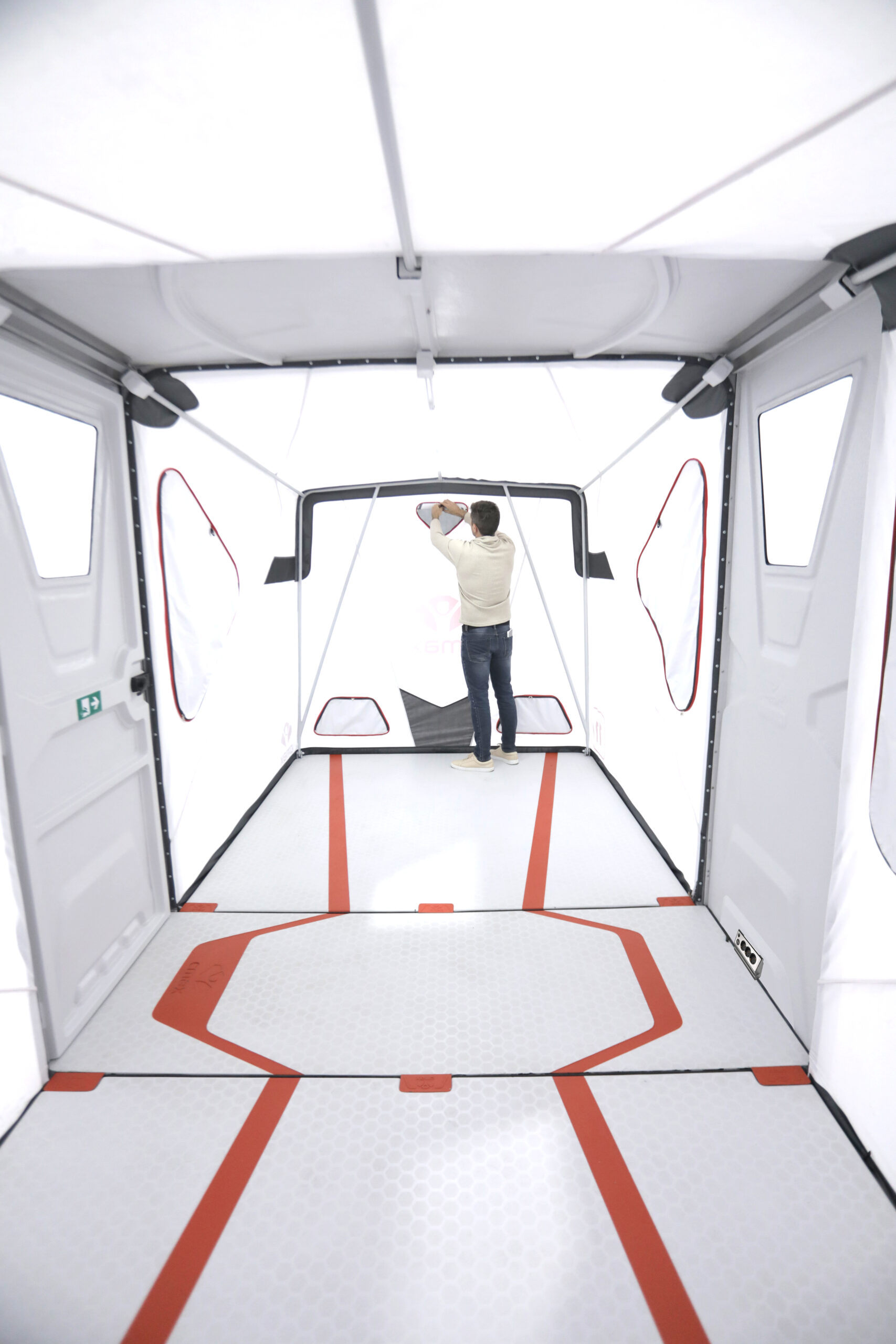
The tall interior and ventilation openings encourage crossflow and provide natural light, but CMAX publishes no insulation value or operating-temperature range. Heating and cooling requirements will therefore depend heavily on the climate, occupancy and selected equipment.
Emergency shelter and mobile-clinic applications
CMAX has promoted variations of its folding shelters for humanitarian accommodation, patient screening, triage, mobile medical facilities, command centers and staff housing. Founder Nicolás García Mayor has said units were deployed as relocatable field hospitals in Ukraine, while NBC Washington reported CMAX shelters being used in the United States, Mexico, Ukraine, Poland and other countries.
That history does not mean every standard CX20 is a certified isolation room or intensive-care facility. Clinical applications can require controlled airflow, filtration, disinfectable surfaces, reliable power, sanitation, accessible entrances and approval from local health authorities. CMAX does not currently publish the medical certifications for a CX20 configured in this way.
Weather resistance needs better documentation
The CX20 is designed to provide more protection and a firmer floor than a basic tent. CMAX calls it water-resistant and capable of resisting strong winds, and company social-media material has mentioned winds of 130 mph.
However, the company does not publish a wind-test report identifying the required anchors, test standard, terrain assumptions or whether the figure represents sustained wind or a brief gust. Its public information also lacks rated snow loads, fire-performance data and a defined rainfall or water-ingress standard.
The safest description is therefore that the CX20 is intended as a weather-resistant temporary shelter when correctly installed and anchored—not that it is a proven hurricane shelter. Its fabric walls also offer less protection against forced entry, sharp objects, vandalism and falling debris than a rigid building.
Price and availability
In 2024, New Atlas reported that a CX20 cost approximately US$8,000, based on information supplied by García Mayor. CMAX no longer publishes a fixed retail price, so that figure should be treated as historical rather than a current offer.
The company’s present inquiry form asks prospective customers about their country, intended application and budget. It does not show a guaranteed delivery date, base specification or shipping charge. CMAX’s terms also say that prices, materials, features and delivery estimates can change.
The final project price could include freight, taxes, duties, beds, HVAC, solar equipment, anchoring, site preparation, installation support and permits. Anyone considering an order should obtain a written configuration, technical data sheet, warranty terms and delivered quotation.
CMAX’s May 2026 warranty provides two years of coverage for shelters and structural components, and one year for accessories and nonstructural components. Coverage is limited to manufacturing and workmanship defects. Among the exclusions are punctures, tears, UV degradation, mold, incorrect storage, improper installation, inadequate anchoring, extreme weather and normal wear.
A humanitarian design more than two decades in development
Argentine industrial designer Nicolás García Mayor began developing the original CMAX concept around 2001 as a way to improve conditions for people displaced by natural disasters and wars. An earlier version was presented at humanitarian events and at the United Nations in 2013. The design has since evolved through multiple generations, meaning specifications for the early polypropylene, aluminum and polyester shelter should not automatically be assigned to the newer CX20.
The current company describes itself as combining commercial sales with humanitarian work through the nonprofit CMAX Foundation. Their donation program promises one donated shelter for every 10 purchased.
The CX20’s core idea remains compelling. It occupies far less transport and storage space than a rigid room, deploys without conventional construction and gives occupants an elevated floor and standing-height interior. But it remains a temporary, configurable shelter—not an instant code-approved house.
Source: CMAX System