

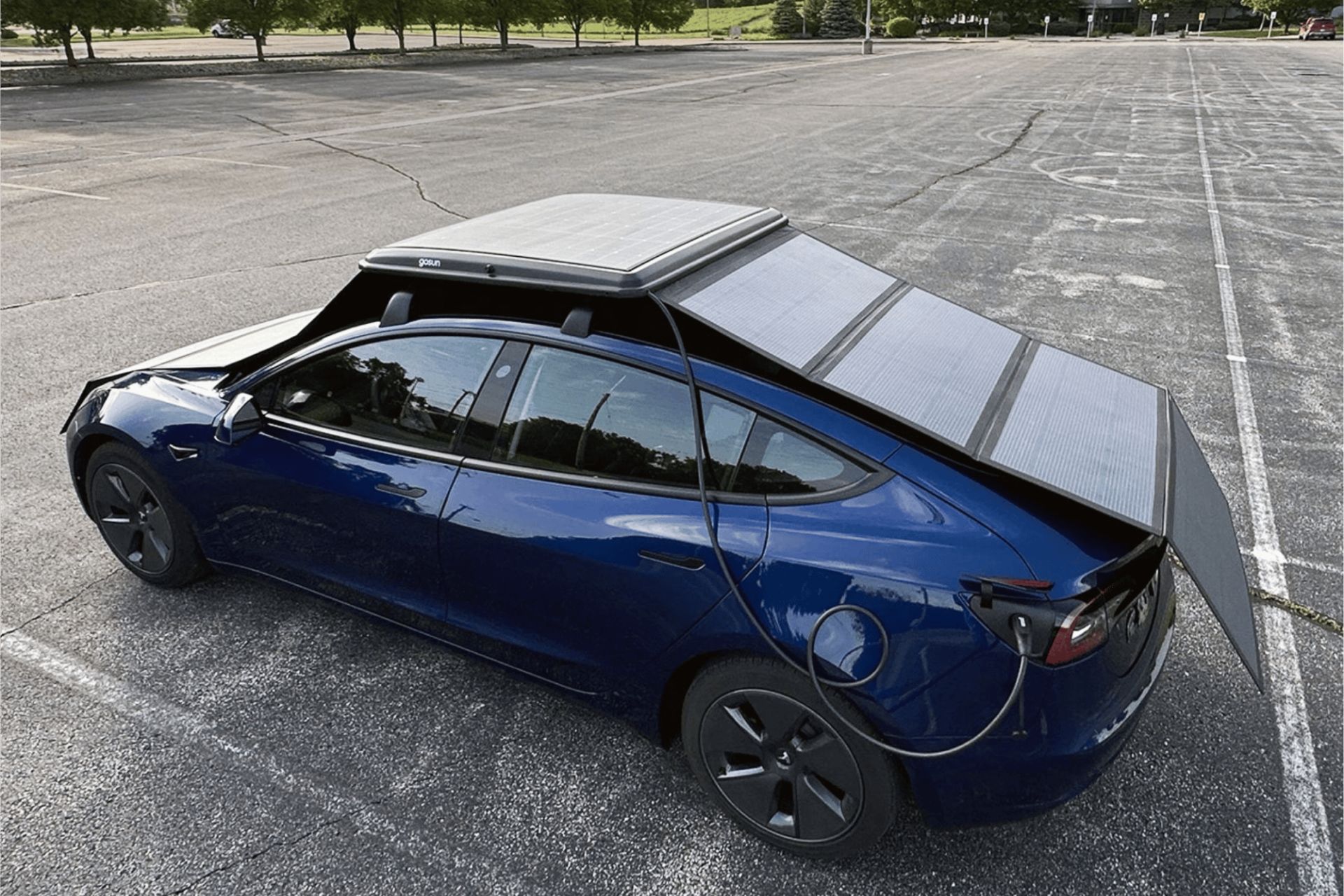
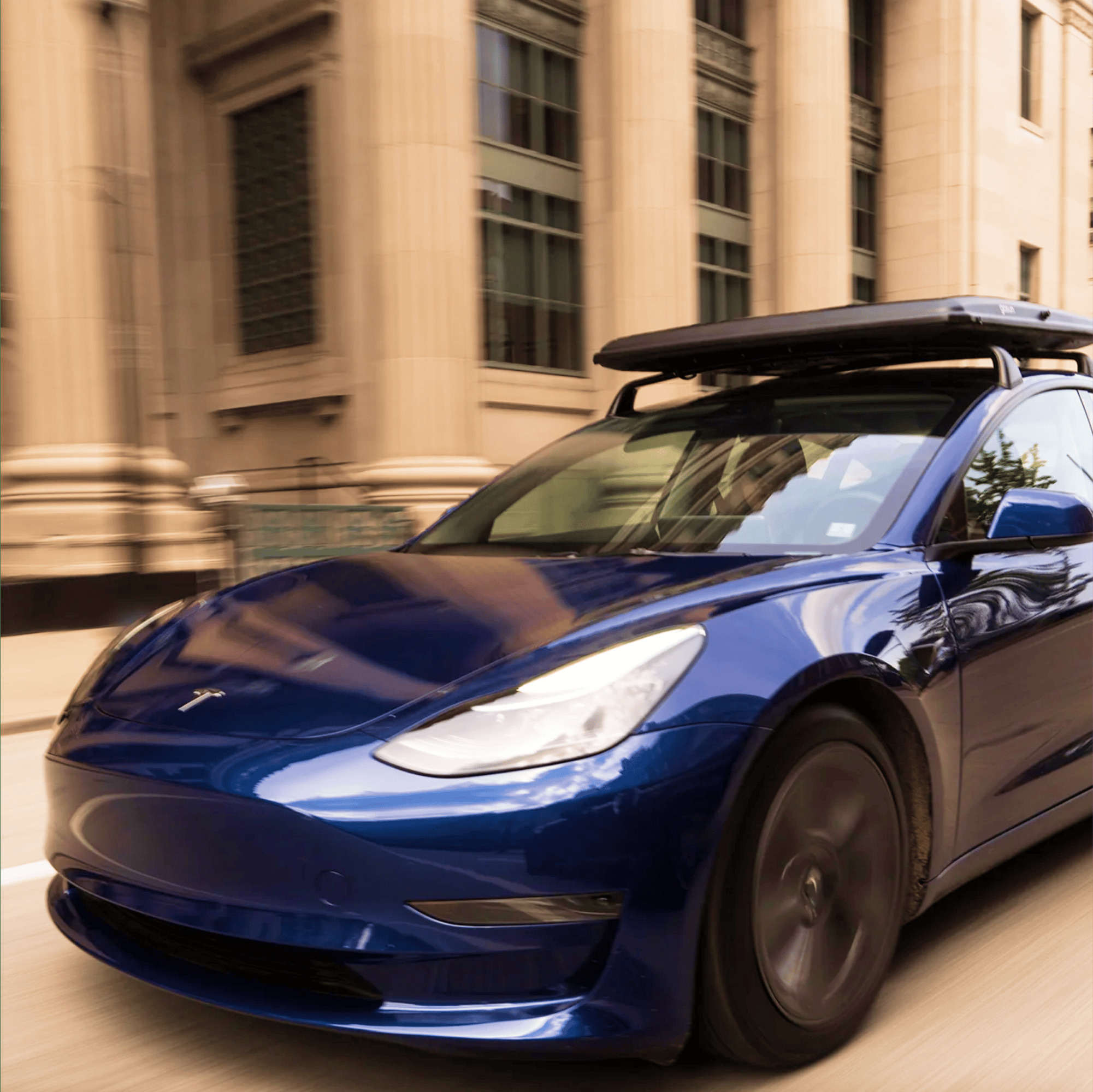
Electric vehicles usually depend on a wall outlet or public charging station, but GoSun has developed a more mobile alternative: a folding solar array that travels on the vehicle’s roof and unfolds when the car is parked.
Called the GoSun EV Solar Charger, the system combines up to 1,100 watts of photovoltaic panels with a 1,500-Wh lithium iron phosphate battery and a Level 1 charging connection. GoSun says favorable sunshine can add as much as 20 miles (32 km) of driving range in a day, potentially giving commuters, campers and drivers without convenient home charging a modest supply of energy wherever they park.
A 20-foot solar array packed into a rooftop case
The charger measures 46.75 × 48 × 5 inches (119 × 122 × 12.7 cm) when closed. At a destination, the driver unlocks its low-profile case and unfolds the panels over the vehicle, extending the array to approximately 245 inches—or 20.4 feet (6.22 m)—long.
That large surface area is what allows the parked system to produce up to 1,100 watts at 60 volts DC under ideal conditions. One panel remains exposed when the case is closed, providing up to 200 watts while the vehicle is on the road. That energy charges the system’s buffer battery; it does not charge the vehicle while it is moving.
GoSun uses 22%-efficient monocrystalline cells with an ETFE coating, supported by aluminum and stainless-steel hardware inside an ABS enclosure. The product weighs 130 lb (59 kg), before adding the required roof-rack crossbars.
How solar energy reaches the car
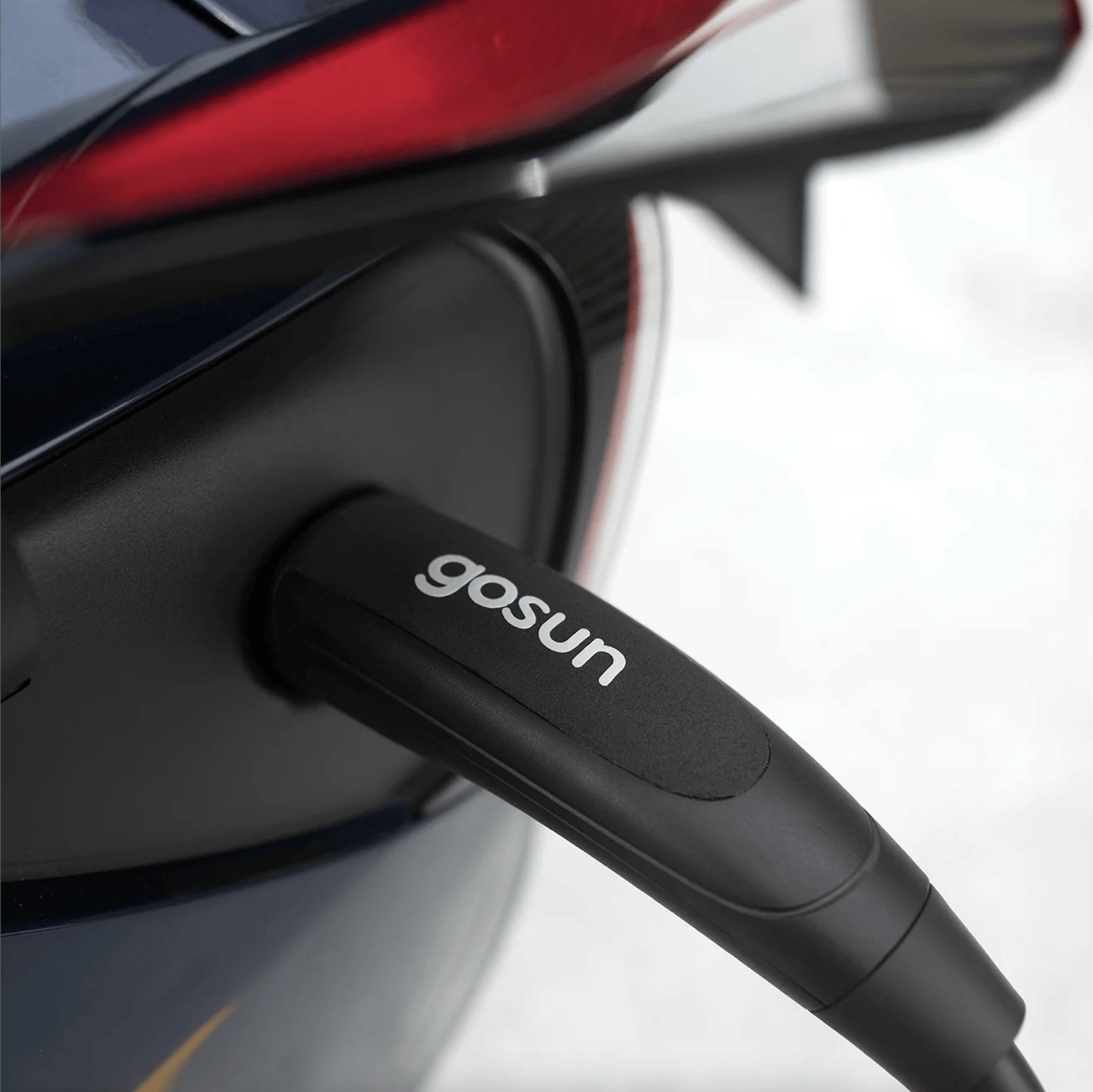
The panels do not feed fluctuating solar power directly into the EV. Instead, they replenish a 1,500-Wh lithium iron phosphate battery inside the charger. An integrated inverter then supplies 110-volt AC power to a compatible Level 1 EV charging cable.
Once sufficient energy is available, the system begins charging the vehicle through the same safety protocols used by a conventional Level 1 EVSE. The battery smooths out changes caused by clouds and shadows, allowing the unit to charge in cycles rather than repeatedly sending unstable power to the car.
GoSun says the solar charger’s power bank can also run other equipment through a 110-V AC outlet, two USB-C Power Delivery ports and two USB-A ports. That makes it potentially useful at a campsite, jobsite or during an outage even when no vehicle is connected.
The EVSE cable itself is not included. Buyers will also need suitable crossbars, which GoSun sells separately or allows customers to source for their own vehicle.
What “up to 20 miles per day” really means
The headline range figure is possible under good solar conditions, but it is not a fixed daily result. GoSun has also described 10 to 15 miles (16 to 24 km) as a more typical daily contribution, while an early test on a Chevrolet Bolt EUV reportedly added 12 miles in one day.
Actual range will depend on the available sunlight, season, latitude, parking orientation, shading, vehicle efficiency and charging losses. A 1,100-W rating is the array’s peak instantaneous output; it is not the amount of energy collected throughout an entire day.
Even 10 miles a day could be useful for a short commuter. Over five sunny workdays, that could recover around 50 miles while the car sits in a parking lot. It will not replace high-speed charging on a road trip, but that is not really its purpose. The product is better viewed as a portable range extender and off-grid energy source.
Deployment takes space—but little time
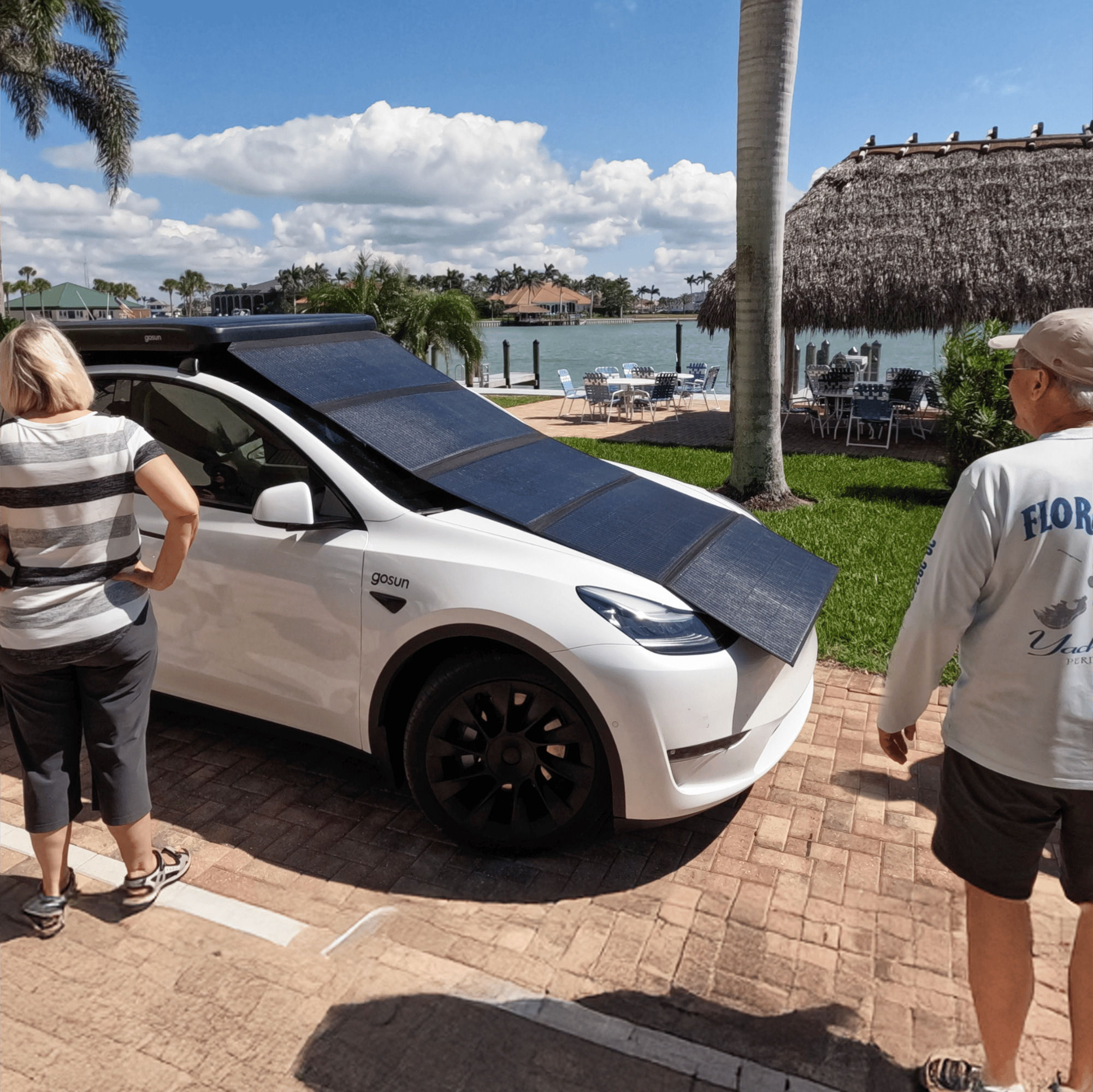
GoSun says one person can deploy or pack the array in about a minute. The panels are removed from the case, unfolded across the parked vehicle and connected before charging begins. An included extender supports the array beyond the front or rear of the car, while a high-wind strap helps secure it.
The long deployed footprint is also the charger’s most obvious practical limitation. A 20-foot array may extend beyond a small car and will not suit every crowded street, parking garage or tight parking space. Drivers must retract and secure it before moving the vehicle.
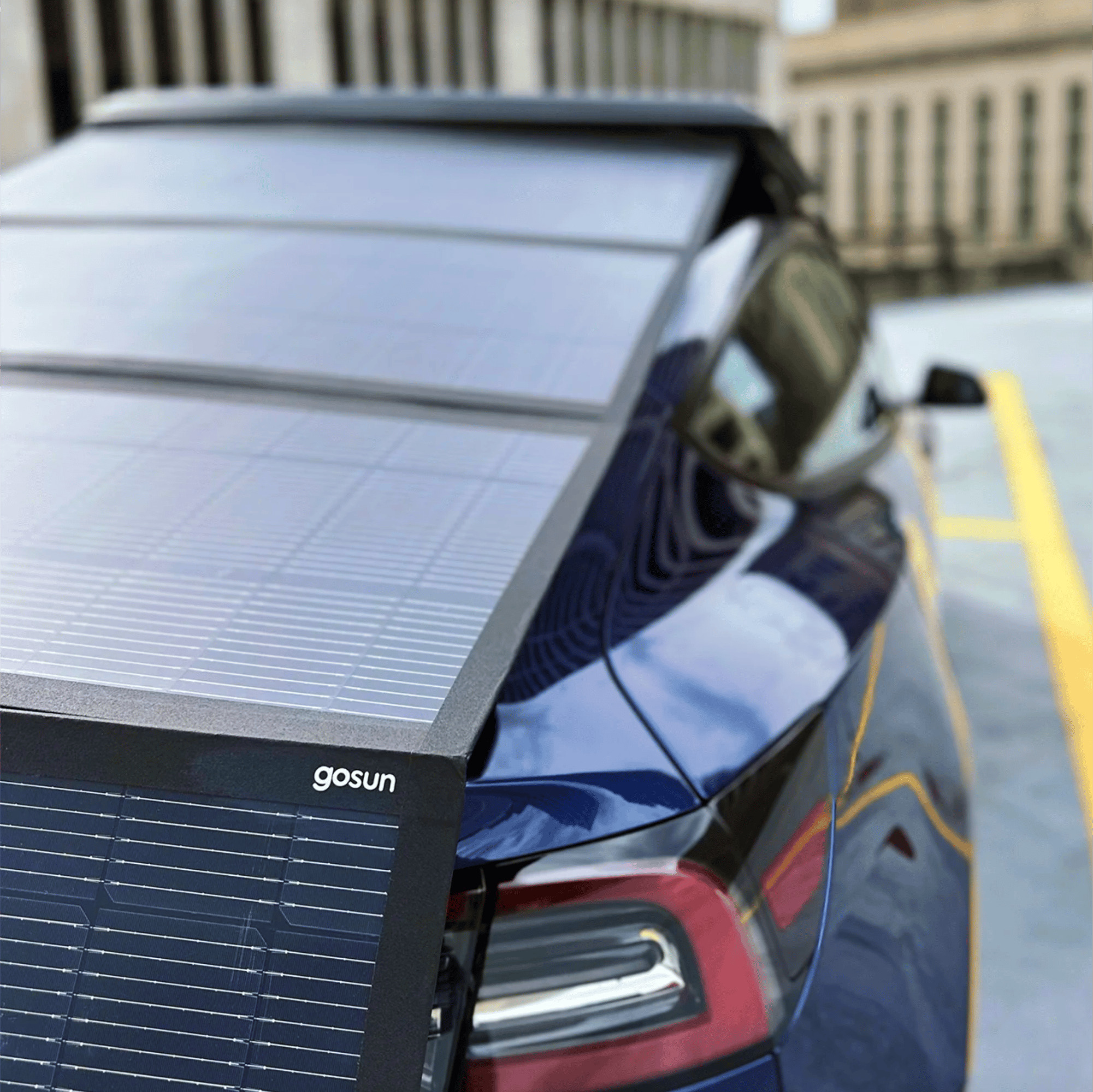
The company rates the closed rooftop case for road speeds of up to 100 mph (161 km/h) and the deployed panels for wind speeds up to 30 mph (48 km/h). Owners would still need to monitor changing weather and pack the array away when conditions become unsuitable.
The product arrives preassembled in two boxes. GoSun estimates installation at about 30 minutes with basic wrenches and two able-bodied helpers. It is designed to remain roof-mounted, although the company says it can be removed within minutes.
Roof capacity and efficiency deserve attention
GoSun describes the charger as compatible with most vehicles fitted with appropriate crossbars, but a 130-lb system is a substantial roof load. Buyers should check the vehicle manufacturer’s roof-load limit, the crossbar rating and any local rules before installation. Some cars may have enough capacity for the charger but little remaining allowance for other rooftop cargo.
Carrying a large case also creates aerodynamic drag, which will reduce efficiency to some degree. GoSun does not publish a universal range-penalty figure, and the effect will vary by vehicle and speed. Prospective owners should therefore balance the solar energy gained while parked against the energy used to carry the unit.
The current 110-V AC configuration is oriented primarily toward North American Level 1 charging. International customers should confirm voltage, plug, grounding and EVSE compatibility before ordering.
Who is it for?
The charger is currently listed at $3,799. GoSun says new orders are scheduled to ship in September 2026. Crossbars and a compatible EVSE cable are sold separately. At that price, the GoSun charger is unlikely to deliver a rapid financial payback for someone who already has inexpensive overnight electricity. Its appeal is strongest where access matters more than the lowest possible cost per kilowatt-hour.
Potential users include apartment residents without assigned charging, commuters whose cars spend sunny days in open parking lots, campers traveling away from the grid and people wanting an emergency energy reserve. It could also reduce dependence on public chargers for drivers whose daily mileage is modest.
GoSun offers a general one-year warranty and a 30-day return window for qualifying direct purchases. Because its published warranty page does not spell out separate coverage for every component in this relatively new product, buyers may wish to request the precise battery, panel, inverter and weather-damage terms in writing. Returns must meet GoSun’s conditions, and customers are normally responsible for return shipping.

The company also notes that the charger may qualify for a US federal clean-energy tax credit, but eligibility depends on the purchaser and installation. That claim should be checked with a qualified tax adviser rather than treated as a guaranteed discount.
A mobile solar charger with a clear niche
The GoSun EV Solar Charger will not refill a large EV battery overnight or eliminate the need for charging infrastructure. What it can do is collect useful energy from a parking space that would otherwise sit idle, then deliver it through a familiar Level 1 connection.
Its price, weight and large deployed footprint make it a specialized accessory, but the underlying idea is compelling: instead of searching for a socket, an EV can carry a modest solar charging station wherever it goes. For drivers whose daily travel fits within the energy it can harvest, that could turn hours of parked time into genuinely useful range.
Product page: GoSun EV Solar Charger


