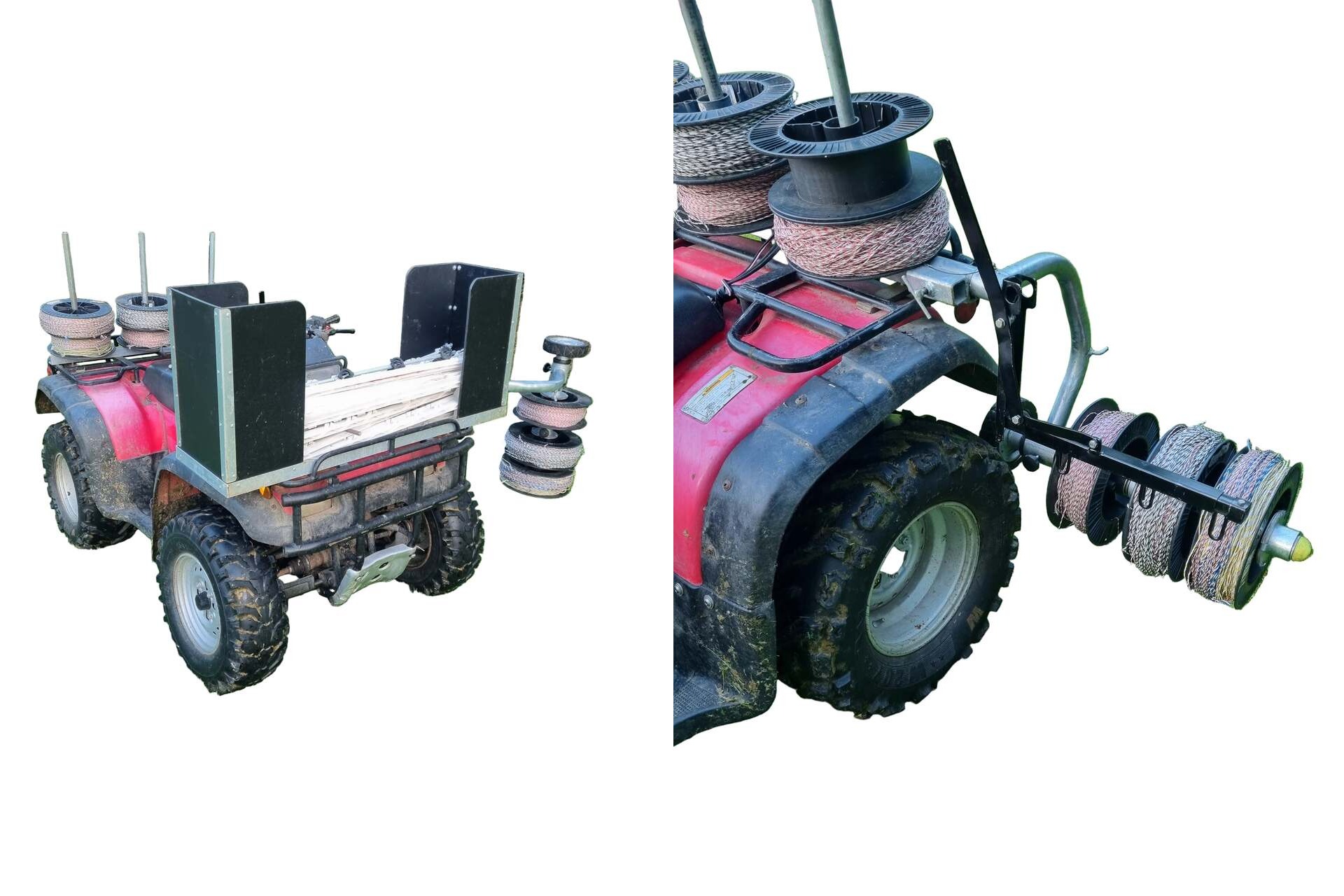
Temporary electric fencing is invaluable for rotational grazing, but moving it repeatedly can involve a surprising amount of labor. Every new boundary may require several reels of conductor to be carried across a field, three separate strands to be walked out, dozens of posts to be installed and all that wire to be wound up again when the animals move.
An Irish farming business called Sheep School has developed an ATV-mounted system intended to make the wire-handling part of that process considerably faster. Its 3-Reel ATV Fencing System carries three reels together, letting an operator deploy three parallel fence strands during one journey along the field. The same mechanism can then be repositioned to retrieve all three strands when the temporary fence is moved.
The machine is deliberately mechanical. It does not rely on an electric motor, battery or hydraulic circuit. Instead, it uses a single shaft, three independently controlled reels and drive supplied by the ATV’s wheel.
Three fence strands deployed together
When a temporary fence is being installed, the three-reel assembly is mounted at the front of the ATV. As the vehicle follows the intended boundary, conductor pays out from all three reels simultaneously.
Each reel has its own clutch. Sheep School says those clutches maintain tension independently, helping prevent one line from running loose while another becomes excessively tight. That matters on turns and uneven ground because the three strands may not always travel exactly the same distance.
Deploying the conductors together eliminates the need to walk the same route three separate times with individual hand reels. It should be especially useful on farms where temporary boundaries are repositioned frequently for strip grazing, winter grazing or pasture recovery.
The system handles the wire rather than constructing the entire fence automatically. Poly posts must still be inserted into the ground, and the conductors must be positioned at suitable heights, connected and energized in the normal way.
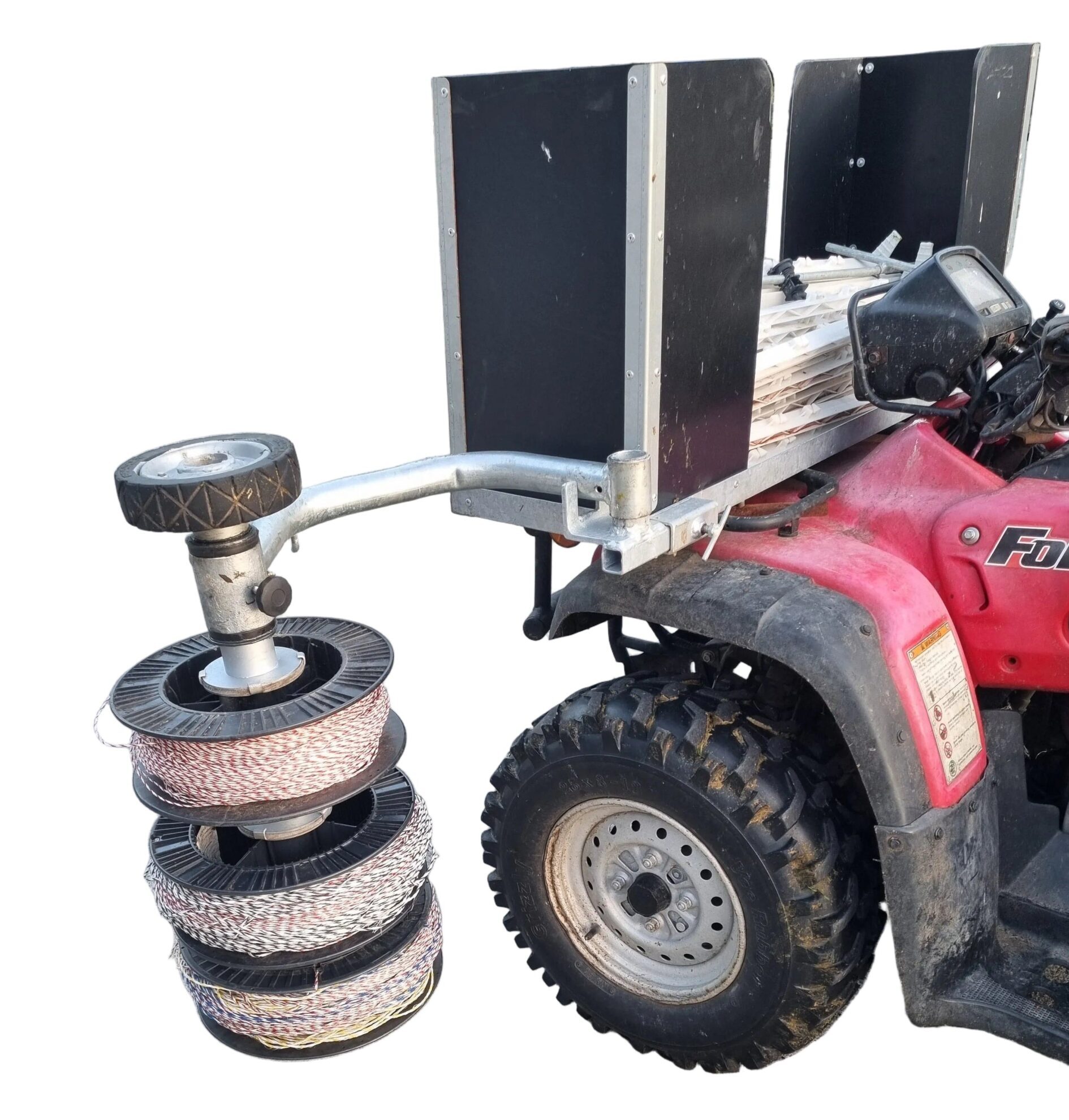
A box carries approximately 70 posts
To keep the rest of the fencing equipment close at hand, the package includes a large storage box designed to carry approximately 70 poly posts. The posts are stored horizontally between tall side panels, reducing the need for a separate trailer or repeated trips back to the yard.
The combination of three loaded reels and a supply of posts allows one ATV to carry the principal components needed for a substantial temporary boundary. Sheep School also states that the rear storage arrangement has capacity for as many as 15 reels, although only three wire reels are listed as part of the standard package.
The exact fence length will depend on the conductor loaded onto those reels. Sheep School does not publish their capacity or specify whether the supplied reels are compatible with polywire, polytape and polyrope in every size. Buyers planning unusually long runs or using wide tape should confirm those details before ordering.
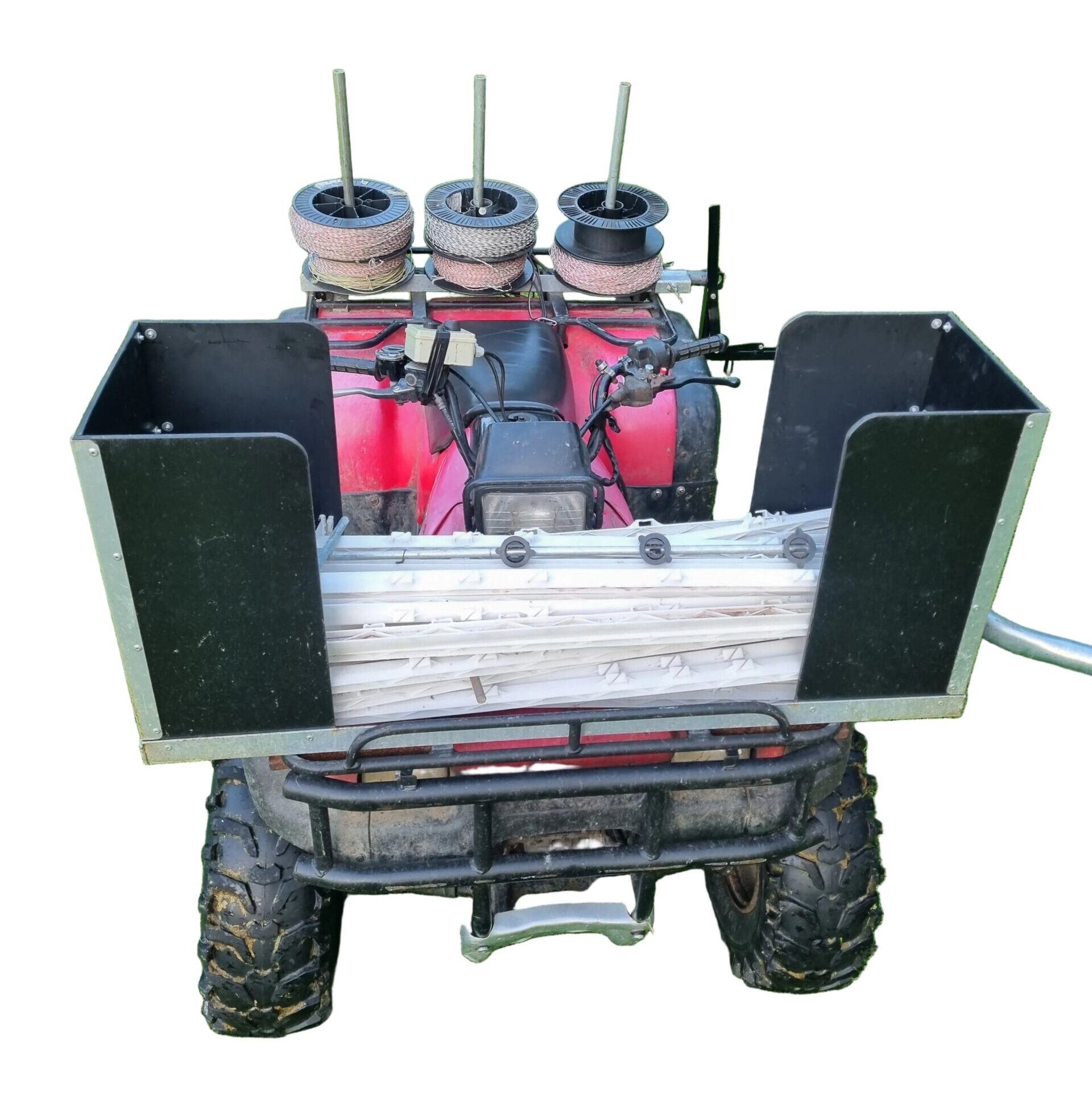
The ATV wheel powers retrieval
When the fence needs to come down, the reel mechanism is mounted at the rear of the ATV. Rotation from the vehicle’s wheel drives the single reel shaft, winding all three conductors as the ATV moves along the fence line.
Because each reel retains its own clutch, the system can accommodate small differences in the rate at which the strands return. Sheep School has also fitted a manual wire-guide bar, allowing the conductors to be directed across their reels during retrieval for a more even wind.
It should not be described as fully automatic: the published description specifically identifies the guide as manual. The operator must still monitor the wires, remove them from posts and ensure they remain clear of the ATV’s tires, axle, brakes and exhaust.
The practical payoff is reduced walking and hand winding. Temporary fences are usually valuable precisely because they can be moved, so simplifying retrieval may make farmers more willing to reposition boundaries as grazing conditions change.
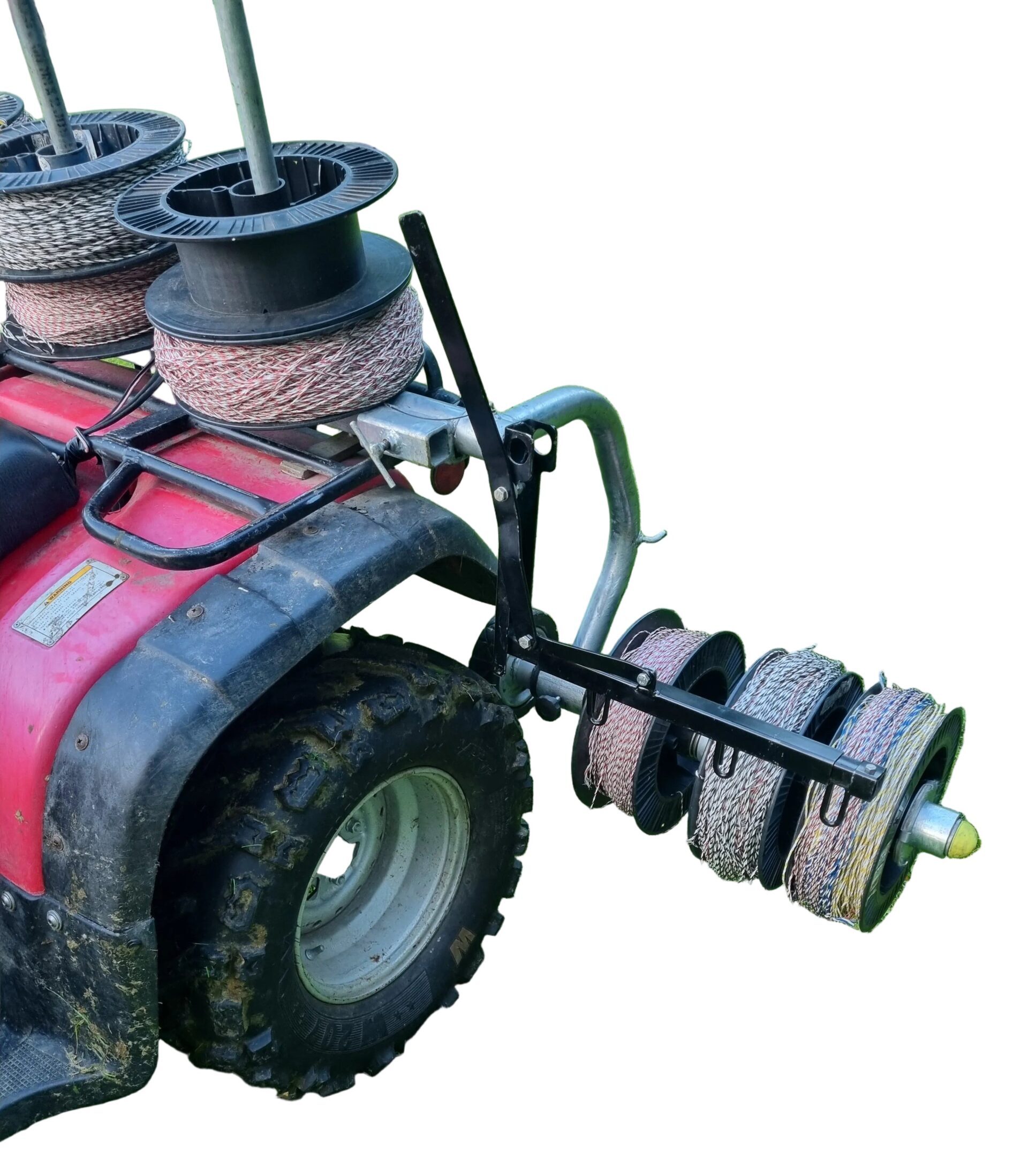
Designed to remain mechanically simple
The main structure is galvanized steel, with painted components used where appropriate. Sheep School says it has been designed for regular exposure to the rain, mud and year-round conditions encountered during farm work.
Its straightforward drive system is one of the product’s more appealing features. A shared shaft and mechanical clutches avoid the wiring, charging and additional control components associated with powered reels. Fewer driven parts should also make routine inspection and maintenance easier.
The manufacturer describes the system as lightweight, but no installed weight or dimensions are currently published. The product page also lacks a list of compatible ATV models. Prospective buyers should therefore confirm the required rack mounts, clearances and installation hardware, as well as the permissible load on their ATV’s front and rear racks.
This is particularly important because added equipment can alter an ATV’s steering and balance. Operators should follow the vehicle manufacturer’s load limits, drive conservatively on slopes and uneven ground, and keep hands and clothing clear of the shaft and reels. The energizer should be disconnected before wire is adjusted or retrieved.
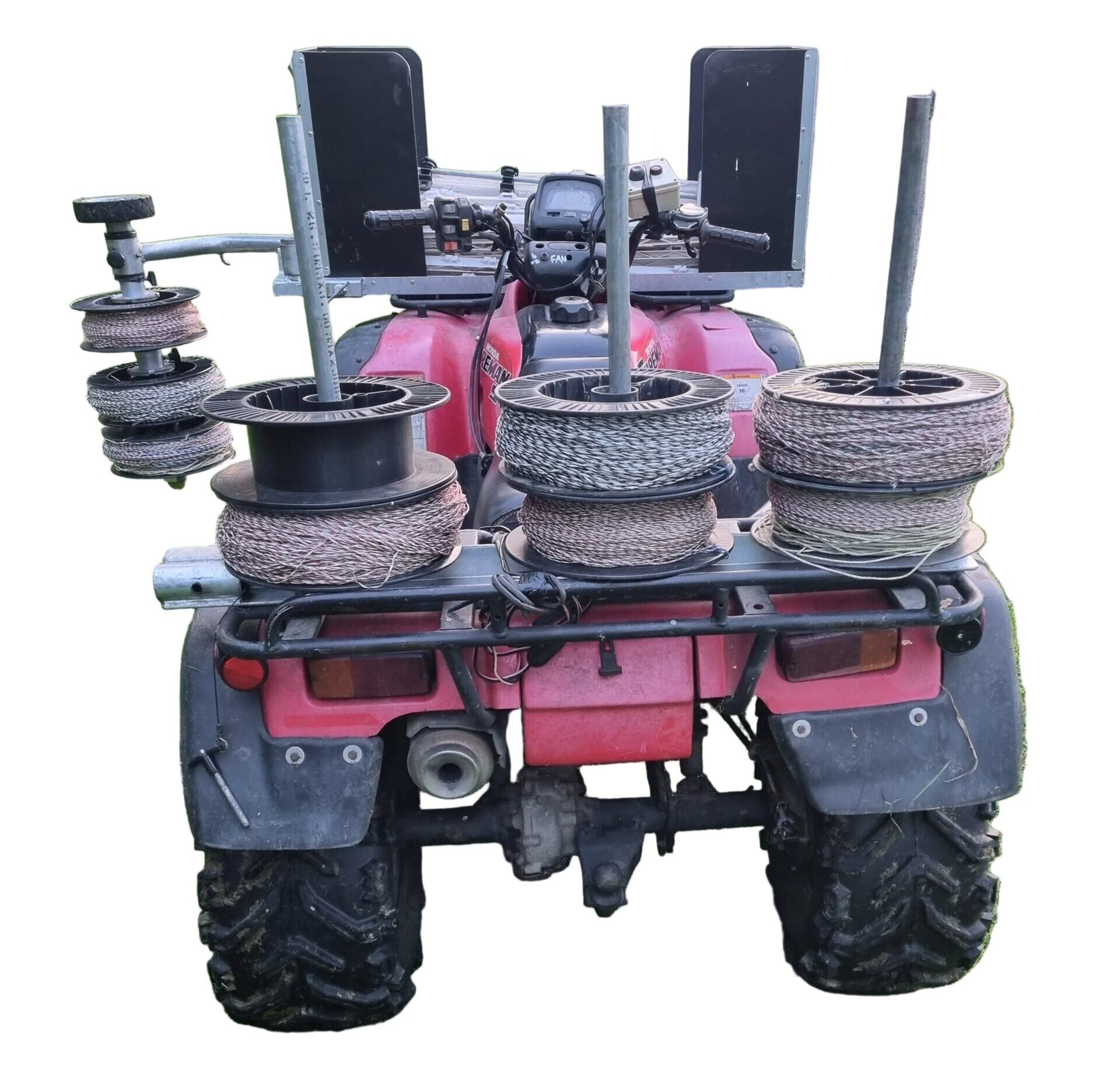
What comes with the system
The standard package includes the three-reel ATV wire reeler, three wire reels and the poly-post storage box. The product listing does not include the fence conductor, posts, energizer or ATV itself.
It is also unclear whether the supplied reels arrive empty or preloaded, so customers should confirm what type and length of conductor must be purchased separately. No published warranty period, maintenance schedule or replacement-clutch pricing is currently provided.
Sheep School says the machine grew from its own experience of repeatedly moving and managing electric fences. The business is based in Dillagh, Ballinagh, County Cavan, Ireland, and sells equipment aimed primarily at practical sheep-farming tasks.
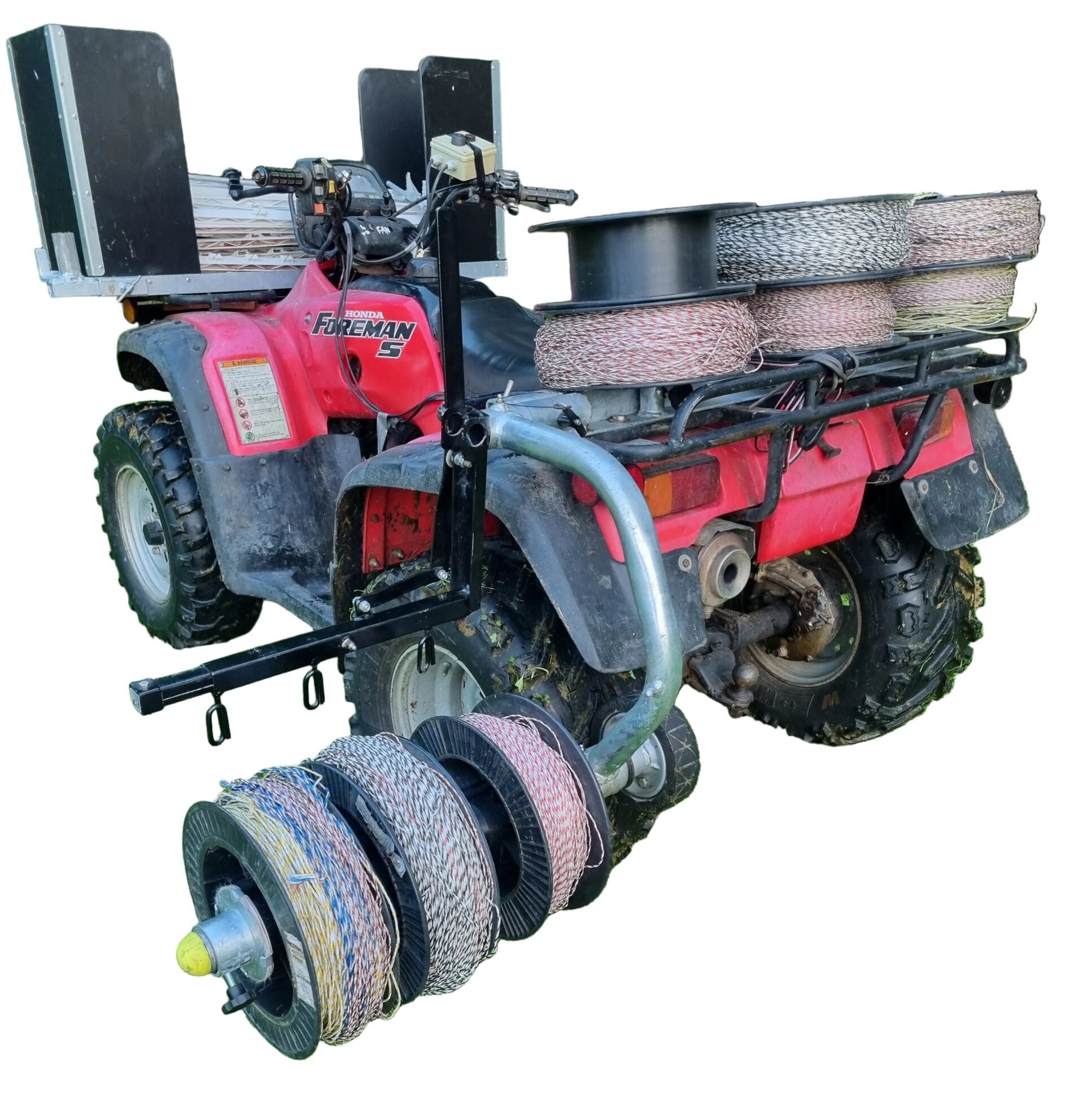
Pricing and delivery
The 3-Reel ATV Fencing System is currently offered at an introductory price of €1,495 plus VAT, compared with a stated regular price of €1,695 plus VAT. Sheep School says the introductory offer applies to the initial production run and remains subject to availability.
Customers can collect the equipment from the company’s workshop in County Cavan or arrange pallet delivery. Shipping charges depend on the destination. The company asks UK and qualifying EU customers seeking zero-rated treatment to contact it directly; buyers should confirm their final tax and import obligations before ordering.
For farms that only move an occasional short fence, three hand reels may remain the simpler answer. But where multiple temporary boundaries are shifted throughout a grazing season, Sheep School’s system addresses the repetitive part of the job with a refreshingly uncomplicated idea: carry the posts on the ATV, handle three wires at once and let the vehicle provide the power when it is time to wind them back in.