Concrete footings are such a familiar part of construction that it is easy to assume every deck, extension or modular building needs them. StopDigging’s SGC Adapter Screw offers a very different approach: rotate a large galvanized steel screw into the ground, bolt the appropriate bracket to its head and begin building without waiting for concrete to cure.
The result is a foundation point that can support anything from a residential deck to a professionally engineered building. The basic idea is simple, but the larger SGC models are far removed from the small anchors sold for garden projects. They are structural components selected for the loads, soil and connection details of a particular job, then installed with specialist machinery.
A foundation with a changeable head
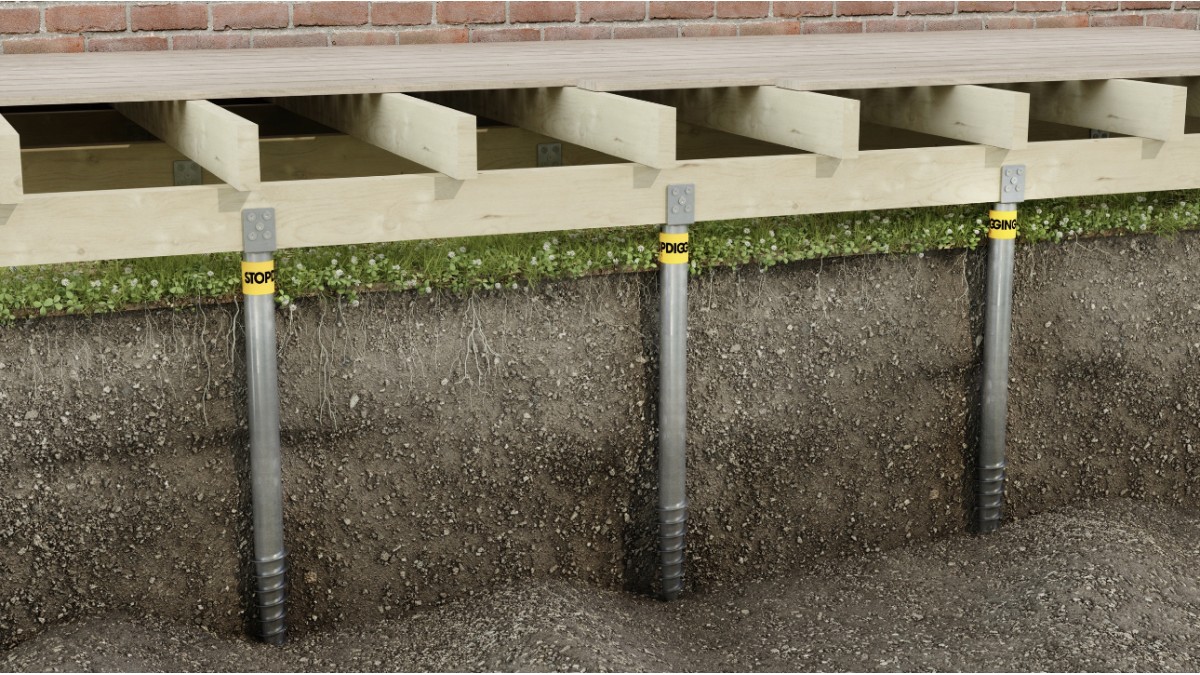
The feature distinguishing the SGC from many other ground screws is its circular mounting plate. Rather than incorporating a fixed post or beam holder, the screw accepts different adapters after it has been installed.
StopDigging offers brackets for horizontal beams, vertical posts, plates and pipe-shaped elements. This allows the same underlying screw family to work with timber frames, steelwork and other structural systems while giving the installer room to make precise adjustments at the connection.
Some models include an M20 threaded center hole, identified by the letter “M” in their names. A “D” suffix denotes additional duplex corrosion protection, while “T” identifies an extra-thick head.
The company produces four principal SGC configurations. Their shaft diameters range from 76 to 114 mm (3 to 4.5 inches), while standard lengths on the product page run from 865 to 3,000 mm (34 to 118 inches). The current technical sheet also lists one 89-mm model at 3,500 mm, so customers requiring that version should confirm its availability locally.
What “up to 10 tonnes” actually means
StopDigging’s technical sheet says the SGC range can take loads of up to 10 tonnes. Its highest published compression value is 104 kN—approximately 10.6 metric tonnes-force—for the 3,500-mm-long SGC 200M 89 × 4.0.
That headline number should not be interpreted as the capacity of every screw in every type of ground. Smaller configurations begin with published compression values of 13.5 kN, while tension and lateral ratings are different again.
The screw is only one part of the foundation system. Real-world capacity also depends on soil strength, installation depth, groundwater, the direction of the applied load, spacing, connection design and the safety factors required by local codes. A structural engineer may therefore specify a considerably lower allowable load than the component’s maximum published figure.
For substantial projects, StopDigging says installers assess the structure’s line and point loads, investigate the site and conduct compression, tension or static pile testing when required. Installation torque can provide useful quality-control data, but it is not automatically a substitute for site-specific engineering.
Driven into the ground by machine
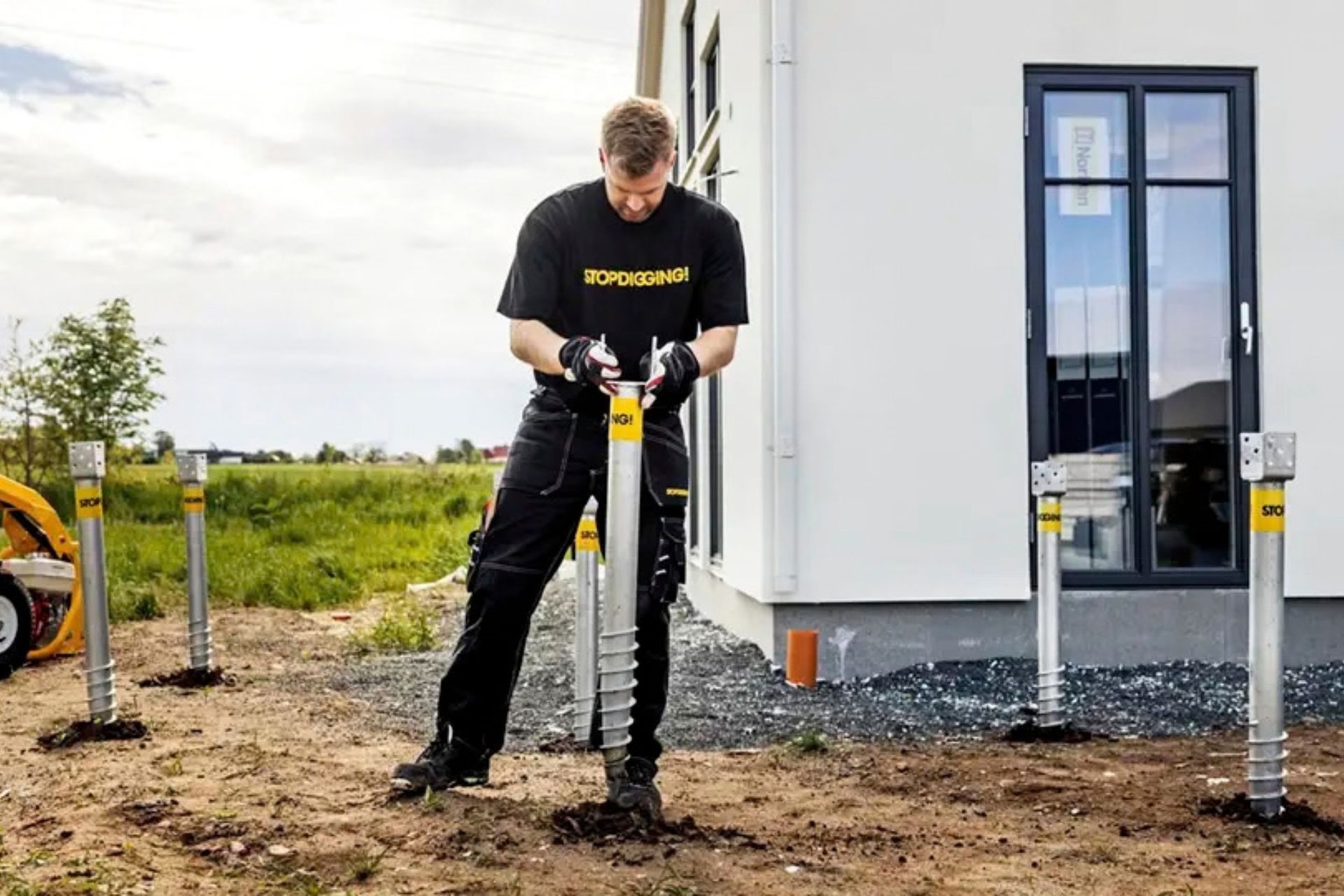
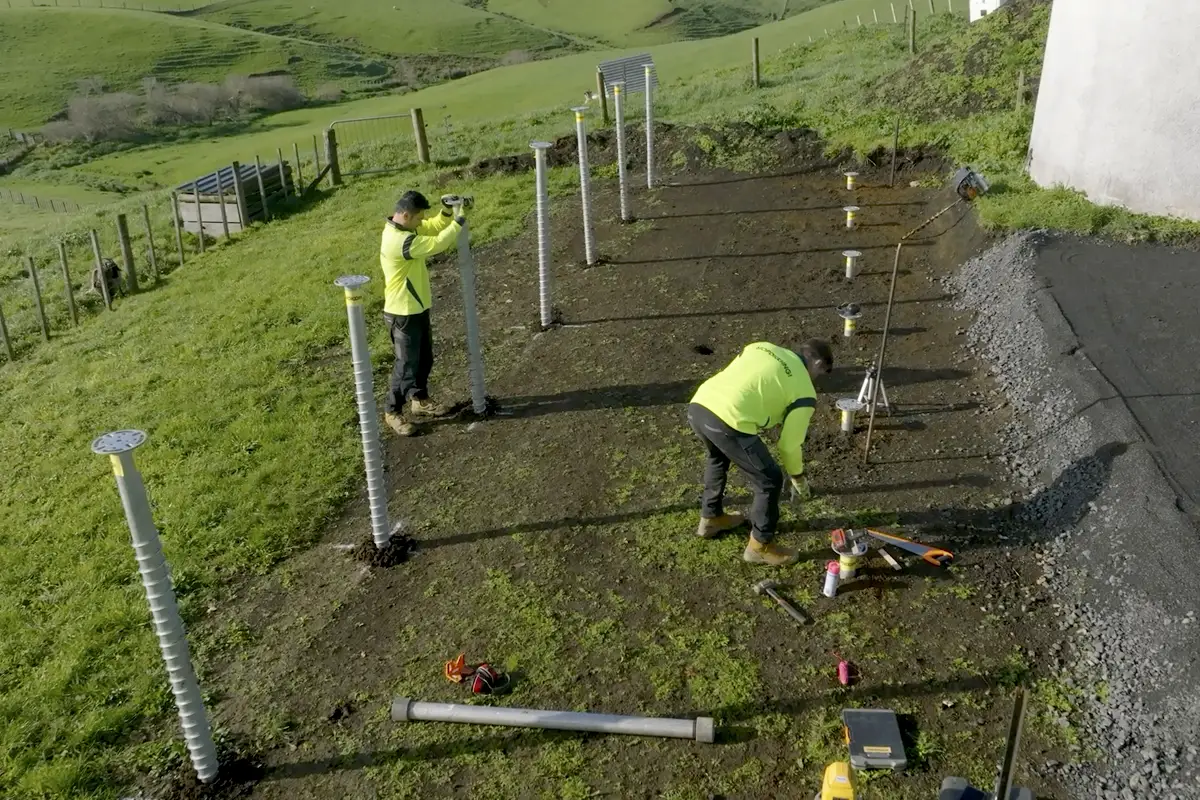
Installation begins by marking the foundation points and checking for underground utilities. Depending on the soil, the installer may create a pilot hole before positioning the screw vertically and rotating it into the ground.
StopDigging supplies equipment ranging from handheld electric drivers to hydraulic rigs capable of producing up to 6,000 Nm of torque. Some machines can record torque and location data as the screws are installed, creating a digital record of the foundation work.
Once the specified depth and alignment have been reached, the appropriate adapter is bolted to the head and leveled. Construction can then begin immediately because there is no wet concrete requiring time to set.
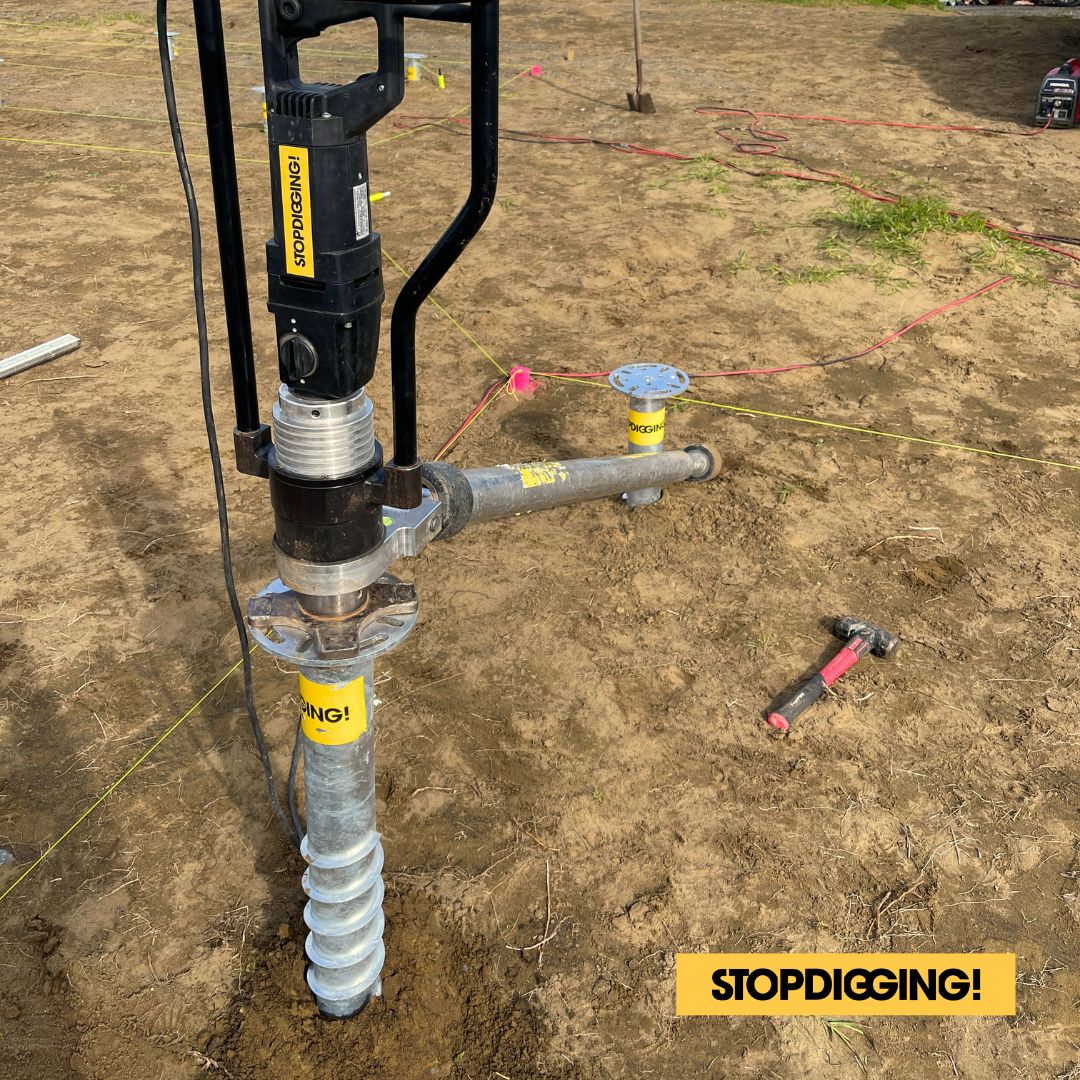
That does not mean the process is simply “screw it in and build.” Rocks, shallow bedrock, very soft soil, groundwater, frost depth, steep ground and limited machinery access can all affect the design. Hard material may require predrilling, while deep weak soils may call for StopDigging’s extendable SGX system rather than a standard SGC.
From decks to house extensions
Potential applications include decks, garden rooms, modular buildings, boardwalks, concrete slab support, house extensions and selected commercial or energy projects.
In one documented timber-frame extension, engineers assessed the building’s weight and the site’s soil before StopDigging conducted compression tests. The project ultimately used 89-mm-diameter SGC screws installed two metres deep, with the tests and subsequent installation observed by the local Building Control authority.
Another project used groups of three-metre screws beneath concentrated loads supporting concrete slabs. These examples show the flexibility of the system, but also underline that foundations for occupied or heavily loaded structures require proper calculations and approvals.
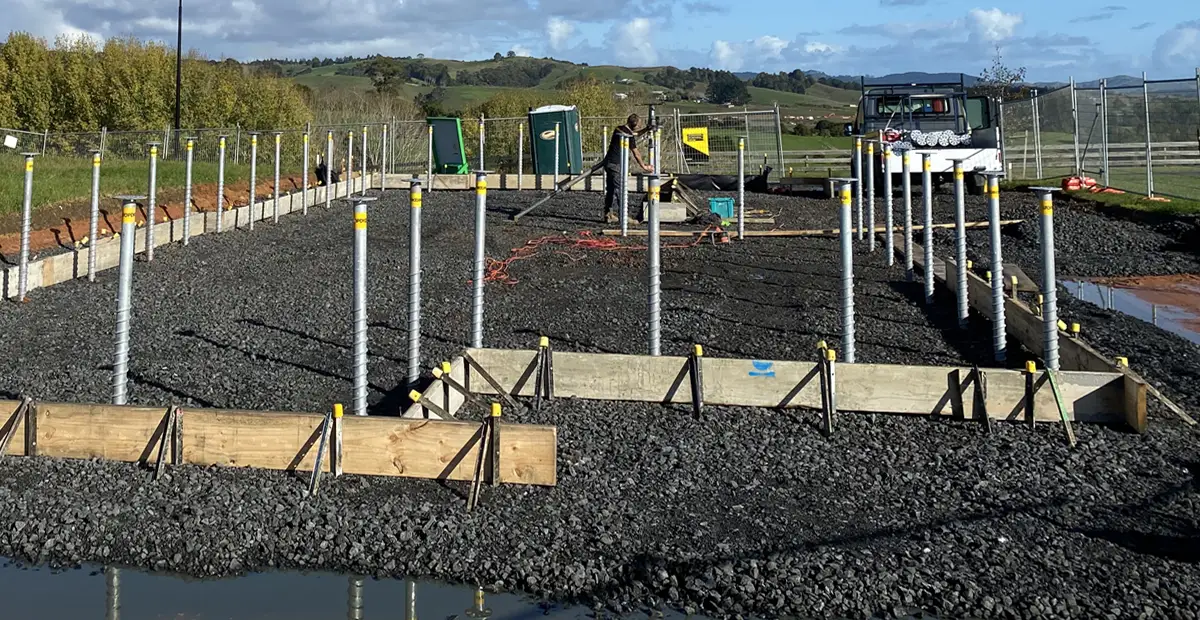
For lighter structures such as decks, the practical advantages can be especially apparent. Ground screws create little excavated spoil, can accommodate uneven terrain and allow framing to begin as soon as the installer finishes.
Galvanized steel designed for a long life
The SGC is made from S235 JR structural steel and hot-dip galvanized to ISO 1461. StopDigging also lists CE certification to EN 1090 and ISO 9001-certified manufacturing and installation processes.
The company estimates a minimum service life of 125 years under normal conditions, based on its experience and research. This is an estimated technical service life rather than a universal warranty. Soil chemistry, moisture, damage to the coating and the surrounding environment can all influence corrosion, which is why unusually aggressive sites may require a duplex-coated product or a separate corrosion assessment.
StopDigging also presents ground screws as a lower-impact alternative to concrete foundations. Its lifecycle assessment reports approximately 60% lower carbon emissions than a comparable concrete solution, while the steel can be recycled and, in suitable temporary projects, potentially removed and reused.
That figure will vary with the project boundaries, materials and transport involved. Ground screws still require manufactured steel, galvanizing and powered installation equipment, but they can reduce concrete consumption, excavation, soil disturbance and waste.
Pricing and availability
StopDigging does not publish a universal retail price for the SGC Adapter Screw. Projects are quoted through its regional installer network because the final cost depends on the screw size, quantity, adapters, soil, access, testing, engineering and local labor.
The company was founded in Sweden in 2012 and now works through installation partners in multiple countries. Customers can use its website to locate a regional installer and request a project-specific quotation.
The SGC is therefore less a single off-the-shelf product than a configurable foundation system. Its appeal is straightforward: it replaces a conventional poured footing with a precisely installed steel component that can carry a structure immediately. For the right site—and with the necessary engineering—it can make foundation work faster, cleaner and considerably less disruptive.
Source: StopDigging SGC Adapter Screw