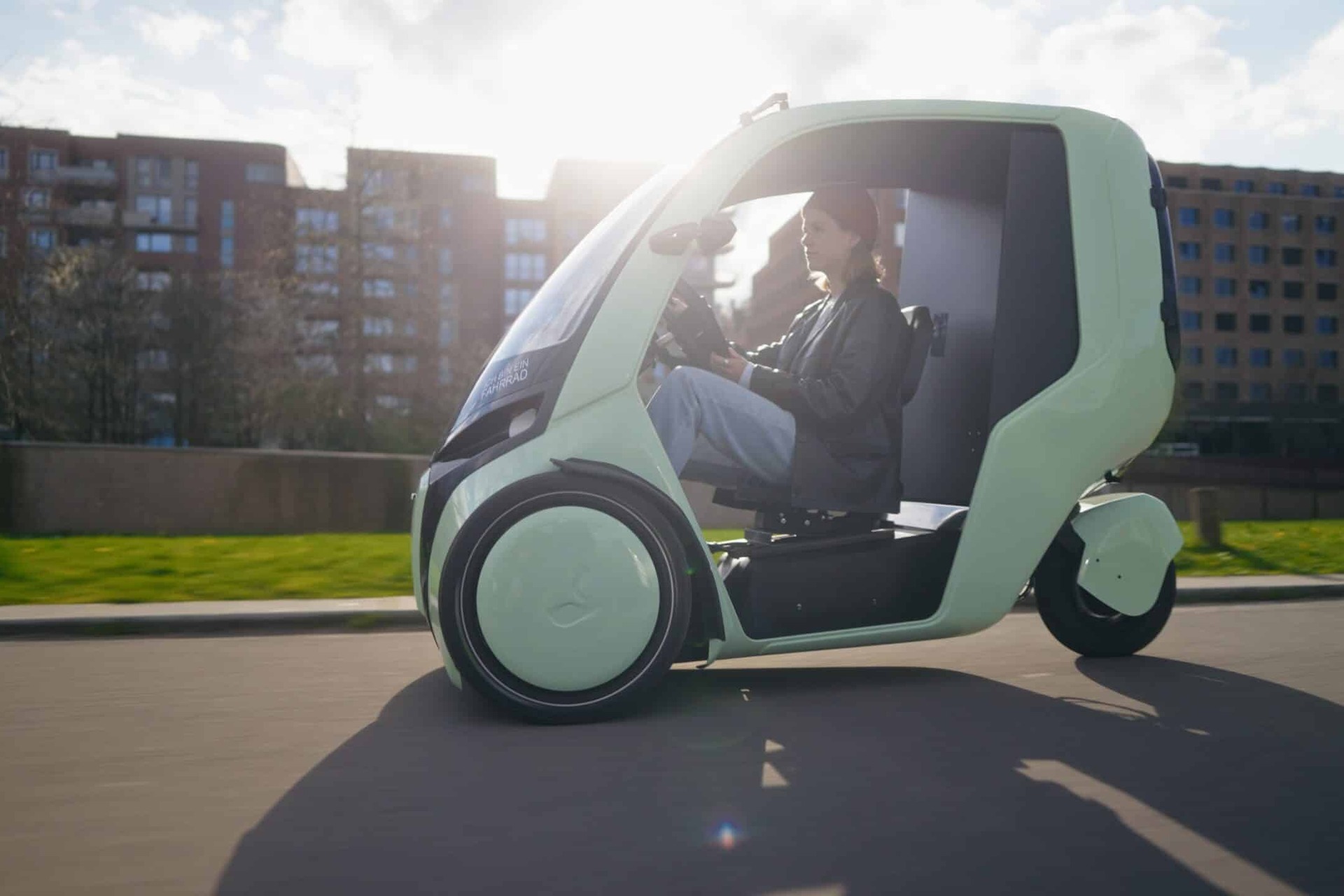
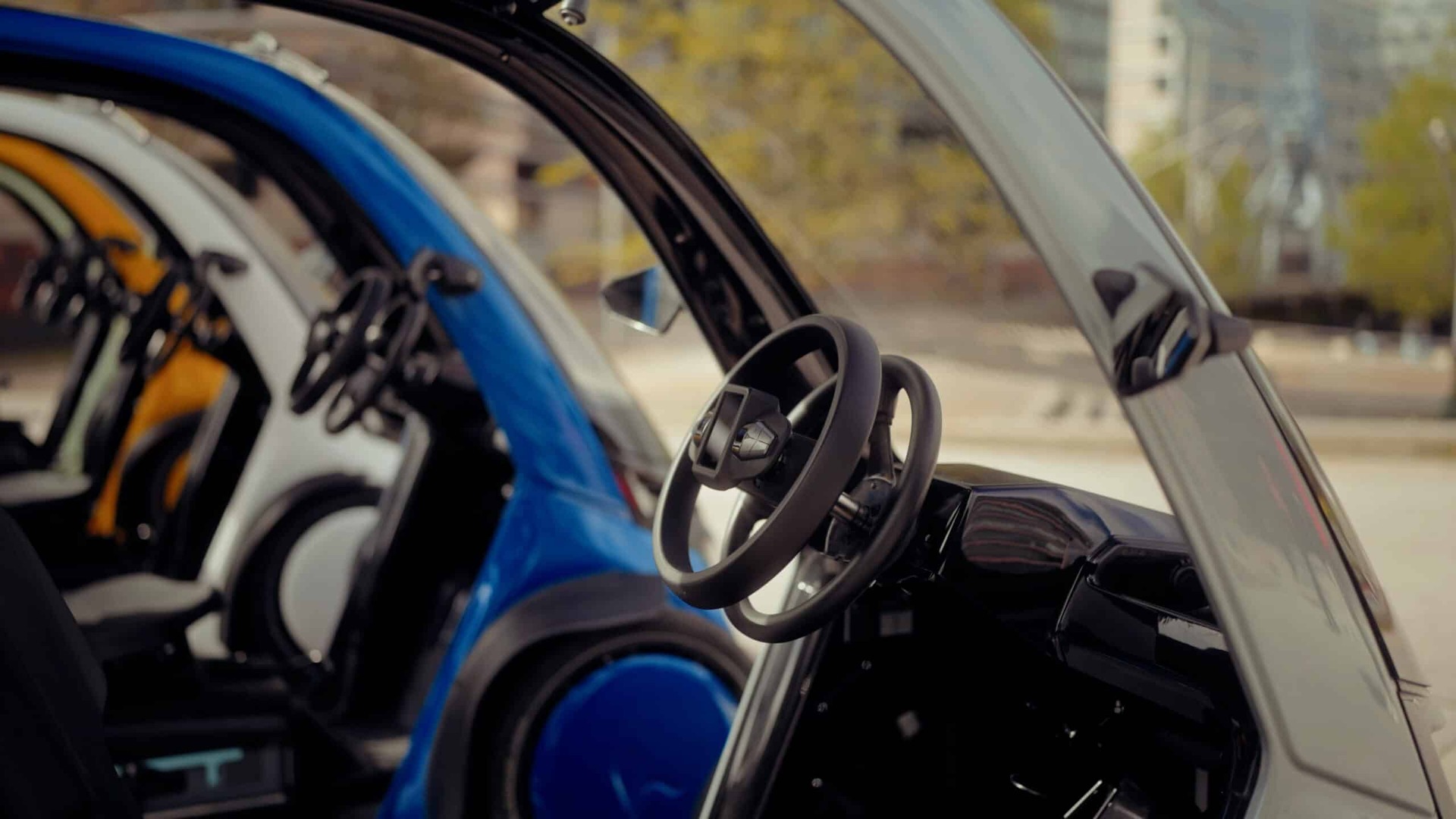
The HOPPER looks like a miniature car, complete with a roof, windshield, steering wheel and lockable trunk. Legally, however, the three-wheeler is an electric cargo bike—at least in its home market of Germany.
Its 25-km/h electric assistance keeps it within Germany’s pedelec category, allowing it to use cycle paths without a driving license or registration plate. Built for short urban journeys, it is available in passenger, cargo and dog-carrying versions and entered series production in 2025.
A tiny vehicle designed around city travel
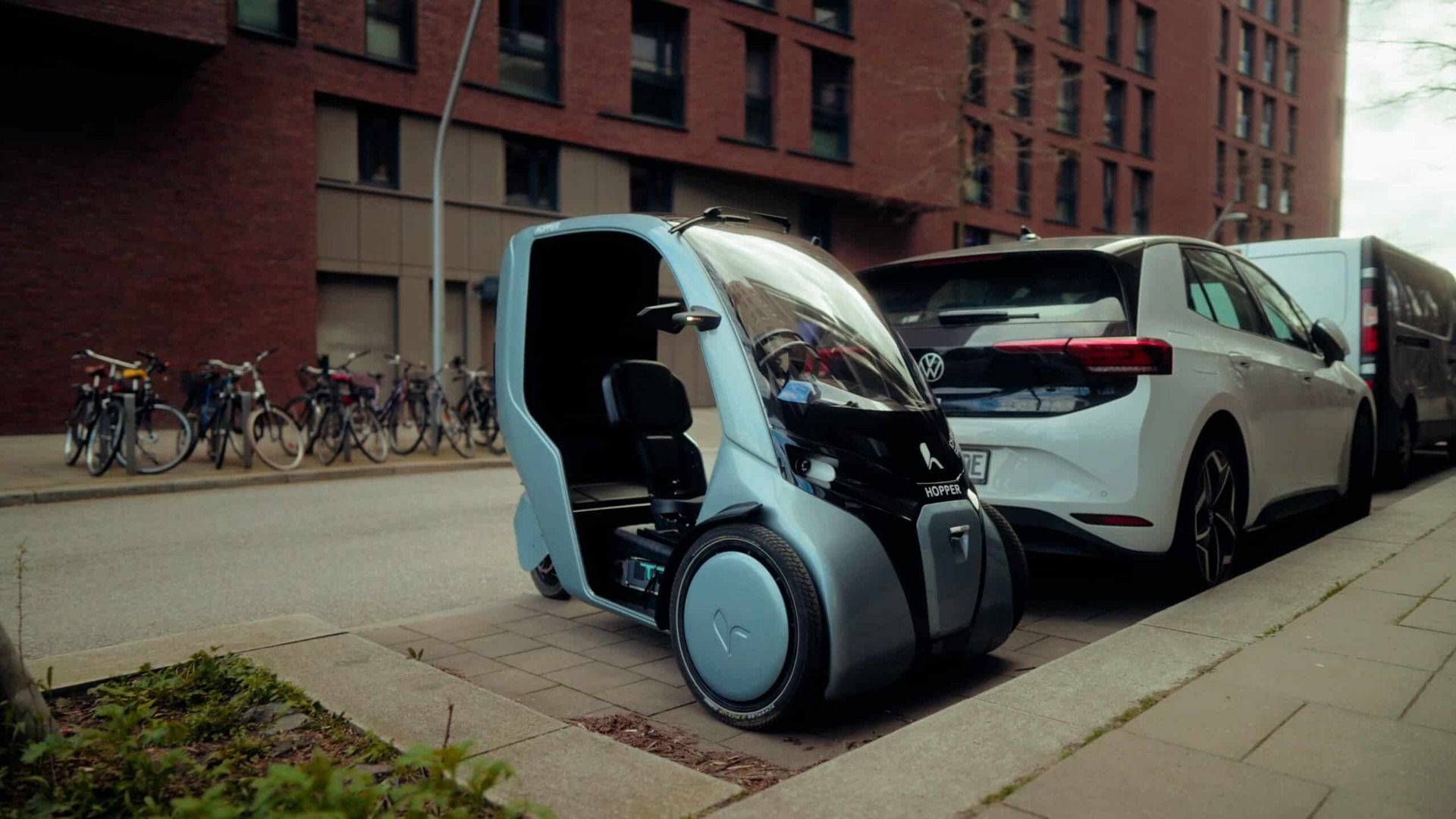
The HOPPER measures 212 cm long, 105 cm wide with its mirrors folded and 150 cm high. It is substantially smaller than a car, although its width is still worth considering on narrow cycle lanes and at access barriers.
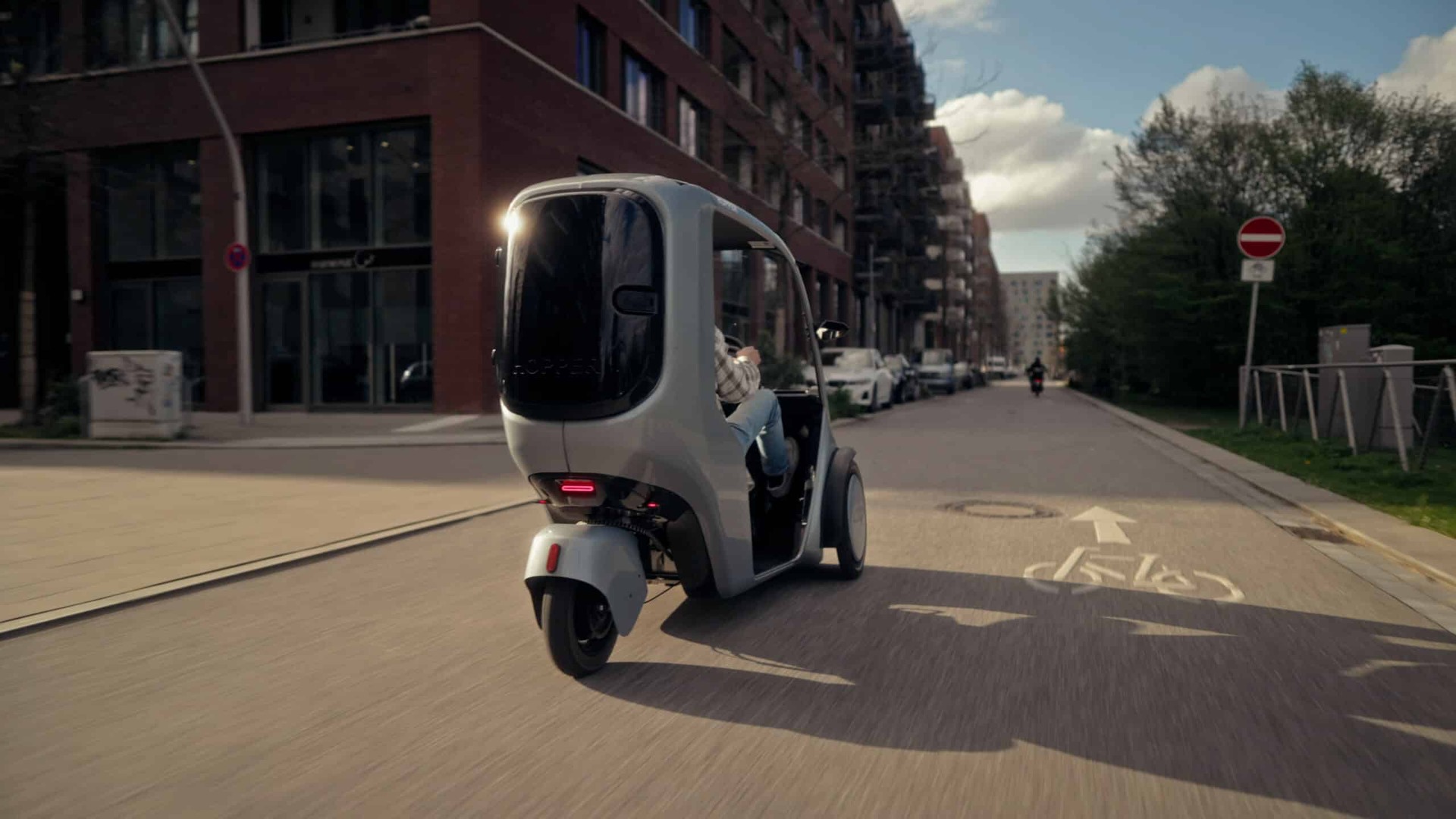
Two 20-inch cargo-bike wheels sit at the front, while a smaller 10-inch rear wheel handles propulsion and steering. Hopper Mobility says it can turn through 90 degrees, giving the vehicle an approximately two-metre turning circle.
The company recommends slowing to 10–12 km/h for ordinary corners and around 5 km/h for very tight turns. Its cornering behavior will not feel identical to a conventional two-wheeled bicycle.
Pedaling without a conventional chain
Instead of mechanically connecting the pedals to the driven wheel with a chain or belt, the HOPPER uses a pedal-by-wire system.
Pedaling operates a generator, while sensors measure cadence and instruct the rear hub motor to provide assistance. This removes the long mechanical drivetrain that would otherwise run through the body.
The Heinzmann hub motor is rated at 250 watts continuously, with a quoted 1,350-watt peak and 112 Nm of maximum torque. Assistance ends at 25 km/h (15.5 mph), while pedaling backward can command slow powered reversing.
There is one practical consequence of the pedal-by-wire arrangement: no direct mechanical connection exists between the pedals and rear wheel. If the battery becomes completely depleted, the HOPPER cannot simply be pedaled home under muscle power.
A large removable battery
Power comes from a removable 48-volt, 30-Ah AES Superpack battery with a capacity of 1,440 Wh. Hopper Mobility advertises up to 60 km (37 miles) per charge, although payload, terrain, temperature and assistance level will affect real-world range.
The standard charger takes approximately five to six hours, while an optional fast charger reduces that to about three hours. A second battery can be carried for longer journeys.
Hopper cites a battery-manufacturer estimate of up to 3,000 cycles at an 80% depth of discharge, translating to roughly eight to ten years depending on care and use.
Passenger, Cargo and Dog versions
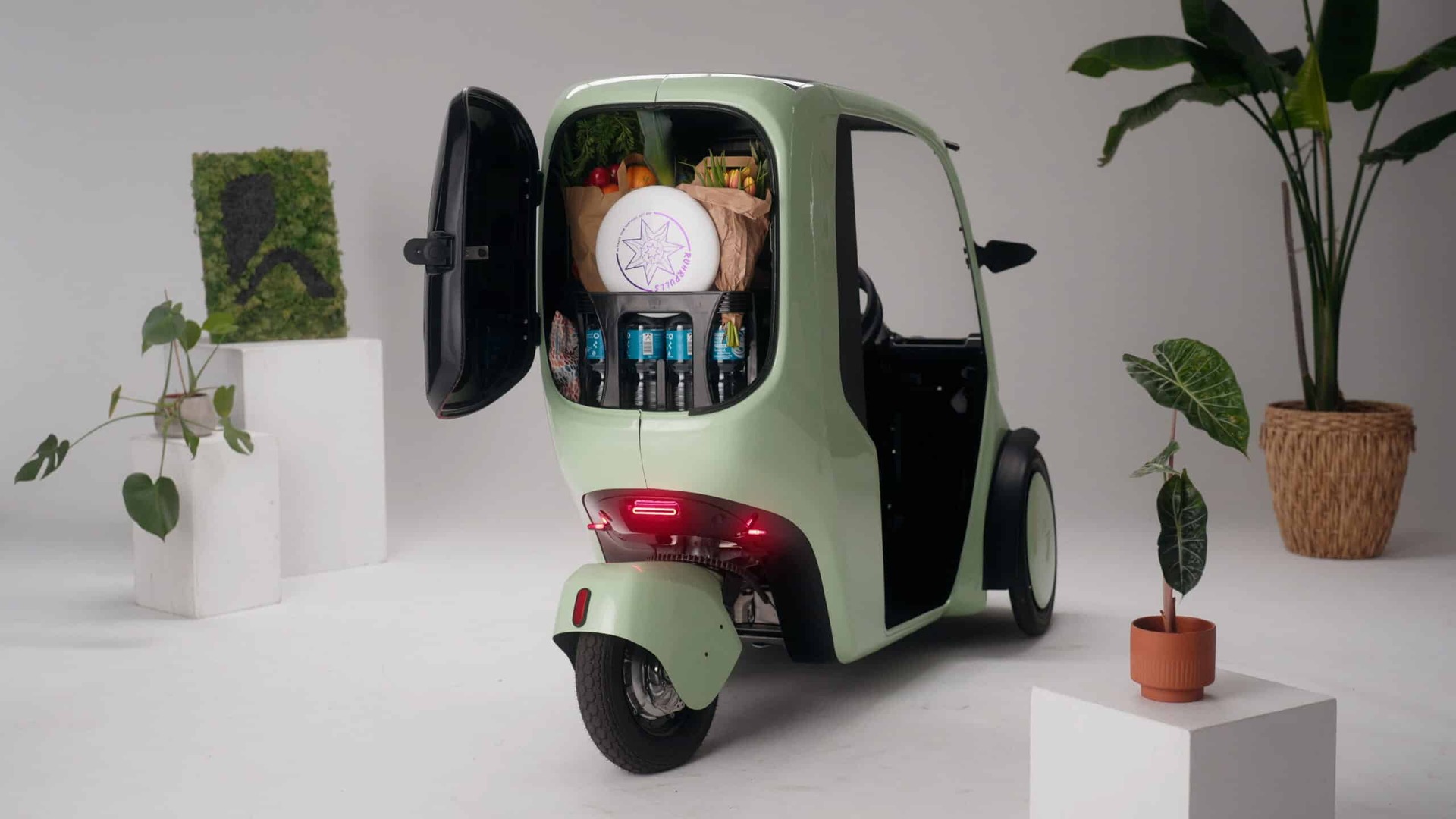
The Passenger HOPPER has a rear bench for one additional adult or two younger children, plus a separate 125-litre lockable trunk.

The Cargo HOPPER replaces the rear seat with around 280 litres of lockable space for shopping, equipment or deliveries.
The Dog HOPPER adds cushioning and a separating grille to the larger compartment. A retrofit kit can also convert the Cargo model.
Prospective family buyers should ask the company about its latest passenger-restraint setup. Although the rear seat is promoted for children, the current FAQ lists child-restraint straps among the accessories still being developed.
Weather protection without becoming a car
A rigid roof, windshield and front bodywork shelter the driver from much of the weather. Standard equipment includes a manual wiper, windshield heating and passive ventilation.
The sides remain open in the standard configuration. Optional removable side panels use zippered openings to create a more enclosed cabin, but they are flexible covers rather than rigid automotive doors. The listed heater warms the windshield, not the entire interior.
Other equipment includes a sprung adjustable seat, high beam, indicators, a brake light, mirrors, USB charging and a steering-wheel display. Mechanical disc brakes serve all three wheels.
The body offers useful weather protection and visibility, but the vehicle should not be described as providing automotive crash protection. It remains an electric bicycle rather than a miniature passenger car with airbags and a car-style safety cell.
Payload, parking and everyday ownership
Hopper Mobility’s latest FAQ gives a curb weight of approximately 155 kg and a permitted gross weight of 300 kg, leaving around 145 kg for people and cargo. Some shop specifications still show 140 kg and a 160-kg payload, so buyers should confirm the figure for their configuration.
In Germany, Hopper says the vehicle can park where bicycles are allowed, including on a sidewalk when at least 1.5 metres remains clear for pedestrians. Rules and legal classification should be checked in other countries.
Security measures include key-controlled starting, an optional display PIN, lockable battery and cargo compartments, and attachment points for bicycle locks. A GPS tracker is optional.
The cable-operated steering still contains two chains, which Hopper recommends cleaning and lubricating around every 1,000 km. The company says bicycle workshops with sufficient space can handle routine service.
From garage prototype to series production
The idea emerged in 2019, followed by a wooden and cardboard prototype built in co-founder Martin Halama’s garage. Halama, Philipp Herrmann and Torben Müller-Hansen founded Hopper Mobility in Augsburg in 2021.
After a 30-vehicle pilot series in 2023, the company moved its headquarters to Hamburg in 2024 and began series production in 2025. Vehicles are assembled in Hamburg and Schleswig-Holstein, predominantly using German and European suppliers. Hopper says financing is secured through 2027 as it works to expand production.
Pricing and availability
The Passenger HOPPER currently starts at €11,900 including VAT. The Cargo version starts at €12,300, while the Dog HOPPER starts at €12,900.
Optional equipment includes side enclosures for €690, colored bodywork for €490, a GPS tracker from €249 and a fast charger for €549. A replacement battery is listed from €1,790.
Ordering normally requires a €3,500 deposit, with the balance due before delivery. Full payment at ordering brings an €800 discount. German delivery costs approximately €190–€590; collection from the Hamburg production site is free.
The company currently quotes an estimated lead time of around ten months and accepts online vehicle orders only with German billing and delivery addresses. International buyers can contact Hopper Mobility while it works to establish partners outside Germany.
The HOPPER costs considerably more than a conventional electric cargo bike, but it tackles a different compromise. For urban users who do not need highway speeds, it combines pedelec rules and compact parking with a seat, steering wheel, useful storage and meaningful weather protection.
Source: Hopper Mobility