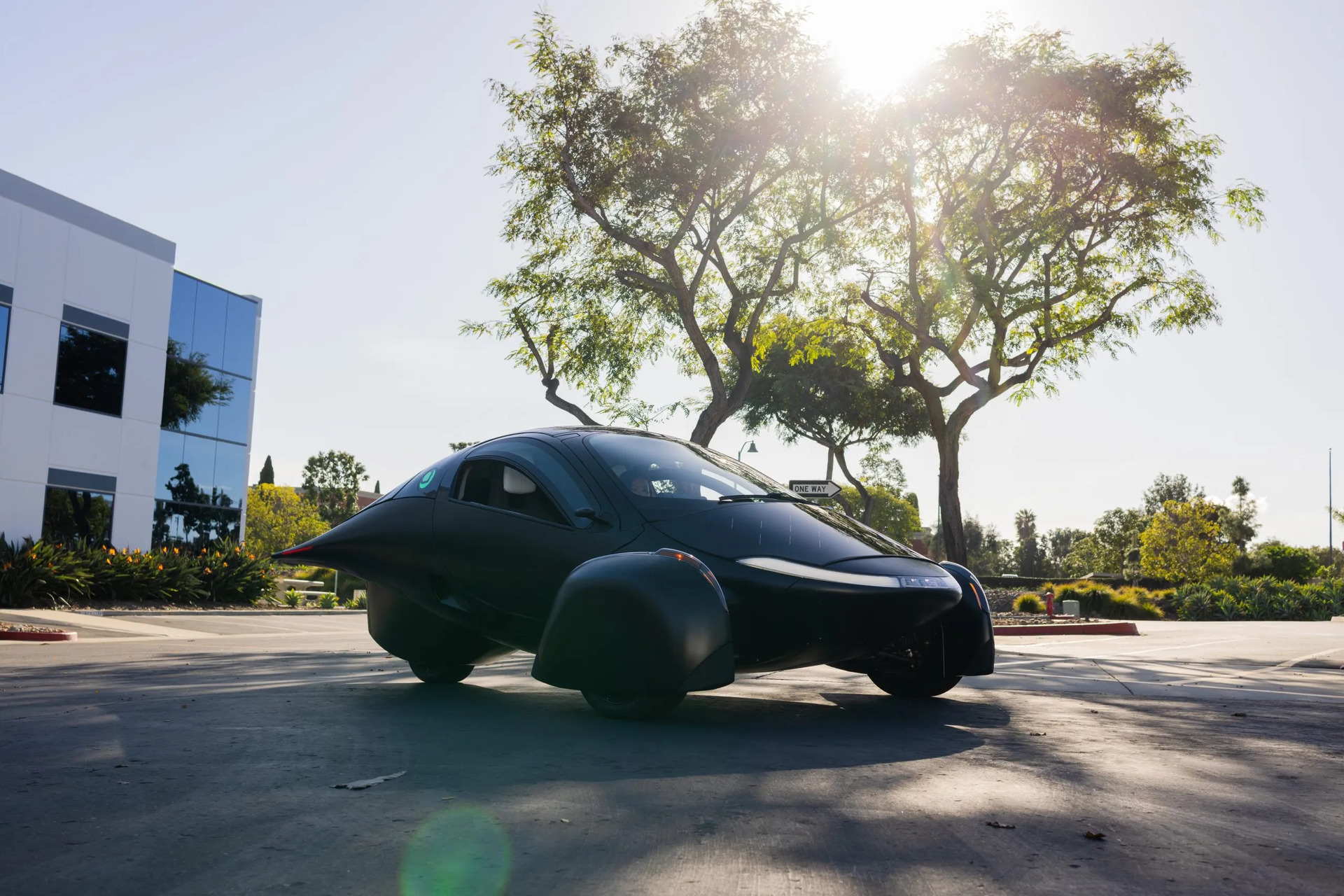
After years of prototypes, validation vehicles and production planning, Aptera has completed its first solar electric vehicle intended for sale to a customer.
The three-wheeler was built for Martin Hartono, CEO of GDP Venture and the top-ranked participant in Aptera’s Accelerator investment program. Finished in the customer-selected Noir matte-black exterior, it represents an important transition from internal test vehicles to a machine intended for private ownership.
There is, however, a distinction worth making: Aptera has completed the vehicle, but had not yet physically delivered it when the announcement was issued. The company still intends to complete the sale, title transfer, export and registration before sending it to Hartono outside the United States.
A milestone, but not yet mass production
Aptera describes the vehicle as its first production solar EV built for a customer. Its Accelerator program gave early investors priority positions based on the amount they invested, with Hartono occupying the first slot.
Completing one customer vehicle does not mean the company has begun high-volume deliveries. Aptera previously said it planned to start building its first 40 production vehicles before the end of 2026, with broader early deliveries expected in 2027, subject to financing, supplier performance and regulatory approvals.
The company reported more than 49,000 reservations at the end of September 2026. Converting those reservations into completed vehicles will require a considerably larger and more repeatable production operation than this first build.
Solar panels supplement plug-in charging
Aptera’s body integrates up to 700 watts of solar cells. The vehicle can still plug into an outlet or charging station like another EV, but the solar array is designed to add as much as approximately 40 miles (64 km) of driving per day under favorable conditions.
That figure depends on weather, season, location, parking orientation and vehicle efficiency. During independent testing in Southern California, TÜV Rheinland measured more than 4 kWh entering an Aptera battery on each of three test days. A vehicle left parked without repositioning collected 4.23 kWh, while other test arrangements produced 4.40 and 4.75 kWh.
Aptera translates that energy into driving distance using its targeted consumption of 100 Wh per mile. The solar energy was measured; the corresponding mileage remains an estimate until production-vehicle efficiency and range are independently established.

The Launch Edition is designed around a 44-kWh battery and an estimated 400-mile (643-km) range. Other published targets include front-wheel drive, two seats, 32.5 cu ft (920 L) of cargo space and acceleration from zero to 60 mph in under six seconds. Aptera continues to state that specifications remain subject to validation and change.
Regulation and production remain the next tests
Aptera received an EPA Certificate of Conformity for the 2026 Launch Edition in June. The company has said it must also complete the remaining applicable safety and regulatory requirements before beginning normal US sales.
Its latest financial filing also makes clear that production remains dependent on additional funding. Aptera estimated that it needed approximately $25 million to reach the start of series production and substantially more to scale output to hundreds of vehicles per month.
Pricing and availability
Aptera currently targets approximately $40,000 for the 400-mile Launch Edition. Its broader planned range has previously been priced between $28,000 and $55,000, depending on battery capacity and configuration.
For reservation holders, the Noir vehicle is an encouraging sign that the long-running project is moving beyond validation builds. The more significant test will be whether Aptera can complete the export and handover, satisfy remaining regulations and turn this one finished vehicle into a steady sequence of customer deliveries.