

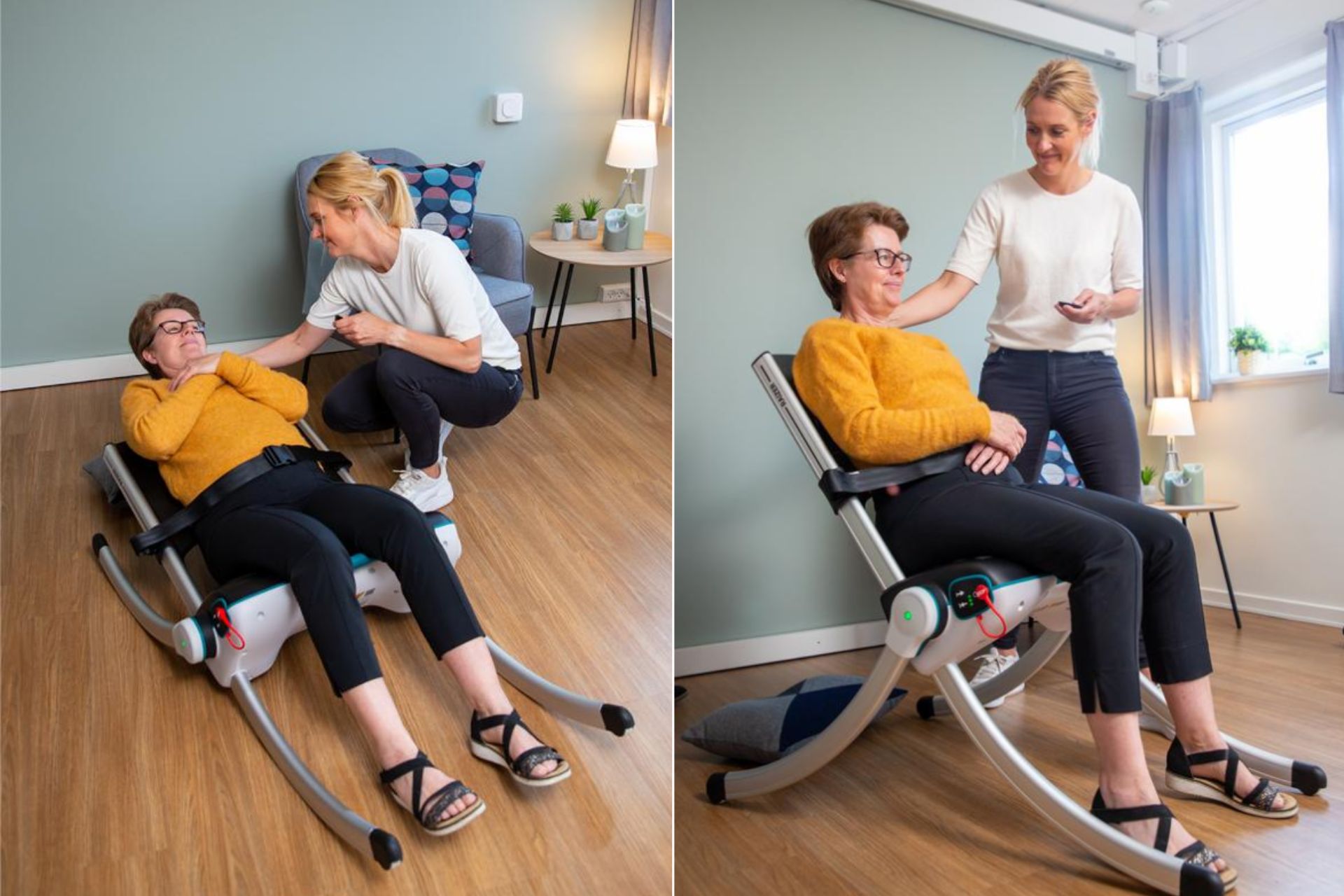
When an elderly person falls at home and can’t get up on their own, the choices facing a caregiver are rarely good ones. Calling 911 for a non-emergency means tying up emergency services and sometimes waiting hours for help to arrive. Attempting to lift someone manually — especially across a significant weight or size difference — risks serious injury to both the person on the floor and the person trying to help. And leaving someone lying on hard flooring while waiting for backup creates its own set of complications.
LiftUp, a Denmark-based medical device company, designed the Raizer line of portable lifting chairs specifically for this scenario. The system assembles around a fallen person in pieces — without requiring them to move significantly — then raises them to a seated position in seconds. Two models are currently available: the battery-powered Raizer II and the manual Raizer M, which uses a hand crank. Both share the same modular design and 330-pound weight capacity, but differ in their lifting mechanism, weight, and price point.
How the Raizer works
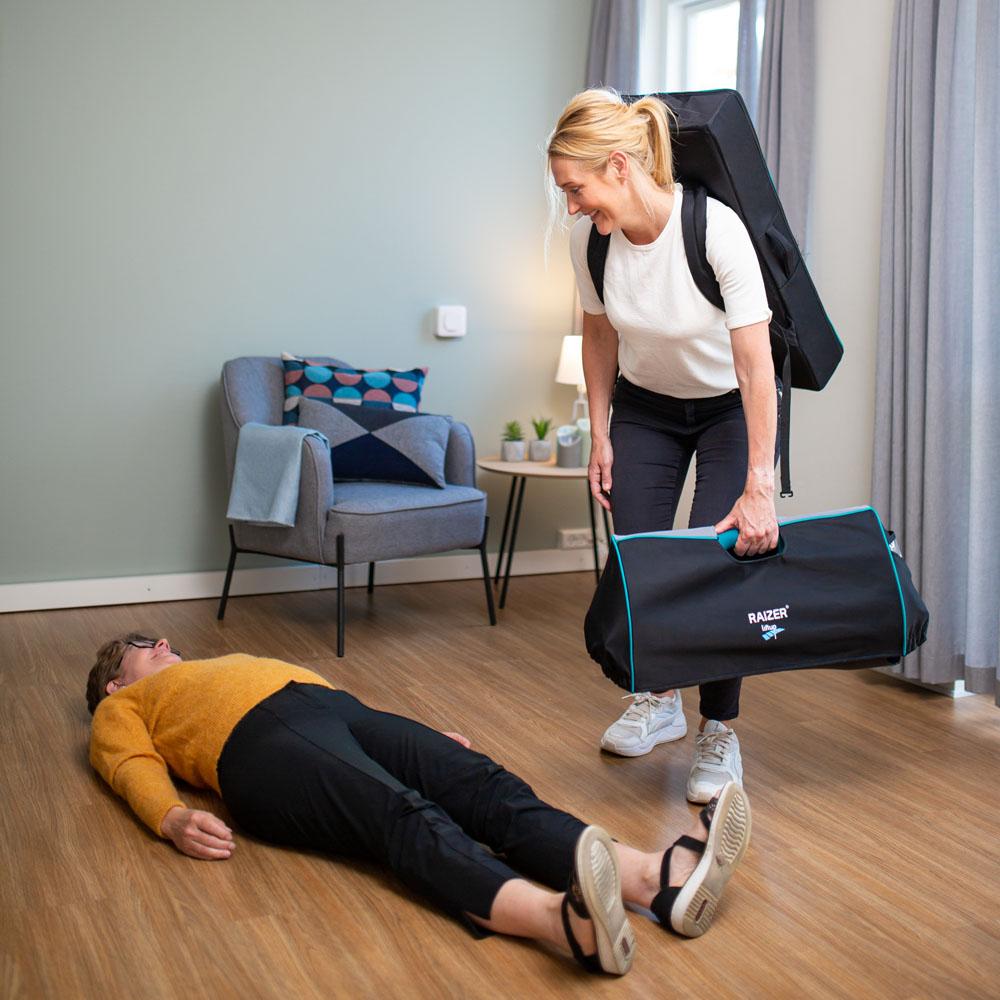
The core design of both models is the same. The Raizer breaks down into seven separate pieces: a main seat unit, two backrest sections, and four leg pieces. When someone falls, a caregiver slides the main seat underneath the person’s knees and fastens a safety belt low across the hips. From there, the leg and backrest pieces are attached one at a time — a process that allows the fallen person to be shifted gently to the side to slot the backrest sections into place, rather than needing to be fully lifted off the floor first.
Each component clicks into place with an audible beep to confirm a secure connection, giving the caregiver a clear signal that the assembly is correct before beginning the lift. Once all seven pieces are in position and the safety belt is secured, the lifting begins — either via remote control on the Raizer II or via hand crank on the Raizer M.
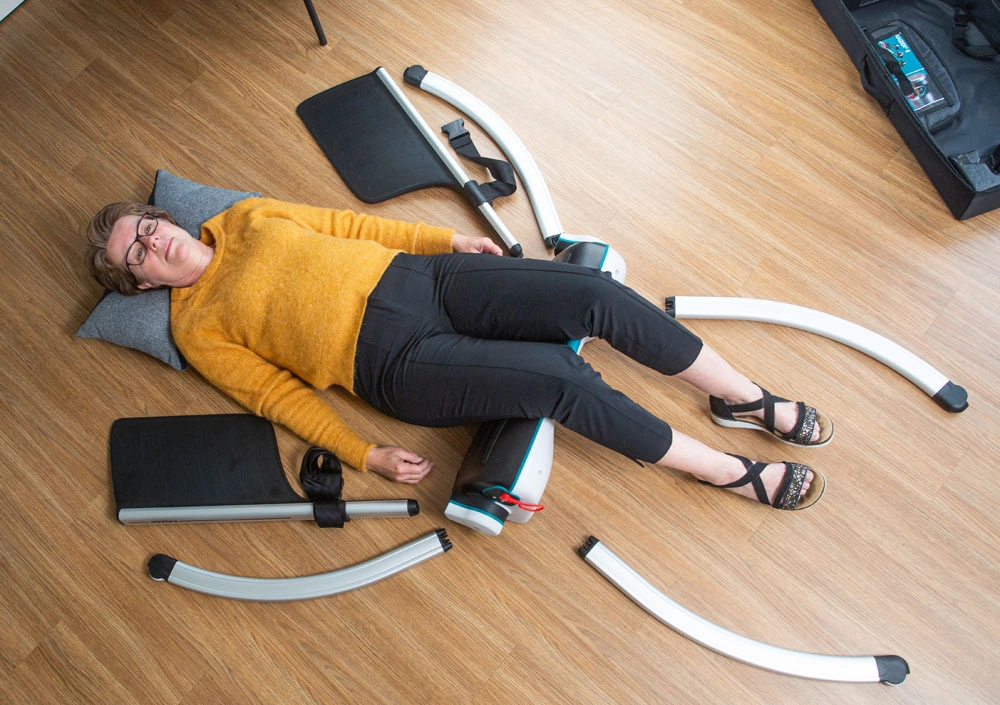
The design means the person on the floor doesn’t need to crawl into a position, use upper body strength, or participate actively in the process. The person who has fallen does not have to move or slide into any position — the chair builds itself around them.
The Raizer II: Battery-powered, remote-operated
The Raizer II is the powered version of the system. It operates with the touch of a button and lifts a fallen person to a seated or nearly standing position in approximately 20 to 30 seconds, once the lift is activated.
The battery delivers up to 40 full lifts per charge at maximum weight capacity, with a full recharge taking approximately six hours. The charger supports 100–240V AC input as well as a 12V car adapter, making it practical for use in vehicles or in settings without consistent access to a wall outlet. The Raizer II can be charged inside any vehicle, which has made it a viable option for ambulance crews and community falls response teams in addition to home caregivers.
The complete package includes a rechargeable battery, a 110V battery charger, a USB charger cable, a 12V car adapter, a remote control, a safety belt, a seat cover, a carrying case, a sample pack of hygiene covers, a quick start guide, and a user manual.
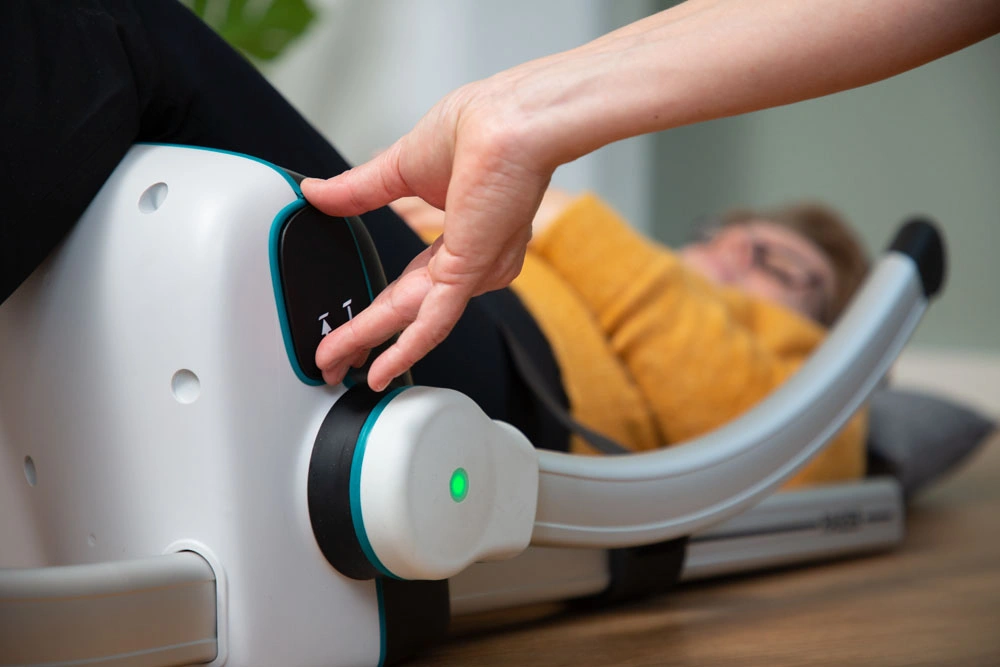
The seat measures 27 inches wide, 10.1 inches deep, and 7.5 inches high. Total system weight is 28 pounds — 18.7 pounds for the seat unit and 9.3 pounds for the legs and backrest pieces.
A trolley and wall bracket kit for storage are available separately.
The Raizer M: Manual, no batteries needed
The Raizer M covers the same basic function using a hand crank instead of a motor. The Raizer M does not require electricity or batteries, which makes it simpler to maintain and eliminates any concern about a depleted battery at a critical moment.
The crank is turned to lift the person, and the Raizer M uses a lightweight crank as a manual patient lift so there’s no need to worry about running out of batteries or finding a plug. The crank handle can be inserted from either side of the seat, which allows operation in spaces where room on one side is limited — relevant in tight hallways, bathrooms, and bedrooms.
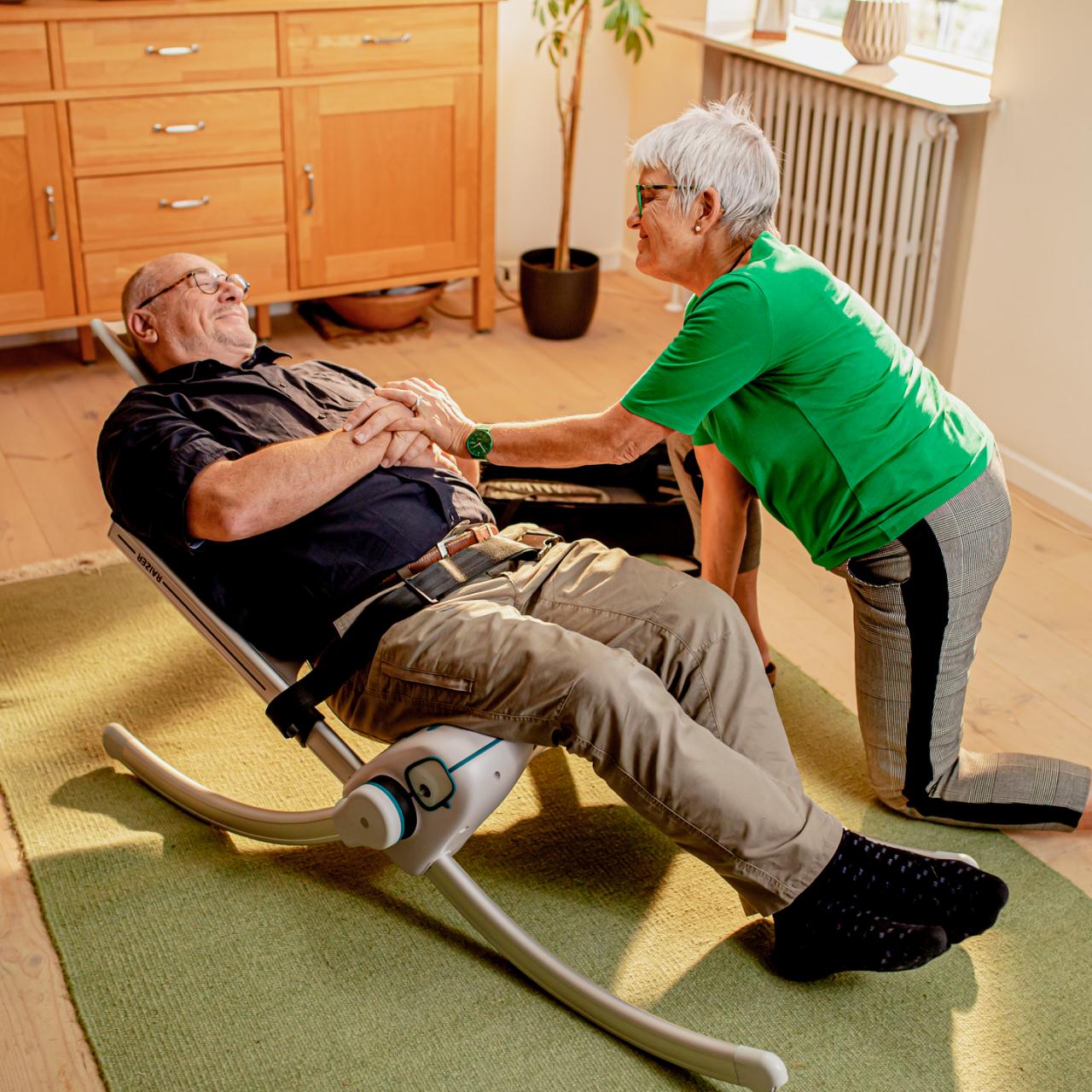
When fully assembled and cranked up, the floor-to-seat height is 26 inches. Total system weight is 27.4 pounds — 15.9 pounds for the seat unit and 11.5 pounds for the legs and backrest. The Raizer M Lifting Chair and a free carrying case ($155 value) are currently included together.
Dimensions when standing fully assembled are 21.26 x 34.65 x 50.16 inches. When laid flat for storage or transport, the footprint is 52.05 x 34.65 x 10.91 inches.
What both models share
Beyond the lifting mechanism, the Raizer II and Raizer M are nearly identical in design. Both carry a 330-pound weight capacity, use the same seven-piece modular assembly with color-coded, snap-together connections, have smooth surfaces that can be wiped down and disinfected, and come with a two-year warranty covering manufacturer defects.
Both models are designed to be operated by a single caregiver, reducing the physical strain typically associated with manual lifts. No physical effort is required to operate the Raizer II, so there is significantly less risk of musculoskeletal injury to caregivers — a meaningful consideration given that back and shoulder injuries from manual patient handling are among the most common occupational injuries in caregiving roles.
Both models can be used in compact spaces including bathrooms and small bedrooms, where larger ceiling or sling lifts can’t be positioned.
Who uses it
The Raizer is used in home care settings, by professional caregivers, by occupational therapists, and by emergency services in several countries. Kohll’s Rx was the first U.S. distributor of this internationally recognized and awarded product, which is made by Denmark-based LiftUp.
User feedback in the U.S. has consistently centered on a few themes: the ability to avoid calling emergency services for non-emergency falls, reduced anxiety for at-home caregivers caring for elderly spouses or parents without outside help, and the relatively low physical effort required to operate both versions.
One buyer from Newton, NC — an elderly woman caring for her 84-year-old husband — described the Raizer II simply: “Any time I can get him off the floor without calling 911 is a blessing… He just has to lay on his back and I put it together around him.”
Another reviewer, a primary caregiver for a 90-year-old mother with limited mobility, wrote: “I tested it out as soon as I got it. It was simple to put together and easy to use. I feel like we’ll be OK when she falls again.”
Users with Medicare Part B may be eligible for reimbursement on the Raizer M. Buyers are advised to contact the retailer directly for claim forms and eligibility details.
Pricing and availability
Neither model is listed with pricing on LiftUp’s official website. Based on current U.S. retailer listings, approximate pricing is as follows:
At the time of this writing, the Raizer M is available for around $1,850, and includes a free carrying case. The larger Raizer II is priced at approximately $4,995. Optional accessories — such as a headrest ($163), replacement safety belt ($36.50), trolley ($266), extra remote control ($242), and battery charger ($212) — are sold separately.
Both models are available through specialty medical equipment retailers in the United States, as well as through Amazon. The company ships internationally.
Product page: Raizer


