

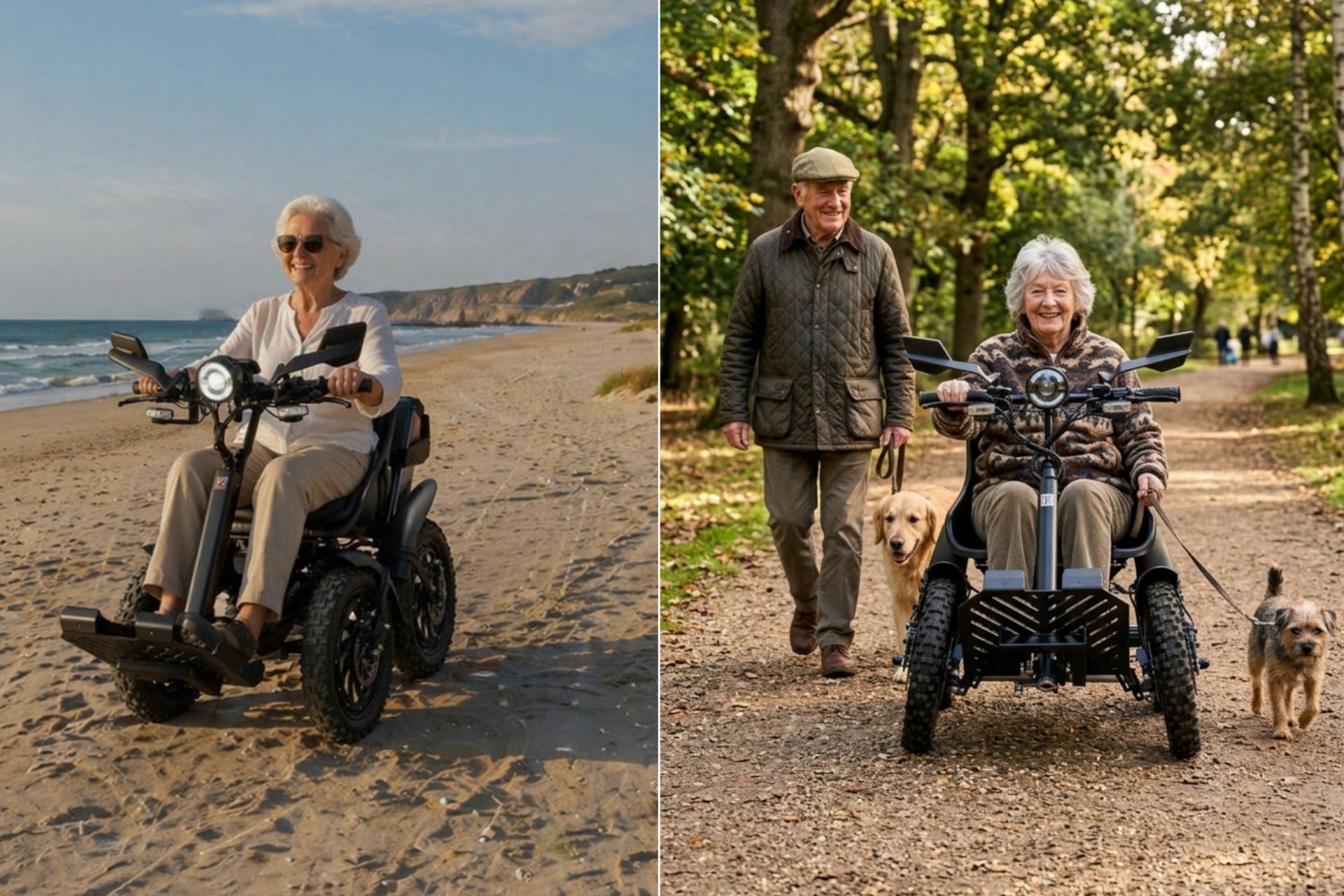
For decades, powered mobility scooters have largely followed the same formula: small wheels, a compact seat, and a design intended for smooth floors, sidewalks, and paved paths. The Zoomability Zoom 2.0, developed by Swedish manufacturer Zoomability AB, takes a different approach. With permanent four-wheel drive, four hub motors, and large off-road tires, it is designed to tackle terrain that conventional mobility devices often struggle with, including beaches, forest trails, gravel roads, grass, snow, and mud.
Launched in 2026, the Zoom 2.0 is the company’s biggest update yet, building on the original Zoom Uphill platform, which has been used by more than 1,000 customers across 17 countries.
Four-wheel drive built for uneven terrain
The Zoom 2.0’s standout feature is its permanent symmetrical four-wheel-drive system. Instead of relying on a single drive axle, each wheel is powered by its own three-phase hub motor in a “0-gear” configuration, eliminating the need for a conventional gearbox.
Each motor delivers up to 1,000 watts and 58 Newton-meters (Nm) of torque, giving the vehicle a combined peak output of 4,000 watts (4 kW) and 232 Nm across all four wheels.
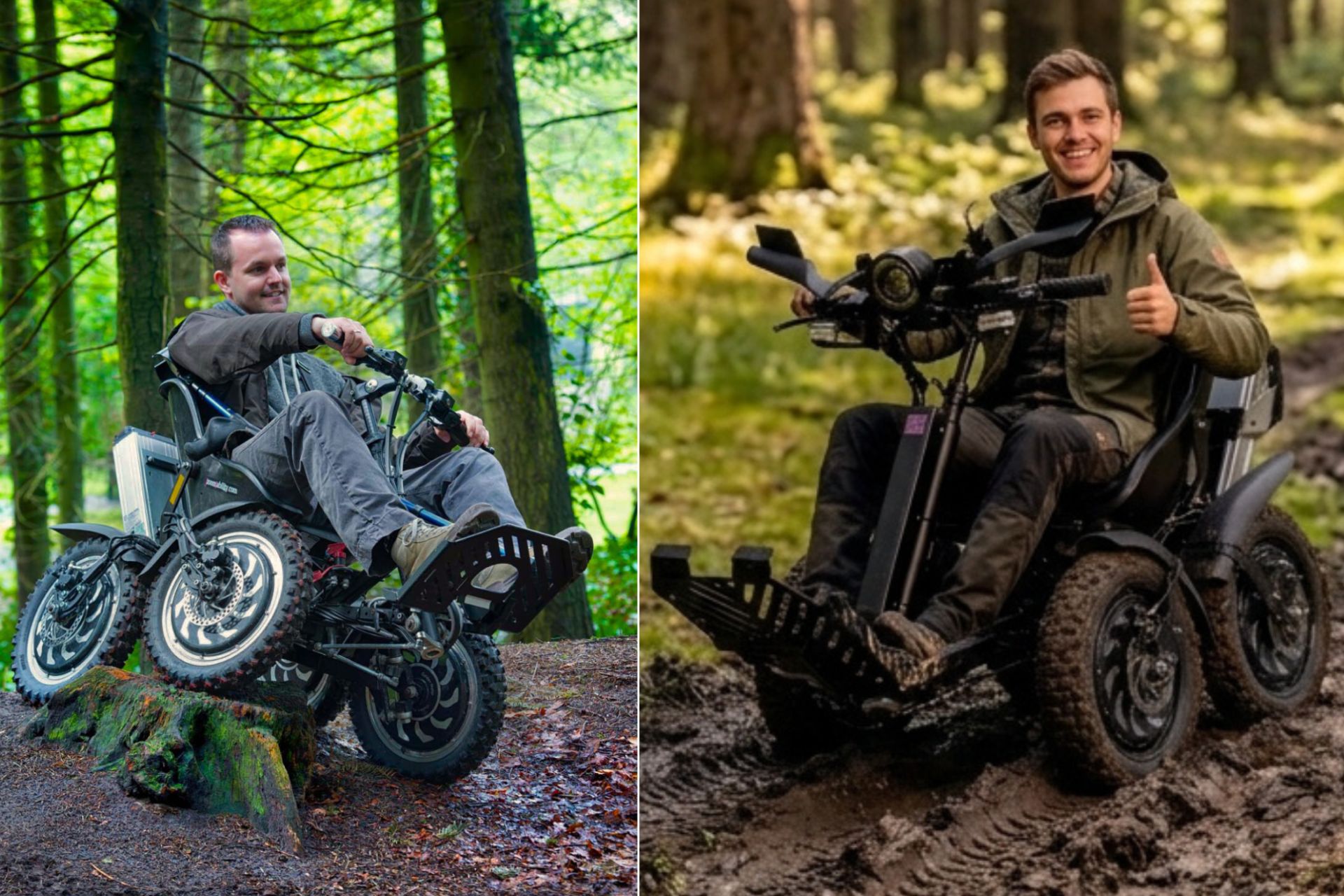
Just as important as the motors is the vehicle’s patented chassis. The frame is designed to keep all four wheels in contact with the ground as the terrain changes, helping maintain traction over rocks, roots, ruts, and uneven surfaces where conventional mobility scooters can lose grip or become unstable.
Speed, battery, and range
The Zoom 2.0 reaches a top speed of 20 km/h (12.6 mph) and accelerates from 0 to 20 km/h in under two seconds. Riders can also choose slower speed settings of 10 km/h (6.3 mph) or 5 km/h (3.1 mph), making it suitable for both open trails and busy pedestrian areas.
Power comes from two 48-volt, 20Ah lithium iron phosphate (LiFePO₄) battery packs. This battery chemistry is known for long service life and improved thermal stability, with Zoomability rating the packs for more than 800 full charging cycles.
Under ideal conditions, the company claims a maximum range of up to 80 km (50 miles) per charge, although actual range depends on terrain, weather, rider weight, and driving style. Recharging takes approximately two to four hours, while a display integrated into the handlebars provides battery level and speed information.
Designed for stability and accessibility
Several design features focus on making the Zoom 2.0 easier to operate and transfer into.
When the rider releases the throttle, the vehicle automatically brakes and can hold its position on hills without requiring the rider to apply a manual brake. Users who prefer conventional control can disable the automatic braking function.
The vehicle’s low-mounted frame creates a low center of gravity, helping improve stability on uneven ground and side slopes.

A rotating seat simplifies getting on and off the vehicle, while folding handlebars reduce the storage footprint and make transfers easier. Standard equipment also includes rear-view mirrors and turn signals.
The steel-frame vehicle weighs approximately 128 kg (282 lbs). Although considerably heavier than a typical powered wheelchair, Zoomability says two people can load it into an SUV, pickup truck, or trailer, with optional aluminum loading ramps available for easier transport.
Despite its off-road capability, the Zoom 2.0 remains narrow enough to fit through standard doorways and navigate many urban pathways.
Built for outdoor adventures
Rather than replacing an indoor power wheelchair, Zoomability positions the Zoom 2.0 as a mobility vehicle for outdoor exploration.
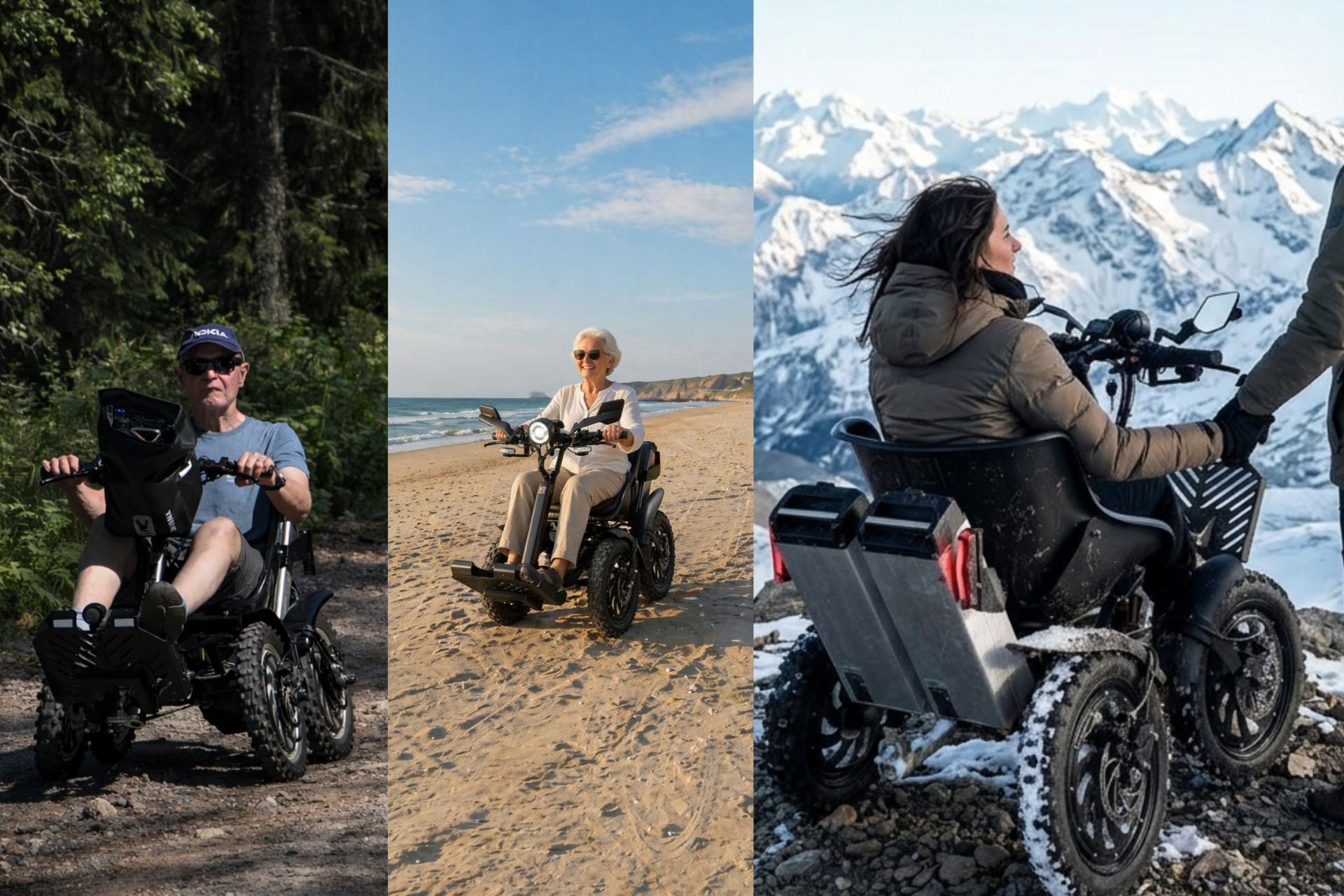
Company demonstrations show it travelling across beaches, forest trails, gravel roads, grassy parks, and city sidewalks. The goal is to help people with limited mobility reach places that are often inaccessible with conventional mobility scooters while still providing a compact vehicle that can be transported in a passenger vehicle.
According to Zoomability, the United States is its largest market, followed by Sweden, the Netherlands, and Italy. The company currently sells the vehicle in more than 17 countries.
Customer experiences
Several customer stories published by Zoomability highlight how the vehicle has changed day-to-day mobility.
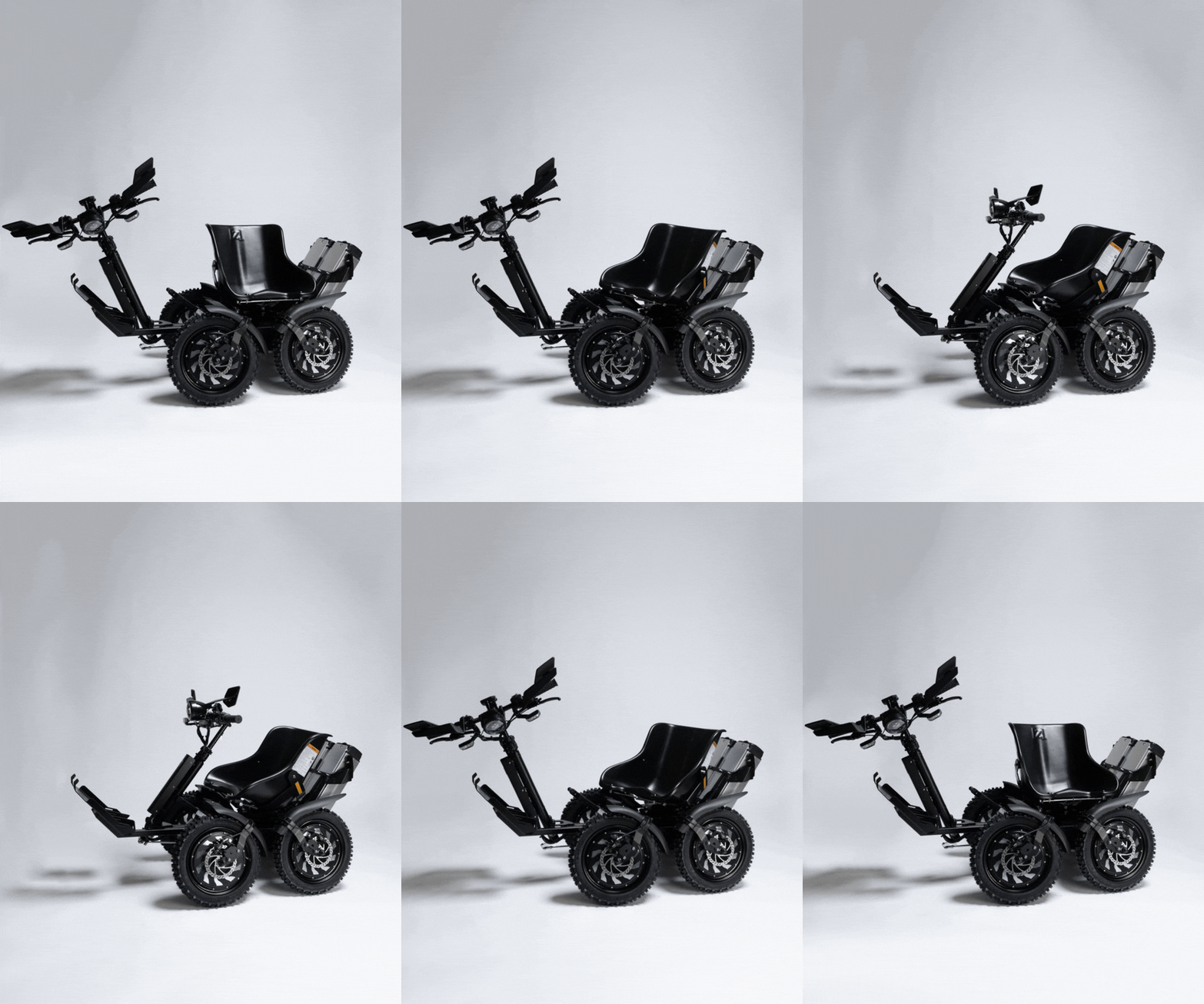
One user, who has lived with a spinal cord injury for 19 years, said years of avoiding mud, soft ground, and icy conditions came to an end after switching to the Zoom. She now regularly drives across rough sheep pastures and says she often returns home covered in mud—but smiling.
Other customers describe the vehicle as life-changing, with many highlighting the freedom to access outdoor locations they previously avoided.
Things to consider
While the Zoom 2.0 offers capabilities beyond those of most conventional mobility scooters, there are a few practical considerations.
At 128 kg (282 lbs), it is significantly heavier than many powered wheelchairs, so loading it into a vehicle may require assistance or optional ramps.
Its advertised range of up to 80 km (50 miles) represents ideal conditions. Steep hills, soft terrain, cold weather, heavier loads, and higher speeds will reduce the achievable distance, as acknowledged by the company.
Pricing and availability
Zoomability does not publish an official retail price for the Zoom 2.0. Instead, the vehicle is sold through an international network of authorized dealers, with pricing varying by country, taxes, shipping costs, and dealer policies.
At the time of writing, U.S. dealer Living Spinal lists the Zoom 2.0 at US$16,500, although prices may differ between dealers and regions.
Interested buyers can locate their nearest authorized dealer through Zoomability’s website.
Bottom line
The Zoomability Zoom 2.0 fills a niche between traditional powered mobility scooters and much larger specialist off-road vehicles. Its permanent four-wheel-drive system, four hub motors, patented articulating frame, and claimed range of up to 80 km (50 miles) are all aimed at helping users confidently travel across terrain that would normally be difficult or impossible to navigate with conventional mobility equipment.
It is a premium product, and its weight means transporting it isn’t as effortless as a standard mobility scooter. However, for people who want to explore beaches, parks, trails, and other outdoor environments without giving up the convenience of a compact electric mobility vehicle, the Zoom 2.0 offers a combination of off-road capability and everyday practicality that remains uncommon in the mobility market.
Source: Zoomability

 range to tackle beaches, trails, gravel, and other off-road terrain.)