Holding an umbrella is hardly the greatest inconvenience in modern life, but Canadian maker John Xu decided it was a problem worth solving—with a drone.
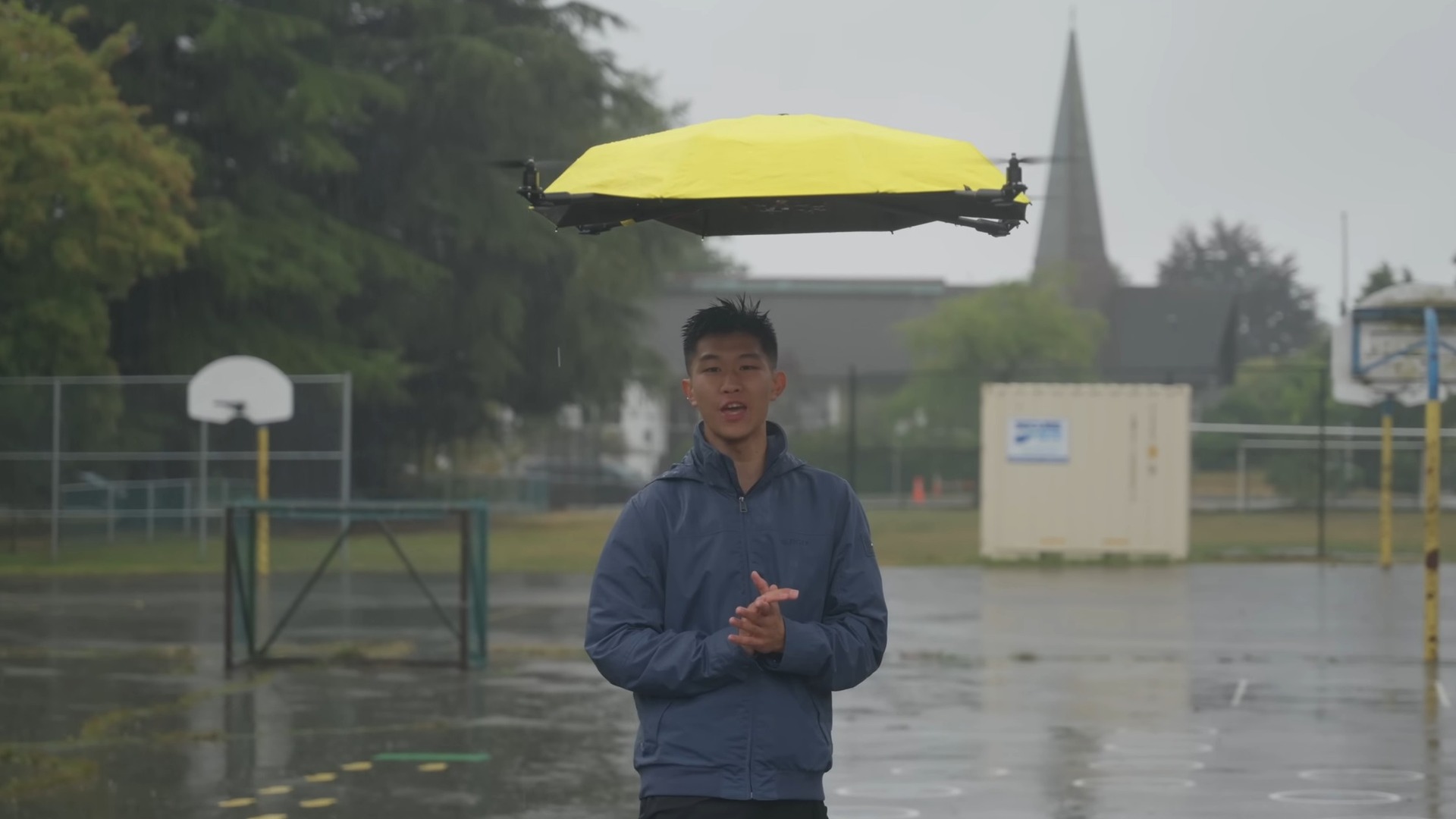
Xu, who runs the I Build Stuff YouTube channel, has created an experimental flying umbrella that can hover over a person and follow them without a handheld controller.
The current machine, called Flying Umbrella 2.0, combines the canopy of an ordinary umbrella with a custom-built quadcopter, a depth-sensing camera, onboard computing and an autonomous flight-control system.
It is a genuine functioning prototype, and Xu’s footage shows it following a user outdoors and operating during heavy rain. It is not, however, a commercial product—and the project still faces some rather obvious practical limitations.
The first version needed a pilot
Xu demonstrated his original drone-powered umbrella in 2024. That version proved that a sufficiently powerful custom quadcopter could lift an umbrella and keep it hovering overhead.
There was one major problem: somebody still had to fly it with a radio controller.
Instead of freeing the user’s hands, the umbrella effectively replaced its handle with a more complicated set of controls. Viewers repeatedly suggested that the drone should simply follow the person beneath it.
Xu subsequently began developing an autonomous second version. The mechanical design also had to remain portable, so the updated drone uses a custom central frame with folding arms. Several structural parts were 3D printed using carbon-fiber-filled nylon to provide rigidity without adding excessive weight.
GPS was not accurate enough
Keeping an umbrella roughly near somebody is not sufficient. To provide meaningful rain protection, the drone needs to remain positioned directly above the user as they change direction and speed.
Xu initially investigated GPS-based tracking, but ordinary GPS could drift by several metres. That margin of error might be acceptable for following a vehicle at a distance, but it is far too large for an umbrella attempting to cover one person.
The eventual solution was a time-of-flight depth camera mounted beneath the aircraft.
Rather than recording only a conventional two-dimensional image, the sensor emits light and measures its return to estimate the distance of surfaces below it. The resulting depth information creates a three-dimensional representation of the scene and can work in low-light conditions.
A Raspberry Pi processes that information, identifies the person beneath the drone and calculates their position. Those coordinates are passed to the flight controller, which moves the quadcopter in an attempt to remain centered overhead.
This approach does not require the user to carry a GPS transmitter or operate a remote control.
It follows—but not perfectly
Xu’s completed prototype can take off, hover and respond as the person below it walks around. The video also demonstrates it flying in substantial rain while maintaining enough control to provide overhead coverage.
That demonstration should not be mistaken for a weatherproofing certification. Water and exposed electronics are a difficult combination, and Xu has not presented the umbrella as a certified all-weather consumer drone.
The tracking system is also not perfect. The aircraft can drift away from the ideal position, particularly when the user moves suddenly or environmental conditions disturb the drone.
Wind is an especially significant challenge. An umbrella is deliberately designed to catch a large area of falling rain, but that same surface can act like a sail in a gust. The flight controller and motors must continually counter both the canopy’s aerodynamic forces and the movement of the person below.
There are further issues involving rotor noise, battery endurance and public safety. Four exposed propellers hovering close to a person’s head would require considerably more protection and redundancy before the idea could be considered suitable for everyday use.
Local drone rules could also restrict where such a device may operate, particularly near other people, roads, buildings or crowded public spaces.
For now, Flying Umbrella 2.0 is best understood as an inventive personal engineering project rather than the next must-have rain accessory. It demonstrates how depth cameras and compact onboard computers can make an unusual autonomous machine follow a person—but it does not yet make the traditional umbrella obsolete.
Source: I Build Stuff